The Night of the Fire: Why a Good Business Protects Itself Against the One Bad Day

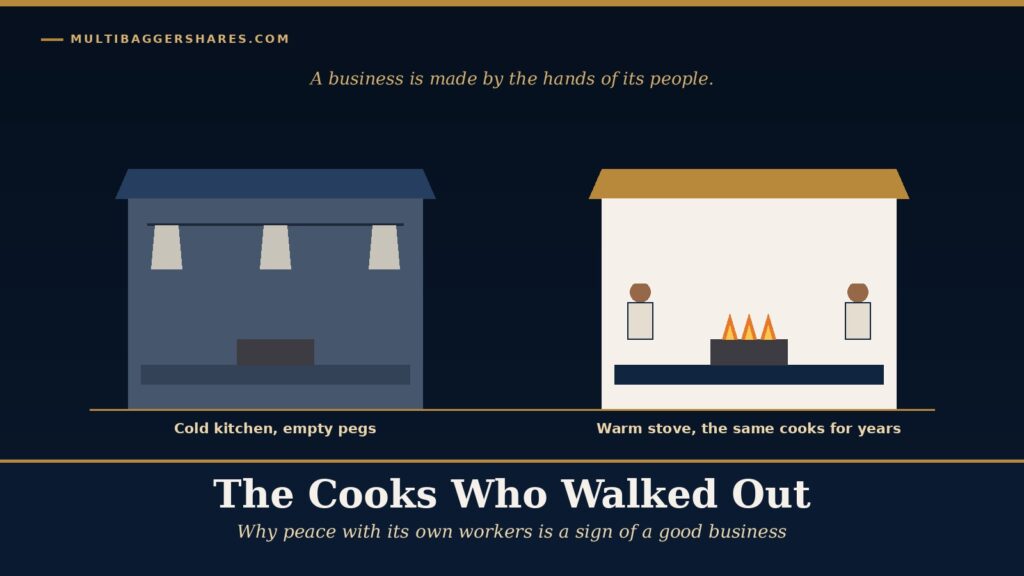
The Cooks Who Walked Out: Why Peace With Its Own Workers Is a Sign of a Good Business
November 23, 2026
In a busy timber market on the edge of Pune, two furniture workshops stand side by side. Both make the same kind of things: beds, wardrobes and dining tables for families who have just moved into new flats. Both have about the same machines, the same stock of wood and about the same number of carpenters. Both owners started out within a year of each other.
Ramesh runs the first workshop. He is careful with every rupee. Three years ago his fire insurance came up for renewal, and the premium (the yearly amount you pay an insurance company to protect you) was about Rs 18,000. Business was slow that month. Nothing had ever caught fire in his twelve years. He decided the money was better spent on new wood, and he let the policy lapse.
Fatima runs the second workshop. She also watches every rupee. But each year she pays for fire cover on her machines, her wood and her building, and a little extra for something called loss of profit cover, which pays part of her running costs and lost earnings if the workshop has to shut after a fire. Last year her accountant noticed that her machines and stock were now worth almost twice what her old policy said. She grumbled about the higher premium, and then she raised the cover to the full value.
Then came one night in March. A loose wire in the lane sparked, and the fire spread through the dry timber before the fire engines could get through the narrow road. Both workshops were badly damaged.
For Ramesh, the loss was about Rs 35 lakh: machines, stock, half-finished orders and the roof. There was no claim to make. He borrowed from a moneylender at a painful rate of interest, gave up his scooter, and still could not reopen for five months. By then most of his customers had found other workshops. Two of his best carpenters had moved to new jobs. He had saved Rs 18,000 a year, and lost almost everything he had built.
Fatima’s loss was just as large. But after the surveyor (the person the insurance company sends to check a claim) had visited and the paperwork was done, her claim was paid over the following months. She used her savings to restart in rented space within weeks, kept paying her carpenters, and finished most of her pending orders late but not lost. One year later her workshop was bigger than before. Some of Ramesh’s old customers were now hers.
The fire did not choose between them. It burned both. The difference was a decision taken quietly, years earlier, on a slow afternoon, about a bill of Rs 18,000.
What it really means
Insurance is a simple idea. You pay a small, certain amount every year so that you never have to bear a large, uncertain loss on your own. Many people share the cost, and the few who suffer the bad luck are paid from the shared pool. It is the same reason a family takes out a health policy, or a scooter owner pays for vehicle insurance. Nobody expects the accident. That is exactly why they plan for it.
For a business, the question is not whether insurance is a nice extra. The question is this: is there one bad day that could end this business, and has the business protected itself against it? A fire, a flood, a machine breakdown, a hacked computer system, a large legal claim, a ship lost at sea with all the goods on board. Most of these will never happen in any single year. But over twenty or thirty years, the chance that at least one of them happens is not small at all.
There are three simple words worth knowing. The sum insured is the amount the policy promises to cover, the most it will ever pay. Under-insurance means the sum insured is lower than the real value of what is being protected, often because the policy was set years ago and never updated. And business interruption cover (sometimes called loss of profit cover) pays part of the earnings a business loses while it is shut after an insured event, not just the cost of the damaged things.
That last one matters more than most people think. When a shop burns, the walls and the stock are only part of the loss. The bigger part is often the months of no sales, while rent, salaries and loan repayments still have to be paid. A business that insures its building but not its earnings is like a person who insures his car but not his ability to keep earning a living if he is hurt in the accident.
Earlier lessons on this site looked at spare cash kept for a rainy day, in The Umbrella in the Cupboard, and at the danger of having just one factory, in One Kitchen, One Oven. This lesson is about a third shield. Spare cash is money you keep. A second site is a back-up you build. Insurance is protection you rent from someone else, for a small yearly fee, against the very large losses that no amount of spare cash could cover.
Why it works
Insurance is a quiet sign of a good business for four plain reasons.
First, it stops one bad day from undoing years of good ones. Compounding (earning returns on your past returns, like a snowball growing as it rolls downhill) only works if the snowball is never smashed. A business that grows steadily for fifteen years and is then wiped out in one night does not compound at all. Avoiding the one big loss is often worth more than squeezing out a little extra profit each year.
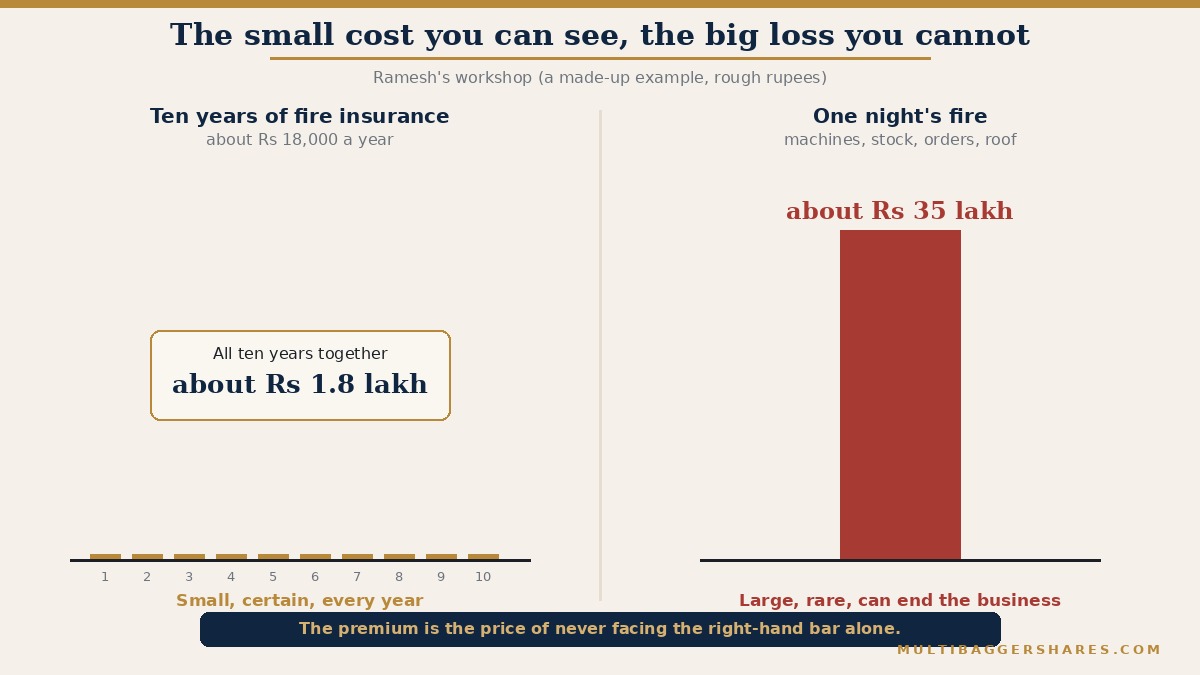
Second, the saving is small and visible, while the risk is large and invisible. This is exactly why weak managers cut it. A premium shows up in the accounts every single year, and cutting it makes this year’s profit look a little better. The danger it protected against shows up only once in a long while, and when it does, it is often too late. A manager who keeps paying for proper cover, even in a slow year, is showing that he thinks in decades rather than quarters.
Third, it keeps the people around the business safe too. When a business stops, its workers, its suppliers and its customers are all hurt. Suppliers who are owed money may not be paid. Customers who were waiting for orders go elsewhere. A business that can restart quickly keeps these relationships, and relationships take years to rebuild once broken.
Fourth, how much cover a business carries says something about how honestly it looks at itself. Taking proper insurance means sitting down and asking uncomfortable questions. What is everything we own really worth today? What could stop us? How long would it take to recover? Managers who ask these questions about insurance usually ask them about many other things as well.
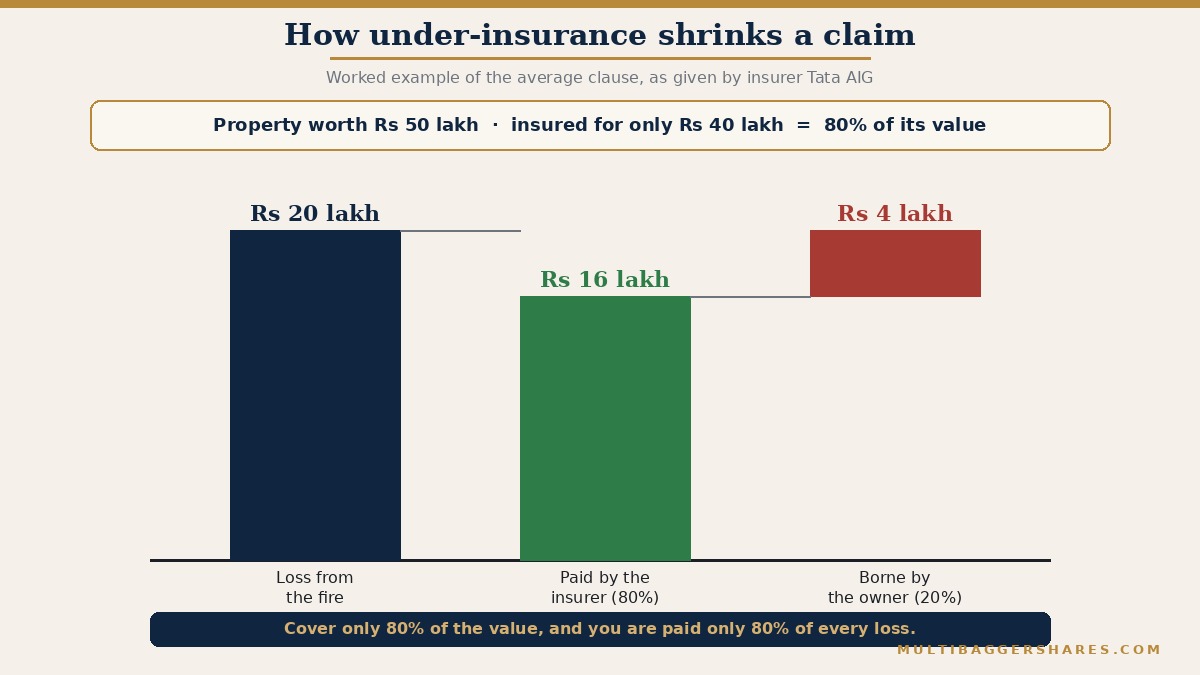
There is one trap even careful owners fall into, and it is the one Fatima nearly fell into. Most fire policies in India carry what is called an average clause. If you insure your property for less than its real value, the insurance company pays only the same share of any loss. Tata AIG, one of the large general insurers, gives a simple example. A property worth Rs 50 lakh is insured for only Rs 40 lakh, which is 80 per cent of its value. A fire causes damage of Rs 20 lakh. The insurer pays 80 per cent of the loss, Rs 16 lakh, and the owner bears the other Rs 4 lakh. So an old, low sum insured does not just limit the worst case. It shrinks every claim, even a small one.
A real example or two
In December 2015, very heavy rain flooded large parts of Chennai. Factories, shops and homes stood in water for days. A study by the reinsurer Swiss Re, reported by IANS in March 2016, put the economic loss at about 2.2 billion dollars. Only about 755 million dollars of that was insured, roughly one rupee of cover for every three rupees lost. The rest fell on the owners themselves.
Small businesses were hit hardest. A later study of 35 small firms, described by the International Labour Organization in 2017, found that 13 of them had no insurance at all. Of the others, many had a policy only because their bank had bundled it with a loan, and those firms received only about 16 per cent of the amount they claimed. Firms that had chosen and paid for their own cover directly fared better, but even they received about a third of what they asked for. A policy that you do not understand, chosen by someone else, is not the same as real protection.
The second example is far bigger, and it shows that new kinds of risk need new kinds of cover. In 2025, Jaguar Land Rover, the British car maker owned by India’s Tata group, was hit by a cyber attack (criminals breaking into its computer systems). According to later reports, the attack was detected on 31 August, and on 2 September the company said its production and retail work had been severely disrupted. Its factories in the UK, which together make about 1,000 cars a day, stopped. Around 33,000 staff were told to stay at home.
In late September, the BBC reported that the company was losing about 50 million pounds a week. Trade publications, citing sources in the insurance market, reported that it had been in the middle of arranging a cyber insurance policy that had not been finalised when the attack came. The company declined to comment on the reports. On 28 September 2025, the UK government announced it would back a loan guarantee of up to 1.5 billion pounds, so the company could keep supporting a supply chain of around 120,000 people, many of them in small firms. A phased restart began on 8 October, more than five weeks after the shutdown started.
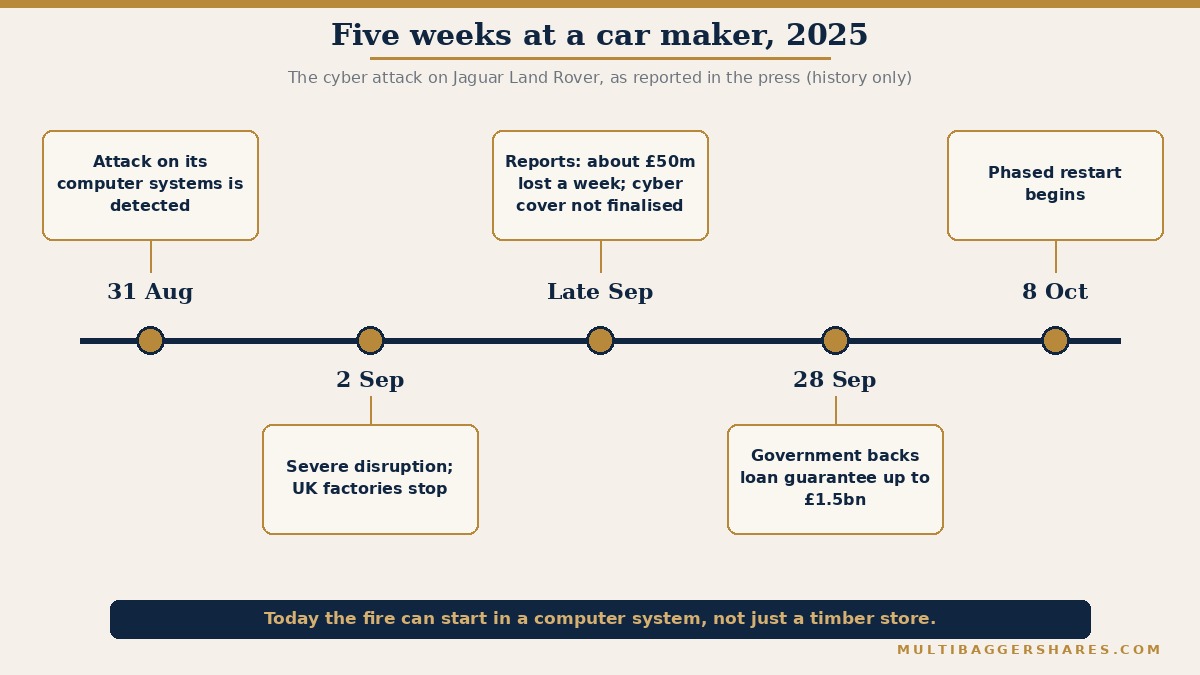
None of this is a comment on that company or its shares. It is a story about how fast one invisible risk can stop a very large and well-known business, and how many smaller businesses around it can be hurt at the same time. A computer system is today what a timber store was a hundred years ago: the place where the fire can start.
How you can use it
You will rarely find a single page in an annual report that tells you everything about a company’s insurance. But you can piece together a fair picture with five simple checks.
1. Find the one bad day. Ask yourself what single event could stop this business for months: a fire at its main plant, a flood in the area, a computer failure, a large product claim, a ship or a warehouse lost. Then read the risk section of the annual report and the management discussion (the part where managers explain the year in their own words). Does management name that risk plainly and say how it is covered?
2. Look at what happened after past accidents. If the company has had a fire, flood or major breakdown before, search its old reports and announcements. Was the loss covered by insurance? Did it record an insurance claim being received? How long did it take to get back to normal? A business that recovered quickly and was paid fairly once is likely to have its protection in order.
3. Watch for under-insurance. A business that has grown fast but talks about its insurance in old numbers may be under-insured, like Fatima before her accountant spoke up. Some companies state the total value of assets they have insured. Compare it, roughly, with the value of their buildings, machines and stock. A large gap is a question worth asking.
4. Notice the new risks. For many businesses today, the biggest single risk is not fire but a computer system going down, or customer data being stolen. Look for any mention of how the company protects its systems and whether it carries cyber cover. Silence on a risk this large is itself a small clue.
5. Listen to the tone. When a manager talks about cutting costs, notice what is being cut. Saving on paper clips and travel is good housekeeping. Saving on safety, maintenance and insurance is borrowing from the future to make this year look better.
Two words of balance are important. First, insurance is not a cure for everything. Some risks cannot be insured at all, such as losing a customer to a better rival, or a product simply going out of fashion. Claims can take months to be paid, and they may not cover the full loss, so a business still needs spare cash to bridge the gap. Second, more insurance is not always better. Insuring every small, everyday risk can waste money, because the insurance company must also cover its own costs and profit. A sensible business carries the small, frequent losses itself and insures only the rare, large ones it could never survive alone.
This is a way to judge the quality and staying power of a business, not a way to predict what any share price will do. Ramesh and Fatima were both hard-working and both made good furniture. Only one of them had asked, on a quiet afternoon, what would happen if the worst night came. That single question is what kept her business alive.
Key takeaways
- Most businesses are not ended by a slow year but by one bad day they never planned for.
- Insurance means paying a small, certain cost so that one large, rare loss cannot end the business.
- Under-insurance quietly shrinks every claim; cover for lost earnings often matters as much as cover for damaged things.
- Check the one bad day, past accidents, the sum insured, new risks like cyber attacks, and the tone of cost-cutting.
- This is a way to judge business quality. It is education only, not a view on any company or share.
— Manish Goel · multibaggershares.com
Manish Goel is a Chartered Accountant and Principal Officer of Multibagger Securities Research & Advisory Pvt. Ltd. (MSRAPL), a SEBI-registered Investment Adviser, Registration No. INA100007736. This content is published by MSRAPL for education only and is not personalized investment advice.
Disclaimer: This article is published by multibaggershares.com for education and general information only. It is not investment advice, investment research, or a recommendation to buy, sell or hold any security. Any companies named are discussed only as illustrative examples. Markets carry risk; please do your own research or consult a qualified professional before making any investment decision. |