The Cooks Who Walked Out: Why Peace With Its Own Workers Is a Sign of a Good Business

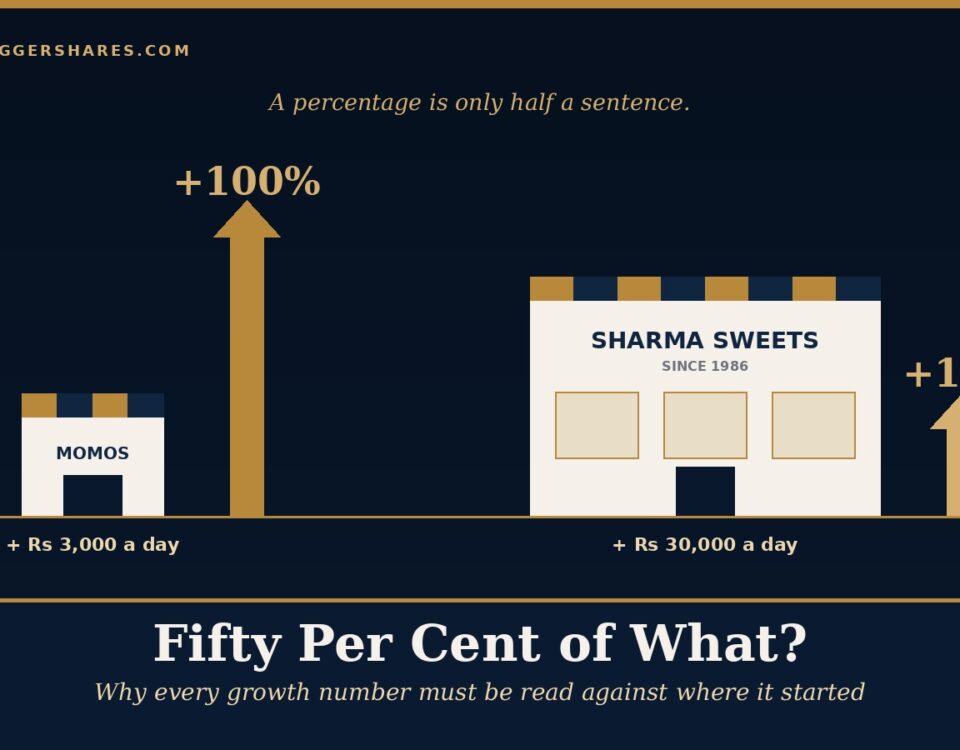
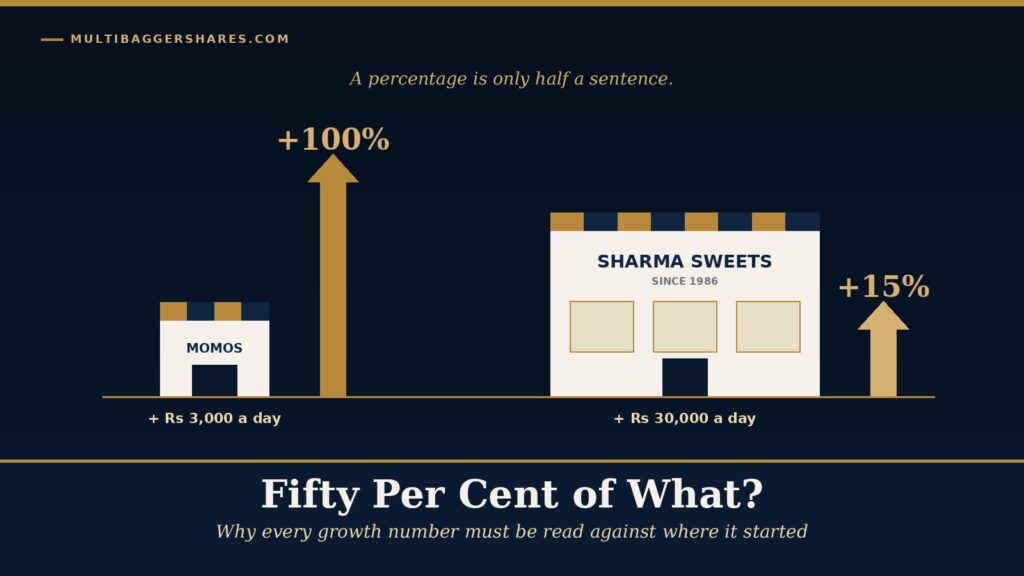
Fifty Per Cent of What? Why Every Growth Number Must Be Read Against Where It Started
November 22, 2026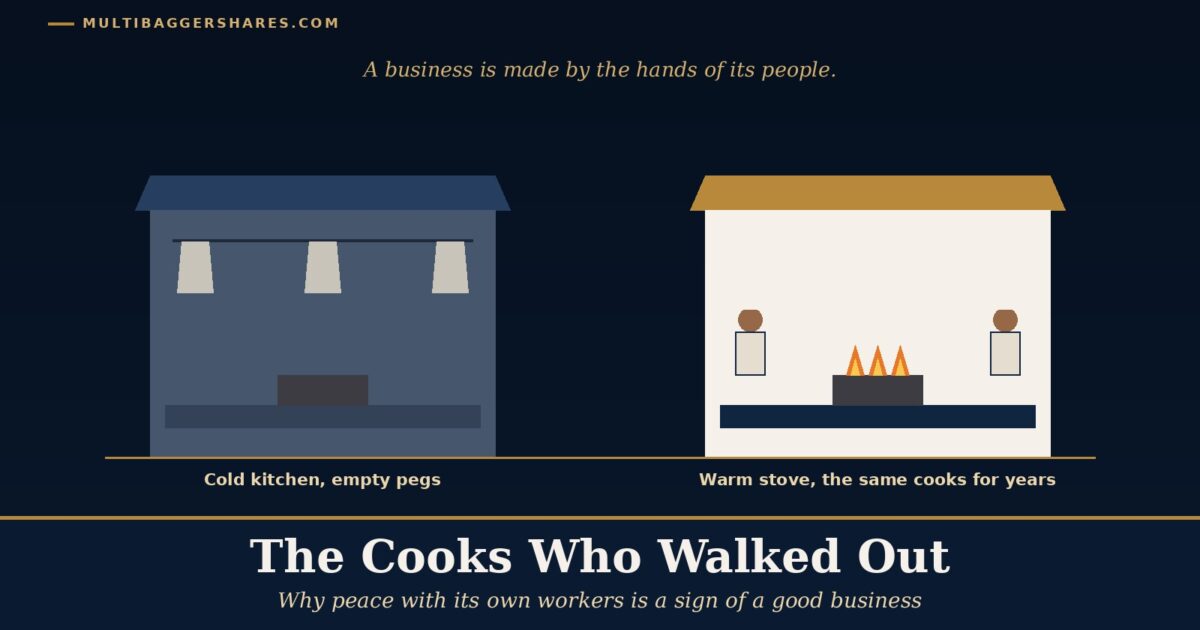
On the highway just outside Indore, two dhabas (roadside eating places) stand a few hundred metres apart. Both have the same truck drivers stopping by, the same kind of menu, the same dal, rotis and paneer. Both owners started at about the same time, almost twenty years ago.
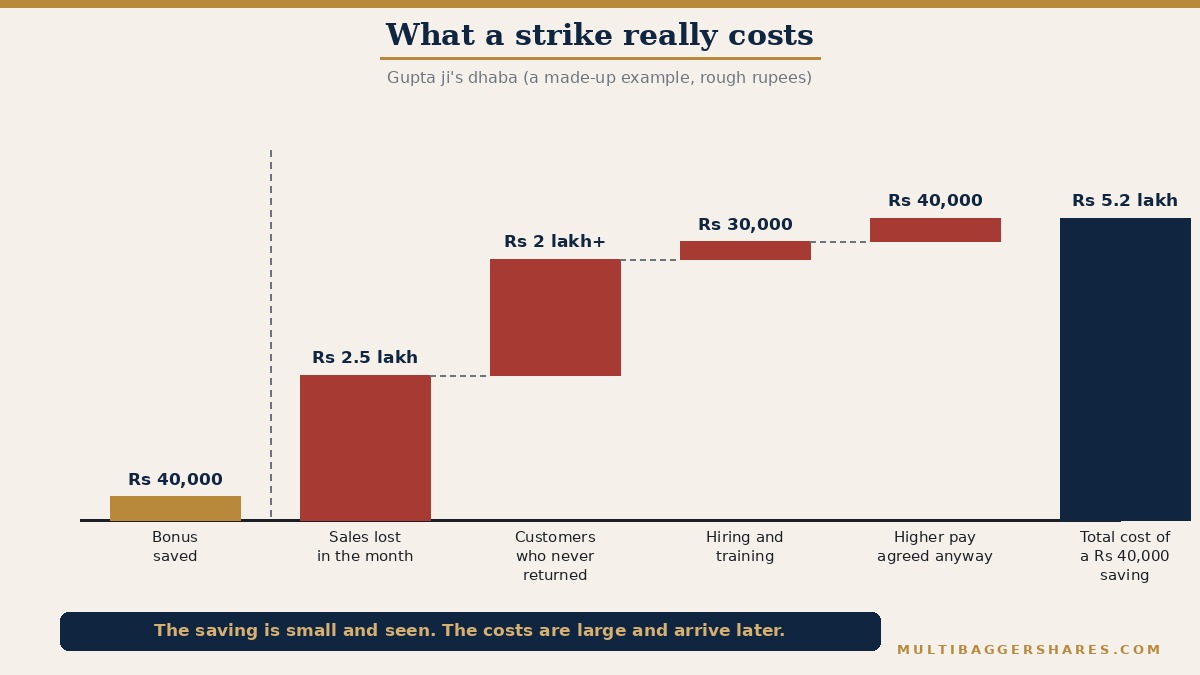
Gupta ji runs the first one. He is clever with money. He pays his cooks late, often by a week or two. He shouts at them in front of customers. Last year, when business was slow, he quietly cut their Diwali bonus and told them to be grateful they still had work. He saved about Rs 40,000 that way, and he was proud of it.
Harpreet Kaur runs the second one. She pays on the first of every month, without fail. When a good season brings extra money, she shares a small part of it with her staff. When a cook suggests a new dish or a faster way to knead dough, she listens and often tries it. Her head cook has been with her for fifteen years.
Then came the wedding season, the busiest time of the year, when big groups stop on their way to family functions. One week before it began, Gupta ji’s three cooks walked out together. They had found work at a hotel in the city. For almost a month, Gupta ji struggled with untrained helpers. The rotis were burnt, the dal was watery, and the waiting time doubled. Truck drivers, who talk to each other on the road, started stopping at Harpreet Kaur’s dhaba instead. Many of them never came back.
Gupta ji had saved Rs 40,000 on a bonus. He lost several lakh rupees in sales, and a reputation that had taken twenty years to build. This is today’s lesson: a business is made by the hands of the people who work in it, and peace with those people is one of the quiet signs of a good business.
What it really means
Every business, however modern, depends on people. A factory needs machine operators, a hospital needs nurses, a software company needs programmers, a bank needs staff at the counter. These people make the product, serve the customer and fix the problems nobody planned for.
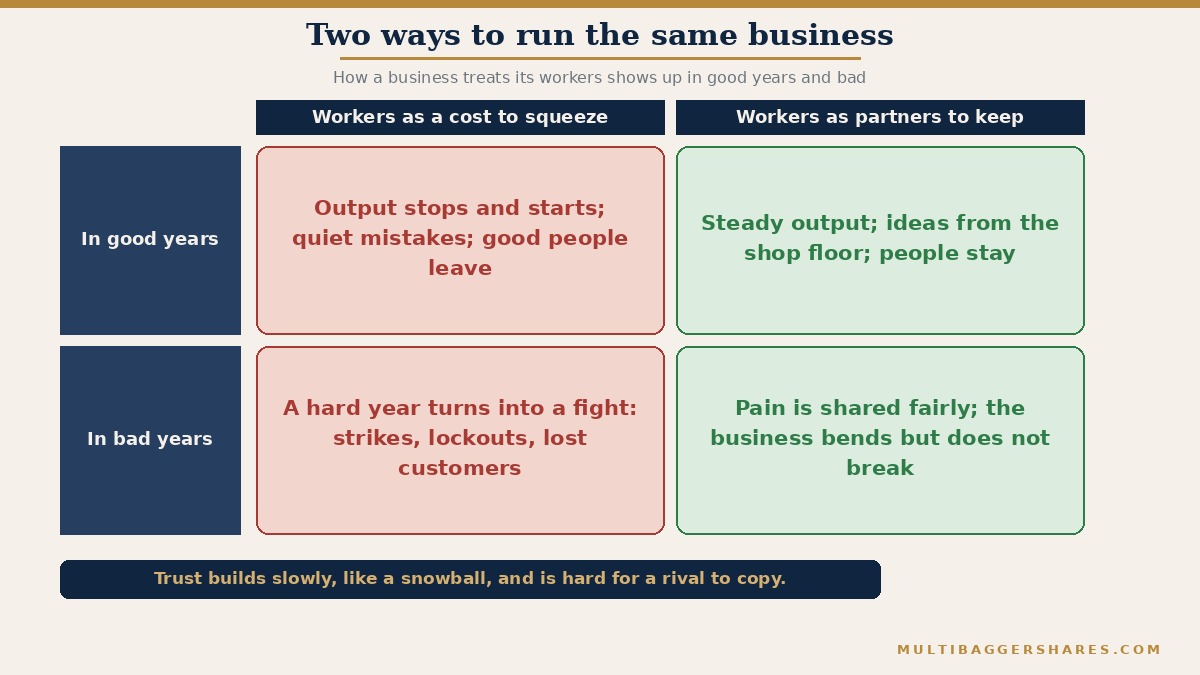
Labour relations (the everyday relationship between a company’s managers and its workers, including how pay, working hours, safety and complaints are handled) can be good, bad or somewhere in between. When they are good, you hardly notice them. Work simply gets done. When they are bad, the trouble shows up in three ways.
The first is loud. A strike (when workers stop working together to press their demands) or a lockout (when the management shuts the workplace and keeps workers out) stops production completely. No product is made, so nothing is sold.
The second is quiet. Unhappy workers may not stop work at all. They may simply slow down, take less care, or stop pointing out problems. This is sometimes called a go-slow. Nothing appears in the newspaper, but quality slips a little every day, like a tap that drips all night.
The third is slow. Good people leave, and the business has to keep hiring and training new ones. We looked at this in an earlier lesson about staff turnover, The Revolving Door. Today’s lesson is wider. It is about the whole relationship between a business and the people inside it: whether there is trust, whether problems are solved by talking, and whether both sides feel they win when the business does well. It is also different from our lesson The Angry Neighbour, which was about the people living around a factory. This one is about the people working inside it.
Why it works
Think of a business as a boat with many people rowing. If everyone rows together, the boat moves fast with little effort. If half the rowers are angry, they row out of time, or stop rowing to argue. The boat slows down, even if the engine, the paint and the map are all excellent.
There are four simple reasons why fair, steady relations with workers make a business stronger.
1. The saving is small, the cost is large. Squeezing workers saves a little money that you can see. The costs that follow are much bigger, but they arrive later and are harder to see: lost sales during a stoppage, customers who leave for good, the cost of recruiting and training, and, very often, a pay rise that has to be agreed in the end anyway. Gupta ji saved Rs 40,000 and lost lakhs.
2. Customers can feel it. Workers who are treated well usually treat customers well. A nurse who is not exhausted and angry is kinder to patients. A salesman who trusts his employer explains the product honestly. Customers rarely know why they like one shop more than another, but the mood of the staff is often part of the answer.
3. The best ideas come from the shop floor. The people closest to the work see the waste, the danger and the shortcuts first. In a business with trust, they speak up. In a business with fear, they keep quiet, and small problems grow into big ones.
4. Trust is a cushion in bad times. Every business faces a hard year sooner or later. A company whose workers trust the management can ask for patience, share the pain fairly and recover together. A company with years of anger behind it often finds that a hard year turns into a fight.
Like compounding (earning returns on your past returns, like a snowball that grows as it rolls), trust builds slowly, year after year. And like a snowball rolling into a wall, it can be broken in a single bad season. That is why a long record of peace is valuable. It cannot be bought quickly by a rival.
A real example or two
These stories are history, told only to explain the idea. They are not a view on any company’s shares today.
Forty days at General Motors. In September 2019, about 48,000 members of the United Auto Workers union at General Motors, the large American car maker, walked off the job. The workers wanted better pay, more job security, a path for temporary workers to become permanent, and protection for their health benefits. The strike lasted 40 days and ended on 25 October 2019, when the workers voted to accept a new contract.
The cost was huge for both sides. Workers went more than a month without their normal pay. General Motors said it had lost production of about 300,000 vehicles, and news reports at the time said the strike cut the company’s profit for 2019 by close to $3 billion. In the end, the company agreed to many of the changes the workers had asked for, including a path to permanent jobs for temporary workers. A great deal of money was lost on the way to an agreement that both sides could perhaps have reached by talking.
More than a hundred years of trust at Jamshedpur. Now look at a very different story from India. Long before the steel plant at Jamshedpur was even built, its founder Jamsetji Tata wrote to his son Dorab in 1902 about the town that should grow around it. He asked for wide streets, shady trees, and space for parks and places of worship. He was thinking about the people who would live and work there before the first furnace was lit.
The company that grew from that plan, Tata Steel, became known for treating its workers in ways that were rare at the time. According to the company’s own history and press reports, it introduced an eight-hour working day in 1912, when long shifts were normal around the world. In 1920 it brought in leave with pay, a provident fund (a savings scheme in which the worker and employer both put aside money every month for the worker’s old age) and compensation for workers injured in accidents. The same year, the workers formed their own association to speak for them. In 1934 it started a bonus linked to the company’s profits.
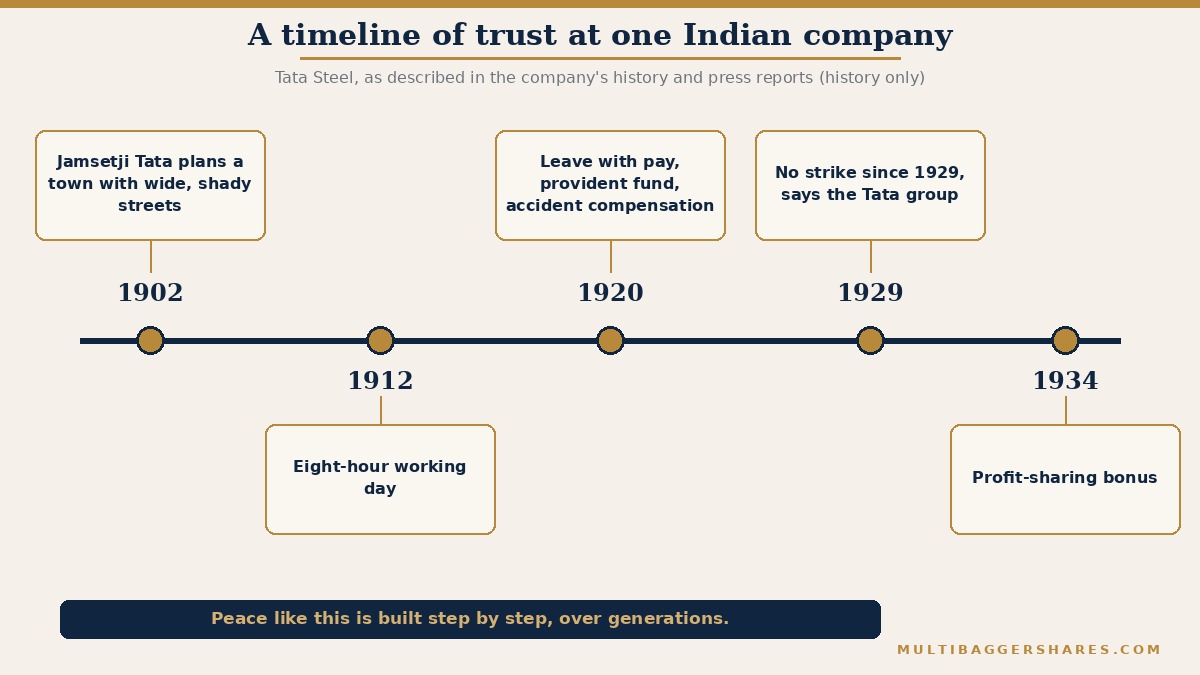
There were difficult years too, including strikes in the 1920s. But according to the Tata group’s own website, the company has not seen a single strike since 1929. Whatever else changed over those decades, the steel kept flowing. That long record of peace did not happen by accident. It was built step by step, by both managers and workers, over generations.
Notice what the two stories teach together. A strike is not just a problem for one quarter. It shows that trust between the two sides had already broken down. And peace is not just luck. It is usually the result of fair treatment kept up for a very long time.
How you can use it
You do not need to visit a factory to learn something about how a company treats its people. A company’s annual report (the yearly book a listed company publishes about its business and results), news reports and a little common sense will take you a long way. Here are five simple questions.
1. Has work stopped in the last ten years? Search the news for the company’s name with words like strike, lockout or labour unrest. One short dispute long ago is not a disaster. Repeated stoppages at the same plants are a warning sign.
2. How does management talk about its people? Read the chairman’s letter in the annual report. Does it speak of workers only as a cost to be cut, or as people whose skills and safety matter? Words are cheap, but over several years, the tone of a company’s letters usually matches its behaviour.
3. How safe is the workplace? In India, larger listed companies publish a Business Responsibility and Sustainability Report (often called the BRSR, a section of the annual report about how the company treats people and the environment). It shows the number of workplace injuries and, sadly, deaths. A business that keeps its workers safe year after year is usually a business that is run with care everywhere.
4. Are many people doing the same work on very different terms? The same report shows how many workers are permanent and how many are temporary or contract workers. Some temporary work is normal. But when a large share of people work side by side with others who earn far more for the same job, resentment can build quietly, as the General Motors story showed.
5. Do people stay and grow? Look for signs that workers and managers stay for many years and rise from within. Long careers inside a company are a simple sign that people feel fairly treated.
Two words of balance are important. First, peace is not the same as silence. A workplace where nobody complains may simply be a workplace where people are afraid. Second, being fair is not the same as paying any amount that is asked. A good business pays fairly and shares its success, but it must also stay strong enough to keep everyone employed in a bad year. What you are looking for is a long record of steady, honest dealing, not a perfect record with no disagreements at all.
This is a way to judge the quality of a business, not a way to predict what any share price will do. Gupta ji and Harpreet Kaur both serve good food. Only one of them has built something that will still be standing, and still serving, when the next busy season arrives.
Key takeaways
- A business is made by the hands of its people. Fair, steady relations with workers are a quiet mark of quality.
- Squeezing workers saves a little money you can see. Strikes, go-slows and lost customers cost far more, later.
- A long record of workplace peace, like Tata Steel’s since 1929, is built over generations and cannot be copied quickly.
- Check for past stoppages, the tone of management’s letters, safety records, the mix of permanent and contract workers, and long careers.
- This is a way to judge business quality. It is education only, not a view on any company or share.
— Manish Goel · multibaggershares.com
Manish Goel is a Chartered Accountant and Principal Officer of Multibagger Securities Research & Advisory Pvt. Ltd. (MSRAPL), a SEBI-registered Investment Adviser, Registration No. INA100007736. This content is published by MSRAPL for education only and is not personalized investment advice.
Disclaimer: This article is published by multibaggershares.com for education and general information only. It is not investment advice, investment research, or a recommendation to buy, sell or hold any security. Any companies named are discussed only as illustrative examples. Markets carry risk; please do your own research or consult a qualified professional before making any investment decision. |