The Restaurant That Wanted Everyone: Why a Good Business Chooses What It Will Not Be

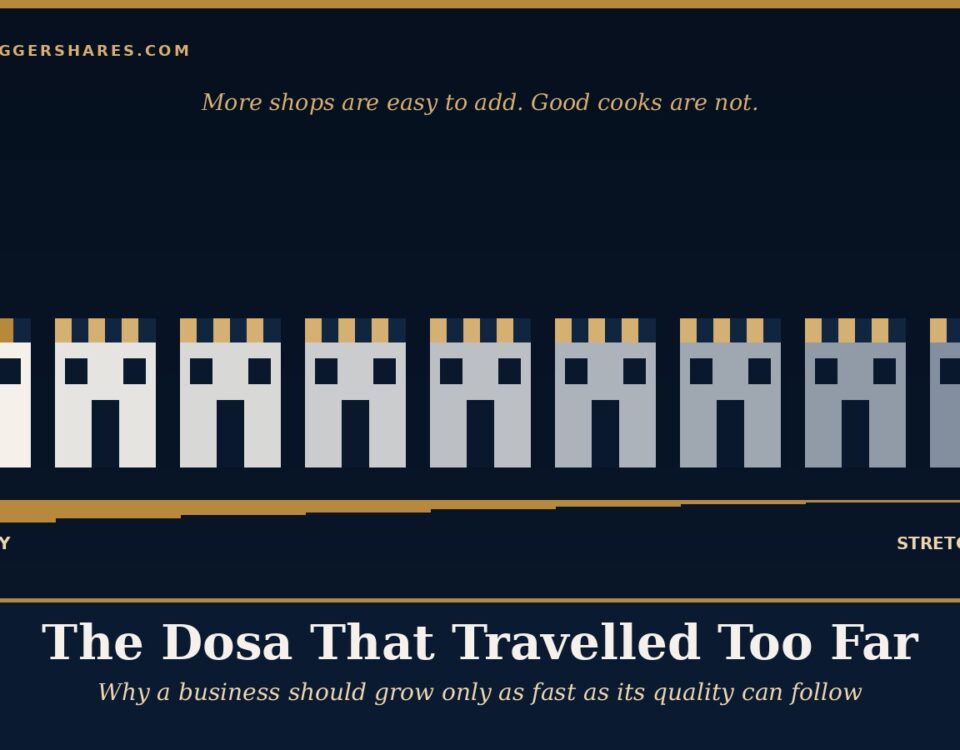
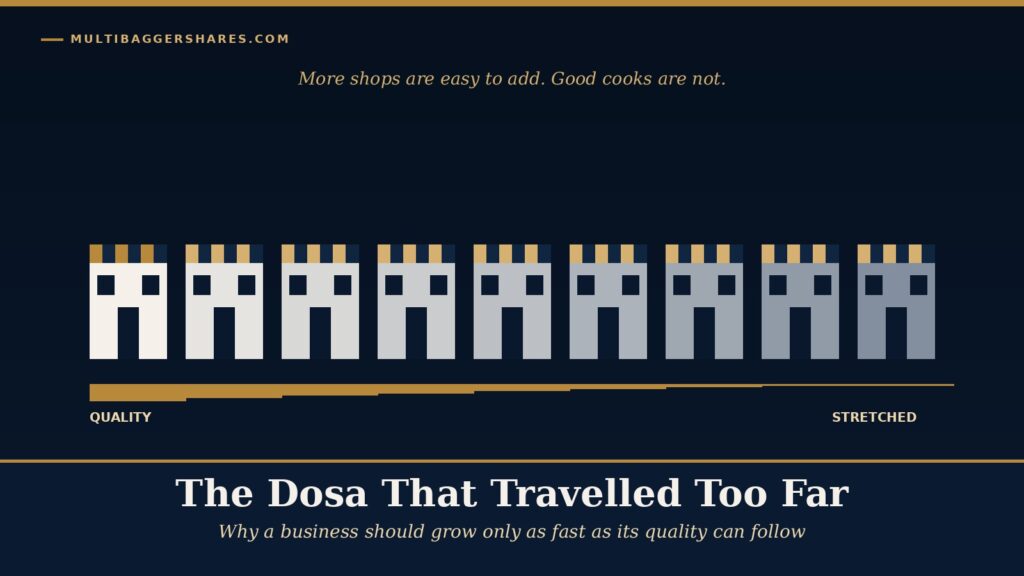
The Dosa That Travelled Too Far: Why a Business Should Grow Only as Fast as Its Quality Can Follow
November 20, 2026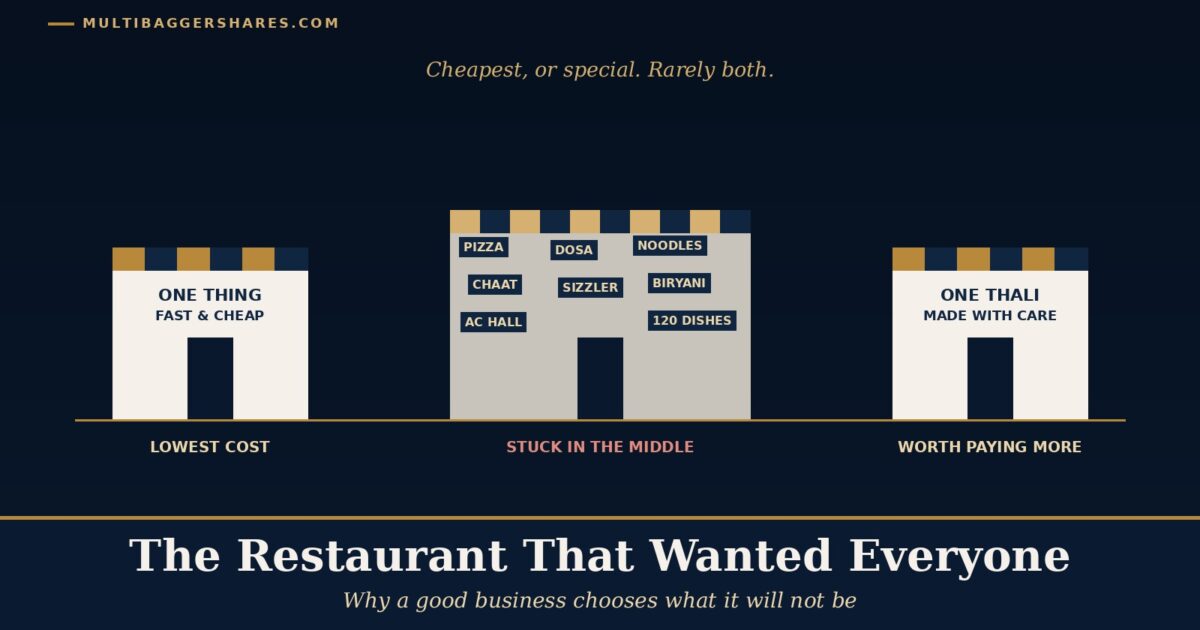
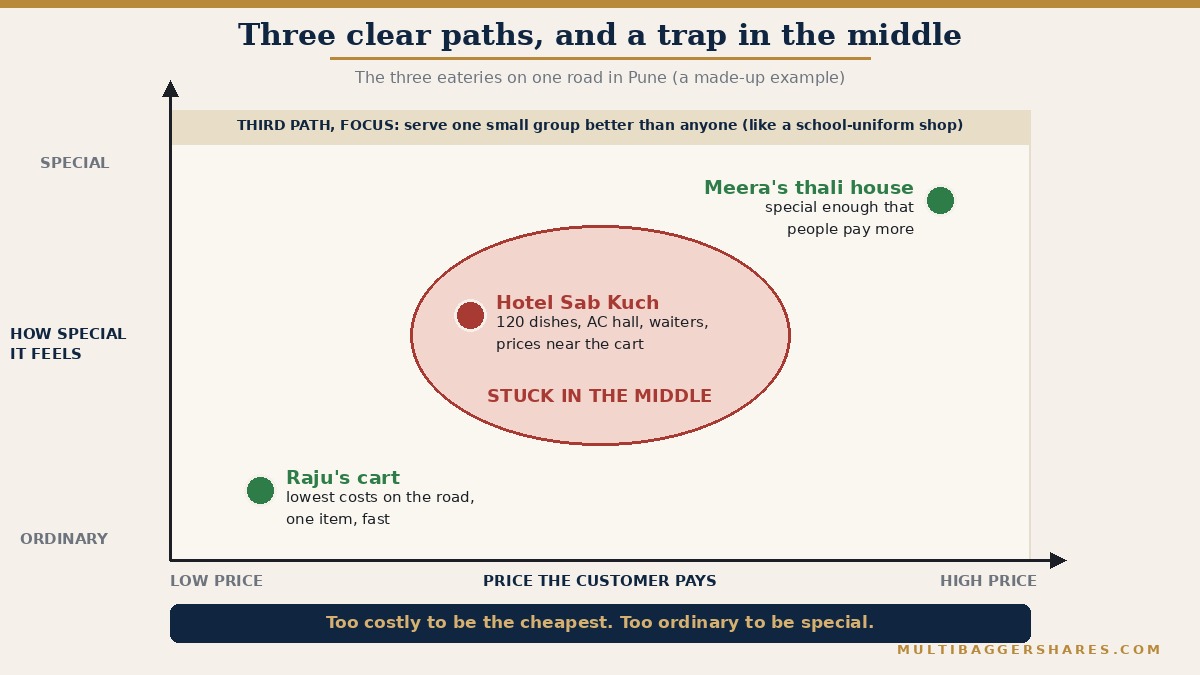
On one busy road in Pune, there are three places to eat. Near the bus stop stands Raju’s vada pav cart. He sells one thing, very fast, at the lowest price on the road. He has no rent for a hall, no waiters and no menu card. Office workers, students and auto drivers queue up, eat standing, and are gone in five minutes.
At the far end of the road is Meera’s thali house. It is small, calm and a little expensive. There is no menu to read, because there is only one meal: a Maharashtrian thali that changes with the season, cooked the way her grandmother cooked it. Families book a table on Sundays. Nobody comes to Meera for a cheap snack, and nobody minds paying more.
In the middle of the road is Hotel Sab Kuch, which means Hotel Everything. Its owner, Vikram, wanted every customer on the road. So he built an air-conditioned hall, hired waiters in uniforms, and printed a menu with 120 dishes: dosa, pizza, noodles, biryani, chaat, sizzlers. To win Raju’s customers, he kept his prices close to the cart. To win Meera’s customers, he added soft music and cloth napkins.
Hotel Sab Kuch is busy at lunch. And yet, year after year, Vikram earns very little. The people who want cheap and fast still go to Raju, because Vikram’s hall and waiters cost money, and he cannot match the cart’s price for long. The people who want something special still go to Meera, because a kitchen that cooks 120 dishes cannot cook any one of them beautifully. Vikram is working hard, but he is not anybody’s first choice.
This story is made up, but the pattern is real and very common. Today’s lesson is about it: a good business makes a clear choice about how it will win, and it accepts what it must give up to make that choice work. A business that tries to be everything to everyone often ends up being nothing special to anyone. Learning to notice this is a simple, powerful way to judge the quality of a business.
What it really means
In 1980, a Harvard Business School professor named Michael Porter wrote a famous book called Competitive Strategy. (A strategy is simply a business’s plan for how it will win customers and earn a good profit, when other businesses are trying to do the same.) Porter said there are three broad ways to win. He called them generic strategies, which just means general paths that almost any business can follow.
The first path is to be the cheapest to run. Porter called it cost leadership (having the lowest costs in your trade, so you can charge low prices and still make money). Raju’s cart is a small example. The second path is to be special. Porter called it differentiation (offering something customers value so much that they happily pay more for it). Meera’s thali house is an example. The third path is to serve one small group better than anyone else. Porter called it focus. Think of a shop that sells only school uniforms, or a clinic that treats only eyes.
Then Porter gave a warning. A business that does not clearly follow any of these paths is, in his words, stuck in the middle. It has higher costs than the cheapest player, so it cannot win on price. And it is not special enough for customers to pay extra, so it cannot win on value. Porter wrote that such a business is almost guaranteed low profitability (it earns thin profits, if any, for the effort and money it puts in).
Sixteen years later, in 1996, Porter wrote an article in the Harvard Business Review called What Is Strategy? In it he gave a line that is worth remembering: the essence of strategy is choosing what not to do. In other words, a clear choice is not only about what a business does. It is also about what it refuses to do.
Porter also gave a name to Vikram’s mistake. He called it straddling (trying to copy a rival’s winning position while keeping your own old position at the same time, like trying to stand with one foot on each of two boats moving apart). Straddling looks clever on paper. In real life, it usually leaves a business with the costs of both positions and the full benefits of neither.
Why it works
Why can a business not simply be cheap and special at the same time? Because the two often pull against each other. Porter called these pulls trade-offs (situations where getting more of one thing means accepting less of another). Here is a simple everyday picture. A school bag and a suitcase are both bags. But a bag designed for a child’s back must be light and small, and a bag designed for a long journey must be big and strong. A bag that tries to be both ends up too heavy for the child and too small for the trip.
Porter described three kinds of trade-off, and each one is easy to see on our road in Pune.
First, the customer gets confused. A business known for one kind of value loses trust when it suddenly offers the opposite. If Meera started selling cheap packaged snacks at the door, her regulars would wonder whether her thali was still special. A clear reputation takes years to build and only a few mixed messages to blur.
Second, the work itself must be set up differently. A low-cost business and a special business need different kitchens, different staff, different equipment and different habits. Raju’s whole cart is built for speed: one recipe, one tawa, no waiting. Meera’s kitchen is built for care: slow cooking, fresh seasonal vegetables, a cook who has been with her for fifteen years. You cannot build one kitchen that is perfect for both. Vikram tried, and his kitchen became good at nothing in particular.
Third, the people inside get mixed signals. When a business has a clear choice, every employee knows how to decide small things. Should we add another dish? Should we buy the costlier oil? Should we offer free home delivery? If the business has chosen to be the cheapest, the answer is easy. If it has chosen to be special, the answer is also easy. If it has chosen nothing, every small decision becomes an argument, and the business drifts.
This is why a clear choice is such a useful sign of quality. It is a bit like a moat (a lasting advantage that protects a business from rivals, like the water-filled ditch around an old fort). A rival can copy one dish or one price cut quickly. It is much harder to copy a whole business in which every habit, every rupee of spending and every hiring decision points in the same direction.
One honest caution. Porter’s warning is a strong tendency, not an iron law. Later researchers found that some businesses do manage to offer good quality at fair prices, especially when they become very large or find a clever new way of working. And Porter’s map of profits does not look the same in every industry. So the lesson is not that every business in the middle will fail. The lesson is narrower and more useful: a business needs a clear, honest answer to the question why do customers choose us? When it cannot give one, be careful.
A real example or two
Airline history gives us one of the clearest examples of a business that made a clear choice. Southwest Airlines in the United States made its first flight in 1971. From the start, its founders chose to be the low-fare airline, and they let that choice decide almost everything else.
Southwest flew a single type of plane, the Boeing 737. That meant pilots, mechanics and spare parts could all be shared, which kept costs down. It did not assign seats, so boarding was quicker and planes spent less time waiting on the ground. It flew simple routes and kept its service plain and friendly. In their 2007 book Made to Stick, the writers Chip and Dan Heath describe how its long-time leader, Herb Kelleher, boiled the whole strategy down to one idea: Southwest is THE low-fare airline. Any new idea, however nice, was checked against that one line. After losses in its first two years of flying, Southwest began a run of yearly profits in 1973 that lasted for decades, in an industry famous for losing money.
Now look at what happened when a big, traditional airline tried to straddle. In 1993, Continental Airlines launched a low-fare, no-frills service inside the company, later called Continental Lite, to fight the rise of low-cost start-up airlines. About 100 jets were repainted and their first-class cabins were removed. By 1994 it served 45 cities and made up about a third of Continental’s flying.
But the rest of Continental was still a full-service airline, with a different way of working. The company was trying to be a cheap no-frills airline and a traditional full-service airline at the same time, inside one business. Continental Lite did not win. Press reports put its losses at between 140 million and 300 million dollars, and in 1994 Continental as a whole reported a net loss of 613 million dollars. The chief executive who had championed the idea, Robert Ferguson, resigned in 1994. His successor, Gordon Bethune, moved away from it, and by 1995 Continental Lite was gone. Business schools have used it ever since as a classic case of straddling.
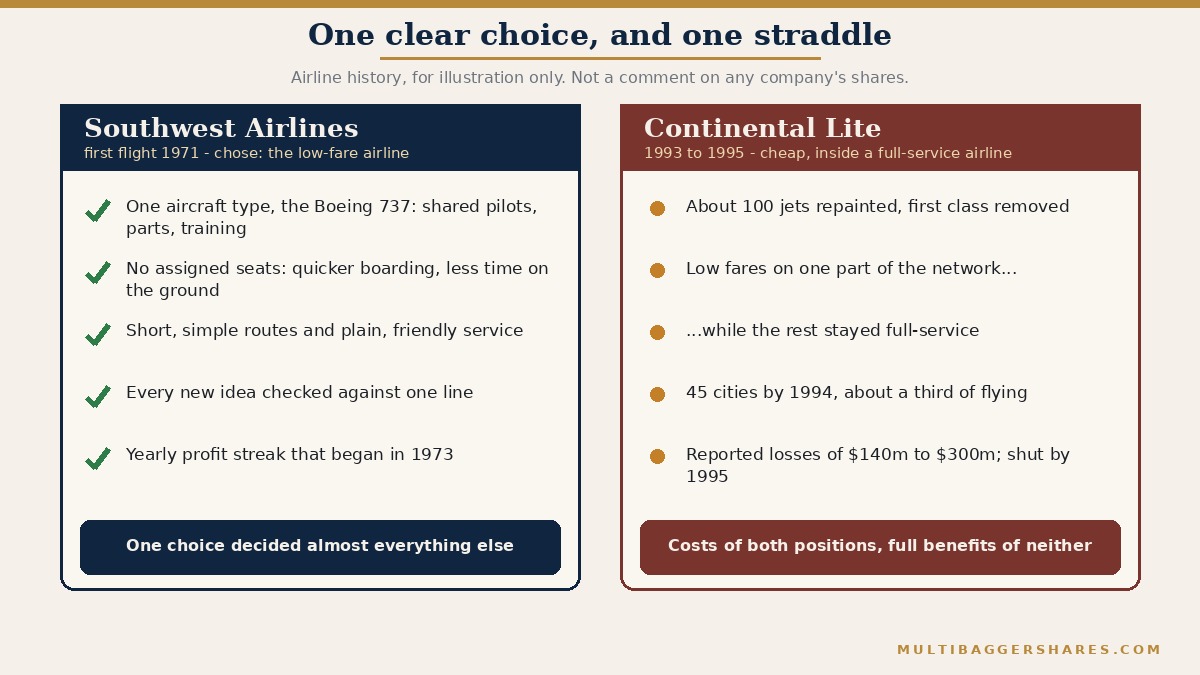
Notice what the two stories share and what separates them. Both airlines saw the same opportunity: travellers who wanted cheap tickets. Southwest built its entire business around that one customer. Continental tried to add that customer on top of a business built for someone else. The lesson is not about airlines, and it is not a comment on any airline’s shares today. It is about the quiet power of a clear choice.
You can see the same idea in great investors’ thinking. Warren Buffett and Charlie Munger often spoke about wanting businesses that are easy to understand, with a lasting edge they could explain simply. A business that cannot explain its own edge in a sentence usually does not have one. Peter Lynch made a similar point when he said an investor should be able to explain a company’s story in a couple of minutes. A clear choice makes that story short.
One more distinction, so the idea stays sharp. This lesson is different from a business wandering into unrelated industries, such as a biscuit company suddenly buying a hotel. That is a separate mistake. Being stuck in the middle can happen inside a single business, on a single road, with a single kitchen, simply because the owner never decided how he would win.
How you can use it
You do not need any special training to use this lesson. You need a notebook, a company’s annual report (the yearly book a listed company publishes about its business and results), and a little patience. Here are five questions to ask.
1. Can you finish this sentence in one short line: customers choose this business because…? If the honest answer is because it is the cheapest, because nobody else does it as well, or because it serves this one group best, that is a good start. If the answer is long, vague, or full of words like everything and everyone, be careful.
2. Which path is it on: cheapest, special, or one small group? Try to name it. Then check whether the numbers agree. A business that says it is special should usually earn healthy margins (the share of each rupee of sales that is left as profit), because customers pay extra. A business that says it is the low-cost player should show costs that stay lower than its rivals’ year after year.
3. What does it refuse to do? Look for signs of saying no: customers it does not chase, products it stopped making, cities it did not enter, discounts it did not give. Remember Porter’s line. A business that never says no has probably not chosen anything.
4. Do its habits fit its choice? A low-cost business with a lavish head office, or a special business that keeps cutting corners on quality to save a little money, is sending mixed signals. The way a company spends its money tells you more about its real choice than the words in its advertisements.
5. When it adds something new, does it sharpen the choice or blur it? Read what management says about new products or new services over several years. Good additions usually make the main reason customers come even stronger. Worrying additions try to grab a different kind of customer, the way Vikram added pizza and soft music to a hotel that was meant to be cheap.
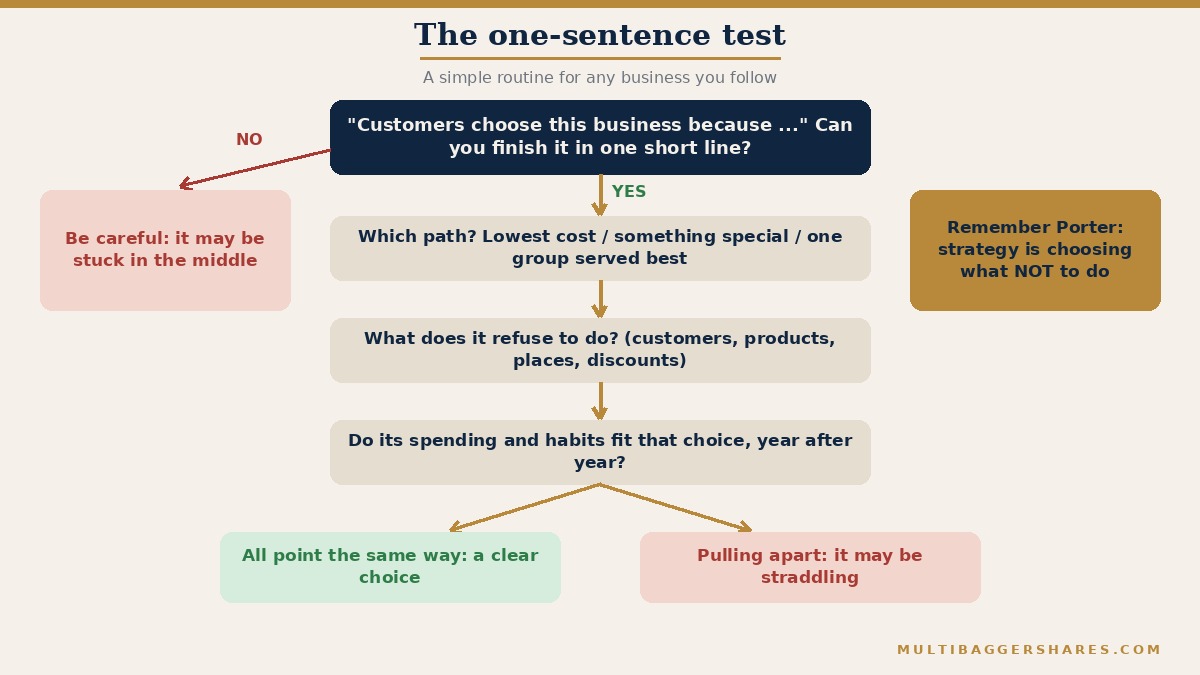
Keep a short note of your answers for any business you follow. Look again every year. A clear choice that stays clear for many years is one of the quiet signs of a wonderful business. A choice that keeps changing with every new fashion is a sign to slow down and look harder.
This way of thinking is not about predicting next quarter’s profit, and it is not a judgement on any company’s shares. It is a way to judge the quality of a business and the people who run it. Raju and Meera are not rich because they are lucky. They are doing well because each of them decided what they would be, and just as importantly, what they would not be. Vikram worked as hard as either of them. He simply never made that choice.
Key takeaways
- There are three clear ways to win: be the cheapest to run, be special enough that people pay more, or serve one small group better than anyone.
- A business that tries to be cheap and special at once is often stuck in the middle: too costly to be cheapest, too ordinary to be special.
- Michael Porter’s lesson: the essence of strategy is choosing what not to do. Clear refusals are a sign of a clear choice.
- Southwest’s single focus and Continental Lite’s straddle show how much a clear choice can matter in practice.
- This is a way to judge the quality of a business and its managers. It is education only, not a judgement on any company or share.
— Manish Goel · multibaggershares.com
Manish Goel is a Chartered Accountant and Principal Officer of Multibagger Securities Research & Advisory Pvt. Ltd. (MSRAPL), a SEBI-registered Investment Adviser, Registration No. INA100007736. This content is published by MSRAPL for education only and is not personalized investment advice.
Disclaimer: This article is published by multibaggershares.com for education and general information only. It is not investment advice, investment research, or a recommendation to buy, sell or hold any security. Any companies named are discussed only as illustrative examples. Markets carry risk; please do your own research or consult a qualified professional before making any investment decision. |