The Sanitiser Summer: How to Tell a Sudden Rush of Customers From Demand That Will Last

The First Cockroach: Why One Unpleasant Surprise From a Business Is Rarely the Last
November 18, 2026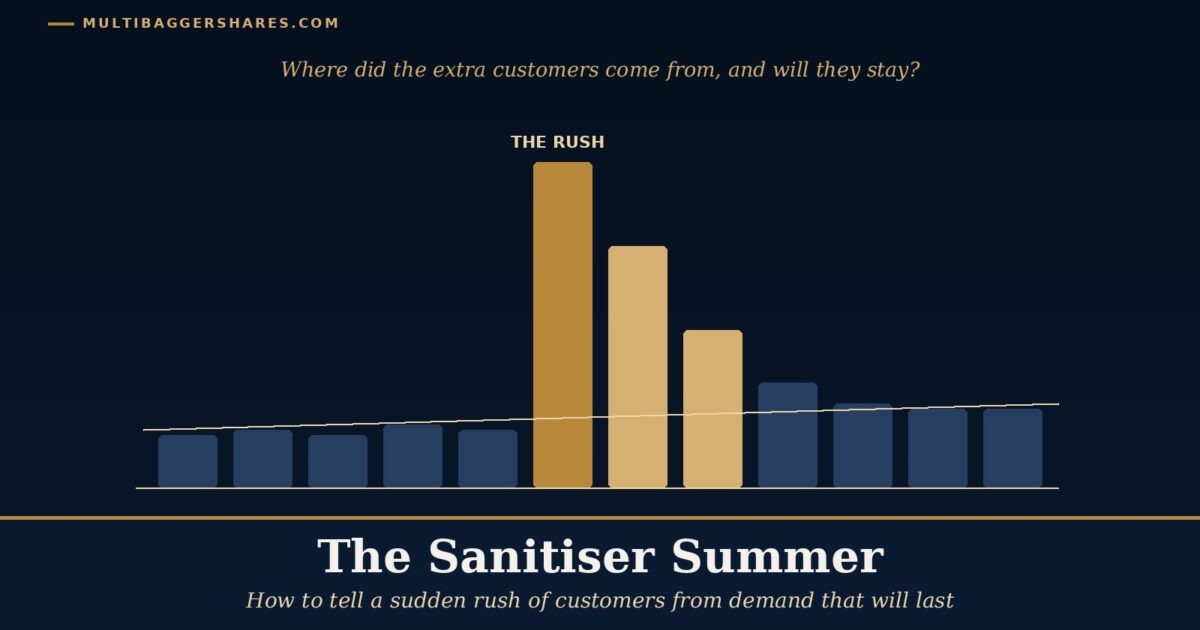
In April 2020, two small business owners in Jaipur had the same lucky problem. Customers were queuing for hand sanitiser. Kavita runs a chemist shop near the old city walls. In a normal month she sold perhaps fifty small bottles. Now she was selling that many before lunch, and she could not get enough stock. Across town, Suresh runs a small unit that fills bottles with hair oil for other brands. A trader called him with an offer. If Suresh could fill sanitiser, the trader would take every bottle he made.
Both of them made money that summer. But they made very different choices. Kavita ordered more stock each week, paid her helper for extra hours and stacked the cartons in a corner she borrowed from her neighbour. Suresh did something bolder. He borrowed money from the bank, bought a second, larger filling machine and signed a two-year lease on a bigger shed. Sales like these, he told his family, were the new normal.
By the next winter, the queues had gone. Kavita sent back her neighbour’s corner, cut her helper’s hours and carried on. Suresh still had a loan to repay, a lease to pay and a big machine that ran for two hours a day. Nobody had cheated him. The demand had been real. It just had not been lasting. This essay is about the difference, and why it matters so much to anyone who owns a piece of a business.
What it really means
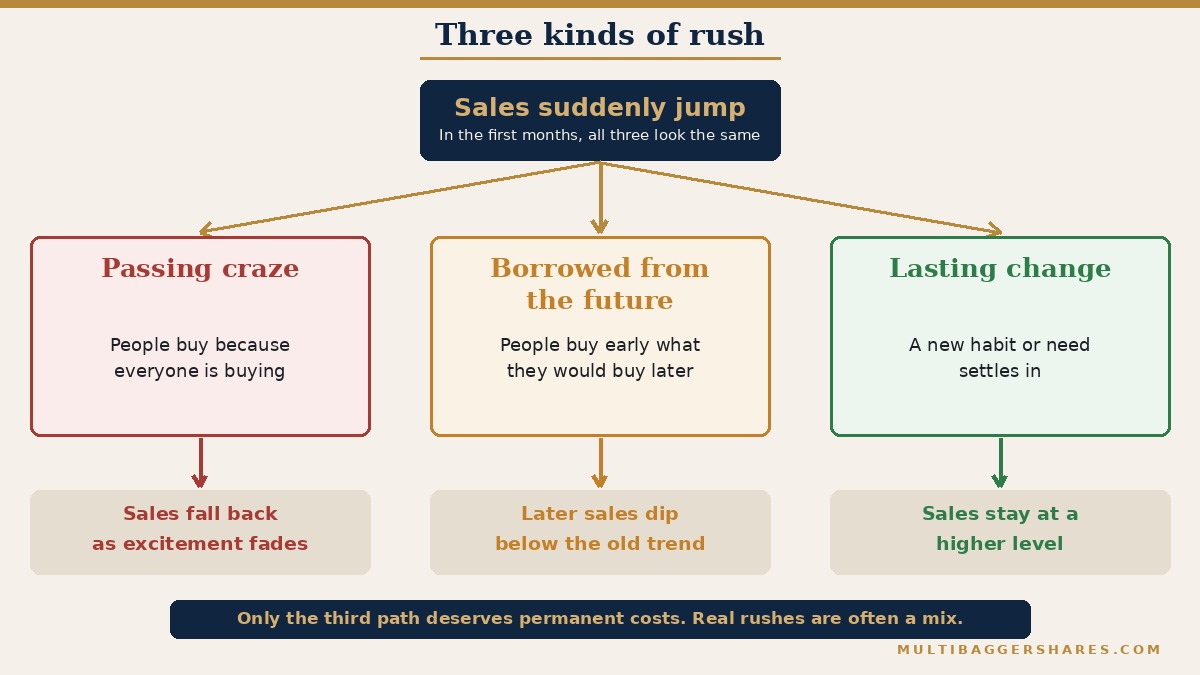
Demand (how much of something people want to buy, and are able to pay for) does not usually change overnight. When it does, an owner or an investor must ask a simple question: where did these extra customers come from, and will they still be here next year? Broadly, a sudden rush comes in three kinds.
The first kind is a passing craze (sometimes called a fad: something people buy mainly because everyone around them is buying it, which fades once the excitement fades). Think of the kite seller in the week before Makar Sankranti, or a toy that every child in the colony suddenly has to own. The buying is real, but it rests on novelty, not on need.
The second kind is demand borrowed from the future (investors call this a pull-forward: people buy now something they would have bought later anyway). Imagine a rumour that the price of a scooter will rise next month. Showrooms are packed, and sales double. But the families who rushed in were going to buy a scooter next year or the year after. So the busy month is followed by quiet months. Over a few years, the total number of scooters sold barely changes. Only the timing does.
The third kind is a lasting change (a new habit, a new need or a new group of customers that stays). When families first moved from loose cooking oil to sealed packets, or when people in small towns first began to pay by mobile phone, the jump in sales did not reverse. A new way of living had settled in.
From the outside, all three look the same in the first few months: a big, happy jump in sales. The difference only shows later. That is exactly why a careful investor slows down at the very moment everyone else gets excited.
Why it works
Why should a sudden rush make a careful investor more cautious, not less? There are three reasons, and you can see all of them in the story of Kavita and Suresh.
The first reason is that rivals rush in too. Extra profit is a signal that every other business owner can see. If the product is easy to make, new sellers arrive within weeks. Suresh was not the only bottling unit in Jaipur that switched to sanitiser. Market researcher Nielsen counted about 152 new hand-sanitiser makers entering the Indian market in March 2020 alone, and shops soon filled with brands nobody had heard of. When many sellers chase the same customers, prices fall. A business needs a barrier to entry (something that makes it hard for a newcomer to copy it, such as a trusted brand, a special skill or a licence) to keep a rush’s profits for long.
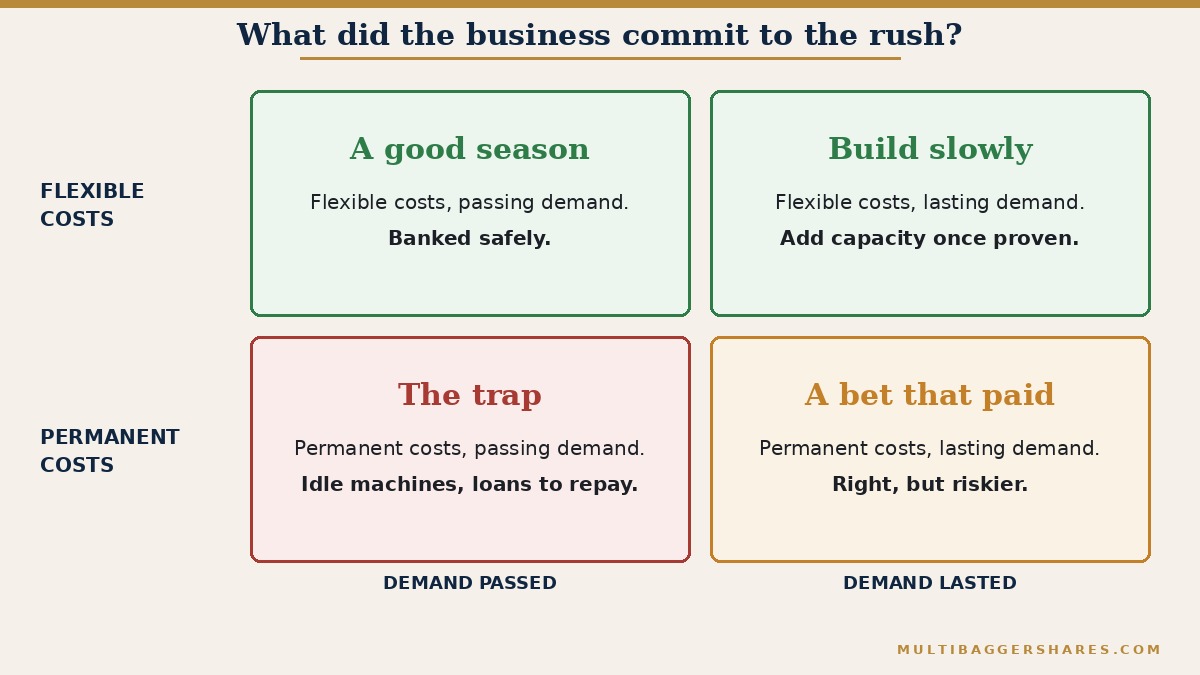
The second reason is that a business can turn a temporary rush into permanent costs. Some costs are fixed costs (costs that stay the same whether sales are high or low, such as rent, loan instalments and salaried staff). Others are variable costs (costs that rise and fall with sales, such as raw material and overtime). Kavita met the rush with variable costs. When sales fell, her costs fell with them. Suresh met it with fixed costs. When sales fell, his costs did not. The second filling machine is a good example of capacity (how much a business is able to produce). Capacity built for the peak of a rush sits idle once the rush passes, but it still has to be paid for.
The third reason is that people extrapolate (assume that what happened recently will carry on happening at the same pace). It is a very human habit. If a shop sold three times as much this quarter, it feels natural to multiply by four and imagine the year ahead. Managers do it, lenders do it and investors do it. But a rush is, by its nature, the least typical period in a business’s life. It is the worst possible base on which to build a forecast.
A simple way to hold all three ideas together is this: treat a rush like a guest, not like a new member of the family. You are glad the guest has come. You cook a little extra and you make room. But you do not build a new bedroom for someone who may leave on Sunday.
A real example or two
The stories below are told only as business history. They are not a comment on any company’s shares, today or in the past.
The fidget spinner, 2017. In the spring of 2017, a small toy that spins between your fingers swept through schools, first in America and then around the world. Fortune reported that, in late May 2017, fidget spinners made up about 17 percent of all daily online toy sales in the United States, according to estimates from Slice Intelligence. Yet the same data showed online sales had already peaked on 5 May, and Google searches peaked the next day. One reason the craze could spread so fast was also the reason it could not last for any one maker: the key patent had expired back in 2005, so anyone could produce the toy. By the time big stores had the spinners on every shelf, children were moving on. It was a textbook passing craze with no barrier to entry.
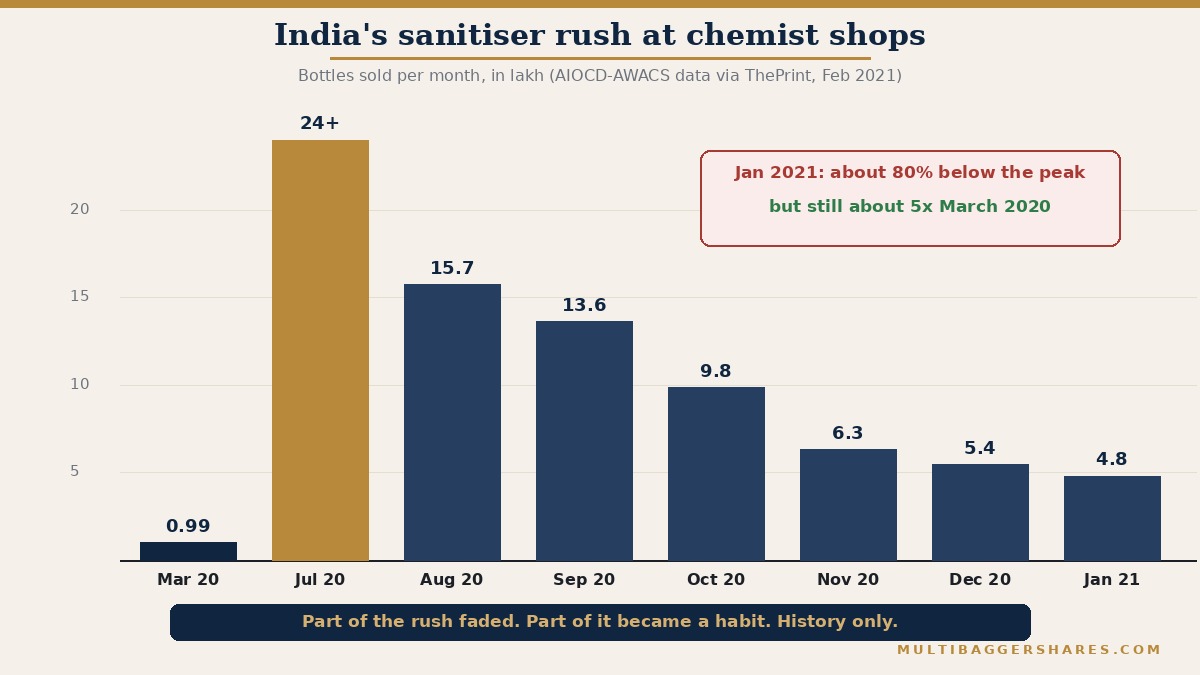
India’s sanitiser summer, 2020. Before the pandemic, hand sanitiser was a small product in India. Then it became something everyone wanted at once. Data from AIOCD-AWACS, the research arm of the All India Organisation of Chemists and Druggists, reported by ThePrint in February 2021, shows the rise and fall at chemist shops. In March 2020, these shops sold about 99,000 bottles. By July 2020, the peak, they sold more than 24 lakh bottles in a single month. Then sales slid month after month, to about 4.8 lakh bottles in January 2021, roughly 80 percent below the peak. Notice something important. Even after the fall, sales were still several times higher than in March 2020. Part of the rush faded, but part of it became a lasting habit. Real rushes are often a mix of all three kinds.
Peloton, 2020 to 2022. Peloton, an American company that sells exercise bikes along with paid online classes, was one of the great winners of the lockdowns, when gyms were shut. Its yearly revenue (the total money a company takes in from sales) rose from about 1.8 billion dollars in its 2020 financial year to about 4 billion dollars in 2021, more than double. In May 2021 it announced a 400 million dollar factory in Ohio, its first in the United States, expected to employ about 2,000 people.
But many families who wanted an exercise bike had already bought one, and as gyms, offices and schools reopened, new orders slowed. In November 2021, Peloton cut its forecast for the year’s sales by as much as 1 billion dollars, and its shares fell by about a third in a single day. In its letter to shareholders, management wrote that it had anticipated the year would be very challenging to forecast. In February 2022, the company dropped the Ohio factory plan, announced about 2,800 job cuts, and its co-founder stepped down as chief executive. The demand had been real. Much of it had simply been borrowed from the future, and a permanent factory had been planned on top of it.
How you can use it
You do not need a spreadsheet to apply this lesson. When you read that a business has had a sudden jump in sales, ask five plain questions, and write the answers down.
One: why are people buying now? Try to name the reason in one sentence. Is it an event, such as a health scare, a festival, a rule change or a price rumour? Or is it something slow and steady, such as rising incomes or a change in how people live? An event can end. A slow change usually does not.
Two: will the same customers need to buy again? A family buys an exercise bike or a refrigerator once in many years. It buys soap, tea or medicine again and again. If the product is bought once, a rush today often means fewer buyers tomorrow.
Three: did people buy early? Compare the rush with the normal trend before it. If you draw a straight line through the sales of the years before the rush, and the sales after the rush fall below that line, some of the rush was borrowed from the future.
Four: how easy is it for others to make the same thing? If a hundred new sellers can appear in a month, the extra profit will not last, however strong the demand. Look for a trusted name, a special skill, a scarce licence or a cost advantage that newcomers cannot quickly match.
Five: what did the business commit to? Read what the company did with the rush. Did it use overtime, rented space and outside makers, which can be switched off? Or did it borrow money for new factories, sign long leases and hire heavily, which cannot? Listen, too, to the words managers use. Phrases like new normal and structural shift are not wrong in themselves, but they should come with evidence, not just with one great quarter.
Finally, be patient with your own judgement. The honest answer during a rush is often it is too early to tell. Wait for the sales of the year after the rush, when the excitement has passed. Then compare them with the years before it. The real size of the lasting change is whatever remains once the guest has gone home.
This way of thinking is not about guessing next quarter’s numbers. It is about judging the quality of a business and of the people who run it. A good business enjoys a rush and banks it. A fragile one mistakes it for a new permanent level and builds a bedroom for a guest. Like Kavita, the best owners stay grateful, flexible and a little doubtful until time gives its answer.
Key takeaways
- A sudden jump in sales can be a passing craze, demand borrowed from the future, or a lasting change; in the first few months, all three look the same.
- A rush attracts rivals; without a barrier to entry such as a trusted name or special skill, its extra profit fades quickly.
- The real danger is meeting a temporary rush with permanent costs, such as borrowed money, long leases and big new factories.
- Judge a rush by the year after it, compared with the years before it, not by its best quarter multiplied by four.
- This is a way to judge the quality of a business and its managers. It is education only, not a judgement on any company or share.
— Manish Goel · multibaggershares.com
Manish Goel is a Chartered Accountant and Principal Officer of Multibagger Securities Research & Advisory Pvt. Ltd. (MSRAPL), a SEBI-registered Investment Adviser, Registration No. INA100007736. This content is published by MSRAPL for education only and is not personalized investment advice.
Disclaimer: This article is published by multibaggershares.com for education and general information only. It is not investment advice, investment research, or a recommendation to buy, sell or hold any security. Any companies named are discussed only as illustrative examples. Markets carry risk; please do your own research or consult a qualified professional before making any investment decision. |