The Angry Neighbour: Why a Business Needs the Goodwill of the People Around It, Not Just a Licence on Paper

The Weekend Special: Why a Good Business Tests an Idea Small Before It Bets Big
November 15, 2026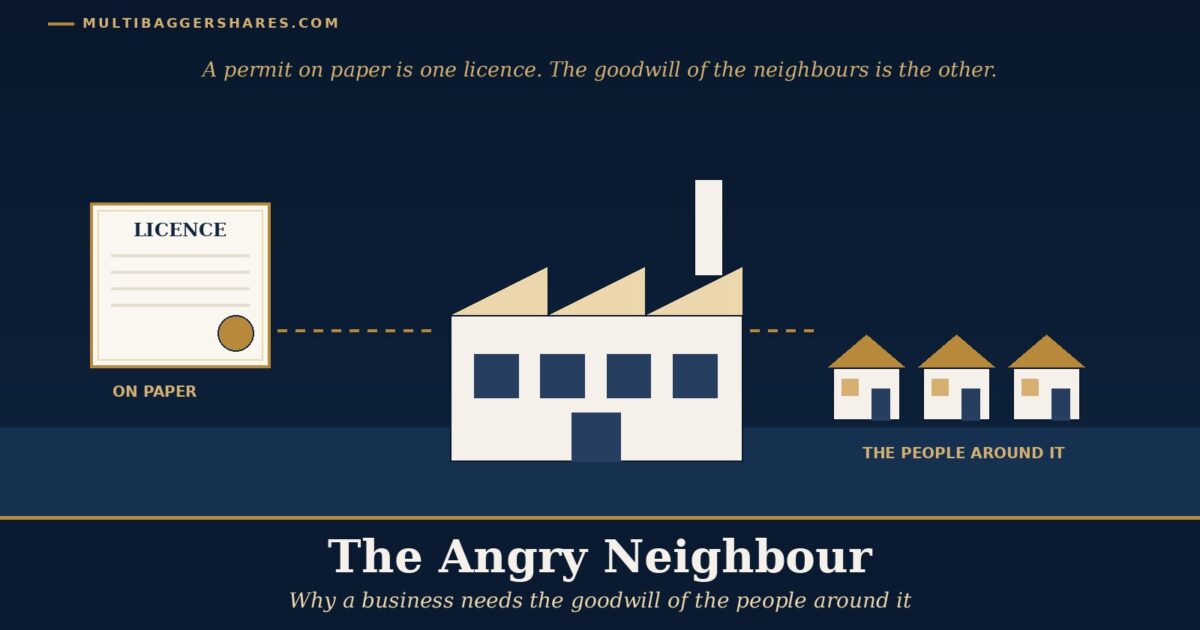
In a busy housing colony in Nagpur there are two small flour mills, the kind people call a chakki. Families bring their wheat and jowar in steel tins and take home fresh atta. Both mills have a trade licence from the city. Both have an electricity connection in their own name. On paper, both are in perfect order.
Lata runs the first mill. When a neighbour mentions that flour dust is settling on her balcony, Lata fits a cloth cover over the machine. When an old man upstairs says the noise wakes him, she stops starting the motor before eight in the morning. She hires a boy from the colony to deliver heavy bags to the older residents. People grumble about many things in that colony, but they do not grumble about Lata.
Shyam runs the second mill. He starts at five in the morning because that is when the power is cheapest. Dust drifts over the parked scooters and into kitchens. When people complain, he waves his licence at them and says he has every right to run his business. The complaints go to the residents’ association, then to the local corporator, then to the municipal office. One day an inspector arrives, finds a wiring fault and a missing fire extinguisher, and puts a seal on the door. It takes Shyam four months and a lot of running around to reopen. By then many of his customers have moved to Lata.
Shyam’s licence was real. It simply was not enough. He had permission from the government, but he had lost a second kind of permission, the one that is never printed on paper. This lesson is about that second permission. It is a quiet sign of the quality of a business, and it has nothing to do with guessing share prices.
What it really means
In 1997 a mining executive named Jim Cooney began using a phrase that has since spread across the business world: the social licence to operate. A social licence is the unwritten approval that a business gets from the people around it. That means its neighbours, the village or town where its plant stands, its workers, and the wider public. Nobody signs it. Nobody stamps it. Yet it can matter as much as any government permit.
Think of it this way. A formal licence (an official permission given by the government, with a number, a date and a file) says a business is allowed to operate. A social licence says the people nearby are willing to let it operate. The first is given once and renewed now and then. The second has to be earned again every single day, by how the business behaves.
Mining companies were the first to talk about it because they learned the lesson the hard way. A mine cannot move. It must be dug where the ore is, often next to farms, forests and villages. If the people there turn against it, no amount of paperwork will keep the trucks moving. But the idea applies to any business with a fixed place in the world: a factory, a power plant, a chemical unit, a hotel by a beach, even a flour mill in a colony.
There is a helpful everyday comparison. If you rent out a flat, the rent agreement gives you a legal right to the rent. But if your tenant is always fighting with the neighbours, playing loud music at night and leaving rubbish on the stairs, the housing society can make your life very difficult, agreement or no agreement. The paper protects you only as long as the people around you do not lose patience.

Why it works
Why should an investor care about something that never appears in the accounts? There are four simple reasons.
The first reason is that a government licence is not as solid as it looks. When enough people complain, officials and courts listen. Licences can be cancelled, renewals can be refused, and inspections can suddenly become very strict. The paper permission often turns out to depend on the people’s permission.
The second reason is that a factory cannot pack up and leave cheaply. Money spent on land, buildings and machines becomes a fixed asset (something the business owns and uses for many years, which cannot easily be sold or moved). If the plant is shut, that money is stuck. The business may still have to pay interest on loans taken to build it, salaries to keep key staff, and lawyers to fight its case, while earning nothing from it. This is why a lost social licence can hurt far more than a bad year of sales.
The third reason is time. Trouble with neighbours rarely ends quickly. Protests, court cases and appeals can go on for many years. During all that time, the managers’ attention is pulled away from running the business well. Think of a farmer who spends every monsoon in a land dispute instead of in his fields. Even if he wins in the end, he has lost several harvests.
The fourth reason is what it tells you about the people in charge. How a business treats those who cannot easily hit back, like poor villagers, a small fishing community or a colony of retired people, is a good test of its character. Managers who cut corners with their neighbours may cut corners elsewhere too. Managers who listen early, fix problems and share some of the benefits are usually the same managers who run the rest of the business with care.
One point needs to be made fairly. Not every protest is right, and not every complaint is reasonable. Sometimes protests are driven by local politics, rumours or rival interests. A good business can still get caught in a fight it did not start. But for an investor the lesson is the same either way: if a business depends on one large site, its fate depends partly on the mood of the people around that site. That is a risk worth seeing clearly, whoever is right.

A real example or two
The examples below are told only as business history, using facts reported in the press and the courts. Nothing here is a comment on the shares of any company, or a suggestion to buy, sell or hold them, and it is not a judgement on who was right in any dispute.
The first story comes from Plachimada, a village in the Palakkad district of Kerala. In 2000 a bottling plant run by Hindustan Coca-Cola Beverages, the Indian bottling arm of the Coca-Cola group, began operating there. Within two years, villagers began protesting outside the gate, starting on 22 April 2002. They said the plant was drawing too much groundwater (water pumped up from under the ground) and that their wells were suffering. On 3 April 2003 the local village council, the panchayat, cancelled the plant’s licence. Court cases followed, and the factory stopped production in March 2004. In July 2017, after years of legal battles, the company told the Supreme Court that it did not intend to start manufacturing at the plant again. A plant built to run for decades ended up working for only about four years.
The second story is from Singur in West Bengal. Tata Motors chose Singur to build the factory for the Nano, a car meant to cost about one lakh rupees. The state acquired close to 1,000 acres of farmland for the project, and construction began in January 2007. Many farmers did not want to give up their land, and a long protest followed, backed by an opposition party. On 3 October 2008 the company announced it was leaving. Ratan Tata, then chairman of the group, put it simply: “You cannot run a plant with police protection, you cannot run a plant when bombs are being thrown.” Within days the company chose Sanand in Gujarat instead, and a new plant was built there in about 14 months. Tata had already put over Rs 1,800 crore into Singur. In 2016 the Supreme Court set aside the land acquisition, and in 2023 an arbitration panel (a private tribunal that settles a dispute in place of a regular court) awarded the company about Rs 766 crore plus interest from the state. That is fifteen years of waiting to recover part of the money.
The third story is from Thoothukudi in Tamil Nadu, where Vedanta’s Sterlite Copper ran a large copper smelter (a plant that melts ore to extract the metal), with capacity of about four lakh tonnes a year, and wanted to double it. Local residents had complained about pollution for years. In May 2018 a protest against the plant ended in tragedy, with 13 people killed in police firing. That same month the Tamil Nadu government ordered the plant shut for good. The company went to court. The Madras High Court upheld the closure in August 2020, and on 29 February 2024 the Supreme Court dismissed the company’s appeal, pointing to serious violations and repeated breaches. One of the country’s largest copper plants has stayed shut ever since.
Notice what the three stories share. In each case the business had a formal permission at the start. In each case the trouble began with the people nearby, long before any court got involved. And in each case a huge amount of money ended up locked inside a plant that could not run. None of these losses would have shown up in the accounts on the day the plant opened.

How you can use it
You cannot visit every factory yourself. But an ordinary investor can still find useful clues about whether a business has its neighbours with it or against it. Here are five simple places to look.
First, read the legal notes in the annual report. Look at the section on contingent liabilities (possible costs that depend on how a pending case or claim turns out) and on litigation (court cases). Notices from a pollution control board, cases before the National Green Tribunal (a special court for environmental disputes), or orders to stop work at a site are all warning lights, especially if they keep coming back year after year.
Second, look at the company’s BRSR, the Business Responsibility and Sustainability Report that large listed companies in India publish. It has a table of complaints received from different groups, including local communities, and sections on the environment and on how the company works with the people near its sites. A few complaints that are resolved quickly are normal. Many complaints that stay pending are a clue.
Third, search the local news. Type the company’s name with words like protest, pollution, closure or land, and read what the papers in that state are saying. Big national news often arrives only after a problem has been growing locally for years, just as Shyam’s trouble started in the residents’ association long before the inspector came.
Fourth, notice how managers talk about the problem. Some blame outsiders, the media or politics, and change nothing. Others admit what went wrong, explain what they have fixed, and report progress the next year. The second kind of management is far more likely to keep its social licence.
Fifth, ask how much depends on one place. A business with one giant plant next to one town carries more of this risk than a business with many smaller sites spread across the country. If most of the profit comes from a single site, the goodwill of the people around that site matters a great deal.
A small notebook helps. For each company you follow, write down where its main plants are, what local disputes, if any, you can find, and how the company has responded. Look again every year. Over time you will see which businesses treat their neighbours like Lata and which treat them like Shyam. That pattern is part of judging the quality of a business, alongside its profits, its debts and its cash flow.
The lesson is not that a business must please everyone. That is impossible. The lesson is that every business with a fixed place in the world holds two licences, one on paper and one in people’s minds, and the second can quietly take away the first.
Key takeaways
- A social licence to operate is the unwritten approval of the people around a business: its neighbours, workers and local community.
- A government permit can be withdrawn when that approval is lost, and a shut plant can lock up years of money that cannot move.
- Plachimada, Singur and Thoothukudi show how local anger, ignored early, can end in closure, long court battles and large losses.
- Outsiders can look for clues in legal notes, the BRSR complaint tables, local news, how managers respond, and how much depends on one site.
- This is a way to judge the quality of a business and its managers. It is education only, not a judgement on any company or share.
— Manish Goel · multibaggershares.com
Manish Goel is a Chartered Accountant and Principal Officer of Multibagger Securities Research & Advisory Pvt. Ltd. (MSRAPL), a SEBI-registered Investment Adviser, Registration No. INA100007736. This content is published by MSRAPL for education only and is not personalized investment advice.
Disclaimer: This article is published by multibaggershares.com for education and general information only. It is not investment advice, investment research, or a recommendation to buy, sell or hold any security. Any companies named are discussed only as illustrative examples. Markets carry risk; please do your own research or consult a qualified professional before making any investment decision. |