The Weekend Special: Why a Good Business Tests an Idea Small Before It Bets Big

The Hidden Factory: Why a Business That Gets It Right the First Time Keeps More of Every Rupee
November 14, 2026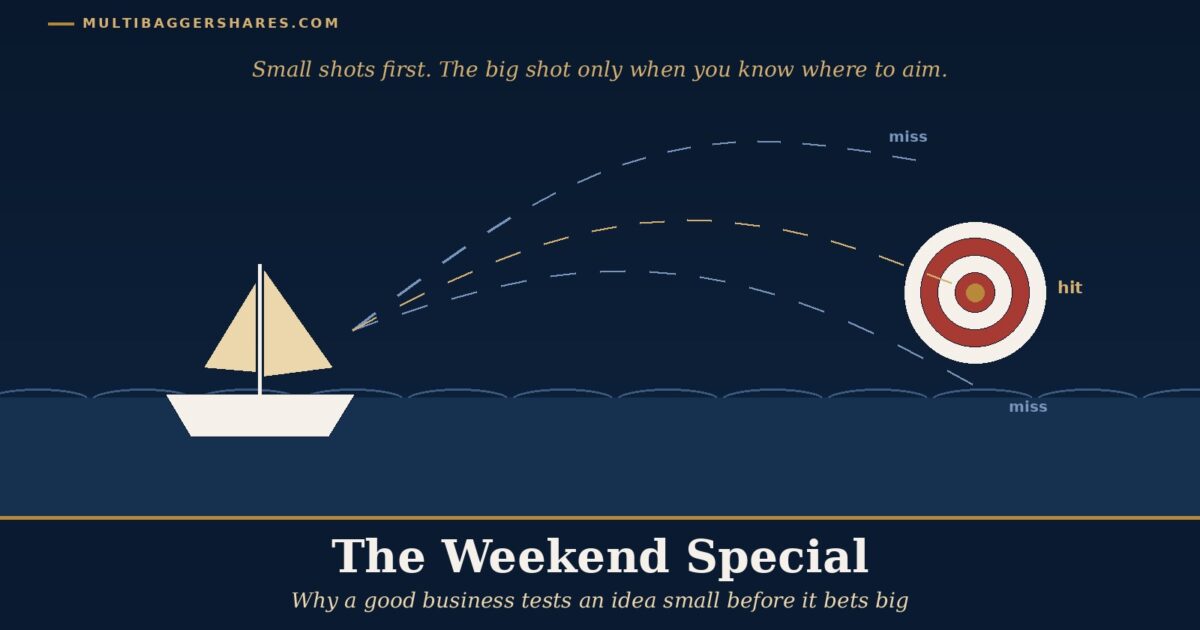
On one busy road in Indore there are two small eating places. Both serve poha and jalebi in the morning and thalis at lunch. Both are full most days. Both owners want to grow.
Meera runs the first one. One day she wonders whether her customers would like dal baati, a dish from her grandmother’s village. She does not change her menu. She does not buy a new oven. She simply cooks a small batch every Sunday and writes it on the board as the weekend special.
For six Sundays she watches. The first week, the baati is too hard and half of it comes back. She changes the dough. By the fourth week, it sells out by one o’clock and regulars ask whether they can order it on weekdays. Only then does Meera add it to the daily menu and buy a proper oven. A year later, the dish is the reason people cross the city to eat at her place.
Ramesh runs the second one. He reads that Chinese food is the next big thing. He borrows forty lakh rupees, rents a large hall on the main road, hires two cooks from Mumbai and opens a grand new restaurant in one go. He has never served a single plate of noodles to his own customers. Eight months later the hall is empty, the loan is still there, and his first shop is short of money too.
Both owners were brave. Both wanted to try something new. The difference was not courage. The difference was the order in which they did things. This lesson is about that order. It is a quiet but powerful sign of a well-run business. It is about the quality of a business, and it has nothing to do with guessing share prices.
What it really means
In 2002 the American business writer Jim Collins and the professor Morten Hansen began a nine-year research project. They started with a list of 20,400 companies and cut it down, step by step, until only seven were left. Each of those seven had beaten its own industry index (an average of the companies in the same line of business) by at least ten times. They called them 10X companies, and in 2011 they published what they learned in a book called Great by Choice.
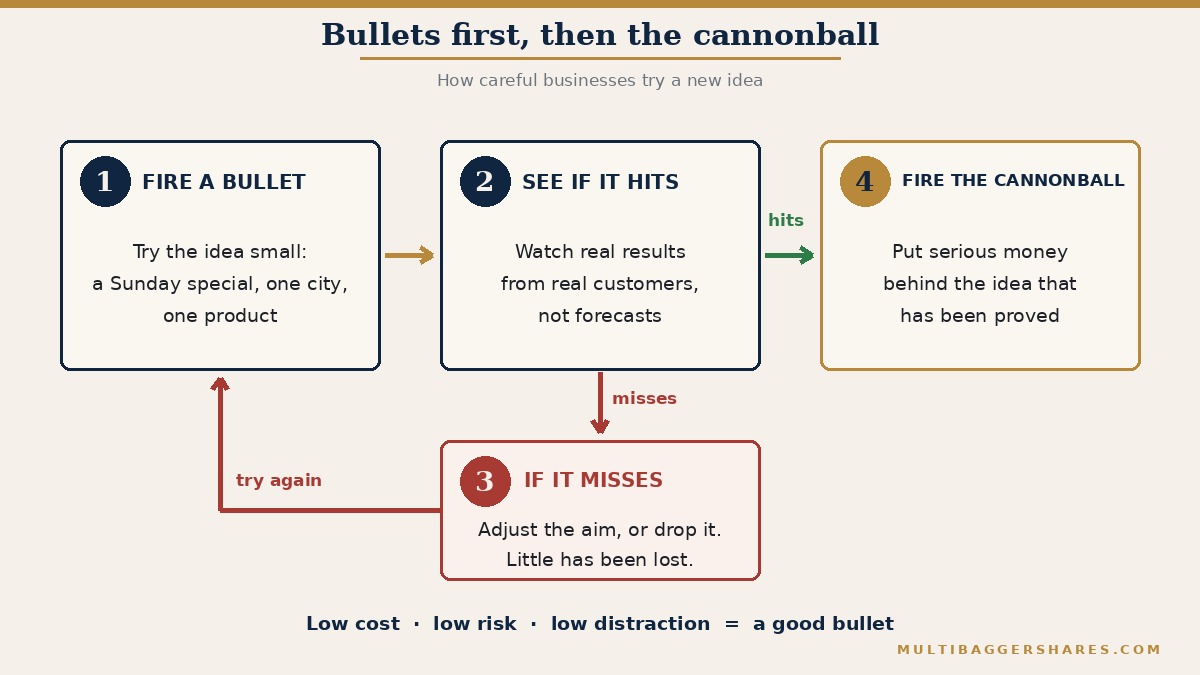
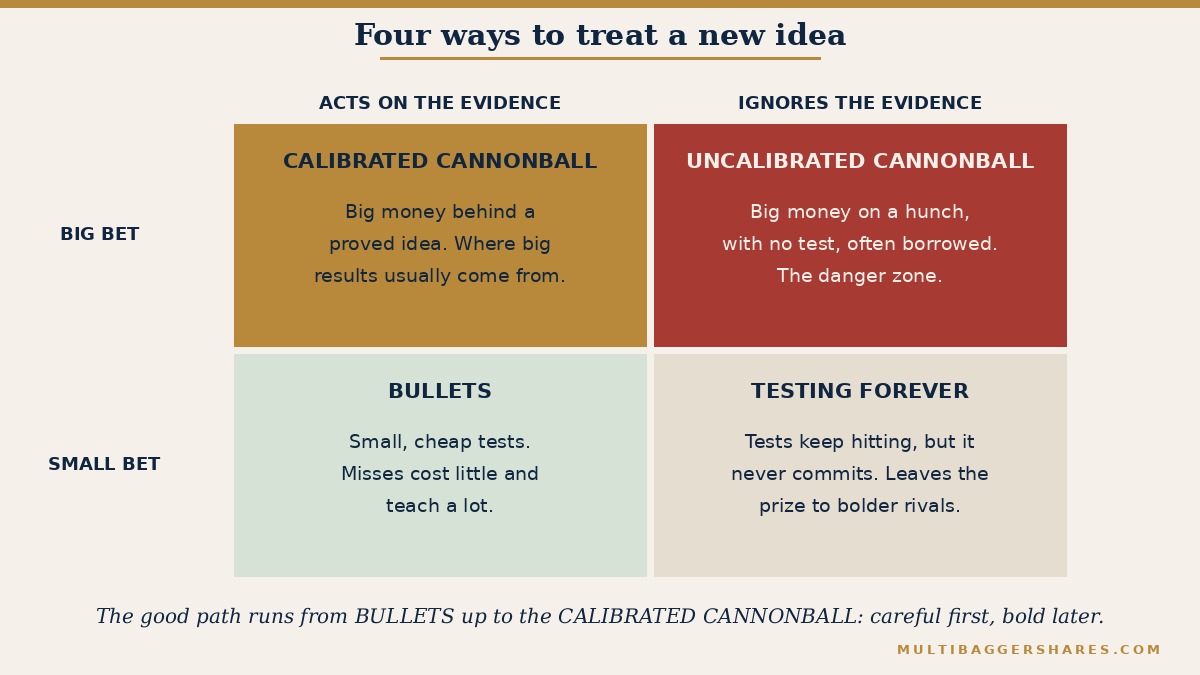
One of their clearest findings has a memorable name: fire bullets, then cannonballs. Collins explains it with a story. Imagine you are on a ship at sea, with a hostile ship coming towards you. You have only a limited amount of gunpowder. If you put all of it into one big cannonball and fire without checking your aim, you will probably miss. Then you have nothing left.
The wiser captain does something different. He first fires a few small bullets. The first one misses by a lot, so he adjusts. The next misses by a little, so he adjusts again. When a bullet finally hits, he knows exactly where to aim. Only then does he load the big cannonball and fire it along the same line.
In business, a bullet is a small test of a new idea. Collins describes bullets as low-cost, low-risk and low-distraction experiments. Low cost means the company can afford to lose the money. Low risk means that if the test fails, nobody is badly hurt and the main business carries on. Low distraction means the test does not pull the managers’ attention away from the work that pays the bills today.
A cannonball is a big, serious commitment: a new factory, a national launch, a large purchase of another company. Collins and Hansen found that the great companies were not timid. They did fire cannonballs, sometimes very big ones. But they usually fired them only after their bullets had shown where to aim. In their language, these were calibrated cannonballs (big bets aimed with the help of real evidence from small tests). The weaker companies they compared them with more often fired uncalibrated cannonballs (big bets based on a hunch, a forecast or a fashion).
Meera’s Sunday special was a bullet. Her new oven, bought only after the dish kept selling out, was a calibrated cannonball. Ramesh’s grand restaurant was an uncalibrated cannonball. A farmer who tries a new seed in one corner of his field before planting the whole field is doing the same thing as Meera.
Why it works
The first reason is simple: nobody can see the future clearly. Not the owner, not the experts, not the newspaper that says something is the next big thing. Customers often behave differently from what anyone expected. A small test replaces guessing with evidence. Collins calls this empirical validation (proof that comes from real results in the real world, not from opinions or spreadsheets).
The second reason is the cost of being wrong. Let us put rough numbers on the two eating places. Suppose Meera’s six Sundays of extra ingredients cost her about Rs 2,000 a week. If the dish had failed, she would have lost about Rs 12,000 and learned something useful. Ramesh put forty lakh rupees of borrowed money on one untested guess. When it failed, he lost the money, still owed the bank, and put his first shop in danger. A wrong bullet is a lesson. A wrong cannonball can be the end of the story.
The third reason is that small tests can be repeated. A business that can afford to fire ten bullets gets ten chances to learn. If seven miss and three hit, it can put its big money behind the three. A business that fires one big cannonball gets one chance. This is a little like a cricket team trying out a young batsman in a few domestic matches before picking him for a Test match. The trials are cheap. The Test match is where the stakes are high.
The fourth reason is protection for the main business. When a test is small, the shop that already earns money keeps running smoothly. The cooks, the managers and the cash are not all pulled into the new adventure. Ramesh’s first shop suffered because his time, his attention and his money were all swallowed by the new hall.
One more point matters. What counts as a bullet depends on the size of the business. For a company with sales of ten thousand crore rupees, a ten crore test is a bullet. For a company with sales of fifty crore rupees, the same ten crores could be a cannonball. When you study a business, the useful question is not how much it is spending on something new, but how much it is spending compared with its own size and its own cushion of cash.
Finally, the rule is not an excuse to stay small forever. A business that keeps testing and never commits, even after the tests keep hitting, also loses. It leaves the prize to a bolder competitor. The skill Collins describes has two halves: be careful before you know, and be bold once you do.
A real example or two
The examples below are told only as business history. Nothing here is a comment on the shares of any company, or a suggestion to buy, sell or hold them.
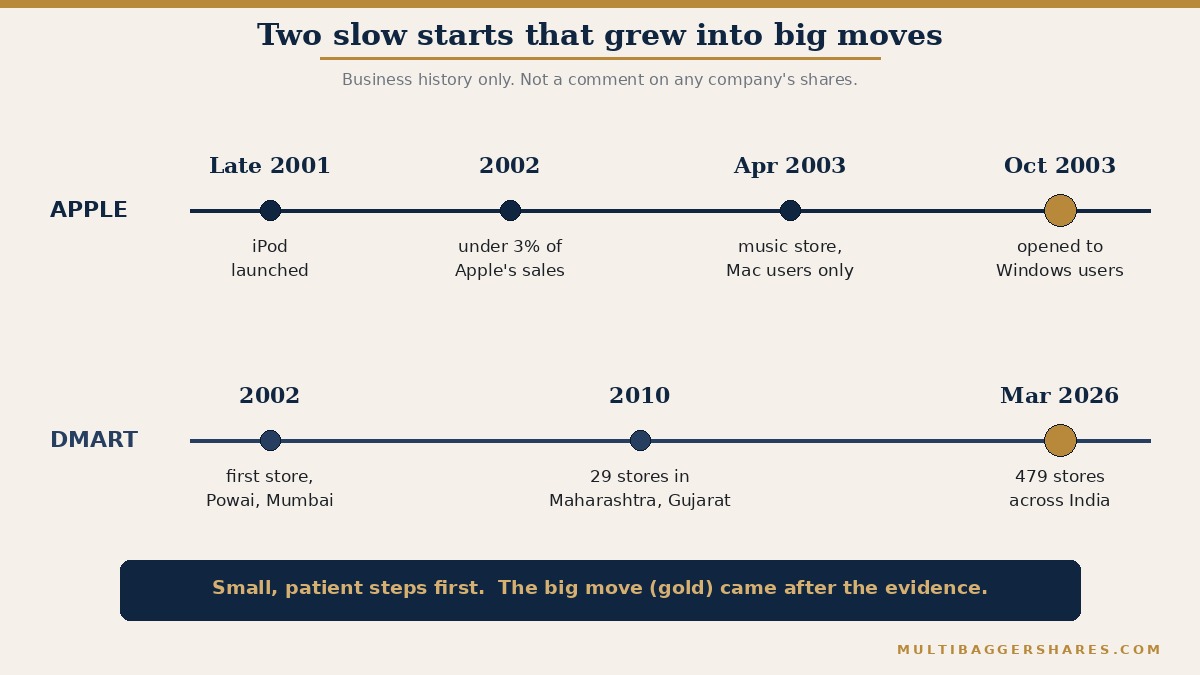
Collins himself points to Apple and the iPod. When the iPod was launched in late 2001, it was a small part of Apple. In 2002 it made up less than three per cent of Apple’s net sales (total sales after returns and discounts). In April 2003 Apple opened the iTunes Music Store, selling songs for 99 cents each, and at first it worked only for people who used Apple’s own Mac computers. Each step showed real customers wanting more. Only after that, in October 2003, did Apple open the store to people using Windows computers, which was most of the world. That was the cannonball, and it was aimed with the help of two years of bullets.
An Indian example comes from retail. DMart, the supermarket chain started by Radhakishan Damani, opened its first store in Powai, Mumbai, in 2002. For years it grew slowly and carefully. By 2010 it had 29 stores, all in Maharashtra and Gujarat. It learned how to run a store well, close to home, before spreading further. Much of its later growth came after that learning: by March 2026 it had 479 stores, and it crossed 500 a month later. The early years looked unexciting from the outside. In fact, they were years of patient aiming.
Now an example of the opposite. Quibi was an American app for short videos made to be watched on phones. Before it had proved that people wanted it, it raised about 1.75 billion dollars from big investors and launched in April 2020 with expensive shows and a lot of publicity. On 21 October 2020, only about six months later, its leaders announced it would shut down. In their letter they wrote that perhaps the idea was not strong enough to stand alone, or perhaps the timing was wrong during the pandemic, and that they would never know for sure. That last line says a great deal. A small test first might have told them, at a fraction of the cost.
Notice that none of these stories is about being clever. Apple, DMart and Meera did not know in advance that their ideas would work. They simply arranged things so that they could find out cheaply, and so that a wrong answer would not sink them.
How you can use it
You cannot sit inside a company’s board meetings. But an ordinary investor can still find many clues about whether a business fires bullets or uncalibrated cannonballs. Here are five simple questions.
First, how big is the new thing compared with the whole business? Annual reports describe new plants, new products and new markets. Compare the money being spent with the company’s yearly sales, its net worth (what the owners would have left if all debts were paid) and its cash. A new project that is a small slice is a bullet. A project as large as the whole existing business is a cannonball, and it deserves a hard look.
Second, did they test before they spread? Good managers often describe a pilot (a small trial run), one city before the whole country, one product before a full range, or one plant before five. When a company announces a nationwide launch of something it has never sold anywhere, ask what evidence it is aiming with.
Third, how is the big bet being paid for? A cannonball paid for out of the company’s own profits can be survived even if it misses. A cannonball paid for with a large loan is far more dangerous, because the interest must be paid whether the idea works or not. Ramesh’s real mistake was not only that his idea was untested. It was that he borrowed to fire it.
Fourth, what happened to past experiments? Read three or four old annual reports side by side. Did the company quietly close the tests that failed, without fuss, and put more money behind the ones that worked? Or does it have a trail of grand announcements that later disappeared? Managers who are honest about small failures are usually the ones who avoid big ones.
Fifth, once a test clearly worked, did they commit? A company that ran a successful pilot five years ago and still has not expanded it may be too timid. The best businesses are careful while they are learning and decisive once they have learned.
A simple notebook helps here too. For each company you follow, write down every new venture it announces, how big it was compared with the company, how it was paid for, and what became of it two or three years later. Over time, a pattern appears. Some managements keep firing small, sensible bullets and then a few well-aimed cannonballs. Others keep making big, loud bets. That pattern tells you a lot about the quality of the people running the business.
The same idea also works for anyone learning something new, including learning about investing itself: learn in small, safe steps before making any big commitment. But the main use of this lesson is as a way to read a business. When a company tells you about its next big plan, it is worth asking one quiet question: where are the bullets?
Key takeaways
- A bullet is a small, cheap, low-risk test of a new idea; a cannonball is a big commitment of money and attention.
- Jim Collins and Morten Hansen found that great companies usually fired big cannonballs only after small bullets had shown them where to aim.
- A wrong bullet is a cheap lesson, but a wrong cannonball, especially one paid for with borrowed money, can sink a business.
- Outsiders can look for clues: the size of new projects against the whole business, pilots before roll-outs, how bets are funded, and what became of past experiments.
- This is a way to judge the quality of a business and its managers. It is education only, not a judgement on any company or share.
— Manish Goel · multibaggershares.com
Manish Goel is a Chartered Accountant and Principal Officer of Multibagger Securities Research & Advisory Pvt. Ltd. (MSRAPL), a SEBI-registered Investment Adviser, Registration No. INA100007736. This content is published by MSRAPL for education only and is not personalized investment advice.
Disclaimer: This article is published by multibaggershares.com for education and general information only. It is not investment advice, investment research, or a recommendation to buy, sell or hold any security. Any companies named are discussed only as illustrative examples. Markets carry risk; please do your own research or consult a qualified professional before making any investment decision. |