The Shared Workshop: Why a Business That Can Add New Products on What It Already Owns Has a Quiet Advantage

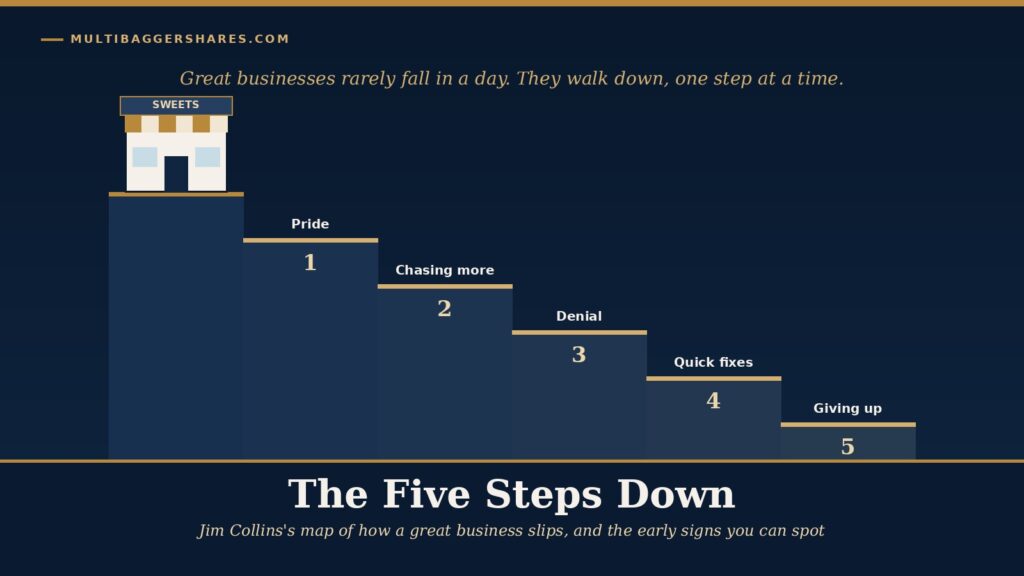
The Five Steps Down: Jim Collins’s Map of How a Great Business Slips, and the Early Signs You Can Spot
November 12, 2026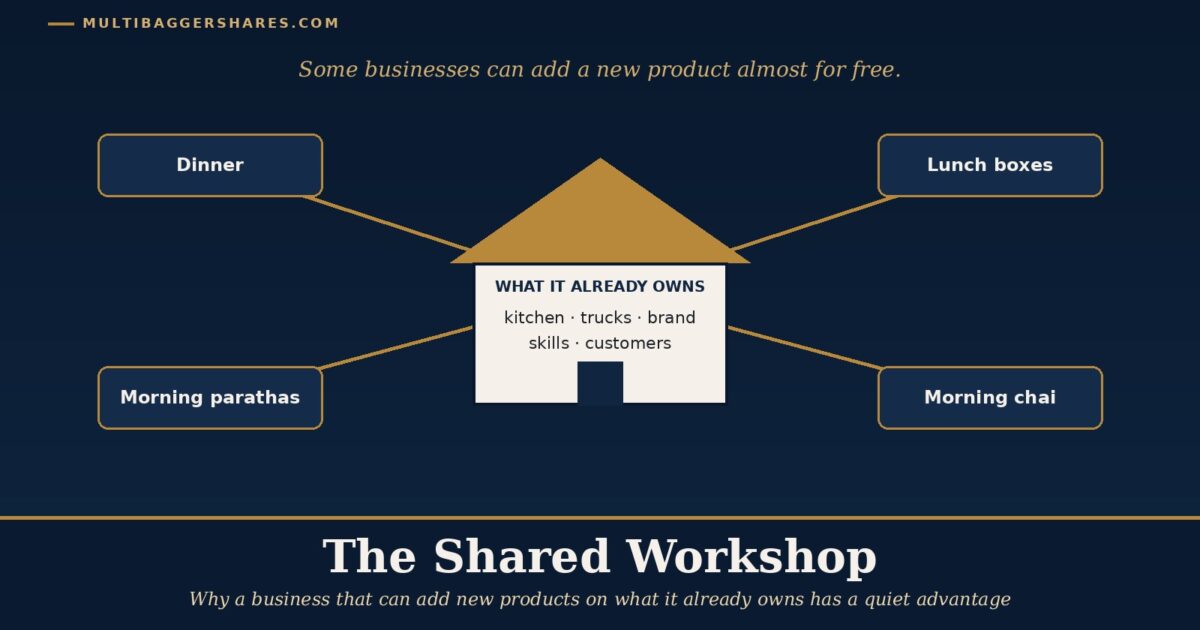
Ramesh runs a dhaba on the highway outside Jaipur. For years it served only dinner. Truck drivers stopped at night for dal, rotis straight from the tandoor, and a cot to rest on. By nine in the morning the kitchen was quiet. The tandoor was cold, the cooks were asleep, and the big parking ground sat empty in the sun.
One winter his nephew asked a simple question. Why not serve parathas and chai in the morning? The kitchen was already there. The tandoor was already paid for. The cooks only had to wake up a few hours earlier. The drivers leaving at dawn were the same drivers who already trusted the food.
Within a year the morning trade was bringing in almost as much money as the dinner trade. And it had cost Ramesh very little to start. He had not built a second kitchen. He had simply let the first kitchen work for more hours.
This lesson is about that quiet advantage. Some businesses can add a new product almost for free, because most of what the new product needs is already owned and already paid for. Learning to spot this helps a patient investor understand why some businesses grow cheaply and steadily, while others spend a fortune every time they try something new. It is a lesson about the quality of a business. It has nothing to do with guessing share prices.
What it really means
Economists have a name for what Ramesh found. They call it economies of scope. Economies means savings. Scope means range, or variety. So economies of scope are the savings a business gets from making a range of different products together, instead of making each one separately.
The idea was named by two economists, John Panzar and Robert Willig. Their paper with that title appeared in the American Economic Review in 1981. One short way of putting it is that these are savings that come from variety, not from volume.
That last part matters, because it is easy to confuse with a cousin idea. Economies of scale are savings from making more of the same thing. A biscuit factory that makes ten crore packets a year can make each packet more cheaply than a factory that makes ten lakh. Economies of scope are different. They come from making different things that share the same base.
What can be shared? Almost anything a business has already paid for. A factory building. A fleet of delivery vans. Shelf space in shops across the country. A brand (the name and reputation customers trust). A skill that took twenty years to learn. Even the customers themselves, and the trust they already place in the business.
Think of the dairy van that reaches your colony at dawn. It is going there anyway with milk. Adding curd, paneer and butter to the same trip costs the dairy very little. The van, the driver, the fuel and the route are already paid for. Each extra product rides along almost free.
Why it works
To see why this is powerful, you need one more piece of plain language. A business has two kinds of costs. Fixed costs (costs that stay the same whether you sell a little or a lot, like rent, machines and salaried staff) and variable costs (costs that rise with each extra sale, like flour, oil and packing boxes).
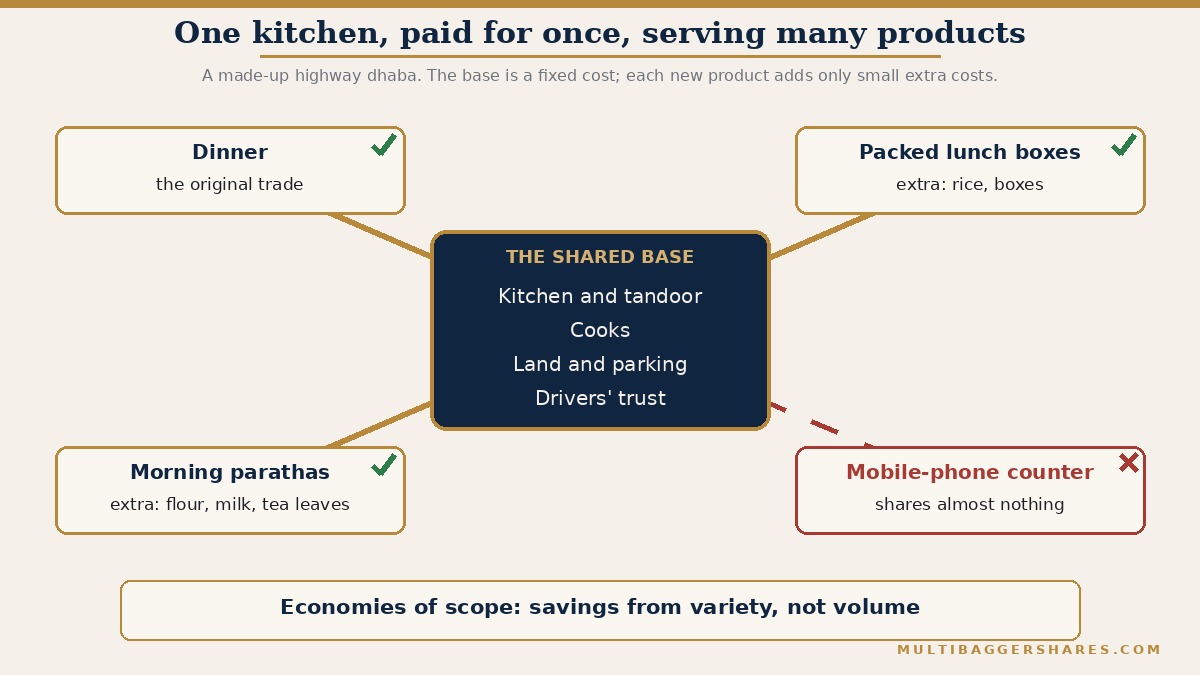
Ramesh’s kitchen, tandoor, land and cooks were fixed costs. He was paying for them all day, but using them only in the evening. When he added the morning trade, the only new costs were variable ones: more flour, more milk, more tea leaves, a little more gas. So nearly every rupee of the new sales, after those small costs, became extra profit.
A business that can do this again and again has a quiet advantage over a rival that cannot. Imagine a new competitor who wants to open a breakfast stall on the same highway. He must find land, build a kitchen, hire cooks and slowly win the trust of drivers. Ramesh only had to light the tandoor a few hours earlier. They are serving the same parathas, but their costs are very different.
A kirana shop shows the same thing on a smaller scale. The owner pays the same rent and sits behind the same counter whether he stocks fifty items or five hundred. When he adds phone recharges, courier pickup or bill payments, he needs no new shop and no new staff. His regular customers already walk in every day. Each new service earns a little, and together they make the same small shop far more useful, and far more profitable, than it was when it stocked only rice and dal.
There is a second benefit, which is less obvious. Every new product that shares the base also helps pay for the base. When the kitchen earns money in the morning as well as at night, Ramesh can afford a better tandoor, a cleaner washroom, a bigger parking ground. Those improvements then make the dinner trade stronger too. The shared base and the products feed each other, a little like a well-tended field where every crop leaves the soil a bit richer for the next.
This is why good investors pay attention not only to what a business offers, but to what it owns underneath. The things underneath are often what makes the next product cheap or expensive to add.
When sharing turns into wandering
Now comes the important warning. Not every new product is a case of economies of scope. Many are just a business wandering away from what it knows.
Back to Ramesh. Encouraged by the success of the morning trade, he added packed lunch boxes for drivers to carry on the road. That also worked. Same kitchen, same cooks, same customers. Then a cousin persuaded him to open a mobile-phone counter in one corner of the dhaba. This time almost nothing was shared. Ramesh knew nothing about phones. His cooks could not repair a screen. The drivers did not come to a dhaba to shop for a phone. After eighteen months the counter closed, and the money spent on stock was mostly lost.
The phone counter looked like the parathas from the outside. It was a new product under the same roof. But it shared only the roof. Economists even have a word for this opposite case: diseconomies of scope, when adding products makes a business costlier and clumsier instead of cheaper. Peter Lynch, the famous fund manager, had a funnier word for companies that wander into unrelated businesses. He called it diworsification.
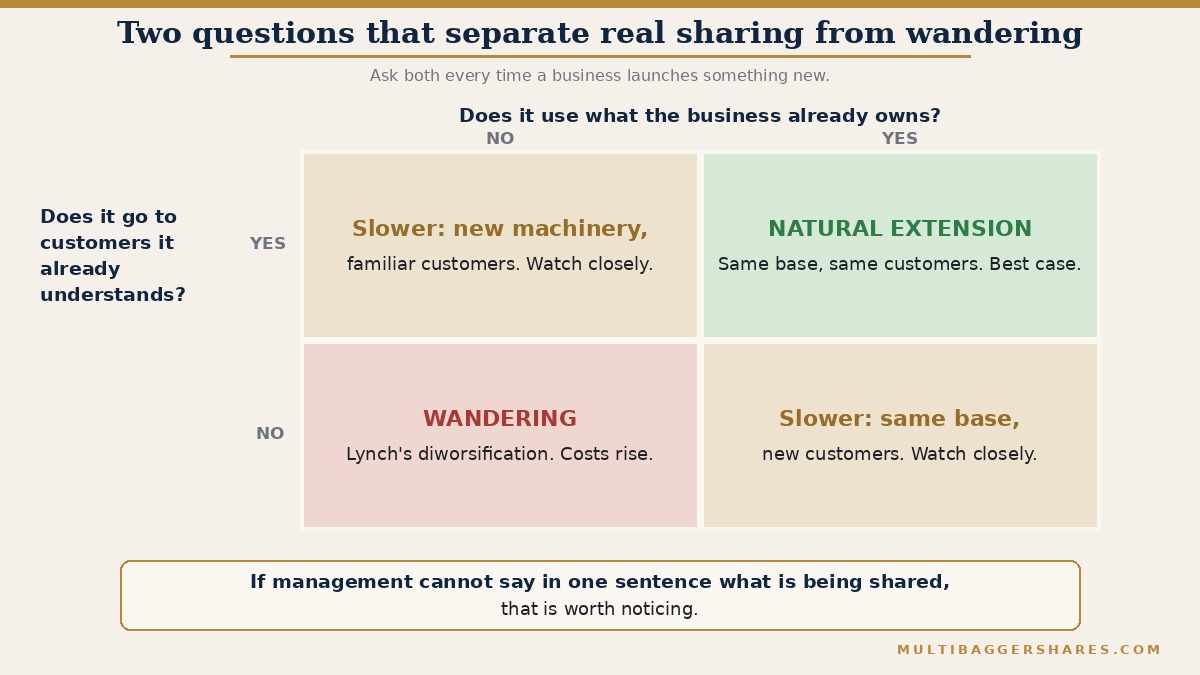
So the real test is not whether a business is adding products. It is whether the new product truly uses what the business already owns. Two simple questions help. Does the new product use the same plant, vans, shelf space or skills? And does it go to customers the business already understands? If the answer to both is yes, it is probably a natural extension. If the answer to both is no, it is probably wandering, however exciting the announcement sounds.
Jeff Bezos, the founder of Amazon, described both sides of this in his 2008 letter to shareholders. He called one approach skills-forward, which asks: we are really good at X, what else can we do with X? He said it was a useful and rewarding way to run a business. But he added a caution. A company that uses only this approach will never be pushed to build fresh skills, and in time its old skills go out of date. Sharing what you have is powerful, but it is not the whole story.
A real example or two
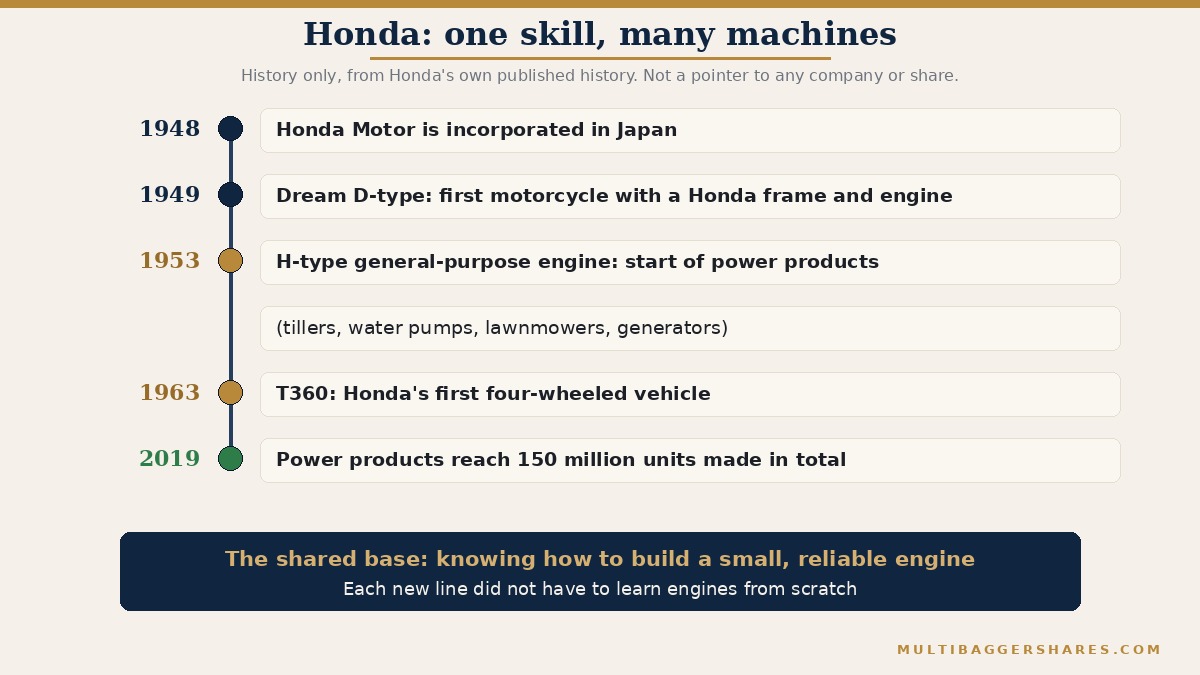
Honda is one of the clearest stories of a shared skill. The company was set up in Japan in September 1948. In 1949 it launched the Dream D-type, the first motorcycle with both a Honda frame and a Honda engine. The heart of the business was a skill: building small engines that were light, strong and reliable.
In 1953 Honda took that same skill somewhere new. It began making a general-purpose engine, the H-type, for farm and work machines. That was the start of what Honda calls its power products, such as tillers, water pumps, lawnmowers and generators. Honda itself describes the general-purpose engine as the core technology of that business. In 1963 came the T360, Honda’s first four-wheeled vehicle. By September 2019, Honda said, its power products alone had reached 150 million units made in total.
Motorcycles, farm engines, generators and cars look like very different products. Underneath, they share one thing that took decades to build: knowing how to make an engine well. Each new line did not need Honda to learn engines from scratch.
Amazon’s cloud business is a more modern version of the same idea. In the early 2000s Amazon was building huge computer systems to run its own online shop. Its engineers found they were building the same storage and computing tools again and again for different teams. Someone suggested that many other companies probably had the same problem. In March 2006, Amazon began renting that same kind of computing power to outsiders, under the name Amazon Web Services. The skill had been built for the shop. It turned out to be a product in its own right, and by 2026 it was bringing in sales of more than a hundred billion dollars a year.
None of this is a comment on any share today. These are stories from history, told only because they show the idea clearly.
How you can use it
You do not need special data to look for economies of scope. You need curiosity and an annual report. Here is a simple way to do it.
First, write down what the business owns underneath its products. Not the products themselves, but the base: the factories, the delivery network, the brand, the shelf space, the skills, the customer list. A business described in one line as a biscuit company may really be a distribution network that reaches lakhs of small shops.
Second, when the business launches something new, ask the two questions from Figure 2. Does it use the same base? Does it go to the same kind of customers? Read the management’s explanation carefully. If they cannot explain in a sentence what is being shared, that is worth noticing.
Third, watch what happens over the following years, not the following quarter. A real extension usually starts small and grows steadily without needing a lot of new borrowed money. A wandering move often needs big spending up front, more debt, and a new set of managers who know the new field better than the old team does.
Fourth, look for the quiet sign that the base is getting stronger. Is the business spreading the same fixed costs over more products each year? Over time this tends to show up as steady or improving profit margins (the share of each rupee of sales that is left as profit) even as the business adds lines. That is the shared workshop at work.
Two cautions keep this tool honest. Sharing can make a business complicated, and complication has its own costs. A kitchen that makes thirty dishes is harder to run well than one that makes five. And remember Bezos’s warning: a business that only ever reuses old skills can be overtaken when the world changes. The best businesses share what they have and still keep learning new things.
Ramesh still runs his dhaba. The tandoor now burns from five in the morning until midnight. The phone counter is a storeroom again. When his nephew suggests a new idea these days, Ramesh asks him the same two questions before he spends a single rupee. That small habit is worth more than any one product.
Key takeaways
- Economies of scope are savings from making a range of products on one shared base, such as a plant, a delivery network, a brand, a skill or a set of customers.
- When the base is already paid for, a new product adds mostly small variable costs, so it can be cheap to start and profitable to run.
- Not every new product shares the base. Wandering into unrelated fields, which Peter Lynch called diworsification, often raises costs instead.
- Two questions help: does the new product use what the business already owns, and does it go to customers the business already understands?
- This is a way to judge the quality of a business. It is education only, not a judgement on any company or share.
— Manish Goel · multibaggershares.com
Manish Goel is a Chartered Accountant and Principal Officer of Multibagger Securities Research & Advisory Pvt. Ltd. (MSRAPL), a SEBI-registered Investment Adviser, Registration No. INA100007736. This content is published by MSRAPL for education only and is not personalized investment advice.
Disclaimer: This article is published by multibaggershares.com for education and general information only. It is not investment advice, investment research, or a recommendation to buy, sell or hold any security. Any companies named are discussed only as illustrative examples. Markets carry risk; please do your own research or consult a qualified professional before making any investment decision. |