
The Summer Stall: Why a Business With a Lumpy Year Must Be Read Over All Twelve Months

The Home-Town Advantage: Why a Business That Knows Its Own Streets Can Beat a Bigger Stranger
November 9, 2026
Picture a small ice-cream parlour on a busy road in a North Indian town. We will call it Kulfi Corner. Everything about it in this lesson is made up, so that the sums stay clean. In April, May and June, with the sun high and the fans on full, the queue reaches the pavement. By November, the owner is wiping tables nobody uses, and the freezer hums away, eating electricity, for almost nobody.
Two visitors pass by. The first comes in June, sees the queue and says, “This is a goldmine. If it earns so much in three months, it must earn four times that in a year.” The second comes in December, sees the empty chairs and says, “This place is dying.” Both are looking at the same shop. Both are wrong.
This lesson is about why, and about one simple habit that protects you from both mistakes: reading a lumpy business over all twelve months, never over one slice. It is a lesson about how to read a business. It has nothing to do with the price of any share.
What it really means
Some businesses sell about the same amount every month. A shop that sells salt and rice is like that. Others earn most of their money in a few weeks or months, because people buy at fixed times of the year. Ice cream and air conditioners in summer. Sweets, clothes and gold around festivals and wedding season. Umbrellas and raincoats in the monsoon. Seeds and fertiliser when sowing begins. Such a business is called seasonal (its sales rise and fall in a regular pattern that repeats every year).
Seasonal is not the same as cyclical. A cycle (a slow rise and fall that follows the health of the whole economy over several years) is irregular and hard to time. A season is on the calendar. You know that summer will come, and you know roughly when. That is what makes a seasonal business easier to understand, and also what makes it easy to misread.
Why does misreading happen? Because companies report their results every three months. In India the financial year (the twelve months a company uses for its accounts) runs from April to March. So the first quarter (a period of three months) is April to June, the second is July to September, the third is October to December, and the fourth is January to March. A seasonal business can look wonderful in one quarter and weak in the next, with nothing about its real quality having changed. The numbers are lumpy (uneven), and lumpy numbers fool anyone who reads only one lump.
You already know this from daily life. Think of a kirana shop (a neighbourhood grocery) near a school. In June, when the new term starts, it sells notebooks, pencils and school bags by the dozen. By October the same shelf gathers dust. The owner does not panic in October, and he does not expand the shop in June. He knows what the year looks like. An investor who studies a business should aim for the same calm, grounded in the same knowledge.
Why it works
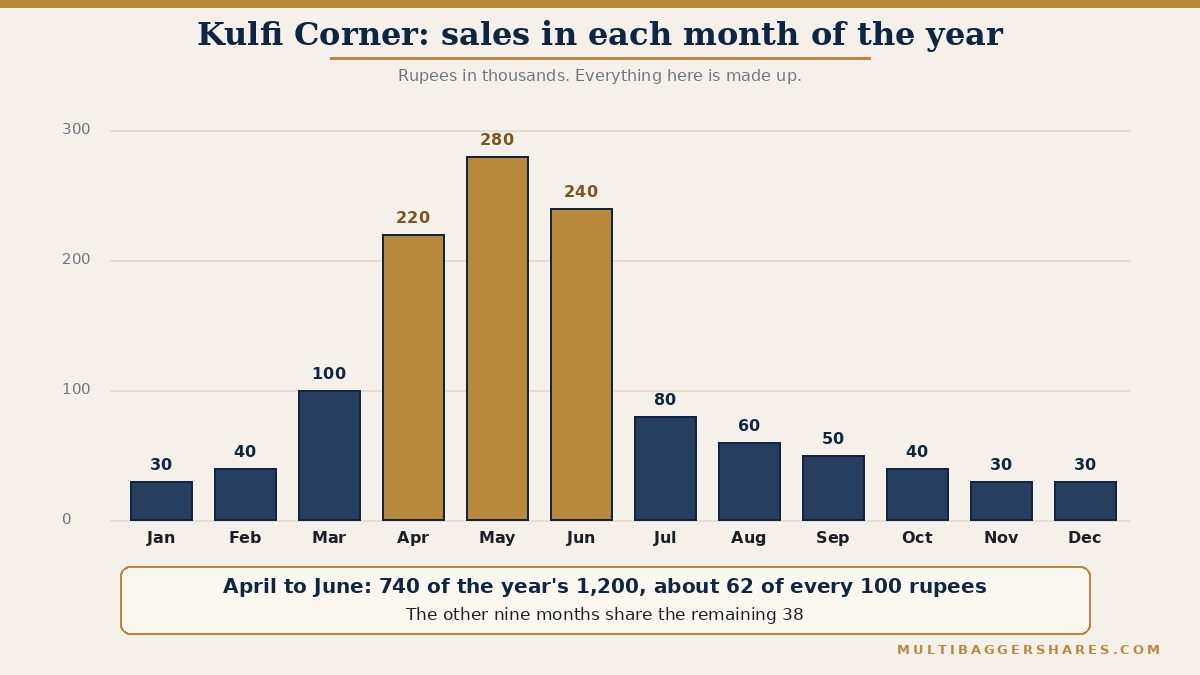
Let us give Kulfi Corner some numbers. Here are its sales for each month, in thousands of rupees: January 30, February 40, March 100, April 220, May 280, June 240, July 80, August 60, September 50, October 40, November 30 and December 30. Add them up and the year brings in 1,200 thousand, which is twelve lakh rupees (a lakh is one hundred thousand).
Look at the shape. April, May and June bring in 740 of the 1,200. That is about 62 of every 100 rupees, earned in one quarter of the year. The other nine months share the remaining 38.
Now the costs, because costs do not follow the seasons the way sales do. Ice cream has two kinds of cost. The first is variable cost (cost that rises and falls with every cone sold), such as milk, sugar and cones. Say it is 40 paise of every rupee of sales, so 60 paise is left. The second is fixed cost (cost that arrives every month whether anyone buys or not), such as rent, the freezer’s electricity and two workers’ wages. Say it is 45 thousand rupees a month.
So each month the shop keeps 60 percent of its sales and then pays 45 thousand. In May, 60 percent of 280 is 168, and after 45 is paid, 123 thousand is left as profit. In November, 60 percent of 30 is 18, and after 45 is paid, the shop is 27 thousand rupees short. The same shop, the same owner, the same quality of kulfi, and a very different month.
Now add the months up, quarter by quarter, in financial-year order. April to June: a profit of 309 thousand. July to September: a loss of 21 thousand. October to December: a loss of 75 thousand. January to March: a loss of 33 thousand. Put together, 309 less 21 less 75 less 33 leaves a profit of 180 thousand for the full year.
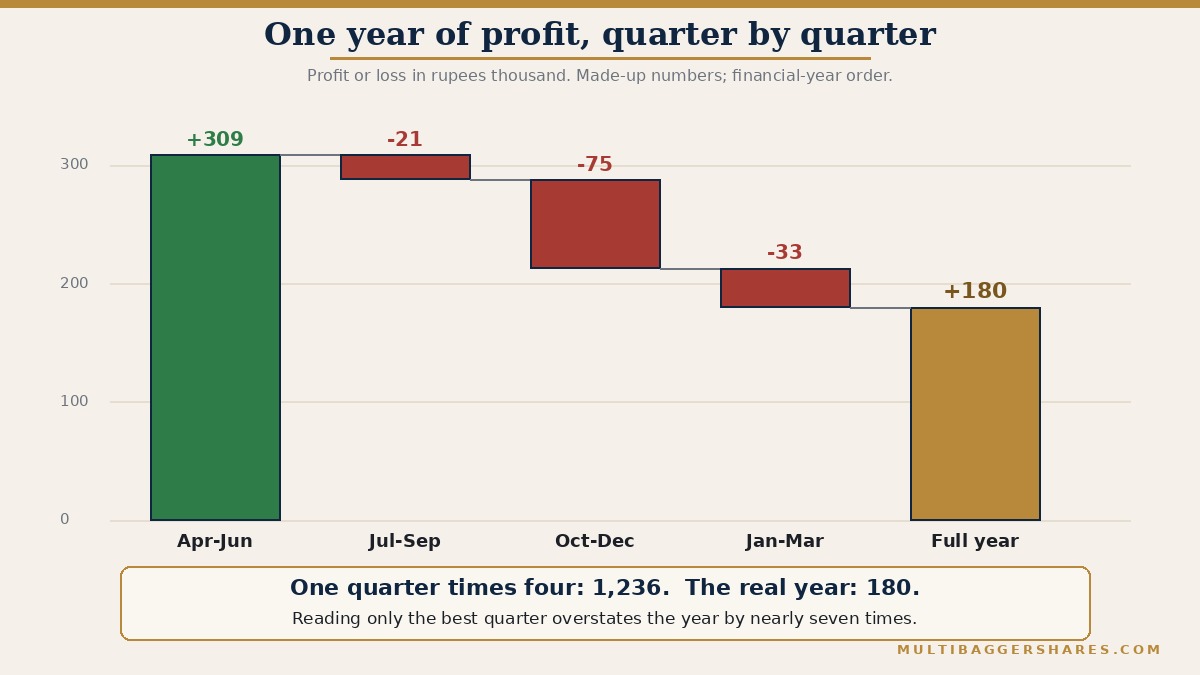
Now go back to our two visitors. The June visitor takes the 309 and multiplies it by four, imagining a yearly profit of 1,236 thousand. The real figure is 180. He is out by nearly seven times. The December visitor sees a loss of 75 and calls the shop a failure. In truth that quarter is just the quiet stretch which the summer profits were always meant to pay for.
A farmer in a village understands this without any arithmetic. He does not judge his year by the harvest week, when the house is full of grain. He does not judge it by the dry weeks before the next sowing, when the store looks half empty. He judges it by the full turn of the year. A seasonal business should be judged the same way: by the whole wheel, not by one spoke.
A small change shows how much hangs on the busy season. Suppose the summer is rainy and cool, and Kulfi Corner sells 20 percent less in April, May and June. That is 148 thousand less in sales, since 20 percent of 740 is 148. Over the whole year, that is only about 12 percent of the 1,200. But the fixed costs do not shrink, so the lost sales take away 60 percent of 148, which is about 89 thousand, straight from profit. The year’s profit falls from 180 to about 91. A dip of one in eight in sales has cut profit almost in half. This is why the busy season carries so much weight for a lumpy business, and why a single bad season can hurt more than the sales figures alone suggest.
There is a second thing that the full year shows, and it is easy to miss. It is cash. Before summer, Kulfi Corner must buy milk powder, cones and packaging, and maybe hire a second freezer, weeks before any customer pays. In the quiet months it must still pay the rent. A seasonal business therefore needs a cushion of cash, or a bank loan taken for a few months, to carry it from one season to the next. If the summer turns out weak, the cushion may not be enough. That is the real danger of a lumpy year, and it never shows up in a single good quarter.
Real examples
Warren Buffett, the American investor, wrote about this in his 1984 letter to the shareholders of Berkshire Hathaway, his company. He was describing See’s Candies, a maker of boxed chocolates that Berkshire owns. In the four weeks before Christmas, he said, See’s did about 40 percent of the year’s volume and earned about 75 percent of the year’s profits. The business also earned useful sums around Easter and Valentine’s Day, but for the rest of the year it pretty much trod water, in his words. More than twenty years later, Berkshire’s annual report for 2006 said that See’s revenues are highly seasonal, with about half of the year’s revenue earned in November and December.
In his 2007 letter, when he explained why See’s needed so little capital, Buffett added that only modest seasonal debt (borrowing taken for a few months and then repaid) was needed each year. Notice what that tells us. A chocolate maker whose year is this lumpy is still a business Buffett called a dream. The lumpiness was not the problem. Misreading the lumpiness would have been. Nobody sensible judges See’s by its January.
India offers its own example. A June 2015 report on the air-conditioner industry said that the April to June quarter brought in about 40 to 45 percent of the year’s AC sales, and that January to June brought in about 70 percent. The same report said that when summer arrived late and erratically that year, April sales fell by as much as 18 percent. So a late summer or an early monsoon does not just shave a little off one quarter. It can damage the whole year, because there is no second summer to make it up.
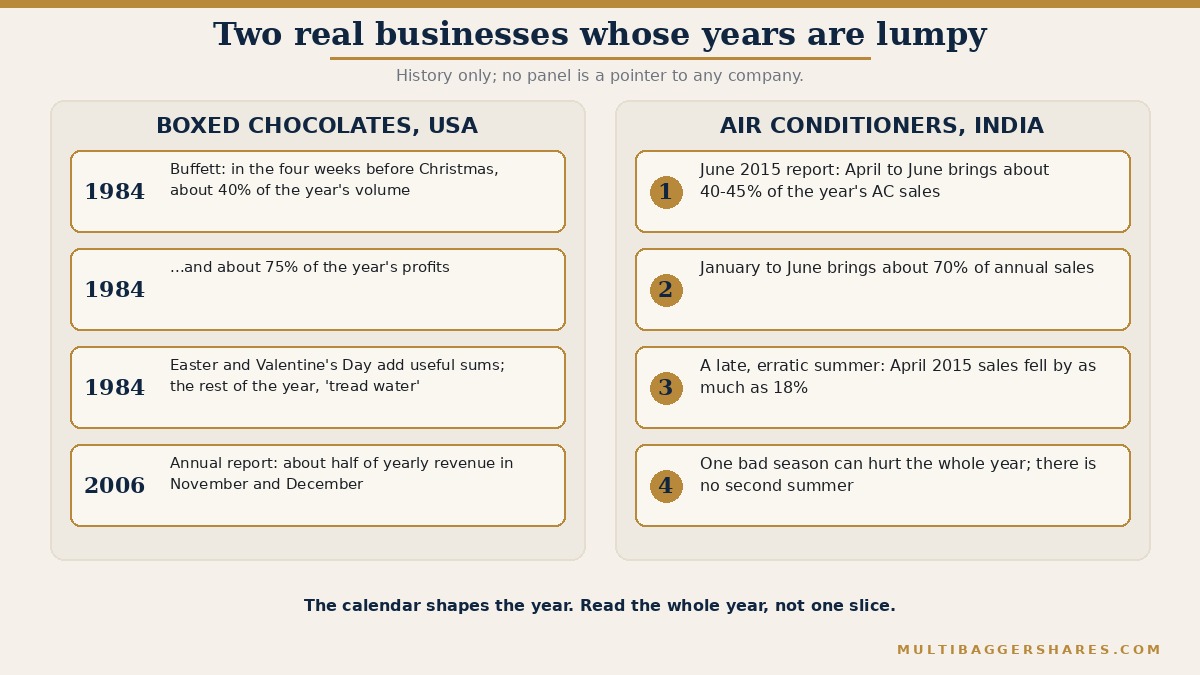
These are stories from history, told to show how a calendar can shape a business. They say nothing about whether any company is a good or poor one. A seasonal business can be wonderful or ordinary. The habit we are learning only stops us from misreading it.
How you can use it
First, ask a plain question about any business you study: when do its customers come? A shop of one kind has a calm, even year. A shop of another kind has one great season and several quiet ones. Knowing which one you are looking at changes how you should read every number that follows.
Second, compare like with like. If a seasonal business reports its April to June quarter, do not set it beside January to March. Set it beside April to June of last year. This is called a year-on-year comparison (this period against the same period a year earlier). Both periods share the same season, so the comparison is fair.
Third, add up the last four quarters. That gives you the full twelve months, with every busy and quiet stretch inside it. It is the nearest thing to the farmer’s view of his whole year. And never take one quarter and multiply it by four. Kulfi Corner shows how far wrong that sum can go.
Fourth, look at the quiet months with the same care as the busy ones. Does the business survive them? Does it borrow before the season and repay after it? If its borrowing is still high after the busy season has ended, that is worth a closer look.
A word on festivals, since so much of Indian business follows them. Diwali, Dussehra, Eid and the wedding months pull large amounts of buying into a few weeks. Gold, clothes, sweets, electronics and cars all feel it. Because the dates of some festivals move on the calendar from one year to the next, a quarter can look strong or weak simply because a festival slid in or out of it. This is one more reason to prefer twelve months over three.
Fifth, keep some humility about the weather and the calendar. Rain, heat and festival dates move from year to year, and one odd season proves little either way. Looking at several years side by side gives a steadier picture than any single summer or any single Diwali.
Key takeaways
Key takeaways
- A seasonal business earns most of its money in a few weeks or months, so one quarter on its own can mislead.
- Costs such as rent and wages keep coming through the quiet months, so a lumpy year is a test of cash as well as of sales.
- Never multiply one quarter by four. Compare the same quarter with the same quarter a year earlier, or add the last four quarters.
- See’s Candies and India’s air-conditioner industry show how a calendar can shape a whole business.
- The habit is about reading numbers fairly. It is not a judgement on any company or share.
— Manish Goel · multibaggershares.com
Manish Goel is a Chartered Accountant and Principal Officer of Multibagger Securities Research & Advisory Pvt. Ltd. (MSRAPL), a SEBI-registered Investment Adviser, Registration No. INA100007736. This content is published by MSRAPL for education only and is not personalized investment advice.
Disclaimer: This article is published by multibaggershares.com for education and general information only. It is not investment advice, investment research, or a recommendation to buy, sell or hold any security. Any companies named are discussed only as illustrative examples. Markets carry risk; please do your own research or consult a qualified professional before making any investment decision. |