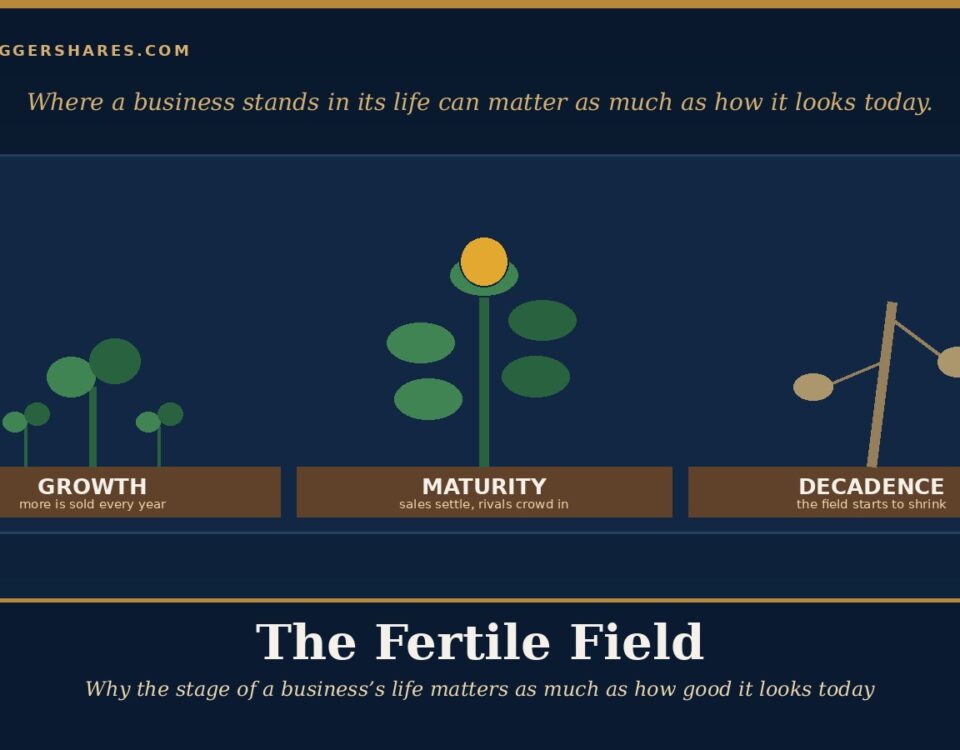
The Home-Town Advantage: Why a Business That Knows Its Own Streets Can Beat a Bigger Stranger

The Lamp-Oil Seller: Why It Matters Whether a Company Thinks It Sells a Product or Meets a Need
November 8, 2026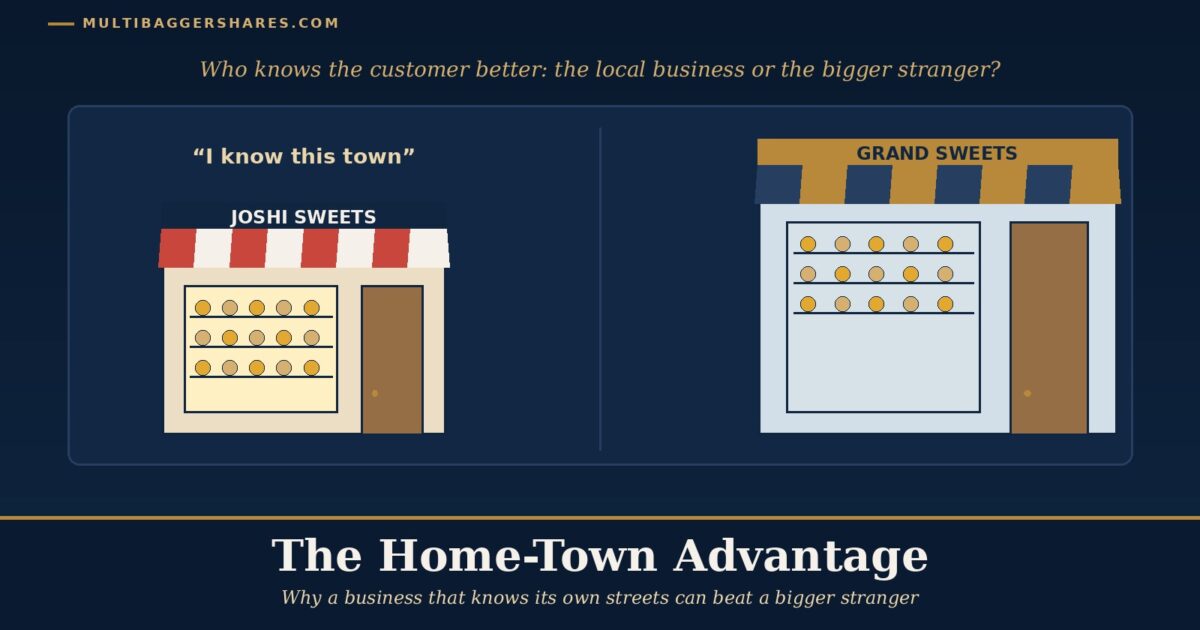
A big-city sweet chain, Grand Sweets, opens a shiny new shop in a small town of about 20,000 people. It has bright lights, a long glass counter, a printed menu of forty items and a large advertising budget. On the first day the queue reaches the pavement. Across the road, in a narrow lane, an old shop called Joshi Sweets watches the crowd with some worry.
Mr Joshi has no advertising budget. What he has is a notebook in his head. He knows the town likes its barfi a little less sweet than the city does. He knows that on Fridays the offices order boxes of 250 grams, that the week before Diwali (the festival of lights, when families gift sweets) is not the week to run short of kaju katli, and that the school gate rush ends by 1:30 in the afternoon. He knows which families pay at month end and which will pay tomorrow.
A year later, the shiny shop is quiet and the narrow shop is steady. Nothing magical has happened. One business knew the people it sold to. The other had to learn them from scratch, and learning is slow and costly. This lesson is about that quiet strength, often called the home-town advantage. It is a way of judging the quality of a business. It has nothing to do with the price of any share.
What it really means
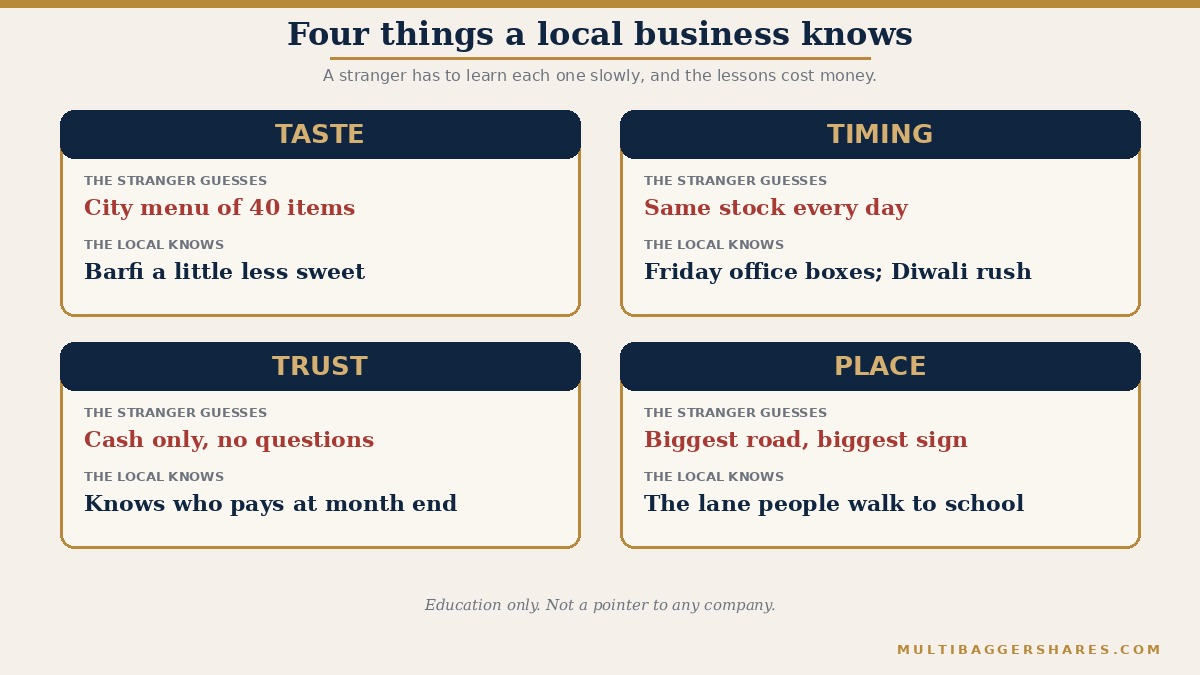
A business has a home-town advantage when it understands the people it sells to better than any newcomer can. That understanding is made of many small pieces. Let us group them into four: taste, timing, trust and place.
Taste is what people actually like, not what a head office thinks they should like. Timing is when they buy: which days, festivals and seasons bring the crowds. Trust is who knows whom, whom to lend to, and whose word is good. Place is where people walk, shop and gather. A local owner usually learns all four without trying, over many years, simply by living there.
Why can a stranger not simply copy this? Because most of it is never written down. It lives in the heads of the owner and his staff. A large company can hire clever people and send them to study the town, and sometimes it works. But the study takes time, and in the meantime the local shop is already serving customers. The knowledge gap is a head start, and a head start only matters if the race is long enough for it to count.
Be clear about what this idea is not. It does not say small beats big. It does not say that every local shop is good, or that an outsider must fail. Many outsiders succeed, and some do so by hiring locals and listening. The idea is narrower: where tastes, timing and trust differ from place to place, knowing them is worth real money, and it is hard for a newcomer to buy.
Why it works
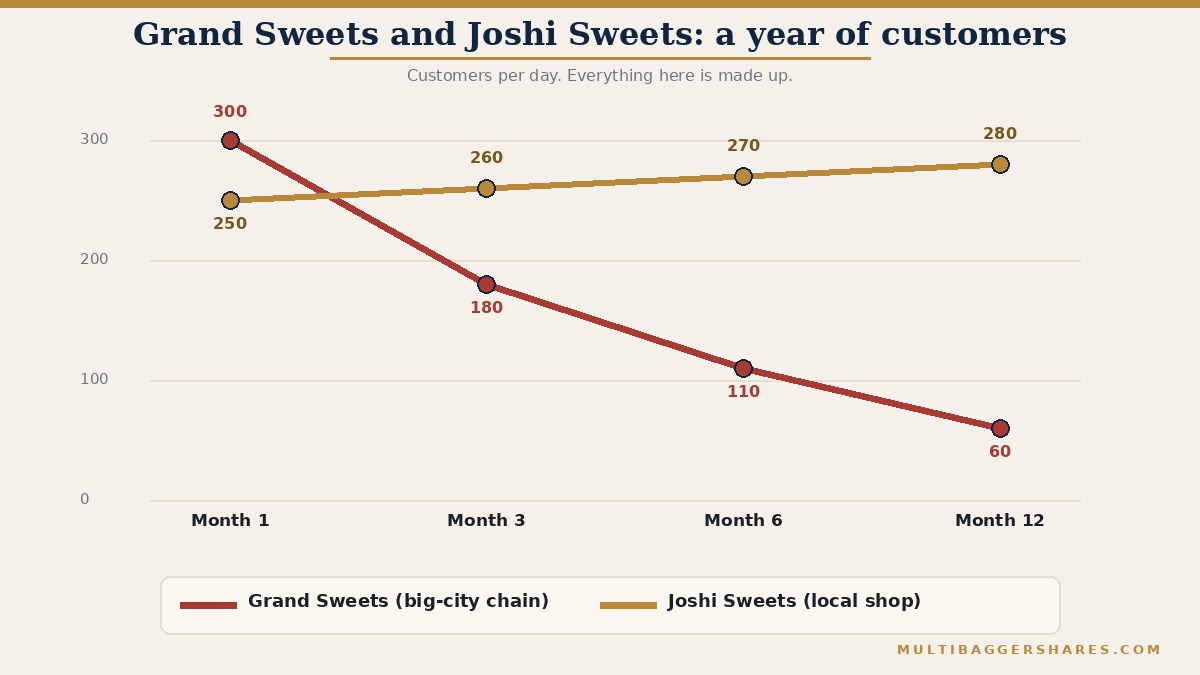
Let us put made-up numbers on the town. Everything here is invented to keep the sums clean. In the first month Grand Sweets serves about 300 customers a day, because it is new and curious people come to look. Joshi Sweets serves about 250. By month three, Grand has slipped to 180 a day and Joshi has edged up to 260. By month six, Grand is at 110 and Joshi at 270. By month twelve, Grand serves 60 customers a day and Joshi serves 280.
Why did the numbers move this way? Look at the shelves. Grand Sweets cooks from its city menu. About 30 of every 100 items it makes go unsold by evening, because the town does not want half of them, and they are thrown away. Joshi Sweets throws away about 5 of every 100, because he cooks what he knows will sell. Every unsold sweet is money spent on sugar, milk, gas and wages that never comes back.
There is a second cost that does not show on the shelf. The customer who does not find what he wants does not complain. He simply does not return. Grand Sweets sees fewer people each month and does not know exactly why. Joshi Sweets does not need to ask, because he already knows what the town wants. When a business cannot hear its customers, it pays for the silence slowly.
A simple picture may help. Think of a monsoon. A farmer who has lived in a village for forty years can read the sky, the soil and the neighbour’s field. A visiting expert may know more science, but he does not yet know this field. In the first season the farmer usually does better. Over many seasons, the expert may learn the field and catch up. The home-town advantage is that first-season edge, and the lesson is to ask how long it lasts.
Notice that Grand Sweets is not stupid. It is well run in the city. Its trouble is that it carried a method that worked in one place into a place where tastes were different. A company can be skilful and well funded and still lose ground, if the thing it is good at depends on knowing people it has not yet met.
There is also a reason that grows over time. A local shop that serves the town well earns trust, and trust brings repeat customers. Repeat customers tell their neighbours, which costs nothing. So the local business gets cheaper customers and better information at the same time, and each helps the other. For an investor, this matters because a business which keeps its customers cheaply tends to be a sturdier business.
A real example or two
Start with two large companies that learned this lesson in public. Walmart, the American retailer, entered Germany in 1997 by buying two local store chains, Wertkauf and Interspar. In July 2006 it agreed to sell its 85 German stores to a rival, Metro AG, and said it expected a pre-tax loss of about US$1 billion on the deal. Reports at the time pointed to several causes. German shoppers were very price-focused, and national discount chains matched Walmart’s prices on the same goods. Some of Walmart’s habits, such as staff who smiled and greeted at the door and packers who bagged groceries, did not fit local custom. And many of the stores it had bought stood in poor locations.
Be careful not to read too much into the smiling staff. One careful account argued that these culture gaps got the headlines, but that price competition and store locations mattered more. That is still a home-town story. Prices, places and habits are exactly the things a local business learns by living in them.
A second example comes from next door. The American retailer Target opened its first stores in Canada in March 2013. In January 2015 it announced that all 133 of its Canadian stores would close, with more than 17,000 jobs affected, after losses reported at about US$2 billion. Reports at the time cited empty shelves caused by supply problems, and shoppers who found prices higher than in Target’s American stores. We cannot say that a missing home-town advantage was the only cause, and it would be wrong to claim so. But a company that cannot keep the right goods on the right shelf at the right price in a new country is missing exactly the knowledge we have been describing.
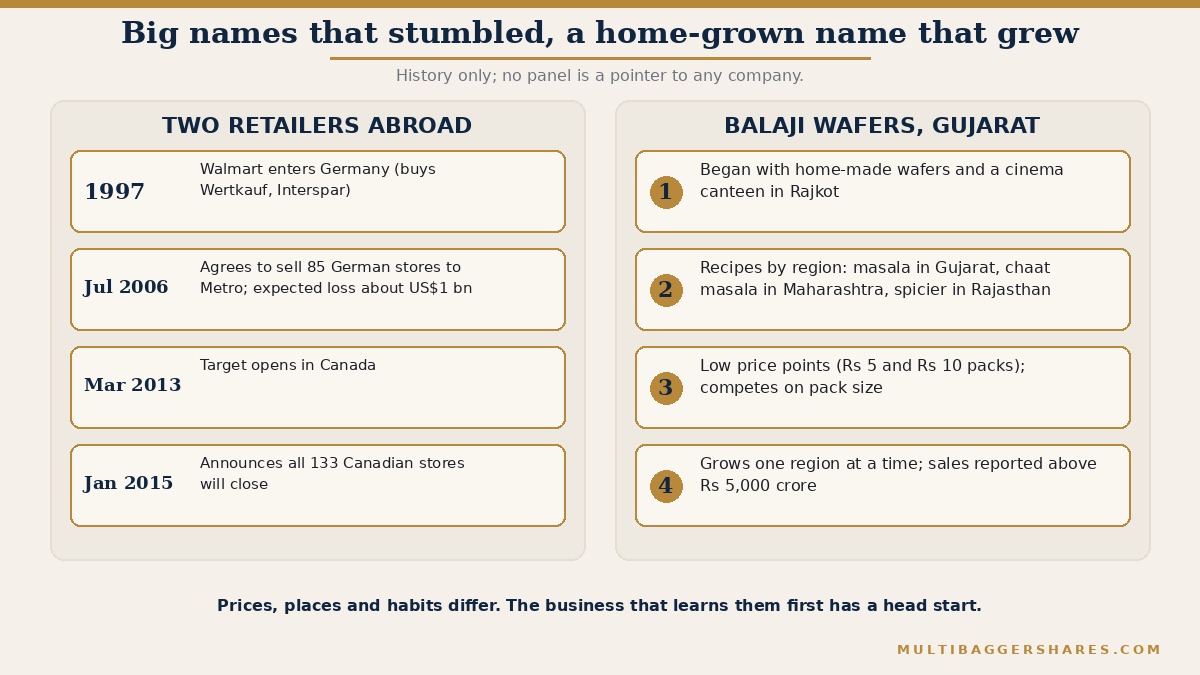
Now a story from India that runs the other way. Balaji Wafers began in Gujarat with home-made wafers and a cinema canteen in Rajkot. The founder, Chandubhai Virani, built the business around the local customer. Reports say Balaji adjusts its recipes by region: masala wafers in Gujarat, chaat masala flavours in Maharashtra, and spicier snacks in Rajasthan. It kept low price points, with packs at Rs 5 and Rs 10, and competed on how much was inside the pack. It reaches shops through a network of dealers, and by one report spends only 2 to 4 per cent of its sales on advertising, against 8 to 12 per cent for some larger rivals.
Notice also how it grew: one region at a time, starting in Gujarat and then moving to nearby states. That is the home-town advantage being stretched carefully, like a rubber band, rather than snapped. Sales are reported to be above Rs 5,000 crore. Balaji is a private company, and we are not saying anything about its worth or about any share. It is simply a clear example of a business that grew by learning each place before it moved to the next.
How you can use it
The first use is to ask where the business sells and how different those places are. A company selling cement, salt or electricity meters sells the same thing everywhere. A company selling snacks, clothes, sweets, jewellery or food depends heavily on local taste. The more the customers differ from place to place, the more the home-town advantage counts.
The second use is to look at how the company grows. Does it open in one region, learn it, and then move on? Or does it open everywhere at once with one fixed menu? Slow, region-by-region growth is often a sign of a management that respects what it does not yet know. Read the annual report (the yearly document a company publishes about its work and accounts) and see how the company describes its expansion.
Here is a small test you can try on any business. Finish the sentence, “If a big stranger opened next door tomorrow, our customers would stay because…” If the honest ending is “we are cheaper,” that is weak, because the stranger can cut prices. If the ending is “we know what they want, when they want it and whom they can trust,” that is stronger, because the stranger has to learn it slowly.
The third use is to watch the company when it is the stranger. When a local winner enters a new region, it loses its home-town advantage and meets the same problems Grand Sweets met. Look at what happened the last time it entered a new area. Did it adjust the product? Did it hire local people? Or did it copy its home formula and hope? How a company behaved at its last new entry is often better evidence than any promise about the next one.
The fourth use is to be fair to the idea. It has limits. Scale can win too: a large company with strong buying power, a trusted brand and patient money can learn a new place faster than a small shop can grow. Technology can also shrink the gap, because online shopping lets a stranger see what a town buys without living there. And a local business that is badly run is still badly run. Use the home-town advantage as a question to ask, not as a promise to rely on.
So think once more of the two sweet shops. Same town, same customers, same festivals. One shop had a long glass counter and a menu from far away. The other had a notebook in the owner’s head. When you study a business, ask who knows the customer better, how long that knowledge takes to copy, and what the company does when it becomes the stranger.
Key takeaways
- A business has a home-town advantage when it knows its customers’ taste, timing, trust and place better than any newcomer can.
- Much of this knowledge is never written down, so a stranger has to learn it slowly and at a cost, through unsold goods and customers who quietly do not return.
- In the made-up town, the chain fell from 300 to 60 customers a day over a year, while the local shop moved from 250 to 280.
- Real stories point the same way, in history only: Walmart in Germany and Target in Canada stumbled, while Balaji Wafers grew by adjusting to each region and entering one region at a time.
- The idea has limits. Scale, strong brands and technology can narrow the gap, so treat it as a question to ask, not as a prediction.
— Manish Goel · multibaggershares.com
Manish Goel is a Chartered Accountant and Principal Officer of Multibagger Securities Research & Advisory Pvt. Ltd. (MSRAPL), a SEBI-registered Investment Adviser, Registration No. INA100007736. This content is published by MSRAPL for education only and is not personalized investment advice.
Disclaimer: This article is published by multibaggershares.com for education and general information only. It is not investment advice, investment research, or a recommendation to buy, sell or hold any security. Any companies named are discussed only as illustrative examples. Markets carry risk; please do your own research or consult a qualified professional before making any investment decision. |