The Rabbit’s Advantage: Why Being Small Can Help an Investor, and Where the Help Ends

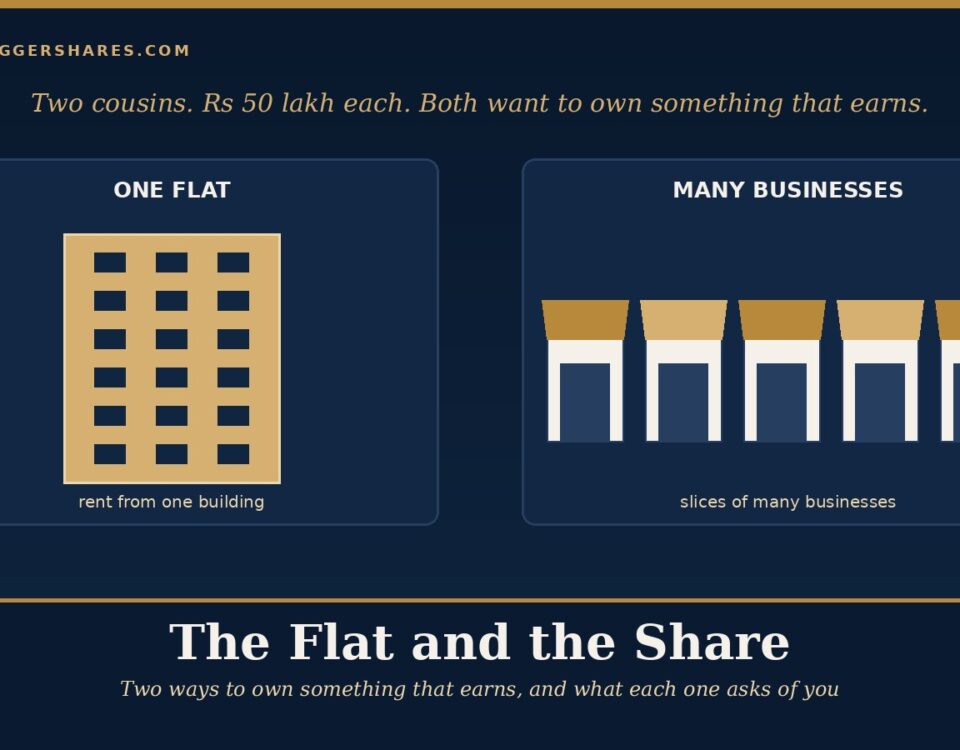
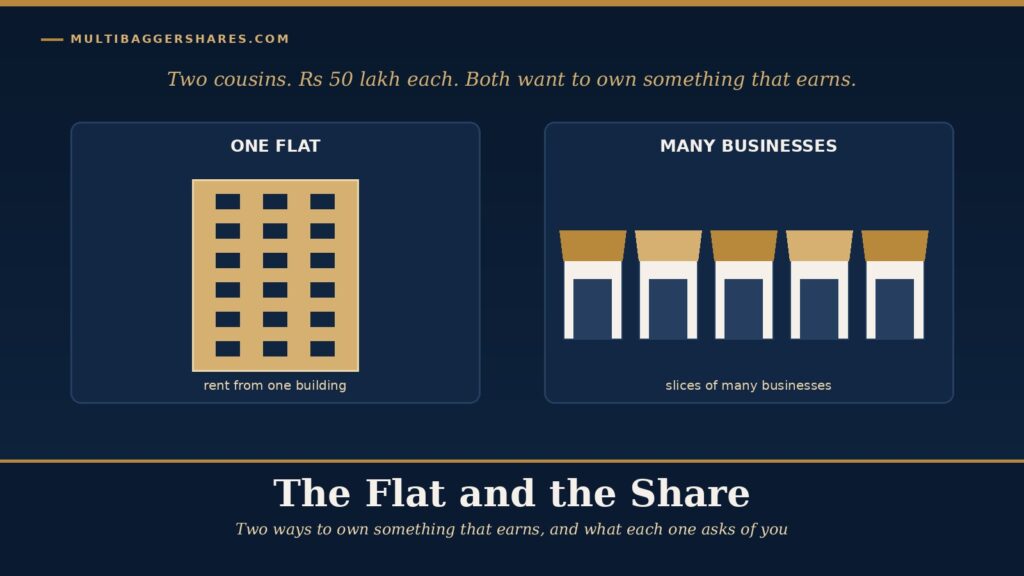
The Flat and the Share: Two Ways to Own Something That Earns, and What Each One Asks of You
November 5, 2026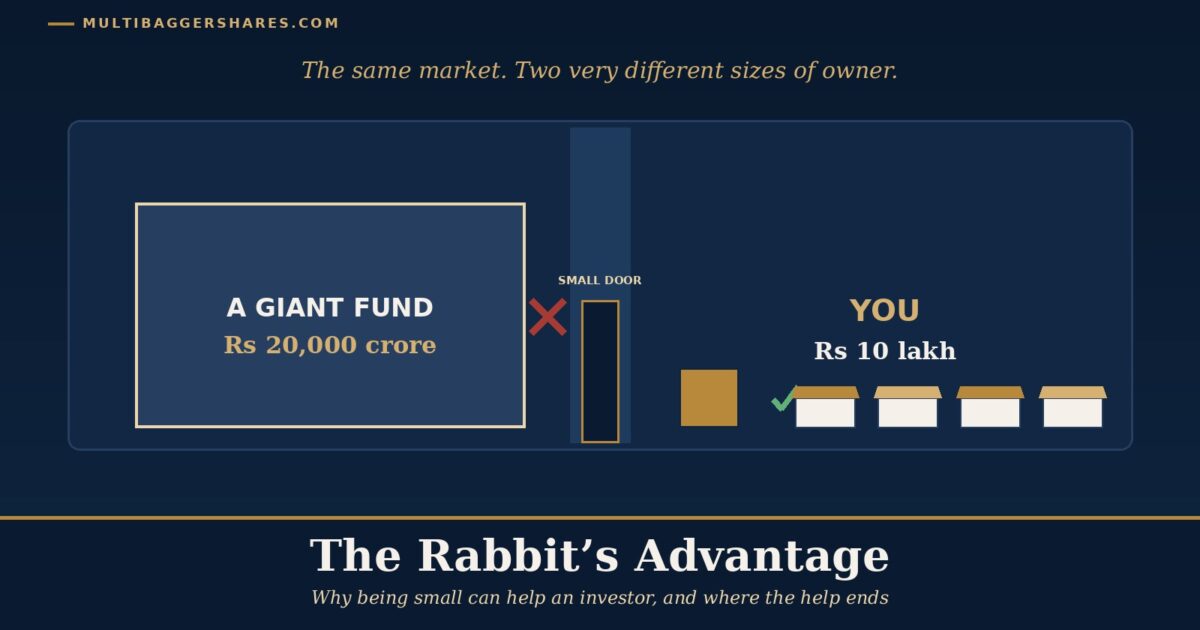
Imagine two shoppers at the same vegetable mandi (the wholesale market where traders and families buy fresh produce) early one morning. The first is the buyer for a chain of two hundred restaurant kitchens. The second is a mother buying vegetables for a family of four. Both want the best tomatoes of the day. Who has the easier job?
The chain buyer has money, a team and a truck. But she needs tonnes of tomatoes, so she can only deal with the big sellers who have tonnes to sell. The best tomatoes of the morning may sit in one small farmer’s single crate. She cannot stop for that crate. It is far too small to matter to her order. The mother can. She walks along the stalls, presses a few tomatoes, finds the ripest crate, and buys two kilos. Size gave the buyer power. It also took away a choice.
Investing has the same pattern. Most of us think of being a small investor as a weakness, and in some ways it is. This lesson looks at the other side. What does being small actually let you do, which things stay closed to the giants, and where does the advantage stop? It is not a lesson saying that small companies are better. It is about what you, as a small owner, are free to do.
What it really means
Start with who the giants are. A mutual fund (a pool of many people’s savings, run by professional managers) can look after a very large sum. The total money it looks after is called its assets under management, or AUM for short. Say a fund has Rs 20,000 crore. That is a made-up figure, chosen to keep the sums clean. A manager with that much money has one big problem: every idea has to be big enough to matter.
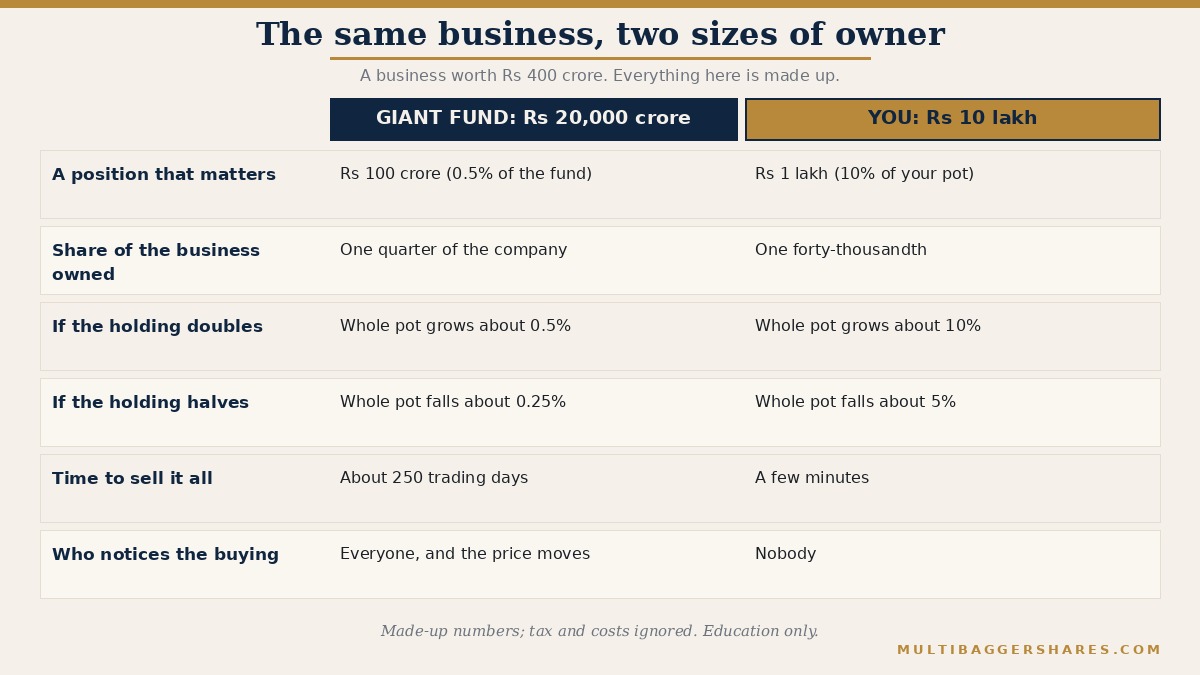
Why? Suppose the manager finds an excellent small business and puts only 0.5% of the fund into it. That sounds careful. But 0.5% of Rs 20,000 crore is Rs 100 crore. If the business is worth Rs 400 crore in total on the stock market, the fund would then own a quarter of it. Buying that much would push the share price up as the fund bought. Selling it later would be just as hard. So for a fund of this size, a business of this size is effectively closed. It is like the farmer’s single crate.
Think of a cargo ship and a small boat. The cargo ship carries far more and is a wonder of its kind, but it cannot enter the narrow canal where the small boat slips through. Neither is better. Each goes where it fits. A giant fund is the cargo ship of the market. You are the small boat, and a good part of the coastline is open only to you.
Now look at it from your side. Say you have Rs 10 lakh to invest in total, and you put Rs 1 lakh into the same business. You then own one forty-thousandth of it. Nobody notices you buy. Nobody notices you sell. The price does not move because of you. The same door that is shut for the fund is wide open for you.
This is what Warren Buffett meant when he spoke about the advantage of small sums. BusinessWeek quoted him in 1999 saying that it is a huge structural advantage not to have a lot of money, and the line was still being discussed when he took questions from university students in 2005. He was talking about his own early years, when he ran small amounts and could put money into the best ideas he could find. He did not say that every small investor will do well. He said that small money has a freedom that large money loses.
Why it works
The freedom comes in three parts. The first is room. When your pot is small, a single good idea can matter to you. Take the same Rs 1 lakh position, which is 10% of your Rs 10 lakh. Say the business it holds later doubles in value. We are not forecasting that, only using it to do the sum. Your Rs 1 lakh becomes Rs 2 lakh, and your whole pot grows by 10%. For the fund, a Rs 100 crore position doubling adds Rs 100 crore to a pot of Rs 20,000 crore. That is only 0.5%. The same event moves your pot twenty times as much.
This is what professionals call moving the needle (making a difference to the total result). A big fund needs ideas that can move its needle, so it must look at bigger businesses. A small saver’s needle moves with almost any idea, so a far larger part of the market is open to you. Open does not mean good. It only means you are allowed to look.
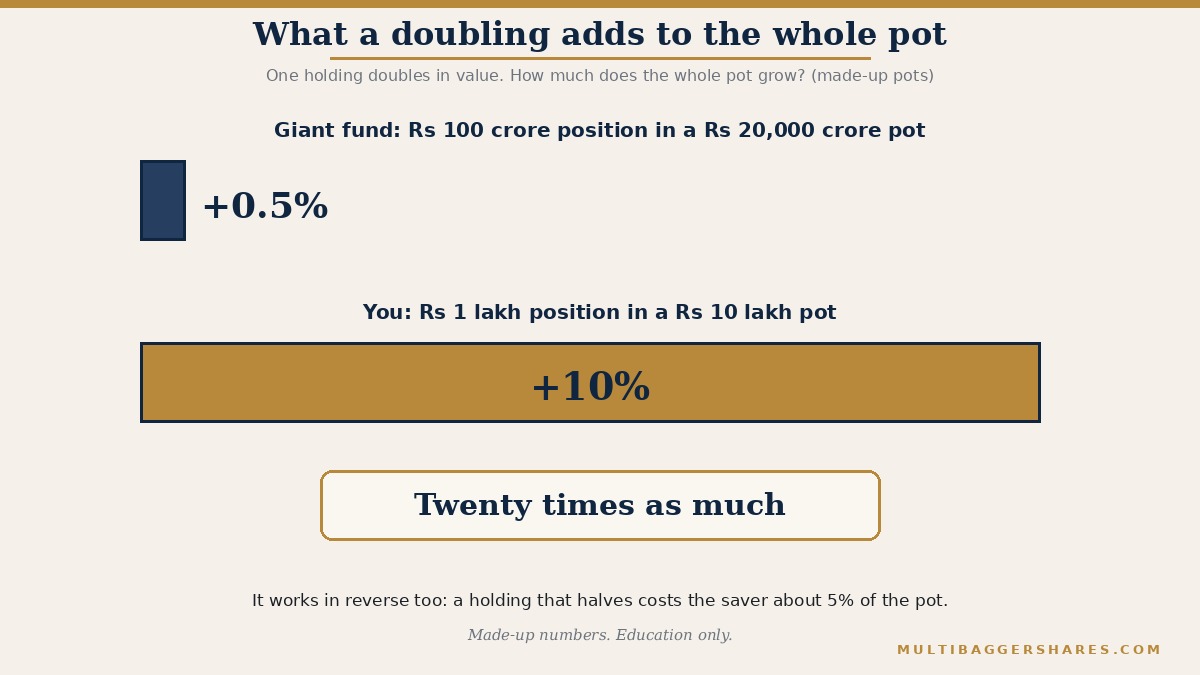
The needle moves both ways, though, and this matters. If a Rs 1 lakh holding falls by half, your pot of Rs 10 lakh falls by 5%. If you had put Rs 4 lakh in it, the same fall would cost you 20%. Room is a freedom to look at more things. It is not a reason to put too much into any one of them. Because a small saver can concentrate, a small saver can also be hurt by concentrating.
The second part is the exit. Here a fund’s problem is just as large on the way out. Say the business trades about Rs 2 crore of shares on an ordinary day, and the fund holds Rs 100 crore of it. If the fund sold a fifth of the day’s trading, which is about Rs 40 lakh a day so as not to crush the price, it would need about 250 trading days, most of a year, to leave completely. You can sell Rs 1 lakh in a few minutes, and no one would notice. We looked at this problem in an earlier lesson on how easily a share can be sold. A fund has to think about it for every holding. You have to think about it only for the very thinnest ones.
The third part is time. A fund manager is judged often. Clients see monthly reports. Newspapers compare the fund with others every quarter. If the fund has a poor year, some investors may withdraw their money, and the manager may then have to sell good holdings at a bad moment to pay them. That pressure shapes behaviour. It is hard to hold a business that looks dull for three years when you are being compared every three months.
You face none of that. Nobody sends you a ranking on Monday. If you own a sound business and it does little for two years, you can simply keep owning it. You are also free to hold very little in the market, or even to do nothing for a long while, if you cannot find something you understand. A fund that is supposed to be invested is often not allowed that choice. This is the same freedom that lets a patient batsman wait for the ball he likes, as we saw in the lesson on the fat pitch.
A real example or two
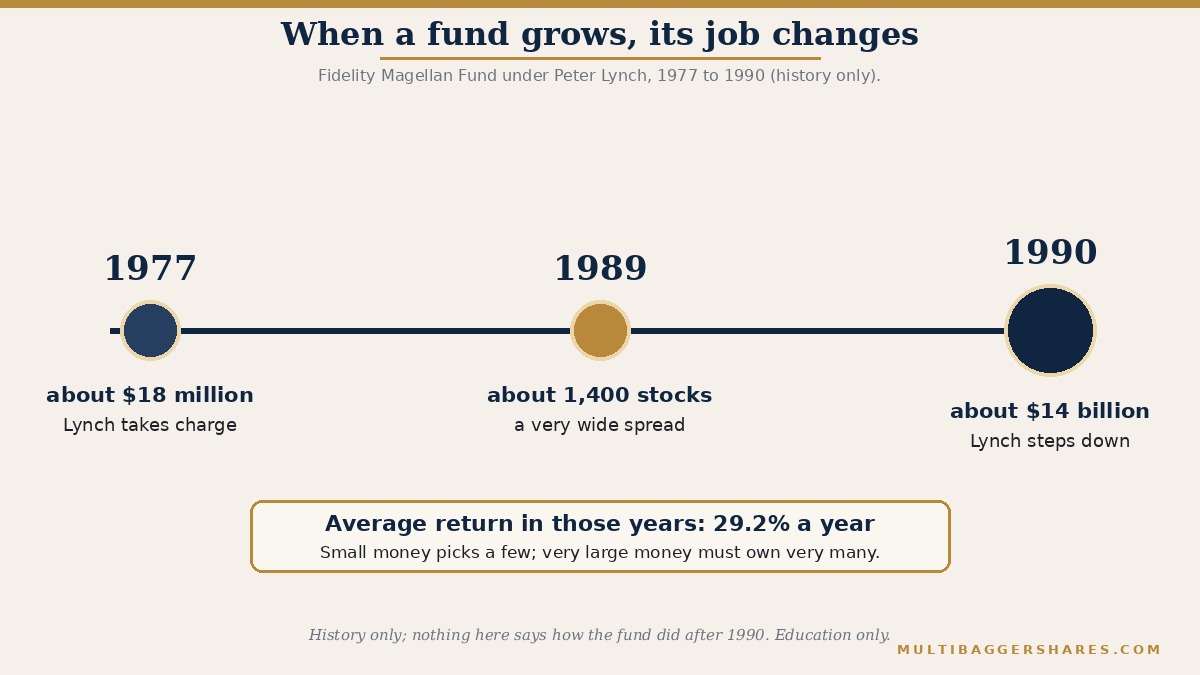
A famous example from history is the Fidelity Magellan Fund in America. According to its record, when Peter Lynch took charge in 1977 it held about $18 million. When he left in 1990 it held about $14 billion. Over those years the fund earned an average of 29.2% a year. By 1989 it owned about 1,400 different stocks. Look at what that tells us about size, without judging the fund. A fund of $18 million can own a handful of ideas it loves. A fund of $14 billion must own a great many things to put all its money to work. Its job had changed from picking a few to spreading across very many. We say nothing here about how the fund did after 1990.
India gives a more recent example. In July 2023 Nippon India Mutual Fund stopped taking fresh lump-sum investments into its Small Cap Fund. An analyst quoted by Business Today put the size of that scheme at well over Rs 30,000 crore. In March 2024, as reported by Business Standard, Franklin Templeton capped one-time investments in its Smaller Companies Fund at Rs 2 lakh a month, and several other fund houses also set limits on their small-cap schemes. The reasons given were to manage liquidity risk and to put money to work gradually, at a time when the regulator had voiced concern about a very hot small-company market.
Read that carefully. Professional fund managers, with large teams and good research, chose to turn money away. They did so because the money they already had was becoming hard to use well in small businesses. In plain words, they were telling their own customers that their size had become a problem. Details of these limits change over time, and this is history, not a pointer to any fund.
How you can use it
The first use is to remember that you do not need to copy a big fund. A fund must own many names, buy in bulk, and look at bigger companies. You may not have to. Many careful individual investors hold a modest number of businesses that they understand well, so that each one matters to them. There is no magic number. The point is that you are allowed to run your portfolio differently, and that different does not mean worse.
The second use is to check the door before you walk in. Your small size helps only if you can leave comfortably. Before buying any share, look at how much of it trades on an ordinary day. If your order is a tiny part of that, you can enter and exit quietly. If you would be a large part of a day’s trading, you have lost the very advantage we are discussing, because you would be the one pushing the price.
The third use is to spend your time freedom wisely. Without a quarterly report card, you can hold a sound business through a dull stretch. But the freedom works only if you use it. If you check prices every hour, sell at the first fall and chase whatever is rising, you behave like the worst version of a fund manager under pressure, without the research team. The advantage is quiet. It belongs to the investor who waits.
A short list of questions can keep you on the right side of all this. Do I understand how this business earns its money? Can I enter and leave quietly, given how much it trades? Could I hold it for years without checking the price every day? How much would my whole pot fall if this one holding halved? And am I here because the business is good, or only because it is small and I am allowed to buy it? If you cannot answer the last question honestly, the size has become a reason to buy, and that is a bad reason.
Now be honest about the other side. Big funds have things you do not. They have teams of analysts, they can meet company managements, and they can negotiate and buy at scale. Small companies, which are the ones open to you, have their own dangers. They often share less information. They can fail more easily when business turns bad. Their prices can swing wildly. Room to look is not the same as skill in choosing. A small investor who buys a business he does not understand has gained nothing from being small.
So think of your size as a doorway, not a prize. It opens up more of the market to you and lets you move without noise. What you do inside, how well you understand the business, how patient you are, and how you size each holding, decides the result. The quality of the business still matters far more than the size of the investor.
This article is for education only. The fund, the saver, the business, the market value, the daily trading and all the rupee sums in the examples are made up, and the sums ignore tax and costs. The Magellan, Nippon India and Franklin Templeton details are history described from the sources named. Nothing here is a forecast or a suggestion to buy or sell any security, fund or scheme.
Key takeaways
- A very large fund needs every idea to be big enough to matter. In the made-up example, 0.5% of Rs 20,000 crore would mean owning a quarter of a Rs 400 crore business, so that business is effectively closed to it.
- A small pot gives you room. The same doubling adds about 10% to a Rs 10 lakh pot when the holding is Rs 1 lakh, but only about 0.5% to a giant fund, which is twenty times less.
- Size also changes the exit. A fund holding Rs 100 crore could take most of a year to sell, while you can sell Rs 1 lakh in minutes. Check how much a share trades before you buy it.
- You are free of quarterly rankings and withdrawals, so you can hold a sound business through a dull stretch. That freedom is only worth something if you use it with patience.
- Being small is a doorway, not a skill. Big funds have research teams, and small companies carry their own risks. Understanding the business and sizing each holding sensibly matter more than size.
— Manish Goel · multibaggershares.com
Manish Goel is a Chartered Accountant and Principal Officer of Multibagger Securities Research & Advisory Pvt. Ltd. (MSRAPL), a SEBI-registered Investment Adviser, Registration No. INA100007736. This content is published by MSRAPL for education only and is not personalized investment advice.
Disclaimer: This article is published by multibaggershares.com for education and general information only. It is not investment advice, investment research, or a recommendation to buy, sell or hold any security. Any companies named are discussed only as illustrative examples. Markets carry risk; please do your own research or consult a qualified professional before making any investment decision. |