The Flat and the Share: Two Ways to Own Something That Earns, and What Each One Asks of You

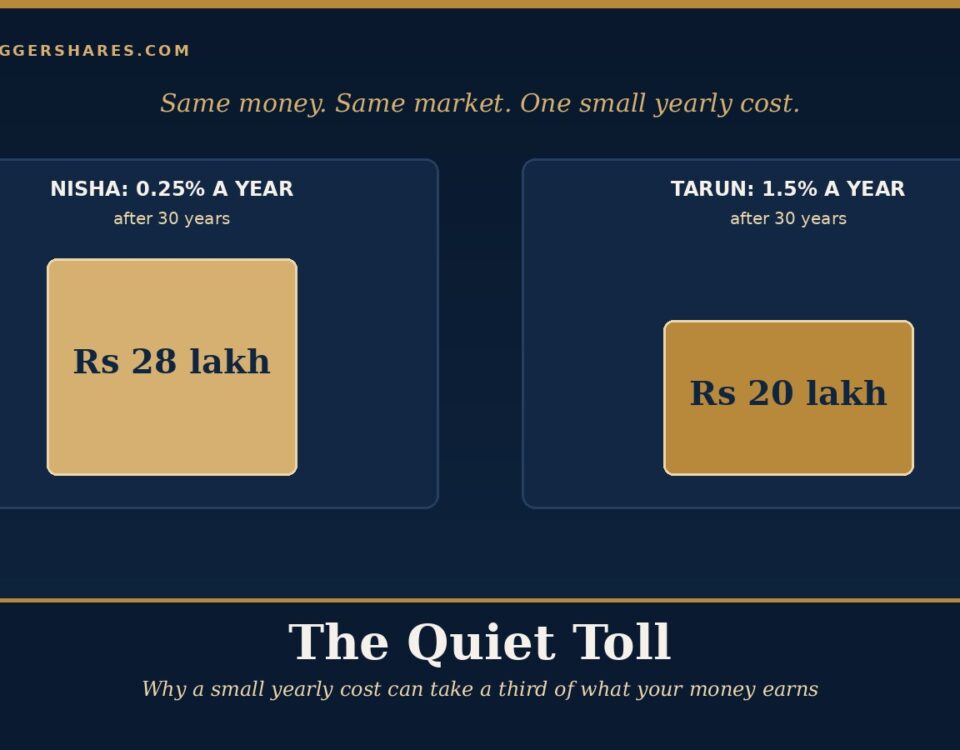
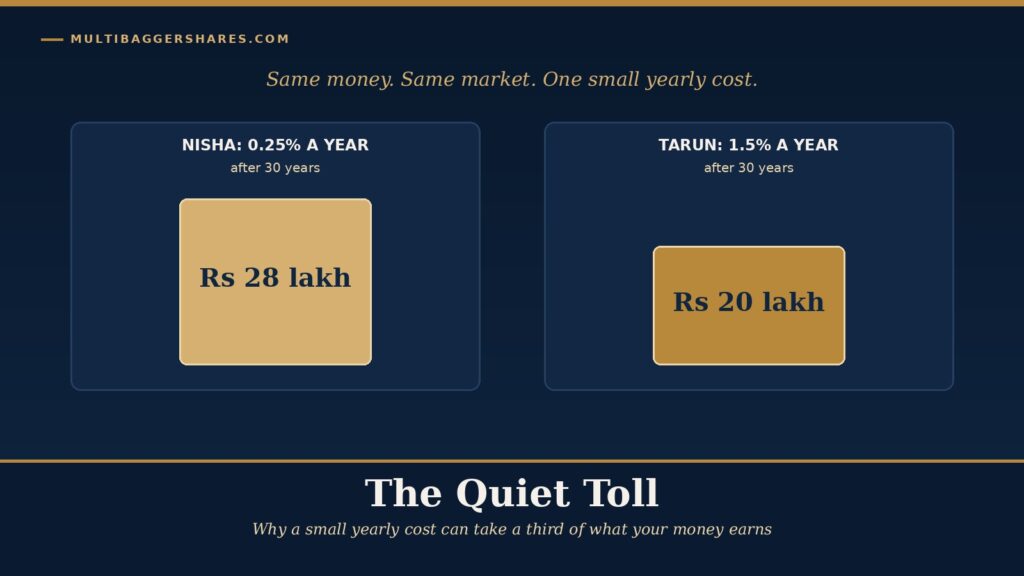
The Quiet Toll: Why a Small Yearly Cost Can Take a Third of What Your Money Earns
November 4, 2026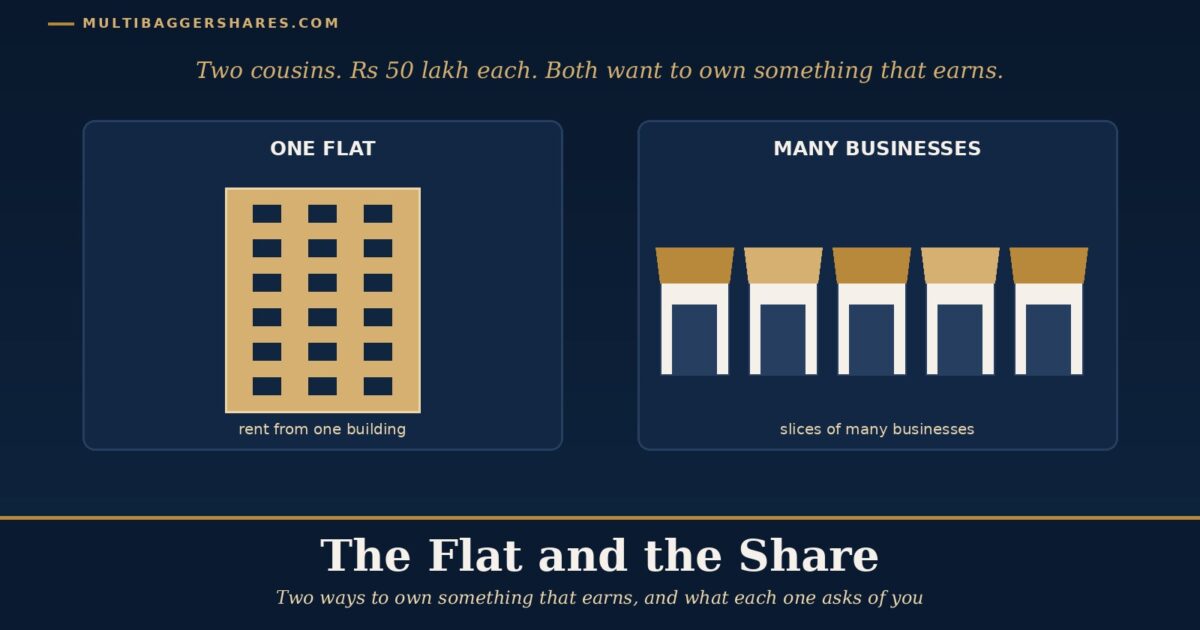
Meera and Rohan are cousins. Each has saved Rs 50 lakh, and each wants the money to earn something over the years. At the family dinner, the advice comes quickly. “Buy a flat,” says an uncle. “Property never goes out of style. You can see it, touch it, and the rent comes every month.” Another relative shakes his head. “Shares are the way. A flat is one building. A share is a slice of a business that can grow.”
Meera listens to the first uncle and buys a flat. Rohan listens to the second and puts his money into small slices of many businesses. Both are trying to do the same thing: own something that earns. Yet the two choices ask very different things of their owners. This lesson does not say which cousin chose better. It gives you six plain questions that help you see what any income-earning asset asks of you, whether it is a flat, a shop, or a slice of a company. Once you can ask them, you can look at almost anything you might own with clearer eyes.
What it really means
Start with what both cousins now own. Each owns an income-producing asset (a thing that pays its owner money over time, rather than just sitting there). Meera’s flat pays rent. Rohan’s slices of businesses pay him through the profits those businesses earn and keep or share. This is the first thing to notice. A flat and a share are not opposites. They are cousins too, in a way. Each is a claim on something that earns.
In India, the first of these has long been the family favourite. A 2017 Business Today report, citing the All India Debt and Investment Survey, put the average household’s assets at about 84% in real estate and other physical things, about 11% in gold, and only about 5% in financial assets. That is older data, and habits are changing. But it shows how deeply the idea of “a flat of my own” runs in Indian families. It also shows why it is worth looking at the flat honestly, with the same questions we would use for anything else.
A share, in plain words, is a small ownership slice of a company (the business that makes or sells things). If you own a share of a tea company, you own a very small part of its factories, brands, cash and future profits. You do not run it. The managers do. Your job as an owner is to pick businesses carefully and hold them patiently. A flat works the other way round. You own the whole building unit, but only one unit, in one lane, in one city.
Think of a kirana shop in your neighbourhood. One person owns the shop building and collects rent. Another person runs the shop inside it. The owner of the building is like Meera. The owner of the shop business is closer to Rohan. Both can do well. But they are exposed to different things, and they get different kinds of help from time. Keep that picture in mind.
Why it works
The six questions are simple. What does it earn? What does it cost to get in and to keep? What happens when the income stops? Who can make it grow? How much of my money sits in this one thing? And how easily can I leave? Let us walk Meera and Rohan through them, using made-up numbers.
The first question is what it earns. Rental yield (a year’s rent shown as a share of the flat’s price) is the usual yardstick for flats. ANAROCK, a property consultancy, reported that in the second quarter of 2026 the rental yields in India’s big cities ranged from about 3.2% in Delhi to about 4.6% in Bengaluru, as reported by Business Today on 4 August 2026. Say Meera’s flat earns 3.5%. On a Rs 50 lakh flat, that is Rs 1.75 lakh a year, or about Rs 14,600 a month.
The second question is what it costs. Here the flat has a cost many people forget. When you buy property you pay stamp duty (a tax paid to the state government when property changes hands) and registration charges (the fee to record the sale officially). A property guide by Square Yards puts the two together at roughly 5% to 9% of the price, depending on the state and the buyer. Say Meera pays 6%. That is Rs 3 lakh, so she has spent Rs 53 lakh to own a Rs 50 lakh flat. Every year there are also costs that the tenant does not pay: property tax, repairs, and the odd month when the flat is empty. Say these come to Rs 25,000. Her Rs 1.75 lakh of rent becomes Rs 1.5 lakh, which is about 2.8% of the Rs 53 lakh she put in.
Rohan’s costs look different. Buying slices of listed businesses (companies whose shares trade on a stock exchange) has small costs for brokerage and taxes on each trade, and he pays them only when he trades. He can start with far less than Rs 50 lakh, even Rs 5,000. Nobody needs to inspect a building or sign a stack of papers. This is one reason ordinary savers find shares easier to start. It is not a reason to rush. Easy to start is not the same as easy to do well.
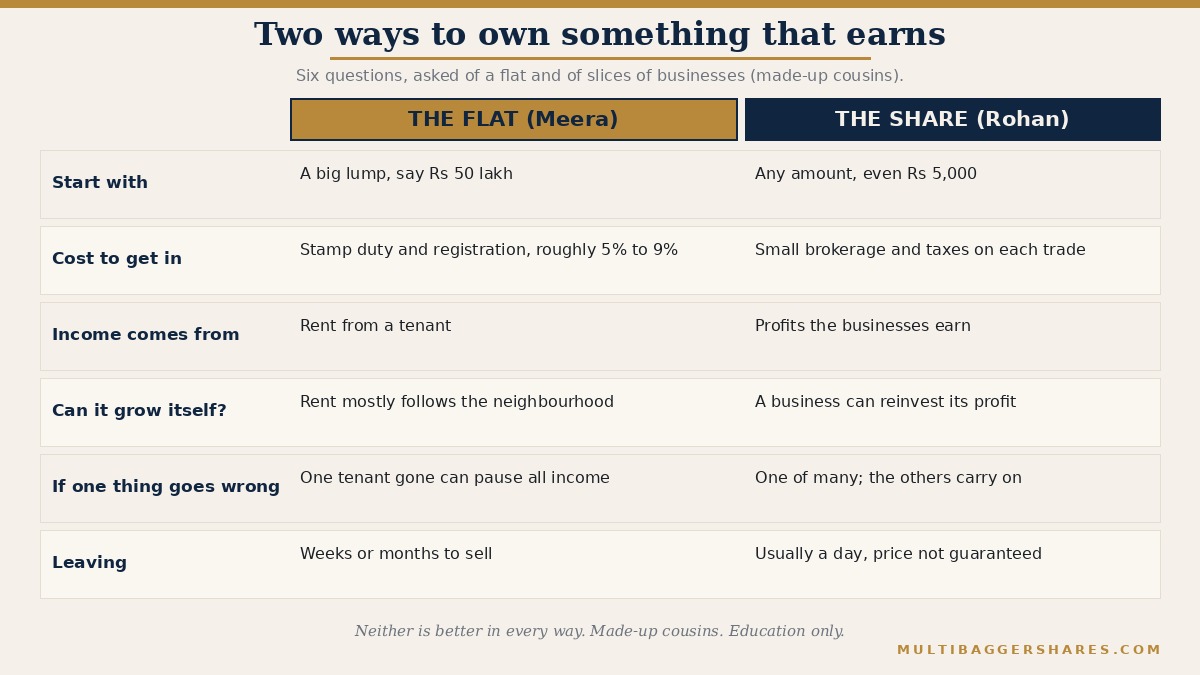
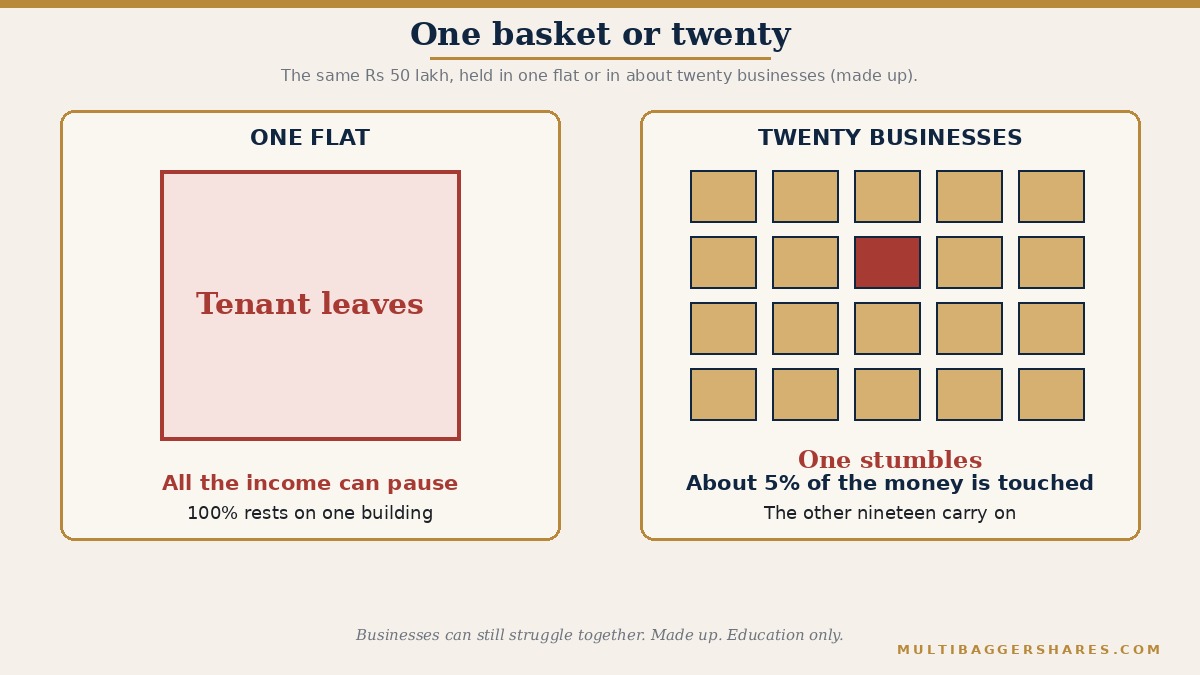
The third question is what happens when the income stops. This is where the two choices part ways most. Meera’s tenant moves out and the flat sits empty for six months. Half the year’s rent is gone, and her costs carry on. Her whole income came from one building, one lane and one tenant. Concentration (having a large part of your money in one thing) is the right word for this.
Rohan spreads his Rs 50 lakh across, say, twenty businesses. Diversification (spreading money across many different things so that one failure does not sink you) means that if one business has a terrible year, it touches only about one-twentieth of his money, or 5%. The other nineteen carry on. He has not removed risk, because all businesses can have a bad stretch together. But he has made sure no single event can stop all of his income.
The fourth question is who can make it grow. A flat is a fixed thing. It does not add a second floor on its own. Its rent usually rises when the rents around it rise, and that is mostly decided by the neighbourhood, not by Meera. A good business is different. It can take part of its profit and use it to grow: open a second shop, add a new product, build a better machine. This is reinvestment (putting earnings back into the business so that it can earn more). Over many years, that is how compounding (earning returns on your past returns, like a snowball picking up more snow as it rolls) can happen inside a business.
Go back to the kirana lane. The owner of the building collects, say, Rs 20,000 rent a month from the tailor who runs a shop there. The tailor earns Rs 50,000 a month and uses some of it to open a second shop two streets away. His earnings grow. The landlord’s rent rises only when the lease is renewed, and then only a little. The landlord has a steady income. The tailor, and any partner who owns a share of his business, has the chance of a growing one. It also has the chance of a shrinking one, if the tailor does badly. Growth and risk travel together.
The fifth question is how much of your money is in one place. The honest answer for most families who buy a flat is: a very large part. A flat is a big, lumpy purchase. It is hard to buy half a flat. For many families, the flat is also where they live, so the choice is partly about a home and partly about an investment, and the two are easy to mix up. Shares can be bought in small amounts, which makes it much easier to keep any single holding small.
The sixth question is how easily you can leave. Selling a flat usually takes weeks or months. You have to find a buyer, agree the price, and handle paperwork. A listed share can usually be sold in a day, though not always at the price you hoped for, as we saw in an earlier lesson on how easily a share can be sold. Neither is better in every way. A harder exit can protect you from selling in a panic. An easy exit can tempt you to do exactly that.
A real example or two
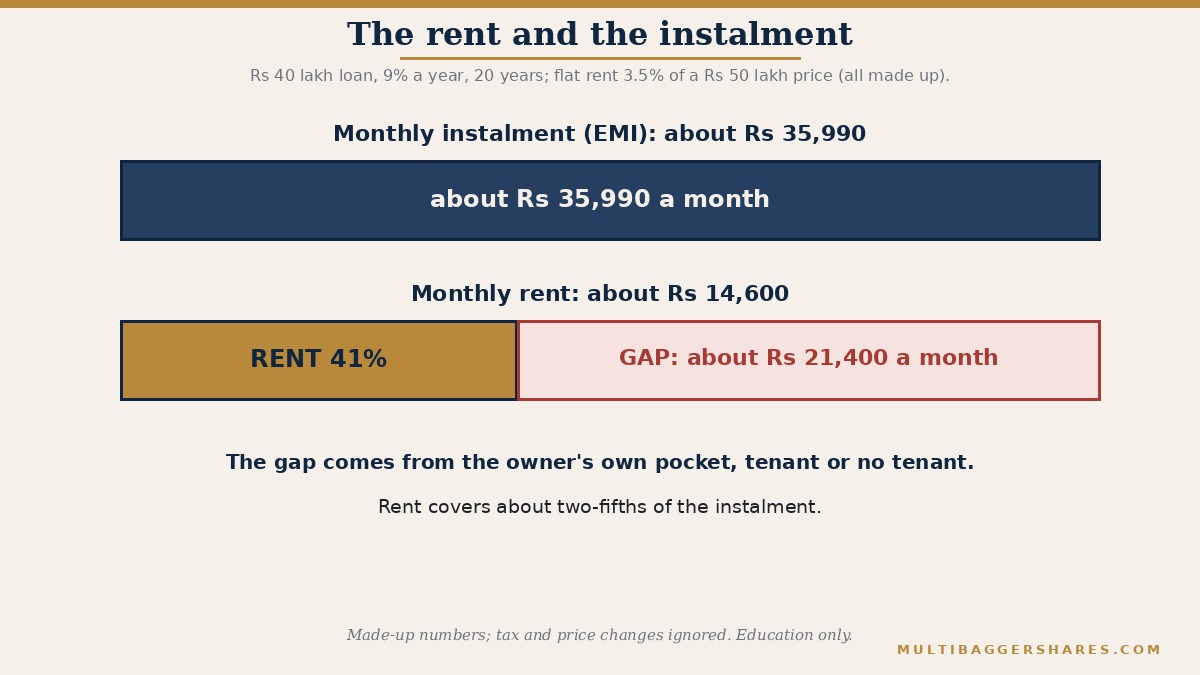
The most important real-life twist is the home loan. Few families buy a Rs 50 lakh flat for cash. Suppose Meera puts down Rs 10 lakh and borrows Rs 40 lakh for 20 years at an interest rate of 9% a year. This is a made-up rate, chosen only to keep the sums clean. Her EMI (equated monthly instalment, the fixed amount you repay each month) would be about Rs 35,990.
Now compare that with the rent. The flat earns about Rs 14,600 a month. The rent covers only about two-fifths of the instalment. The remaining Rs 21,400 or so must come from Meera’s own pocket every month, for 20 years, whether or not the flat has a tenant. She is borrowing to own something whose income is smaller than the interest. That is leverage (using borrowed money to own more than you could with your own savings). Leverage can raise the gain when things go well. It raises the pressure when they do not. Over 20 years, she would pay back about Rs 86 lakh in total on a Rs 40 lakh loan.
This does not mean the flat is a bad idea. If the flat rises in price over the years, and rents rise with it, the picture can improve a lot. Many Indian families have done well that way. The point is only that the monthly cash flow does not look like “rent covers the cost”. A buyer who does not see that clearly may be surprised. Warren Buffett wrote about this in his 2010 letter to Berkshire Hathaway shareholders. He said home ownership makes sense for most Americans, but that a house can be a nightmare if the buyer’s eyes are bigger than his wallet. His advice was to aim for a house the family can afford, not the house of their dreams.
Rohan has a different set of dangers. His businesses can disappoint. Their prices can fall sharply for months or years, and a screen that shows a price every minute can make a patient person nervous. Rohan will also have to do his own work: choosing good businesses, understanding what they do, and not selling in a panic. Nobody collects a cheque for him on the first of the month. The profits come in the form of growth in what his slices are worth, and in some cases dividends (the share of profit a company pays out in cash). His reward is less steady in the short run, and he must be the kind of person who can live with that.
These are also the places where the two cousins are most alike. Both must watch the quality of what they own. A flat in a lane that is losing its tenants is a weak asset, just as a business losing its customers is a weak asset. Both must keep their borrowing at a level they can carry in a bad year. And both must remember that the price they see on any given day is not the same thing as what the asset earns.
How you can use it
The first use is simply to ask the six questions of anything you own or are thinking of owning. What does it earn, in rupees a year and as a share of what I put in? What does it cost to get in and to keep? What happens to my income if one thing goes wrong? Who or what can make it grow? How much of my total savings is in this one place? And how easily can I leave, and at what cost? Write down the answers. Often the act of writing exposes a gap you did not notice.
The second use is to count the whole cost, not just the sticker price. For a flat, that means stamp duty, registration, repairs, property tax and empty months, as well as the loan interest. For shares, it means brokerage, taxes and the yearly costs of any fund you use. A rupee spent on costs is a rupee that cannot earn. We looked at this in the lesson on the quiet toll.
The third use is to size things honestly. If a single flat would be most of your savings, ask what happens if it is empty for a year, or if you must sell in a hurry. If a share portfolio would swing your mood each day, ask whether you can hold it through a bad stretch. In both cases the question is the same: how much can this go wrong before it hurts my life?
It is also fair to say what this lesson does not claim. It does not say that shares are better than flats, or the other way round. Many people own both, and a flat that you live in serves a purpose that no share can. The prices of both can rise or fall, and neither is guaranteed to beat the other over any period. The aim is only to compare them on equal terms, so that the choice is made with open eyes and not just with the loudest voice at the dinner table.
Finally, remember that the quality of the thing matters more than the label. A well-located flat with a steady tenant and a modest loan is a different object from an over-priced flat bought with a stretched loan. A strong business run by honest people is a different object from a weak business with a fancy name. Learn to look at what each one actually earns, what it costs you, and how it behaves in a bad year. That habit will serve you whichever way you invest.
This article is for education only. Meera, Rohan, the tailor and all the numbers in their examples are made up, and tax is ignored. The rental-yield, stamp-duty and household-asset figures are described as background from the sources named. Nothing here is a forecast or a suggestion to buy or sell any property, security or fund.
Key takeaways
- A flat and a share are both claims on something that earns. Judge each with the same six questions: what it earns, what it costs, what happens if income stops, who can grow it, how much of your money sits in it, and how easily you can leave.
- Count the whole cost. In the made-up example, stamp duty and registration of 6% plus yearly holding costs left a Rs 53 lakh flat earning a net 2.8% of what was put in.
- One flat is one basket, so a tenant leaving can pause all the income. Twenty businesses spread the same money so that one stumble touches only about 5%, though businesses can still struggle together.
- With a home loan, the made-up rent covered only about two-fifths of the monthly instalment. Borrowing raises the pressure as well as the possible gain, so know your monthly gap before you buy.
- Neither choice is better in every way. The aim is to compare them on equal terms and to size any single holding so that a bad year does not hurt your life.
— Manish Goel · multibaggershares.com
Manish Goel is a Chartered Accountant and Principal Officer of Multibagger Securities Research & Advisory Pvt. Ltd. (MSRAPL), a SEBI-registered Investment Adviser, Registration No. INA100007736. This content is published by MSRAPL for education only and is not personalized investment advice.
Disclaimer: This article is published by multibaggershares.com for education and general information only. It is not investment advice, investment research, or a recommendation to buy, sell or hold any security. Any companies named are discussed only as illustrative examples. Markets carry risk; please do your own research or consult a qualified professional before making any investment decision. |