The Hidden Factory: Why a Business That Gets It Right the First Time Keeps More of Every Rupee

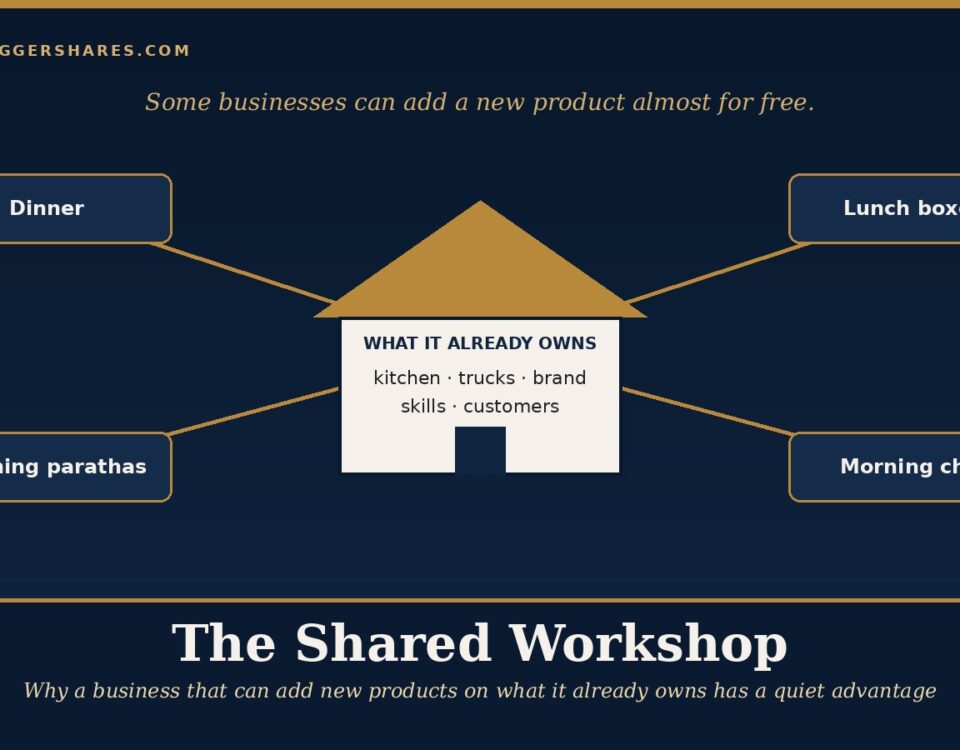
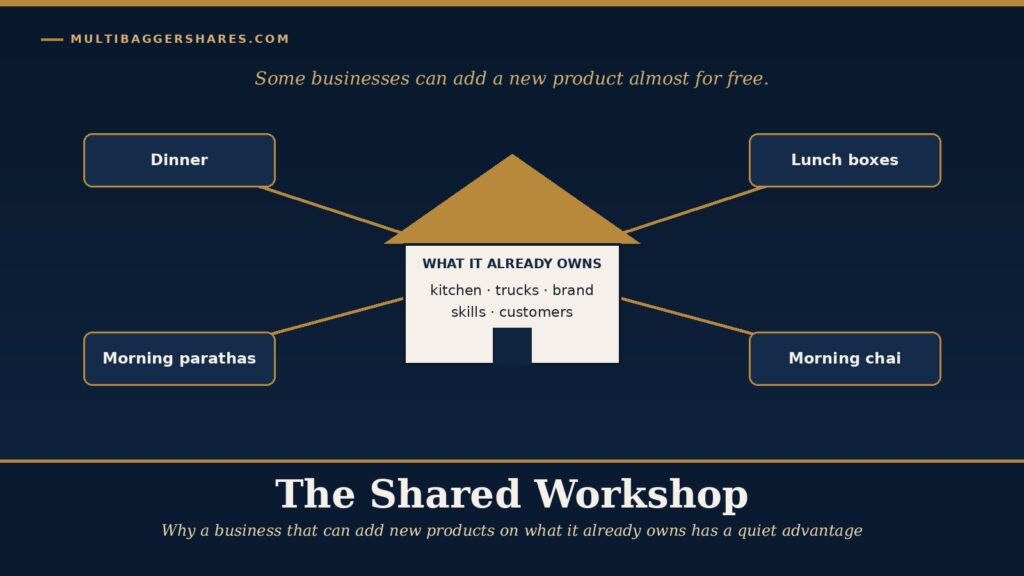
The Shared Workshop: Why a Business That Can Add New Products on What It Already Owns Has a Quiet Advantage
November 13, 2026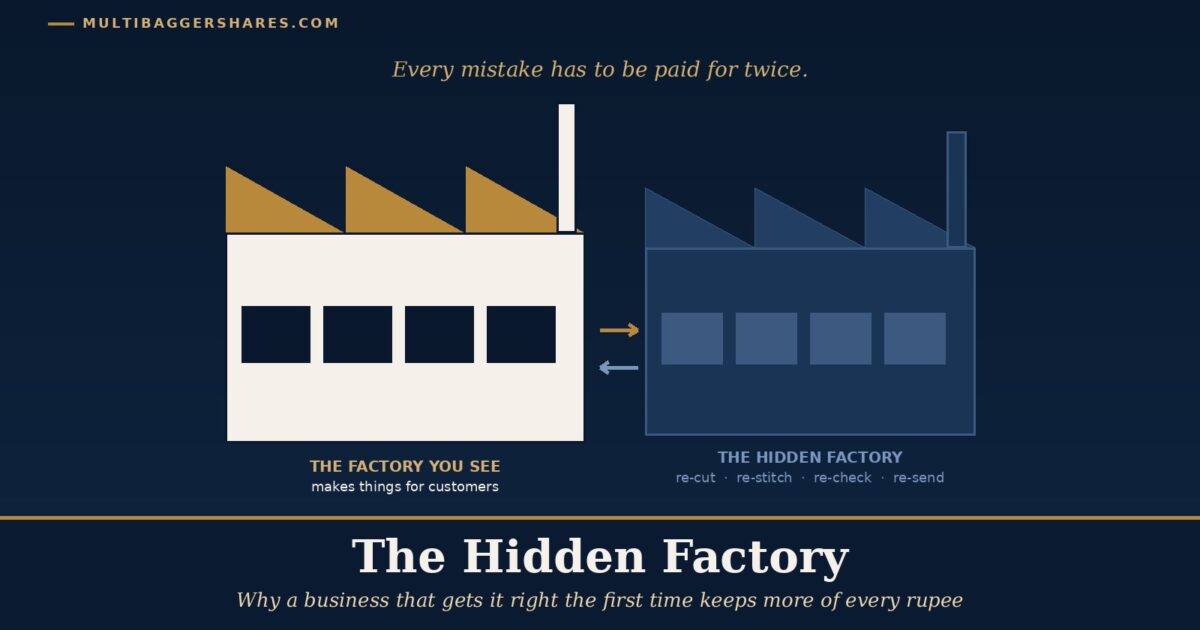
On one narrow lane in Tiruppur there are two small shirt workshops. Both have twenty sewing machines. Both buy the same cloth from the same mill. Both make about a hundred shirts a day for the same wholesale buyer. From the outside, you could not tell them apart.
Kamal runs the first one. Every morning, before work starts, his senior tailor spends fifteen minutes checking the machines and the thread. New workers sit beside an old hand for two weeks before they are allowed to stitch alone. Almost every shirt that leaves Kamal’s shop is right the first time.
Javed runs the second one. His workers are just as hard-working. But nobody checks the machines, and new workers learn by trial and error. Roughly one shirt in ten comes out with a crooked collar or a seam that opens. Those shirts are cut up and made again. A few that slip through come back from the buyer.
At the end of the month, both men have sold the same number of shirts at the same price. Their sales are equal. But Kamal has noticeably more money left over. Javed works longer hours and earns less, and he cannot quite see where the money went.
This lesson is about where that money went. Quality experts have a name for it: the hidden factory. It is a simple idea, and it is one of the quietest differences between a good business and an ordinary one. It is about the quality of a business. It has nothing to do with guessing share prices.
What it really means
Inside almost every business there are two factories. The first one makes things for customers. The second one is hidden. It makes the same things again, because they were not right the first time. It cuts, re-stitches, re-checks, re-packs and re-sends.
The American quality expert Armand Feigenbaum called this the hidden plant, and it later became known as the hidden factory. He pointed out that a surprisingly large share of a plant’s capacity (the most it can produce in a day) could be swallowed by this quiet repair work, in some cases as much as forty per cent.
Nobody puts the hidden factory on a signboard. It does not appear as its own line in the accounts. Its costs hide inside other costs: a little more cloth, a little more overtime, a few more refunds. That is exactly why it is easy to miss.
In 1979 another American, Philip Crosby, wrote a book called Quality Is Free. Its opening lines became famous: quality is free, it is not a gift, but it is free. His point was that doing things right does not cost extra. What costs money is everything that has to be done because a job was not done right the first time.
Experts usually split these costs into four groups. Prevention costs (money spent to stop mistakes before they happen, such as training and machine checks). Checking costs (money spent to look for mistakes, such as inspection). Inside-failure costs (mistakes caught before the customer sees them, such as scrap, which means material thrown away, and rework, which means doing a job again). And outside-failure costs (mistakes the customer finds, such as refunds, repairs under warranty, which is the company’s promise to fix a faulty product for free for a set period, and lost customers).
Kamal spends a little on the first group. Javed spends a lot on the last two. That is the whole difference between them.
You meet the hidden factory in daily life too. Think of a courier who delivers a parcel to the wrong flat. The parcel has to be picked up, carried back, sorted again and sent out again. The customer was charged once. The courier company paid for the trip twice. Or think of a bank that types your name wrongly on a cheque book. A new one must be printed, posted and checked again. Each mistake is small. Repeated thousands of times a day, it becomes a large, silent cost.
Why it works
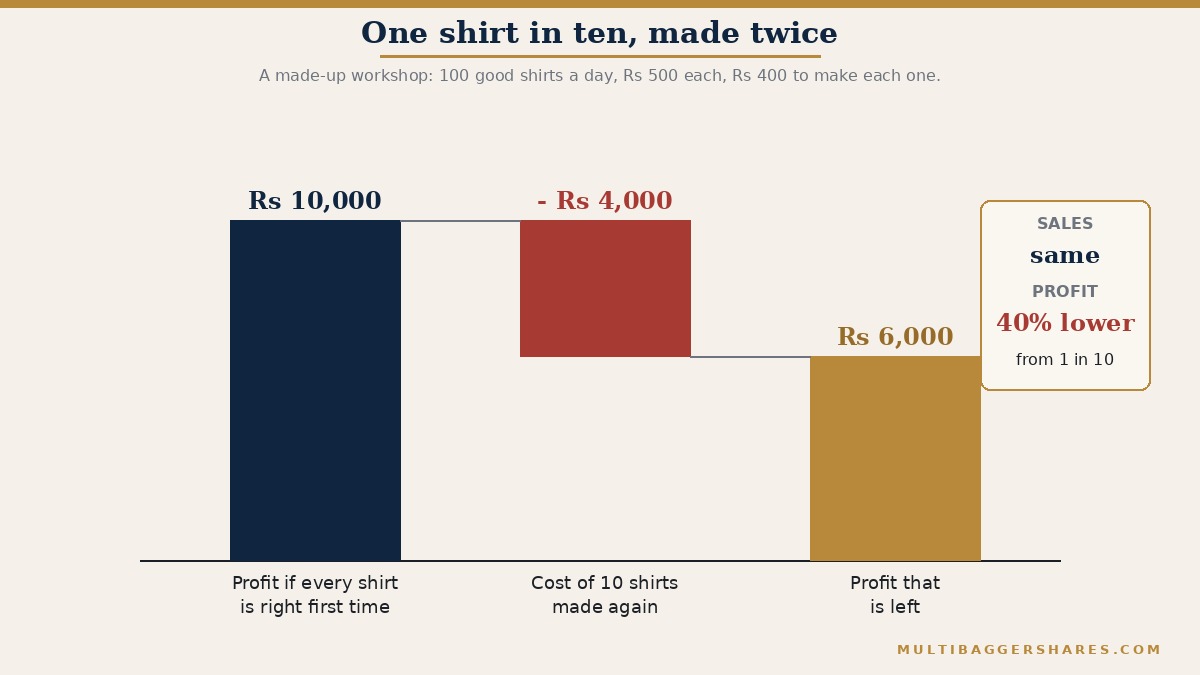
Let us do Javed’s arithmetic slowly. Suppose each shirt sells for Rs 500 and costs Rs 400 to make, counting cloth, thread, wages and power. To deliver a hundred good shirts, Kamal makes a hundred. His profit is Rs 100 a shirt, or Rs 10,000 a day.
Javed must make a hundred and ten shirts to deliver the same hundred good ones. The ten extra shirts cost him Rs 4,000, and he cannot sell them. His sales are still Rs 50,000 a day, the same as Kamal’s. But his profit falls from Rs 10,000 to Rs 6,000. One mistake in ten has eaten four rupees out of every ten of profit.
This is the first reason the hidden factory matters so much. A mistake costs the full price of making something, but it earns nothing. And because profit is only a small slice of sales, even a small mistake rate takes a big bite out of that slice. The thinner the profit margin (the share of each rupee of sales that is left as profit), the bigger the bite.
The second reason is time. Think of a leaking roof before the monsoon. Sealing a small crack in May takes a mason one afternoon. Leave it, and by August you are repainting the ceiling, drying the cupboard and replacing the spoilt mattress. Mistakes in a business behave the same way. Caught early, they are cheap. Caught late, they are expensive. Caught by the customer, they can be the most expensive of all.
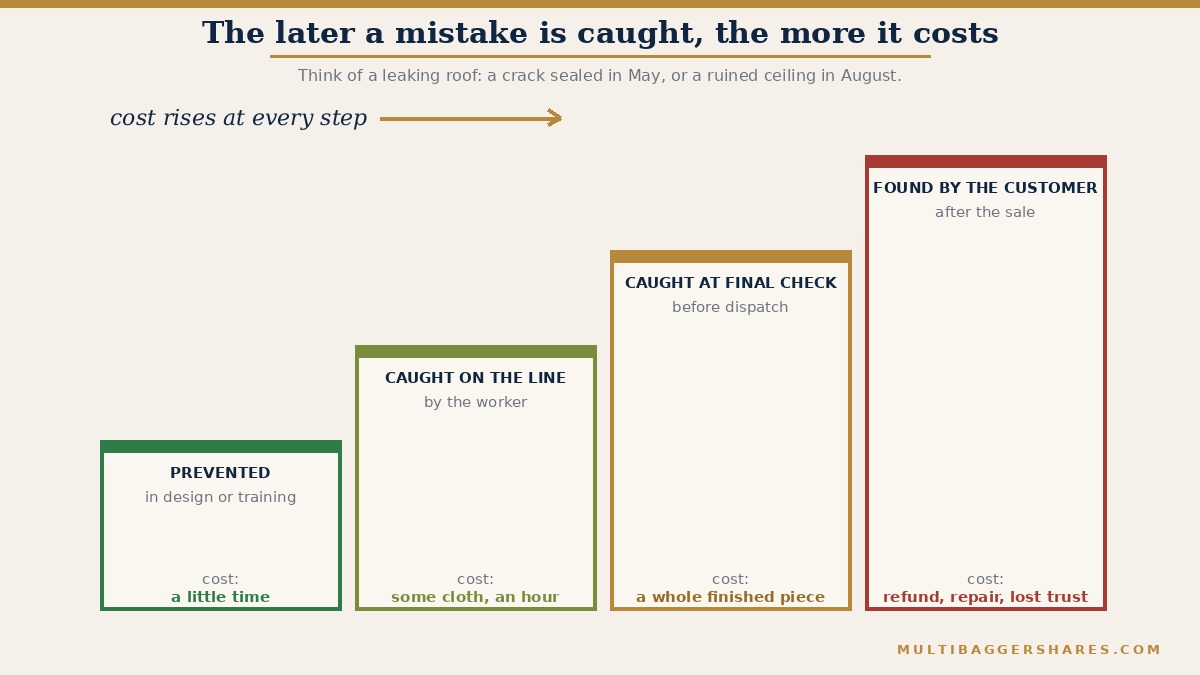
The third reason is trust. When a customer finds a fault, the business does not only pay for the repair. It also risks losing the customer. A family that bought a mixer-grinder which broke in the first month will not easily buy that brand again, and they will tell their relatives too. That cost never appears neatly in the accounts, but it is real.
The fourth reason is capacity. Every hour that Javed’s tailors spend re-stitching collars is an hour they are not making new shirts. When the buyer asks for more, Kamal can say yes with the machines he already has. Javed has to buy more machines, or turn the order away. In this way, a business that makes fewer mistakes can grow without spending as much money.
Put these together and you see why the hidden factory is a quiet advantage. Two businesses can have the same products, the same prices and the same customers, and still end up with very different profits. The difference is not in what they sell. It is in how often they have to do the same work twice.
A real example or two
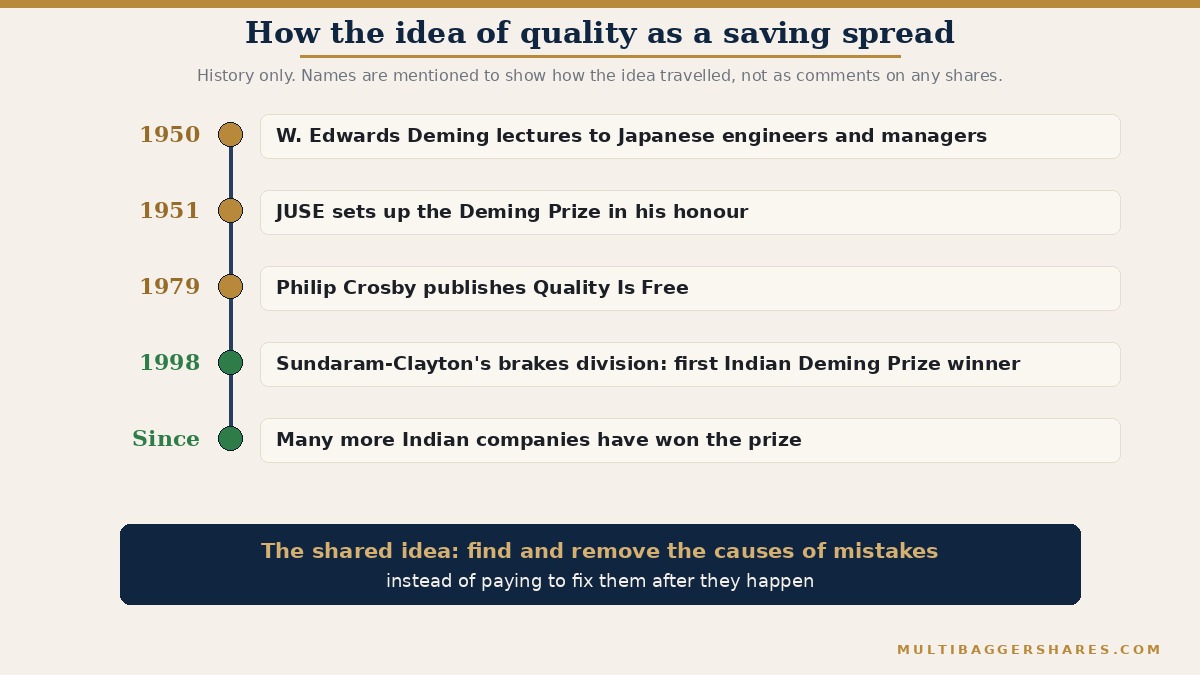
The idea that quality saves money rather than costs money was not always popular. In 1950, an American statistician named W. Edwards Deming was invited to Japan by the Union of Japanese Scientists and Engineers, known as JUSE. He gave lectures to engineers and company leaders about finding and removing the causes of mistakes, rather than just inspecting the finished goods.
The ideas spread widely in Japanese industry. In 1951 JUSE set up the Deming Prize in his honour, to recognise companies that improve quality across the whole organisation. Over the following decades, Japanese factories became known around the world for products that rarely broke down.
India came to this a little later. In 1998, the brakes division of Sundaram-Clayton, a company in the TVS group, became the first Indian company to win the Deming Prize, according to a Business Standard report of that year. Many Indian companies have won it since then. The prize list even records Mahindra and Mahindra’s tractor business as the world’s first tractor company to win it.
These names are mentioned only as history, to show how the idea travelled. An award is not proof that a business is good, and nothing here is a comment on any company’s shares. The lesson is the idea itself: that a company which works hard at getting things right the first time is not wasting money on quality. It is avoiding a much bigger bill later.
You can see the same thing closer to home. Think of two sweet shops. One makes every batch of laddoos with the same weighed recipe and the same trained hands. The other guesses, and throws away a burnt batch every few days. The first shop never talks about its quality. It just quietly earns more on every box.
How you can use it
As an outside investor, you cannot walk into a factory and count crooked collars. But you can look for clues. None of them is perfect on its own. Together, over several years, they tell a story.
First, read the note on warranty provisions in the annual report. A provision is money set aside today for a cost the company expects to pay later. Many companies that sell machines, vehicles or appliances set aside money every year for free repairs. Compare this amount with sales over five or more years. If it stays small and steady, that is a good sign. If it keeps rising faster than sales, ask why.
Second, for larger Indian listed companies, read the Business Responsibility and Sustainability Report, or BRSR (a yearly report that the biggest listed companies must publish about how they treat customers, workers and the environment). In the section on consumers, companies report how many customer complaints they received, how many were still pending, and how many times they had to recall a product for safety reasons. A business that rarely recalls products and resolves complaints quickly is giving you a useful clue.
Third, watch what happens when sales jump. A business with a large hidden factory often struggles when it suddenly has to make much more. Its costs rise faster than its sales, because mistakes multiply under pressure. A business that gets things right the first time usually handles a busy year more smoothly.
Fourth, listen to how the managers talk about mistakes. Some leaders mention defect rates, repeat repairs or customer complaints in their letters and calls, and explain what they did about them. Others never mention mistakes at all, or talk only about new launches and big targets. A team that measures its mistakes is more likely to be shrinking its hidden factory than a team that never counts them.
Fifth, ask the people closest to the product. A mechanic, a dealer or a shopkeeper can often tell you which brand keeps coming back for repair and which one never does. Philip Fisher called this kind of asking around scuttlebutt, and it works here too.
A simple way to keep these clues is a small notebook, or a page in a spreadsheet, for each company you follow. Each year, write down four things: sales, the warranty provision, the number of complaints, and any recalls. After five years, the pattern is usually clear without any clever maths. Steady or shrinking numbers next to growing sales are a quiet sign of a business that is learning to do things right the first time.
Finally, keep one caution in mind. Zero mistakes at any cost is not the aim. A business that checks everything five times can become slow and expensive in a different way. What you are looking for is a business that prevents mistakes cheaply and early, so that it rarely has to pay for them late.
The best businesses rarely boast about this. Like Kamal, they simply have a little more money left at the end of every month. When you study a company, it is worth asking a quiet question: how much of its work is being done twice?
Key takeaways
- The hidden factory is the repair work inside a business: everything made, checked or delivered twice because it was not right the first time.
- A mistake costs the full price of making something but earns nothing, so even a small mistake rate can eat a large share of profit.
- Mistakes get more expensive the later they are caught, and the most expensive ones reach the customer and cost trust.
- Outsiders can look for clues: warranty provisions against sales, complaints and recalls in the BRSR, behaviour in busy years, and what dealers say.
- This is a way to judge the quality of a business. It is education only, not a judgement on any company or share.
— Manish Goel · multibaggershares.com
Manish Goel is a Chartered Accountant and Principal Officer of Multibagger Securities Research & Advisory Pvt. Ltd. (MSRAPL), a SEBI-registered Investment Adviser, Registration No. INA100007736. This content is published by MSRAPL for education only and is not personalized investment advice.
Disclaimer: This article is published by multibaggershares.com for education and general information only. It is not investment advice, investment research, or a recommendation to buy, sell or hold any security. Any companies named are discussed only as illustrative examples. Markets carry risk; please do your own research or consult a qualified professional before making any investment decision. |