Don’t Buy the Poorer Cousins: Why the Leader and the Also-Ran in the Same Growing Field Rarely Share the Same Fate

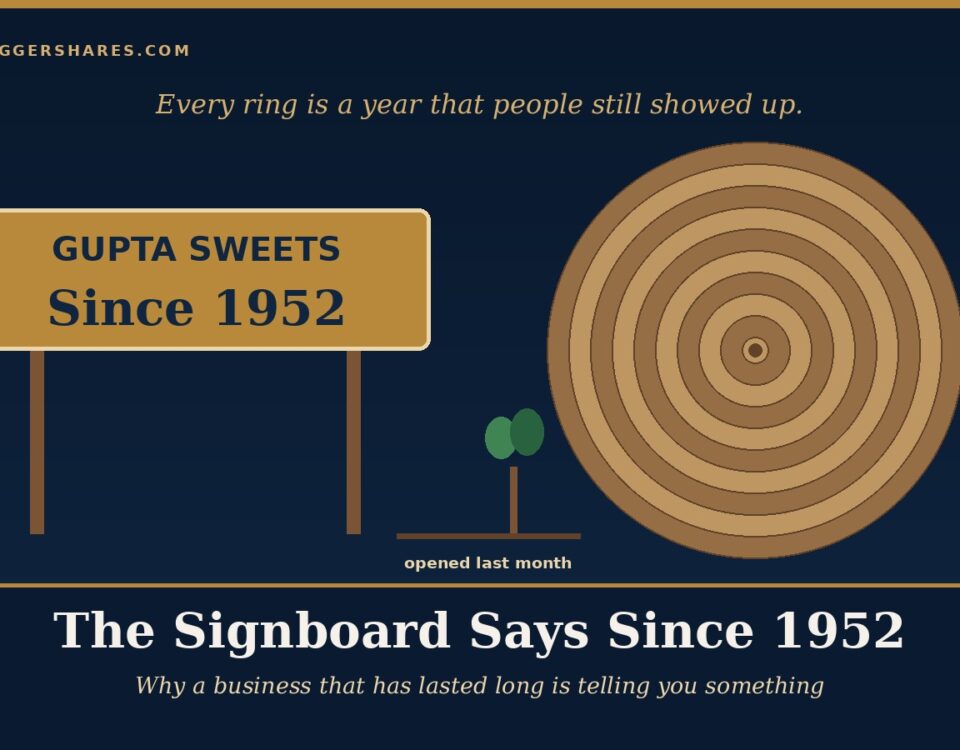
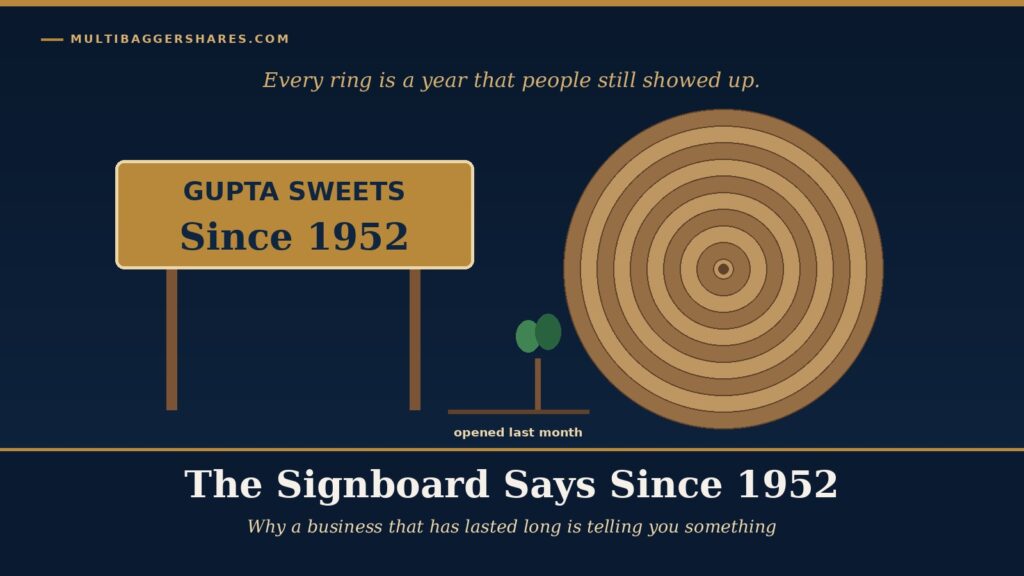
The Signboard Says Since 1952: Why a Business That Has Lasted Long Is Telling You Something
October 18, 2026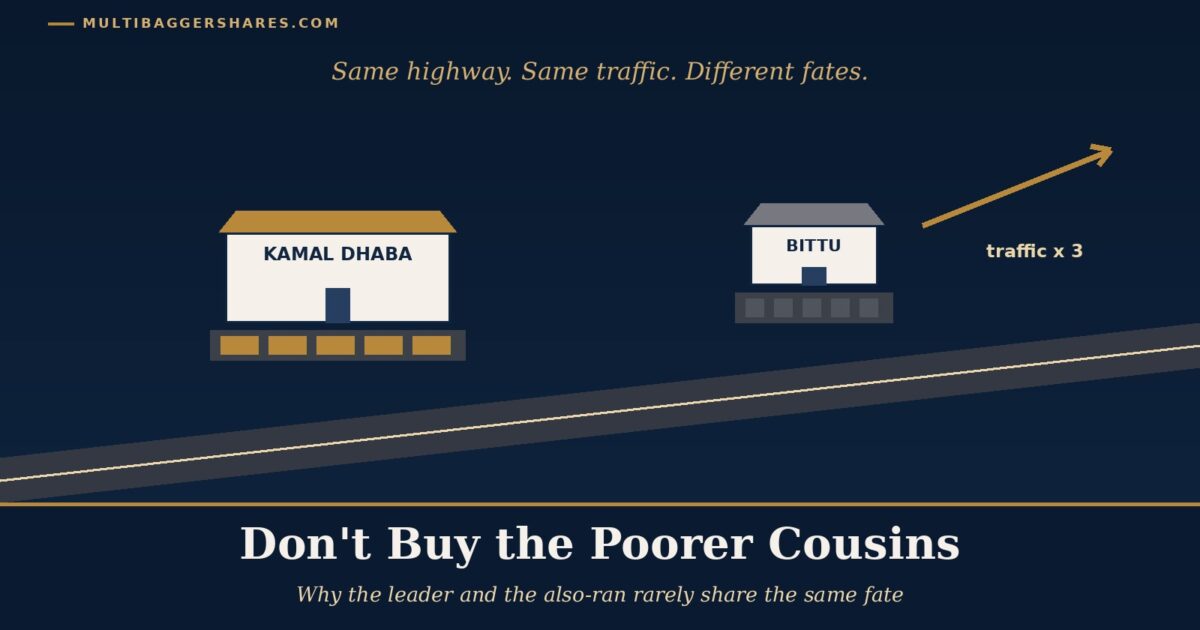
Imagine a small town where a new highway is about to open. Everyone is excited. Traffic on the old road was about 1,000 vehicles a day. Once the highway is ready, it will be about 3,000. Two roadside dhabas (small, simple eateries that serve truck drivers and families on the road) are waiting for the crowds. One is Kamal Dhaba. The other is Bittu Dhaba.
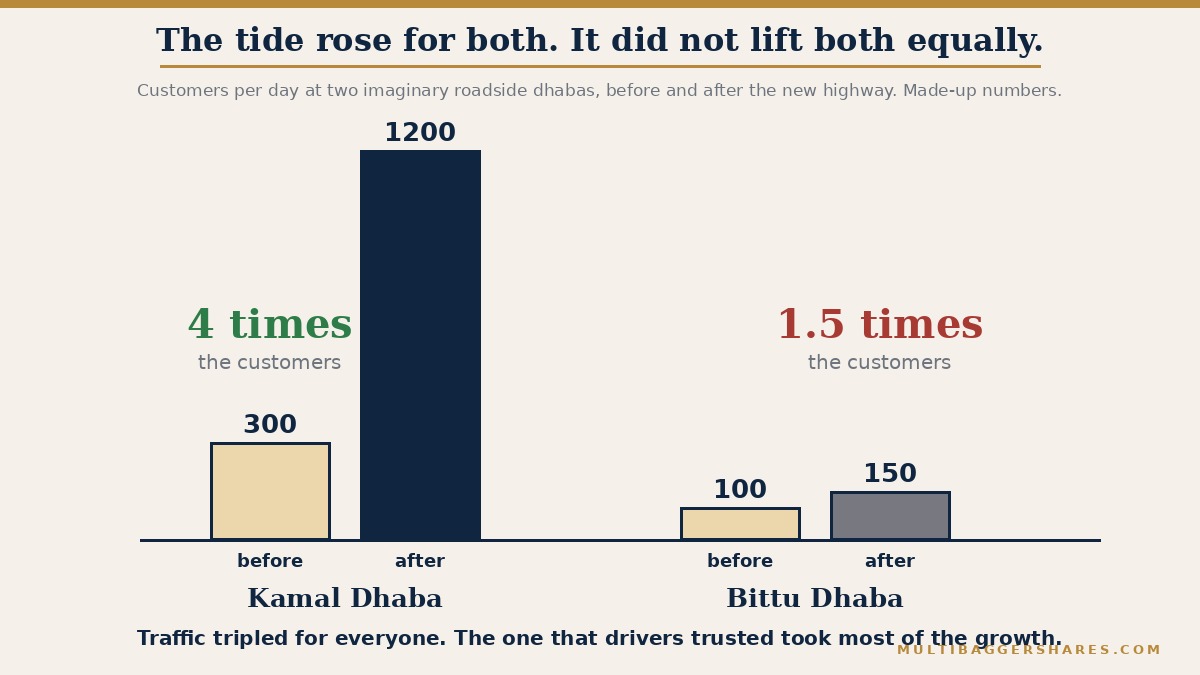
Kamal Dhaba has a big parking area, clean washrooms and a cook who has made the same dal for twenty years. Bittu Dhaba is a little cheaper, but its parking space holds only three trucks and its washrooms are not something you would want to describe to a friend. Before the highway, Kamal served about 300 customers a day and Bittu about 100.
Now the traffic triples. Many people say, “The whole area will grow, so both dhabas will do well.” That sounds sensible. But watch what happens. Drivers on a long road are tired. They pick the place that looks safe, has room to park and is known to be clean. Within two years, Kamal is serving about 1,200 customers a day. Bittu is serving about 150. The numbers in this story are made up, but the pattern is very real.
That pattern is the heart of today’s lesson. When a whole field starts to grow, the leader and the poorer cousin do not share the same fate. Basant Maheshwari, one of India’s well-known long-term investors, put it in one short sentence that is easy to remember.
What it really means
In March 2015, the journalist Aarati Krishnan wrote for Value Research about a seminar given by Basant Maheshwari. He was explaining how he looks for businesses that can grow a great deal over many years. His guidance on this point was short: once you see a trend taking shape, go for the leaders of that sector. In his words, as the article reports them, “Don’t buy the poorer cousins in a sector.”
Let us unpack that. A sector (a group of businesses doing similar work, such as software, cement or biscuits) can grow for many reasons. People earn more. A new technology arrives. A new law opens a door. This growth is like the monsoon: it falls on every field. But a farmer with a good well, strong seeds and a healthy bullock makes much more of the rain than a farmer with none of these.
The article gives one example from India’s own history. When software was becoming a big trend in the nineties, the leading company in that field made its investors wealthy. Other, weaker companies in the same field, by the article’s account, left investors with nearly nothing. Same sector, same years, same excitement. Very different endings.
The word “leader” needs care. It does not simply mean the largest. It means the business customers choose first, the business that earns its growth honestly, and the business that is still standing when the weather turns. Size usually comes with these things, but size alone is only a clue.
Why do beginners so often reach for the poorer cousin? There are two common reasons. The first is that the weaker name feels easier to start with, as if a smaller business must have more room to grow. Sometimes that is true, but often it is not. A small business that cannot win customers does not grow just because the field does. The second reason is a feeling of being late. The leader is already well known, so the beginner thinks, “That story is over, let me find the next one.” Yet in many fields the leader’s story is only beginning, because leaders keep winning customers from weaker rivals year after year.
Why it works
The first reason is that customers like to choose the safe option. When many sellers offer something similar, buyers want to feel they will not be let down. A well-known name, a good record and a clean shop all say, “You can relax here.” Once people trust you, they come again, and they tell their friends. Trust is slow to build and quick to lose.
The second reason is that the leader can afford to improve. When Kamal Dhaba earns a good profit, it can build a bigger kitchen, hire better cooks and add a play area for children. Each improvement brings more customers, which brings more profit, which pays for the next improvement. It is a little like a snowball rolling down a hill: the more snow it picks up, the faster it grows. Bittu Dhaba has no spare money, so it cannot take part in this cycle.
The third reason is that good people want to work for leaders. A skilled cook, a sharp manager or a clever engineer would rather join the best name in the field. This is true for dhabas and for large companies alike. Talent is one of the quietest advantages a leader has, and one of the hardest to copy.
The fourth reason is that the leader survives the bad year. Every field has a bad year. Suppose the highway is closed for two months for repairs. Kamal Dhaba has saved money and has almost no loans, so it waits patiently. Bittu Dhaba took a loan of Rs 10 lakh to build a new hall. The customers are gone, but the monthly instalments are not. Debt (money borrowed that must be repaid with interest) turns a bad season into a crisis. This is why a poorer cousin often does not survive the very trend it was supposed to benefit from.
A real example or two
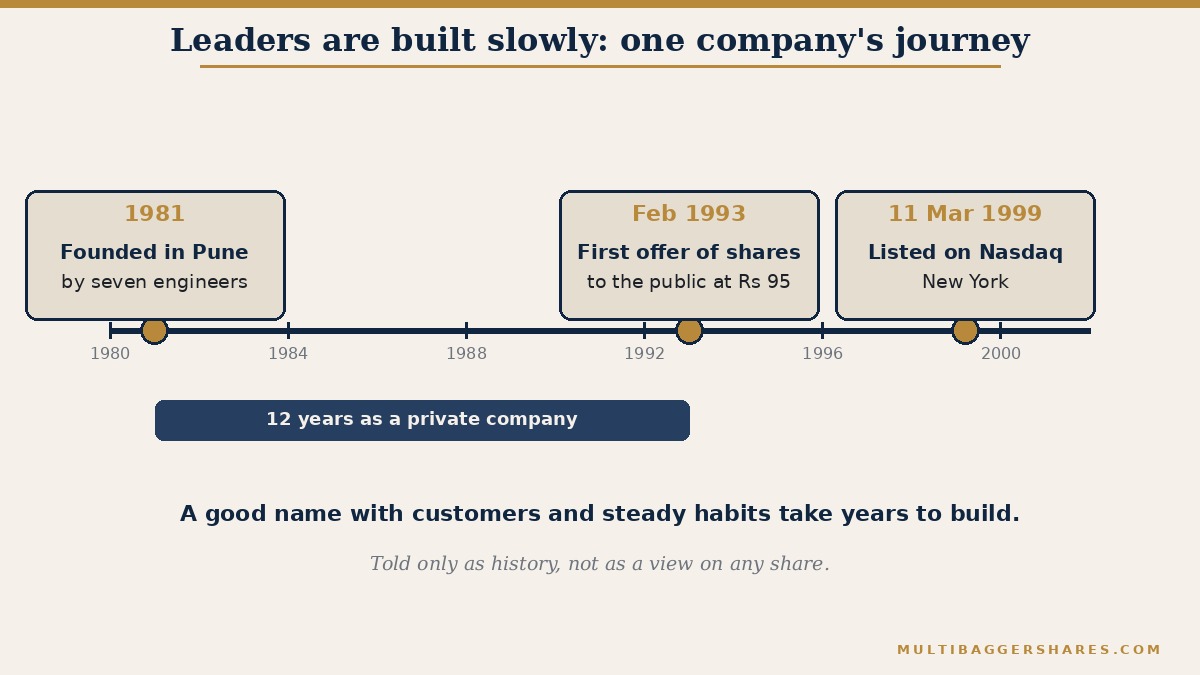
Let us look at one real story, told only as history. Infosys was started in 1981 in Pune by seven engineers. Its first offer of shares to the public came in February 1993 at Rs 95 a share. On 11 March 1999, it became the first Indian company to list on the Nasdaq, a major stock exchange in the United States. These dates are from the company’s public record. Between those years, India’s software field grew very fast, and many companies tried to grab a piece of it.
Notice what the timeline shows. A leader is not created in a day. Infosys spent twelve years as a private company, growing step by step, before its first offer of shares. A good name with customers and steady habits take years to build. This is why Maheshwari’s guidance is not “run after the biggest name today.” It is closer to “understand which business in the field has been earning its place.”
The article also describes the leaders he has in mind as companies with strong cash flows and a high return on equity. Let us take both terms slowly. Cash flow (the money that actually comes into the bank, not just profit written on paper) matters because a business can show a profit while its customers are still to pay. Return on equity (how much profit a business earns each year for every Rs 100 the owners have put in) tells you how well the owners’ money is being used.
Go back to our dhabas. Suppose the owner of Kamal Dhaba has put Rs 100 of his own money into the business and earns Rs 25 a year from it. That is a return of 25 percent. Suppose the owner of Bittu Dhaba has also put in Rs 100 but earns only Rs 8. Both are making some money, but one rupee works three times harder in the first dhaba. Over many years, that difference grows enormous, just as interest on interest grows in a bank deposit that is left untouched.
A second example comes from daily life. Think of the famous sweet shop in your own city, the one with a queue outside during Diwali. There is usually a second, quieter shop two lanes away, selling similar sweets at a lower price. In a good festival season, both shops sell more. But the queue stays outside the first shop, its sweets are fresh because they sell so quickly, and its owner can afford to improve. The second shop is often left with unsold boxes. A rising season lifts both, but it does not lift them equally.
How you can use it
Here is a simple method with four signs. You do not need a computer or any special training. You need a notebook and some patience.
Begin where you already have some knowledge. A teacher may understand coaching classes, a pharmacist may understand medicine shops, and a homemaker may understand kitchen goods better than most analysts. Pick one such field. Write down three names in it. Then test each name against the four signs below, using the annual report (the yearly book in which a company tells its owners how it did) and your own observation. Keep the notes. A single page of honest notes will teach you more than a hundred market headlines.
Sign one: do customers choose it first? Look for a business whose customers come back on their own, without being pushed. Ask friends, shopkeepers and people who use the product. A leader is usually the name that comes to mind first.
Sign two: does it earn a good return, and is the profit real? Look at the return on equity over several years, not just one. Look also at whether the profit turns into cash. A business that earns well year after year, and has cash to show for it, is behaving like a leader.
Sign three: does it pay for its own growth? A leader mostly grows from its own earnings. If a company has to keep borrowing just to keep up, it may be running a race it cannot win. Little debt gives a business the freedom to wait out a bad year.
Sign four: does it get through a bad year without drama? Look back at the last difficult period for that field. Did the business keep its customers, pay its staff and keep its promises? Leaders are often defined by how they behave when conditions are poor, not when everything is easy.
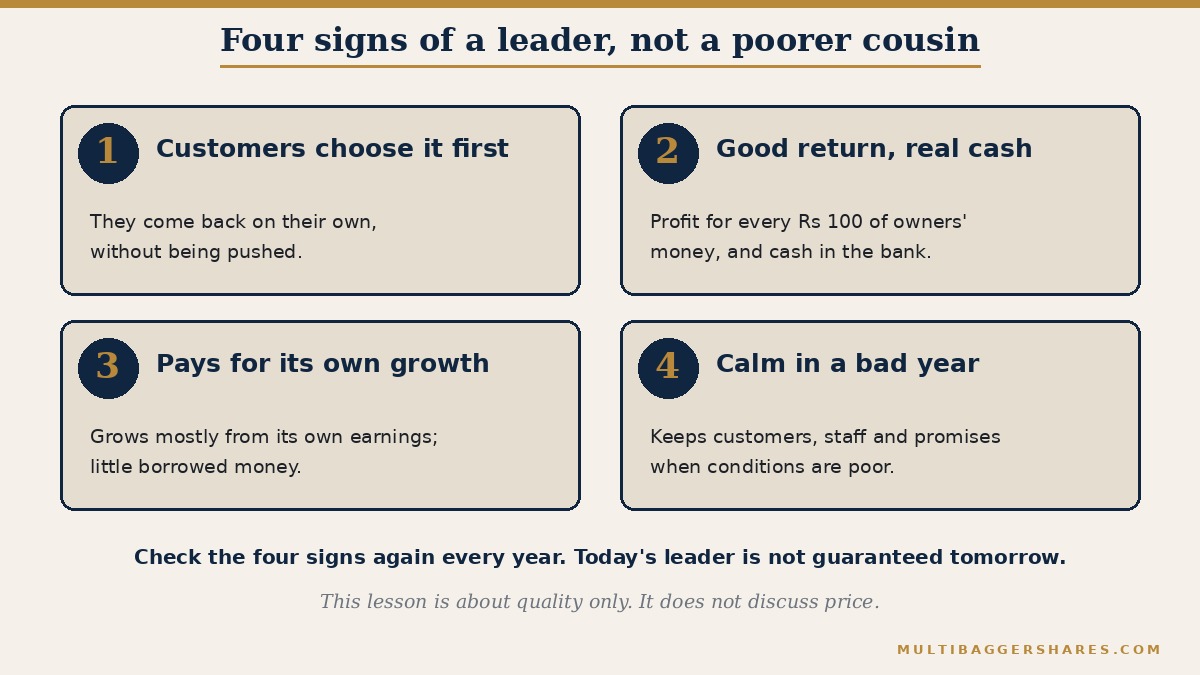
A few cautions are worth keeping in mind. First, today’s leader is not guaranteed to remain tomorrow’s leader. Leaders can grow careless, and fresh rivals can appear. So check these signs again every year. Second, the poorer cousin is often tempting, because its shares may seem to cost less. This lesson does not talk about price at all. It asks only one question: which business in the field is of better quality? Third, do not mistake a loud name for a strong one. Advertising can make a business famous, but it cannot make it trustworthy.
Finally, remember what this lesson is not. It is not a list of names, and it does not say which shares to hold. It is a habit of looking. The next time you read that a whole industry is booming, pause and ask, “Who in this industry is Kamal Dhaba, and who is Bittu Dhaba?” That one question can save a beginner from many disappointments.
This article is for education only. It does not tell you what to do with any particular investment.
Key takeaways
- When a whole field grows, the leader and the poorer cousin rarely share the same fate; growth is like rain that helps a good farmer far more than a poor one.
- Basant Maheshwari, as reported by Value Research in 2015, said to go for sector leaders and not the weaker players.
- A leader is not just the biggest name; it is the business customers choose first, that earns real cash, and that survives a bad year.
- Return on equity (profit for every Rs 100 of owners’ money) and cash flow help show who is really using money well.
- Use four signs: customers choose it first, a good return with real cash, growth paid from its own pocket, and calm in a bad year. Then check them again every year.
— Manish Goel · multibaggershares.com
Manish Goel is a Chartered Accountant and Principal Officer of Multibagger Securities Research & Advisory Pvt. Ltd. (MSRAPL), a SEBI-registered Investment Adviser, Registration No. INA100007736. This content is published by MSRAPL for education only and is not personalized investment advice.
Disclaimer: This article is published by multibaggershares.com for education and general information only. It is not investment advice, investment research, or a recommendation to buy, sell or hold any security. Any companies named are discussed only as illustrative examples. Markets carry risk; please do your own research or consult a qualified professional before making any investment decision. |