The Milkman’s Map: Why Customers Packed Close Together Make a Business Cheaper to Run

The Copy Test: Could a Rich Rival With Unlimited Money Copy This Business?
October 3, 2026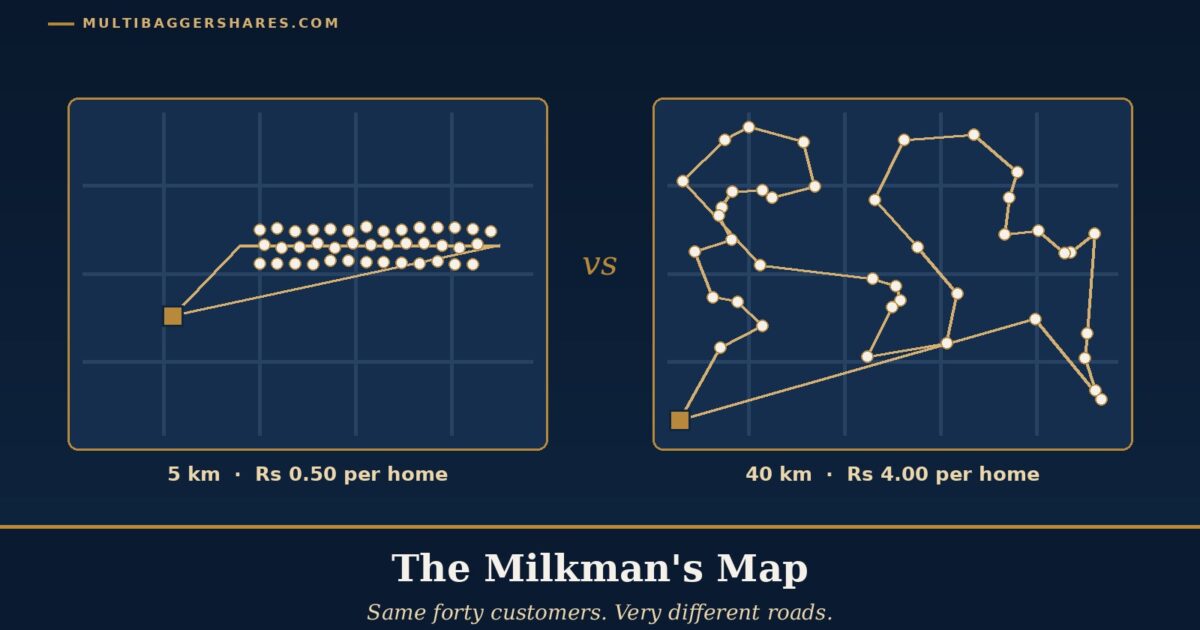
Meet Ramesh, a milkman in a mid-sized Indian town. Every morning at five, he loads forty one-litre packets of milk onto his scooter and sets off. After paying the dairy, he earns four rupees on every litre. His scooter costs him about four rupees in petrol for every kilometre he rides. These are made-up numbers, but they are close to how a small delivery business feels.
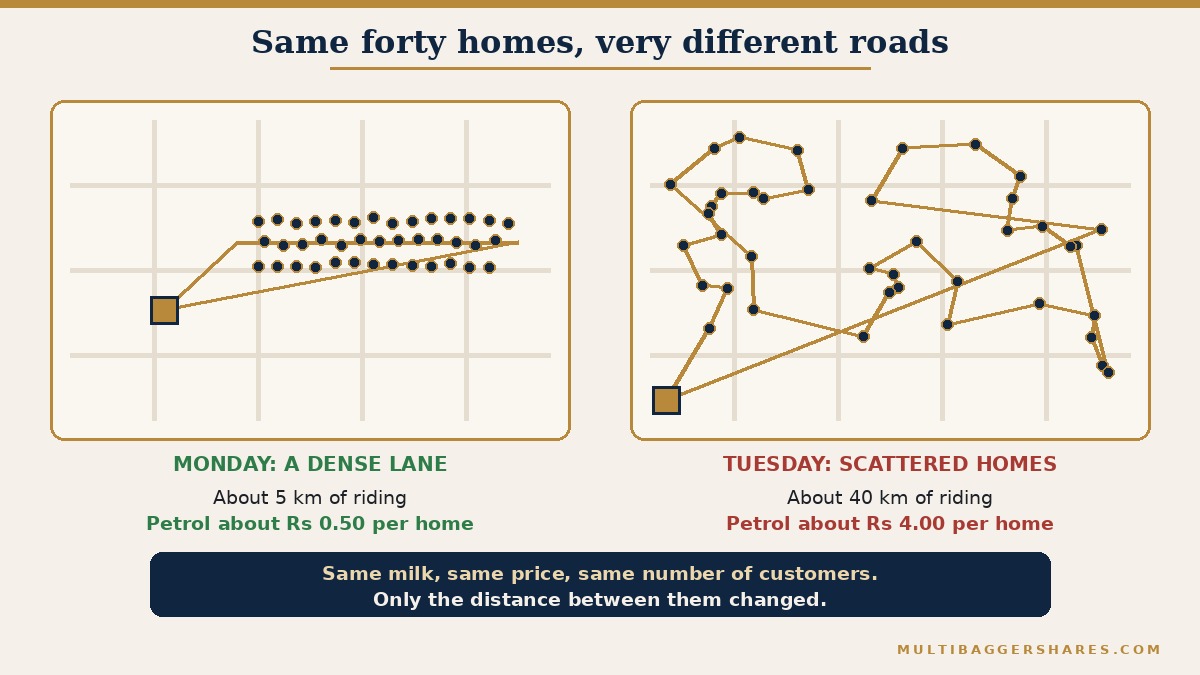
On Monday, he is given a lane. All forty customers live along one road and the two small streets beside it. Ramesh rides about five kilometres in all, there and back. His petrol costs twenty rupees. He earns one hundred and sixty rupees on forty litres, so after petrol he keeps one hundred and forty.
On Tuesday, he is given a different list. The forty customers are the same kind of homes. They pay the same price and drink the same milk. But they are scattered across the whole town. Some live near the railway line, some near the river, some out in the new colony. Ramesh now rides about forty kilometres. His petrol costs one hundred and sixty rupees. He earns the same one hundred and sixty rupees. After petrol, he keeps nothing at all.
Same milk. Same price. Same number of customers. One list makes a living and the other makes a loss. The only thing that changed was how close the customers live to one another. Today’s letter is about that idea. People who run delivery businesses call it route density.
What it really means
A route is the path a business must travel to reach its customers. It may be a delivery rider’s path, a truck’s path, a salesman’s path or a repair engineer’s path. Density simply means how tightly things are packed. So route density (how many customers a business can serve for each kilometre it must travel) tells you how crowded the customers are along the road.
Think of a school bus. If forty children live in one colony, the bus makes one stop and is full. If forty children live in forty different villages, the bus needs a whole day and a lot of diesel. The fare is the same. The cost is wildly different.
Here is the key point. Most of the cost of a trip is paid once per trip, and not once per customer. The rider’s wages, the vehicle, the petrol to leave the depot (the base from which the deliveries start) and the hours lost in traffic are all paid whether the rider stops at ten homes or at fifty. Accountants call a cost like this a fixed cost (a cost that stays about the same, however many customers you serve). The more stops on a trip, the more customers share that one bill. So the cost per drop (what it costs to make one delivery) falls.
Why it works
Go back to Ramesh for a moment. On Monday he had forty homes and a five-kilometre ride, so petrol cost him fifty paise per home. Now suppose twenty more families in the same lane start taking his milk. His ride grows only a little, to about six kilometres. Petrol is now twenty-four rupees across sixty homes, which is forty paise per home. His profit after petrol rises from one hundred and forty rupees to two hundred and sixteen. He worked a little harder, but the new customers cost him almost nothing extra to reach. That is the whole magic of density.
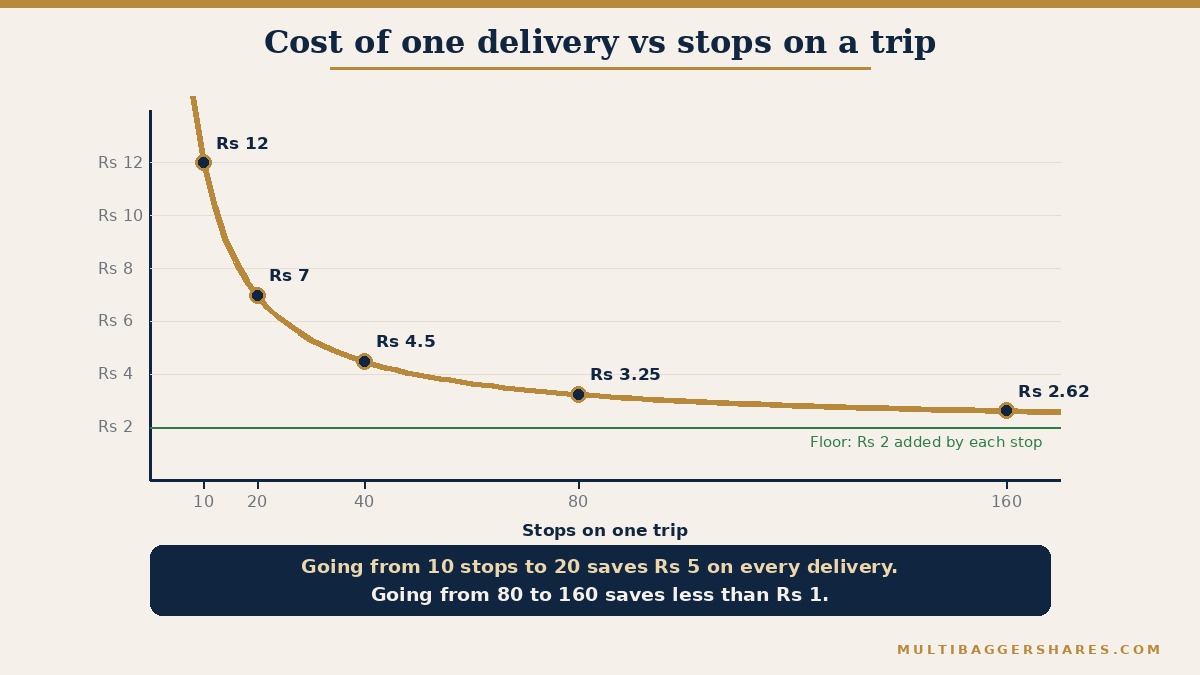
Let us put numbers on it. Suppose every trip costs one hundred rupees to run, whatever happens, and each extra stop adds another two rupees. With ten stops, each delivery costs twelve rupees. With twenty stops, it costs seven. With forty stops, four and a half. With eighty stops, about three and a quarter. With one hundred and sixty stops, about two and a half.
Notice two things. First, the biggest savings come early. Going from ten stops to twenty saves five rupees on every delivery. Going from eighty to one hundred and sixty saves less than one. Second, the cost never falls below the two rupees that each stop adds. Density helps a great deal, and then it flattens. That is a useful lesson in itself. A business that has already packed its routes tightly has little more to gain, while a business with thin routes may have a lot.
Density is also a cushion in hard times. Suppose a few customers leave, or a heavy monsoon keeps some families away from their doors for a week. On a dense route, the trip still covers its bill, because the fixed cost is shared among many homes and the remaining ones carry it easily. On a thin route, the same loss of a few customers can turn the whole trip into a loss. Businesses with tight routes tend to be calmer in difficult seasons for exactly this reason.
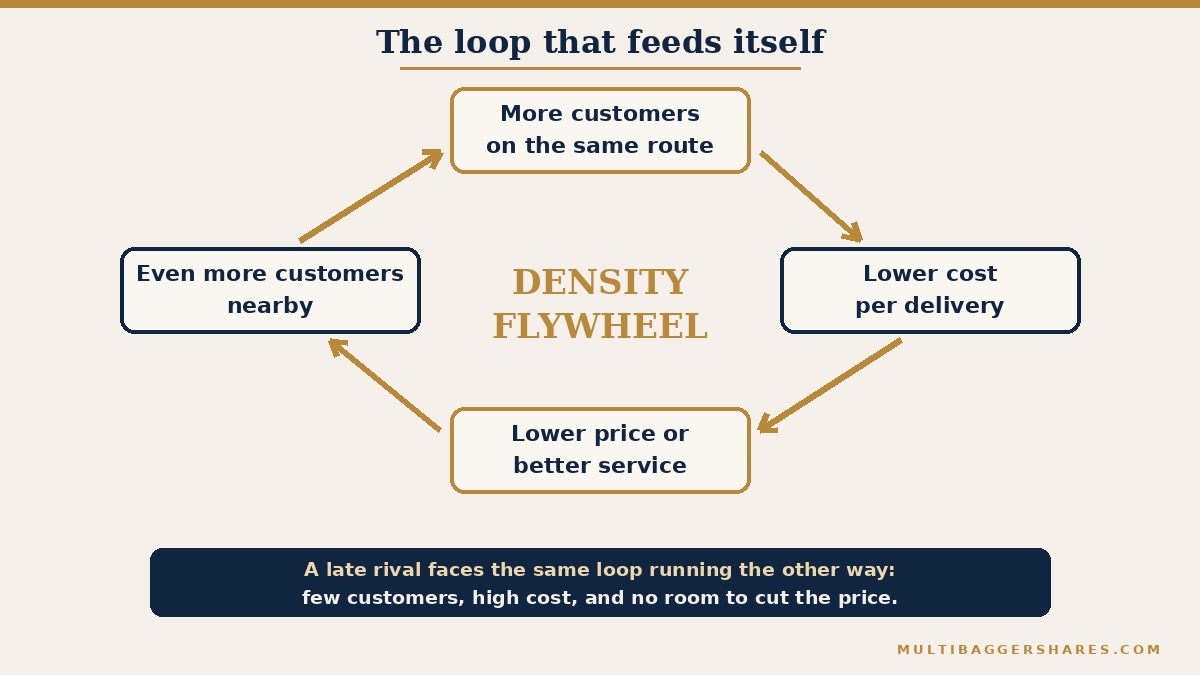
There is a second, quieter reason route density matters. It feeds itself. A lower cost per delivery lets a business charge a little less, or give a little better service, such as a faster delivery or a smaller minimum order. That attracts more customers in the same area. More customers in the same area means more stops on each trip. And that lowers the cost again. Investors call a loop like this a flywheel (a heavy wheel that is hard to start but, once spinning, keeps going with very little push).
A rival who arrives later faces the same loop running the other way. With only a few customers scattered across the same area, the newcomer’s cost per delivery is high. To match the leader’s price, he must lose money on each delivery. To make money, he must raise his price. Either way, the customers stay with the leader. This is why density can work as a quiet moat (a lasting advantage that keeps rivals out, the way a water-filled ditch kept armies away from a castle). It is not a patent or a famous name. It is simply arithmetic that favours whoever already has the customers nearby.
It also tells you what healthy growth looks like. A business can grow by thickening, which means adding more customers inside the areas it already serves. Or it can grow by spreading, which means entering new areas far away. Thickening makes every existing trip cheaper. Spreading, at first, makes things more expensive, because the new area has few customers and a long road to reach them. Spreading is not wrong. But it must be paid for with patience, until the new area fills in.
A real example or two
Start with Mumbai’s dabbawalas (the men who carry home-cooked lunch boxes from homes to offices). The service began in 1890, when Mahadeo Havaji Bachche started a lunch delivery with about a hundred men. Today it is commonly reported that around 4,500 to 5,000 people work in the system, moving somewhere between 175,000 and 200,000 lunch boxes on a working day.
How can that be cheap? Because the density is built into the design. Boxes are collected from homes in the same neighbourhood and sorted by a simple mark. They travel together by local train, which is the same road for thousands of boxes at once. They are sorted again near the destination and carried the last stretch to office doors. Almost nobody makes a long trip with one box. The expensive part, the long ride across the city, is shared among a vast number of customers. You may have read a famous claim about the service almost never making a mistake. That particular figure has been questioned, so I leave it out. The density needs no help from it.
Now a much larger example. UPS, the American courier company, spends enormous effort on the order in which its drivers visit their stops. Its route-planning software, which it began developing around 2003, chooses the sequence of stops for each driver each day. As widely reported, the company has said that trimming just one mile a day from every driver’s route would be worth tens of millions of dollars a year in fuel, with about $50 million the figure usually quoted. Notice what that says. When a business makes millions of stops, a few steps saved on each stop become a vast sum.
Finally, a retailer. Sam Walton, the founder of Walmart, described his early expansion plan in his autobiography, Made in America. As quoted from the book, “Each store had to be within a day’s drive of a distribution center.” He would place a store as far out as that rule allowed, then fill in the map around it, county by county. One business-school case study describes each distribution centre as eventually serving well over a hundred stores. Every new store near an existing depot made the trucks that fed it more useful, without adding many new kilometres.
I name these three organisations only as stories from business history, because they show the idea so clearly. They are not a signal about any share, and nothing here says what any share is worth.
How you can use it
You do not need a computer for this. You need a notebook and a little curiosity. Here is how an ordinary investor can use the idea on any business.
First, ask whether the business has to move something. Milk, parcels, medicines, cement, a repair engineer, a salesman with samples. If the business sells software or a service that travels by internet, route density barely matters, so move on.
Second, ask where the customers are. Are they packed into a few areas or scattered thinly across a whole country? Many delivery businesses quietly choose one city, win it completely, and only then move to the next. That is thickening before spreading.
Third, ask how the business grows. When it opens a new depot, does it fill in the area around the existing ones, or does it leap to a far corner? Management often explains this in the annual report using words like cluster, catchment (the area from which a shop or depot draws its customers) or micro-market.
Fourth, look for evidence in the numbers. Find the line for freight cost (the money spent moving goods) or distribution cost, and divide it by sales for several years. If that share is slowly falling while the business grows, density may be doing its quiet work. If it is rising, the business may be spreading too thin.
Be careful of three false friends. A large total number of customers is not density, if they are spread across a whole country. A single dense city can also become full, and the curve we saw earlier flattens. And density is a moat only for the business with the most customers in an area. A second-place rival in the same lane is the one who pays the higher cost per drop.
One caution. This idea is about understanding the quality of a business, not about guessing a share price. It says nothing about what any share should cost, and it is not meant to. Its job is smaller and more lasting: to help you see why some businesses grow cheaper to run as they grow bigger.
Return, for a moment, to Ramesh. On Monday and Tuesday he was the same hard-working man on the same scooter. The first list was not better because of him. It was better because of where the homes sat. Learning to look at a map, and to ask how close together the customers really are, is one of the simplest habits an investor can build.
Key takeaways
- Route density means how many customers a business serves for each kilometre it must travel, and it can decide whether the same sale earns a profit or a loss.
- Most of the cost of a trip is paid once per trip, so more stops on the same trip make each delivery cheaper.
- The savings come early and then flatten, so a business with thin routes has more to gain than one with tight routes.
- Density can feed itself: lower costs bring more nearby customers, which lowers costs again, and a late rival faces the loop in reverse.
- Look at how a business grows: filling in around its existing depots is healthier than leaping to far corners, and the freight cost as a share of sales shows which is happening.
— Manish Goel · multibaggershares.com
Manish Goel is a Chartered Accountant and Principal Officer of Multibagger Securities Research & Advisory Pvt. Ltd. (MSRAPL), a SEBI-registered Investment Adviser, Registration No. INA100007736. This content is published by MSRAPL for education only and is not personalized investment advice.
Disclaimer: This article is published by multibaggershares.com for education and general information only. It is not investment advice, investment research, or a recommendation to buy, sell or hold any security. Any companies named are discussed only as illustrative examples. Markets carry risk; please do your own research or consult a qualified professional before making any investment decision. |