The Tiffin Lady’s Arithmetic: What It Costs a Business to Win a Customer, and What That Customer Is Worth Over the Years

The Umbrella in the Cupboard: Why Spare Cash Lets a Strong Business Go Shopping When Everyone Else Is Panicking
October 1, 2026
Meera runs a small tiffin service (a home kitchen that delivers lunch boxes every day) from her flat in Pune. She charges 3,000 rupees a month. After the vegetables, the rice, the gas cylinder and the two ladies who help her pack, she keeps about 600 rupees of that as profit. That is 20 paise in every rupee. It is not a fortune, but it is steady.
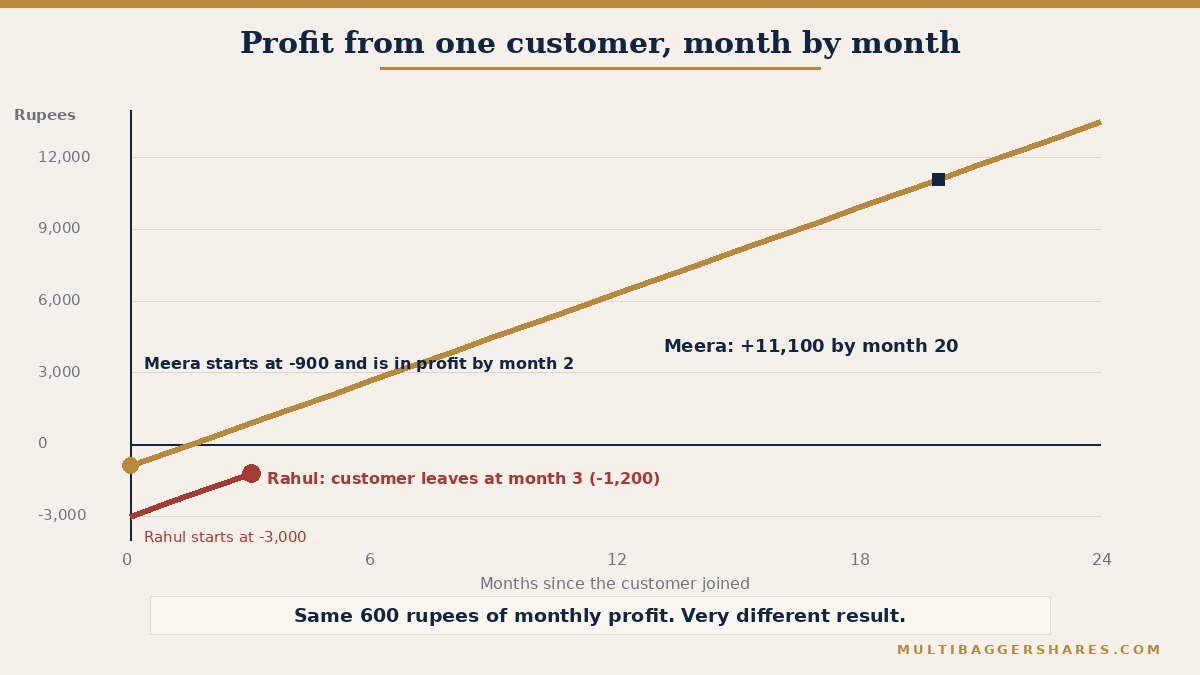
Every time Meera wants a new customer, she has to spend something first. She sends a free trial week of lunches to anyone in the neighbouring society who is curious. That costs her about 700 rupees in food and effort. She also prints a few pamphlets and drops them in letterboxes, which adds another 200. So each new customer costs her about 900 rupees to win, before the person has paid her a single rupee.
Today’s letter is about that 900 rupees. It is a small number in a small kitchen, but the idea behind it sits inside every business in the world, from a tiffin service to a mobile phone company to a supermarket chain. Once you see it, you will start reading business news a little differently.
What it really means
Businesses use three plain ideas here, and none of them needs a calculator. The first is customer acquisition cost (what a business spends to win one new customer, including free trials, discounts, advertising and the time of its salespeople). For Meera, that is 900 rupees.
The second is lifetime value (the total profit a customer brings before they eventually leave). Notice that this is profit, not sales. If a customer pays 3,000 rupees a month but only 600 of that is left after costs, it is the 600 that counts.
The third idea decides how big the second one becomes. It is churn (the share of customers who leave in a given period). If one out of every twenty of Meera’s customers drifts away each month, her average customer stays for about twenty months. A handy shortcut: the average time a customer stays is roughly 1 divided by the share who leave. One in twenty leaving is 1 divided by one-twentieth, which is twenty months.
Now do Meera’s arithmetic. A customer who stays twenty months and leaves 600 rupees of profit each month brings her about 12,000 rupees in all. She paid 900 to win that customer. For every rupee she spent at the start, she gets back about thirteen over time. That is a wonderful trade, and it is why she can happily offer the free trial week.
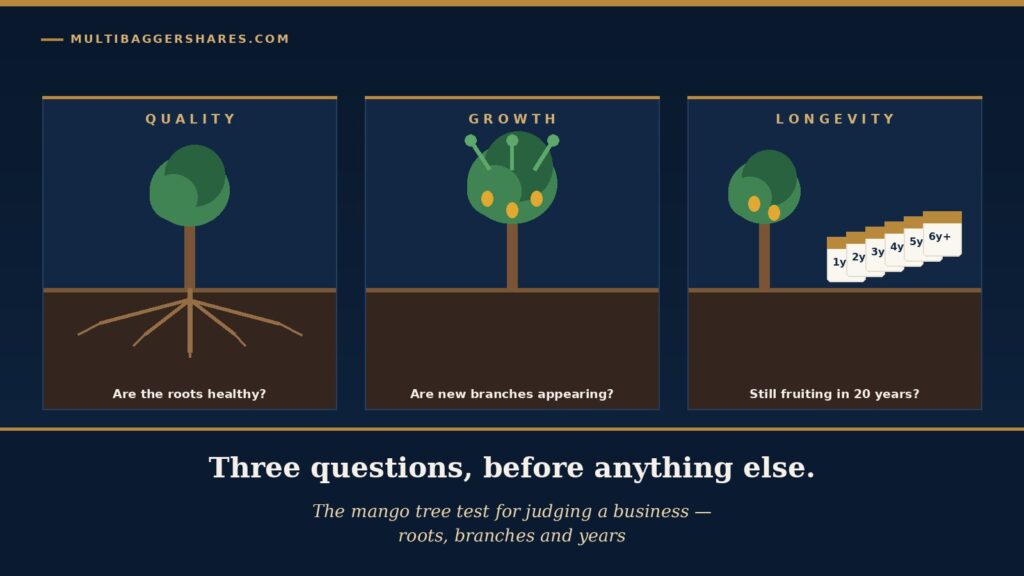
Look at what is really going on. The cost comes first, all at once. The profit comes later, a little each month. It is exactly like planting a mango sapling: you pay for the sapling and the watering today, and the fruit arrives year after year. The only question is whether the tree stays standing.
Why it works
To see why the length of stay matters so much, meet Rahul, who runs another tiffin service across the road. His food is perfectly decent and his monthly profit per customer is the same 600 rupees. But he wins customers differently. He gives the first month free and a heavy discount on the second. By the time a new customer has signed up, Rahul has spent about 3,000 rupees to win them.
Customers who come for a free month often leave when the free month ends. Rahul finds that about one in three of his customers leaves every month, so the average customer stays for three months. Three months at 600 rupees is 1,800 rupees of profit. He spent 3,000 to get it. On every new customer he is poorer by 1,200 rupees.
Here is the surprising part. On the day you look at the two businesses, they can look alike. Both have a full order book. Both are adding customers every week. Both show rising sales. Rahul may even report faster growth, because he is giving things away. But Meera is building something that gets stronger every month, and Rahul is running to stand still. He is, in a way, renting his customers rather than earning them.
Notice, too, that the whole difference came from two numbers: what it cost to win a customer, and how long the customer stayed. It was not about the food, and it was not about the monthly profit, which was identical. This is why careful investors look past “how fast is it growing?” and ask “what does the growth cost, and does it stay?” We met a cousin of this thought in an earlier letter on why growth only counts when it earns a return.
There is a second benefit for Meera that does not show in the arithmetic. Happy customers who stay also tell their neighbours. So some of her new customers arrive for free, and her average cost of winning a customer falls over time. For Rahul it works the other way. Discount-hunters tell their friends about the next discount, not about the food. His cost of winning keeps climbing.
Churn matters even when the cost of winning is low. Imagine a third shop that wins customers cheaply, say for 100 rupees, but loses half of them every month. On paper the cost looks tiny. But the owner must keep winning customers just to stay the same size, like a bucket with a hole in it. The cheap tap never quite fills it.
None of this means that spending a lot to win a customer is always foolish. Suppose a fourth kitchen spends 2,000 rupees on every new customer, but its customers are so happy that they stay for six years. That is a patient investment, much like planting a slow-growing teak tree. The cost is high, yet the long stay more than repays it. The danger is not the size of the cost. The danger is a high cost that is paired with a short stay. That pairing is the treadmill, and it is the one to watch for.
A real example, and the one to remember
Most big companies do not tell us their cost of winning a customer. But some of them tell us how many customers stay, and that is half of the story. A famous example is Costco, the American warehouse club (a chain of large stores where people pay a yearly membership fee for the right to shop).
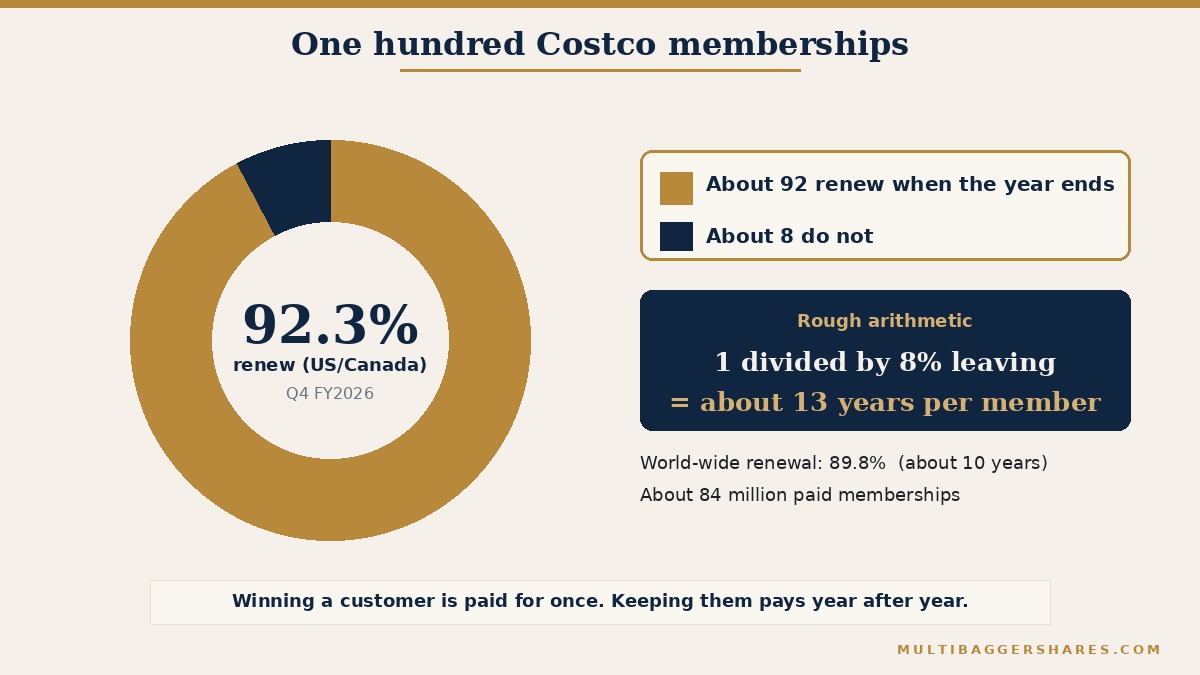
In the supplementary information for the fourth quarter of its 2026 financial year, Costco reported about 84 million paid memberships. It also reported a renewal rate (the share of members who sign up again when their year ends) of 92.3 percent in the United States and Canada, and 89.8 percent across the world. These are the company’s own reported figures, and they move a little from quarter to quarter.
Use Meera’s shortcut. If about 92 out of 100 members renew, about 8 leave each year. One divided by 8 percent gives roughly thirteen years. So an average Costco member, on this rough arithmetic, stays for more than a decade. At the world-wide rate, with about 10 in 100 leaving, it is about ten years. Real members do not behave so evenly, and this is only a back-of-the-envelope picture. But it shows how powerful a high renewal rate is: the same customer pays the fee again and again, year after year, and the cost of winning them was paid only once.
Please read this as a lesson about how to look at a business, not as a verdict on Costco or on any other company. We are not saying anyone should do anything with any share. The point is the habit of mind. A business whose customers keep coming back is working with a tailwind. A business that has to win everyone again every month is working against a headwind.
The founder of Walmart, Sam Walton, put the same idea in one line that is widely quoted: “There is only one boss. The customer. And he can fire everybody in the company from the chairman on down, simply by spending his money somewhere else.” The customer who stays is the customer who has not fired anyone yet.
A last everyday example. Think of the chai stall at the corner of your lane. The owner knows that your regular order is worth far more than a one-time sale. That is why he remembers how much sugar you like, and why he never lets you wait longer than a minute. He cannot put a number on it, but he is doing lifetime-value arithmetic every morning, in his head.
How you can use it
You will rarely find the words “customer acquisition cost” in an Indian annual report. But the clues are there, and you do not need special tools to find them. Here are three plain questions to ask of any business you are studying.
Question one: do customers come back? Look for any figure the company gives on repeat orders, renewals, retention, or the share of sales that comes from existing customers. A company that is proud of its loyal customers usually says so, in numbers. If a company never mentions it, that silence is worth noting.
Question two: what does it spend to win the next customer? In the profit and loss statement (the page of the report that shows sales, costs and profit), look for lines such as advertising, sales promotion, commissions and customer incentives. Compare them with sales over several years. If these costs keep rising faster than sales, the business may be paying more and more to stand still.
Question three: is the growth coming from customers who stay? Ask whether sales are growing because existing customers spend more over time, or only because a stream of new customers is being brought in through offers. Growth from people who stay is like Meera’s. Growth from people who were bought is like Rahul’s.
One more habit helps. Whenever you read that a company has “added a million customers”, quietly ask how many it lost in the same period. A bucket that gains a million litres and leaks eight hundred thousand has not really grown by a million. The number that matters is the water that is still in the bucket at the end of the year.
A few cautions. Not every business should have high renewal. A shop that sells wedding jewellery will not see the same customer every month, and that does not make it a bad business. What matters is whether the customers it does win are worth more than they cost to win. Also, a number that looks good for one year can hide a bad trend, so look at a few years together.
Finally, remember that this is a way of understanding quality. It is not a way to decide whether a price is high or low, and it does not tell anyone what to do with any share. It simply helps you separate businesses that earn their customers from those that rent them, which is among the most useful things a beginner can learn to see.
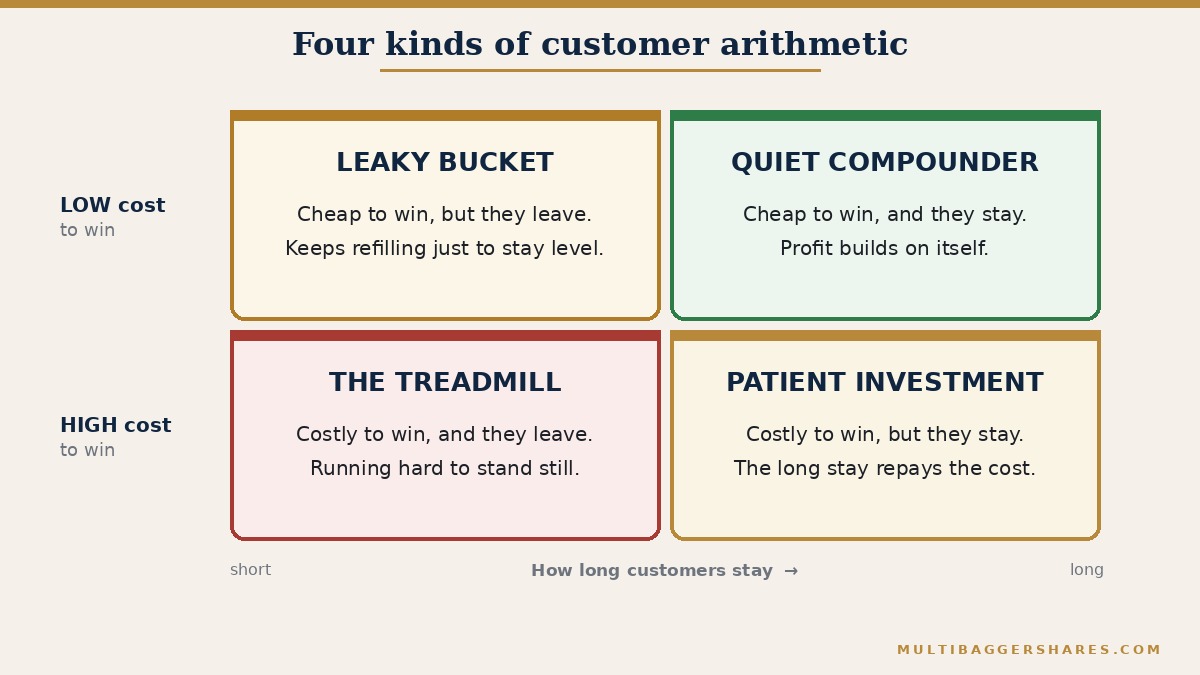
Go back to the two tiffin kitchens in Pune. On a quick visit, you might not tell them apart. Same rice, same dal, same smiling delivery boy. The difference lives in two numbers that never appear on the menu: what it cost to win the customer, and how long the customer stayed. Learn to ask for those two numbers, and you will see a business more clearly than most people ever do.
Key takeaways
- Every customer costs something to win before they pay anything. The real question is what they bring in profit afterwards.
- The average time a customer stays is roughly 1 divided by the share who leave, so small improvements in keeping customers can double their value.
- Growth that is rented with discounts looks the same as growth that is earned, until the customers stop coming.
- Look for clues in the annual report: repeat or renewal figures, selling costs against sales over several years, and where the growth comes from.
- A high renewal rate means the cost of winning a customer is paid once and the profit arrives year after year.
— Manish Goel · multibaggershares.com
Manish Goel is a Chartered Accountant and Principal Officer of Multibagger Securities Research & Advisory Pvt. Ltd. (MSRAPL), a SEBI-registered Investment Adviser, Registration No. INA100007736. This content is published by MSRAPL for education only and is not personalized investment advice.
Disclaimer: This article is published by multibaggershares.com for education and general information only. It is not investment advice, investment research, or a recommendation to buy, sell or hold any security. Any companies named are discussed only as illustrative examples. Markets carry risk; please do your own research or consult a qualified professional before making any investment decision. |