The Mango Tree Test: Raamdeo Agrawal’s Three Simple Questions for Judging a Business

The Interest Coverage Ratio: How to Tell Whether a Company Can Actually Afford Its Debt
September 29, 2026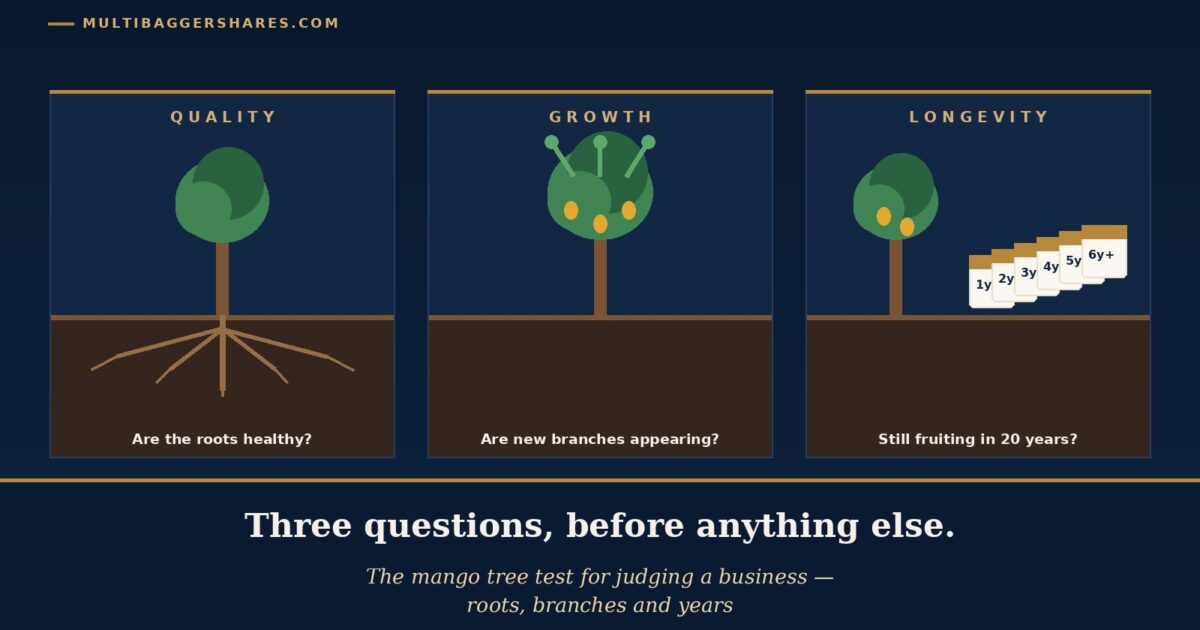
Walk through any mango orchard in Maharashtra or Uttar Pradesh in the weeks before the harvest and you will notice something curious about the farmers. The good ones spend surprisingly little time staring at the fruit. They walk the rows, crouch down, and look at the base of each tree. Are the roots firm in the soil? They look up and ask whether fresh branches are appearing every season. And they think a long way ahead: will this tree still be giving fruit when their children are running the orchard? A tree that fails any one of those three tests is a bad bet, no matter how many mangoes it happens to be carrying this July.
It is a wonderfully practical way to think, and it turns out to be very close to the way one of India’s best-known long-term investors thinks about businesses. Raamdeo Agrawal is a Chartered Accountant (a professionally qualified accountant) and the chairman of Motilal Oswal Financial Services, a firm he co-founded in 1987. Over many decades he has explained his approach with four letters: Q, G, L and P. Today’s letter is about the first three. They are simple enough to explain to a fifteen-year-old, and useful enough that you can start using them this week.
What the three letters really mean
Q is for quality. In Agrawal’s framework, as it is commonly explained, quality means two things together: the strength of the business itself, and the character and skill of the people running it. A strong business is one that earns good returns on the money put into it, does not need to borrow heavily to survive, and has something (a trusted brand, a low-cost way of working, a service customers find hard to leave) that makes it difficult for rivals to copy. Honest, capable management means the people in charge treat outside shareholders as fellow owners. In our orchard, quality is the roots: it is hidden below the surface, you cannot see it from the road, and yet every other good thing depends on it.
G is for growth. Growth simply means the business is getting bigger in a way that actually matters — more customers, more sales, and above all more profit each year. A tree with healthy roots that never puts out a new branch will give you the same modest harvest forever. Growth is what turns a good business into a wealth-building one, because of compounding (earning returns on your past returns, so that a small yearly gain snowballs into something large given enough years). But notice the order of the letters. Growth comes second, after quality. A business that grows fast on weak roots is like a tall, thin sapling that looks wonderful for two seasons and then falls over in the first strong wind.
L is for longevity. This is the letter most beginners never think about, and it is the one that separates a nice year from a nice life. Longevity means how long the first two letters can last. Quality that fades after three years is not much use. Growth that runs out in five is not much use either. The real question is whether a business can keep being good, and keep growing, for a decade or two — long enough for compounding to do its slow, quiet work. Our farmer’s version is the calendar: will this tree still be fruiting when the children take over?
How can a beginner check the roots without a finance degree? Three everyday clues go a long way. First, look at whether the business has needed to borrow a great deal just to keep going; a company that is constantly in debt is like a tree that needs a stranger to water it every week. Second, look at whether the business earns good returns on the money it uses year after year, not just in one good season. Third, look at how the owners behave when times are hard — whether they explain problems plainly, or hide them in small print. None of these needs a calculator. They need patience and a willingness to read what the company says about itself.
The fourth letter, and why we are leaving it alone today
The last letter, P, stands for price — what you pay to own a share of the business. Agrawal treats it as important, and he places it last on purpose: as widely reported, his line is that quality comes first and price comes last. That is also how we like to teach here. Deciding whether a particular price is sensible is a separate skill with its own pitfalls, and this letter deliberately does not go there. Today is about the first three questions, because a beginner who learns to answer them well has already avoided most of the mistakes that hurt investors, long before price ever comes up.
It is worth saying plainly what this framework is not. It is not a formula that spits out an answer, and it is not a list of names to copy. Two careful people can look at the same business and disagree about its roots or its calendar, and that is fine. What the three letters give you is something more modest and more valuable: a fixed order of questions, so that you do not get distracted by whatever happens to be loudest on the day — a headline, a whispered rumour, a sudden jump in a share price.
Why asking them in this order works
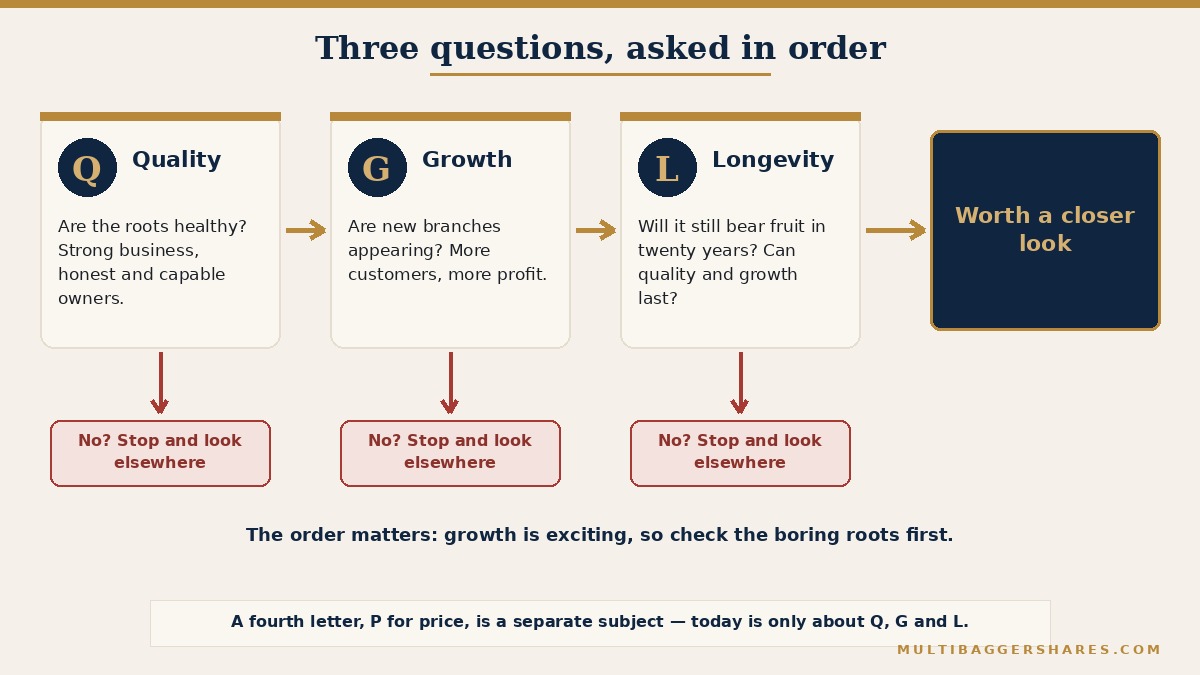
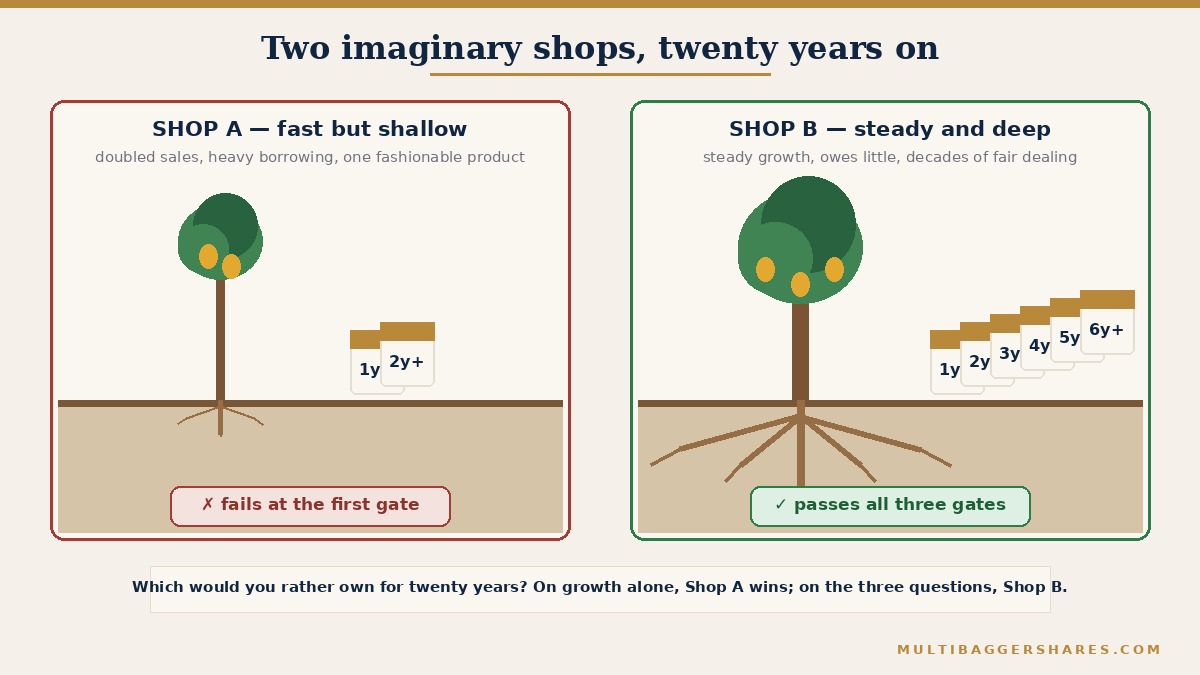
The order is the clever part. Imagine you had to choose between two neighbouring shops for a twenty-year partnership. Shop A has doubled its sales in two years and everyone in the market is talking about it, but it borrowed heavily to open new counters, its owner has already changed three times, and it depends on a single fashionable product. Shop B has grown by a steady, unexciting amount every year, owes very little, is run by a family that has treated its customers fairly for decades, and is now teaching the third generation. On growth alone, Shop A wins. On the three questions in order, Shop B walks away with it, because Shop A fails at the very first gate.
This is why the first question is about quality rather than about growth. Growth is easy to see and exciting to talk about. Quality is slow, hidden and rather boring. That is exactly why so many newer investors get it backwards, and why asking the boring question first is such a useful habit. If the roots are weak, nothing that follows can be trusted. If the roots are strong but nothing is growing, you have a safe but rather sleepy investment. If the roots are strong and the tree is growing, you then ask the third question — and it is the third question that quietly rules out many attractive-looking businesses whose best days, it turns out, are already behind them.
What actually shortens a calendar? A few things come up again and again. A business may depend on one big customer who can walk away, or on a single product that a newer invention can replace. Its industry may change faster than it can adapt, the way the makers of typewriters once watched the world move to computers. Or its leaders may quietly stop caring about the customer and start caring about the next quarter. Longevity is not something you can measure with one number. It is a judgement, made by asking honestly what could go wrong, and whether the business has the habits to survive it. This is precisely why the third question is the hardest, and why so many people skip it.
A real example of the habit: the study that has looked back for thirty years
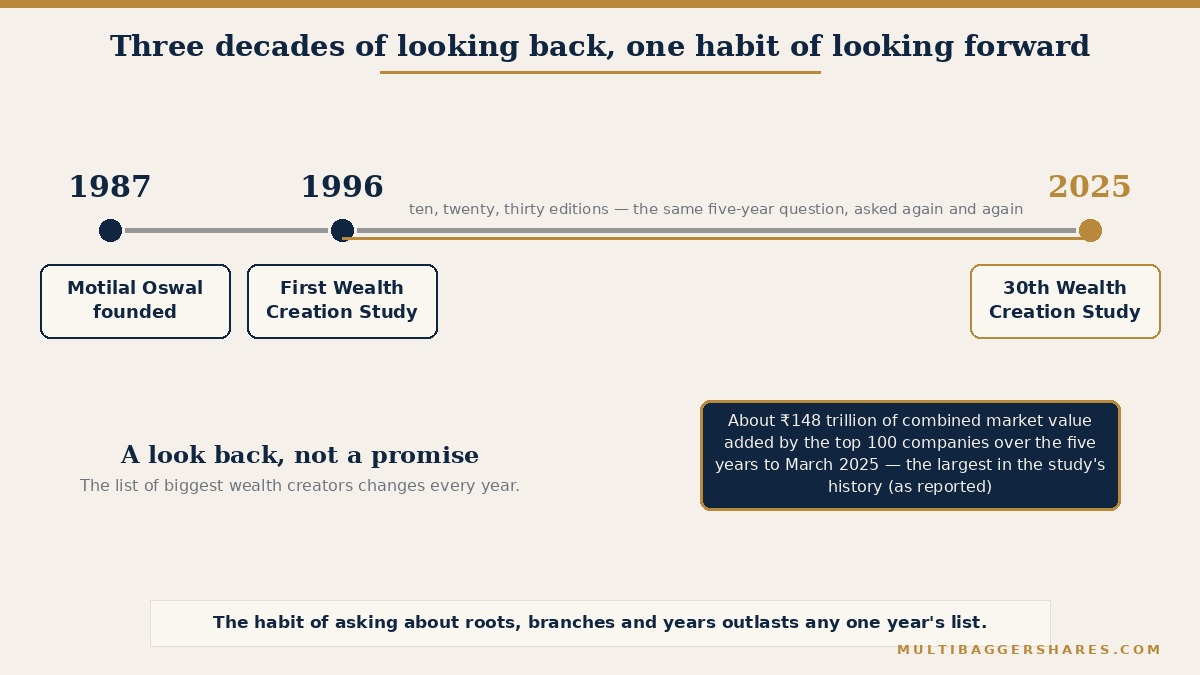
Agrawal does not only talk about the framework; he has spent decades testing it against real results. Since 1996, he has directed an annual publication called the Motilal Oswal Wealth Creation Study. Each edition looks at the biggest companies listed in India and measures how much their market value (the total price the stock market puts on all of a company’s shares) grew over the previous five years, adjusted for things like dividends, mergers and new share issues so that the comparison is fair. It is a long, patient look backwards, repeated year after year.
The most recent edition, the thirtieth, was released in December 2025 and covered the five years to March 2025. As reported at the time, the top one hundred companies together added about ₹148 trillion of market value over that period, the largest figure in the study’s history. In releasing it, Agrawal said, in substance, that long-term wealth in India would be created by high-quality businesses that can keep compounding for decades. That is the mango tree test in one sentence: quality, growth and longevity, in that order.
There are two honest cautions here, and we should state them clearly. First, a look backwards is a look backwards. The businesses that created wealth over the last five years are not thereby guaranteed to do so over the next five, and nothing in this letter suggests otherwise; we are describing a way of thinking, not pointing at any company. Second, the study is worth reading precisely because it forces an uncomfortable humility. Year after year, the list of biggest wealth creators changes. Some names that looked unbeatable slip down; some that looked ordinary climb. The habit of asking about roots, branches and calendar is a way of staying sensible in the face of that constant change.
How you can use it this week
You do not need any special software. Take any business you already know well — the company behind a product your family has bought for years, say — and write three short answers on a sheet of paper. For quality: does this business seem to earn good returns without borrowing heavily, and do its owners behave like people you would trust with your savings? For growth: is it selling more, and earning more, than it was five years ago? For longevity: what would have to go wrong for this business to be much weaker in fifteen years, and does that seem likely?
Be honest about the answers you cannot give. If you cannot say whether the roots are healthy, that is not a failure; it is useful information, and it tells you the business may sit outside your circle of competence (the set of businesses you genuinely understand well enough to judge). Many good investors spend most of their lives saying “I do not know” to most businesses, and saving their attention for the few where all three answers come easily.
One more small habit. Do the exercise in the order the letters come, and resist the temptation to skip to growth because it is more fun. If the first answer is weak, stop there and go looking elsewhere. There will always be another orchard. Agrawal’s own motto for what comes after the three questions is “Buy Right, Sit Tight” — a reminder that once the questions have been answered honestly, the hardest and most valuable part is often simply patience, letting the tree do its slow work through the seasons.
The farmer looking at the base of the tree is not being pessimistic or clever. He is asking the questions that decide whether there will be fruit in twenty years, not just whether there is fruit today. Quality, growth and longevity are those questions, translated into the language of business. Learn to ask them calmly, in order, and you will already be thinking about companies in a way that most people never do.
Key takeaways
- Ask three questions in order, like a farmer looking at a tree: is the business strong at the roots (quality), is it growing new branches (growth), and can it keep doing both for decades (longevity)?
- Quality comes first because it is hidden and slow. Fast growth on weak roots is a tall, thin sapling that looks wonderful for two seasons and falls in the first strong wind.
- Longevity is the letter beginners forget. Good quality and good growth only build real wealth if they last long enough for compounding to work.
- The framework is Raamdeo Agrawal’s QGLP; today’s letter covers only the first three letters and deliberately leaves the fourth, price, alone.
- Try it on one business you already know: write three short answers on paper, in order, and be honest about what you cannot answer — that is where your circle of competence ends.
— Manish Goel · multibaggershares.com
Manish Goel is a Chartered Accountant and Principal Officer of Multibagger Securities Research & Advisory Pvt. Ltd. (MSRAPL), a SEBI-registered Investment Adviser, Registration No. INA100007736. This content is published by MSRAPL for education only and is not personalized investment advice.
Disclaimer: This article is published by multibaggershares.com for education and general information only. It is not investment advice, investment research, or a recommendation to buy, sell or hold any security. Any companies named are discussed only as illustrative examples. Markets carry risk; please do your own research or consult a qualified professional before making any investment decision. |