The Small Print Nobody Reads: Why the Notes Behind a Company’s Numbers Matter

When More Growth Makes You Poorer: Why Growth Only Counts When It Earns Its Keep
September 25, 2026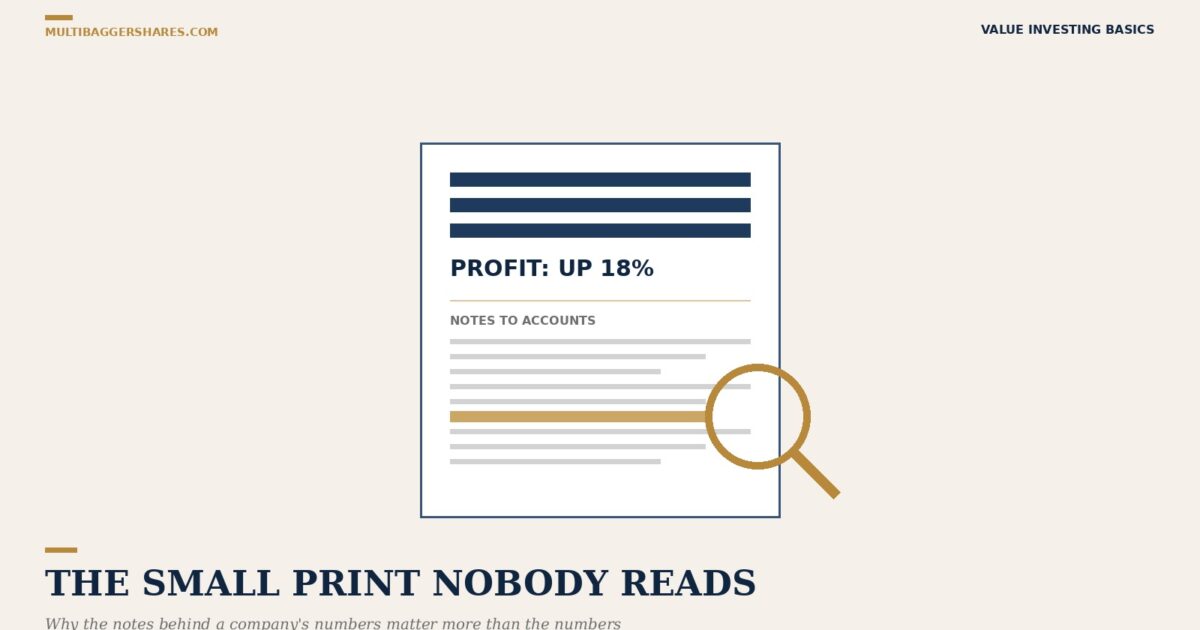
Imagine you are about to rent a flat. The landlord shows you a one-page summary: rent, deposit, move-in date. It looks simple and fair. But the real agreement is twelve pages long, in small print, and it is sitting on the table too. That small print might say the deposit is non-refundable if you leave before eleven months, or that you must repaint the walls before you go, or that the landlord can raise the rent every six months instead of every year. Nobody reads it, because the one-page summary already told a nice story. The people who do read it are the ones who never get an unpleasant surprise.
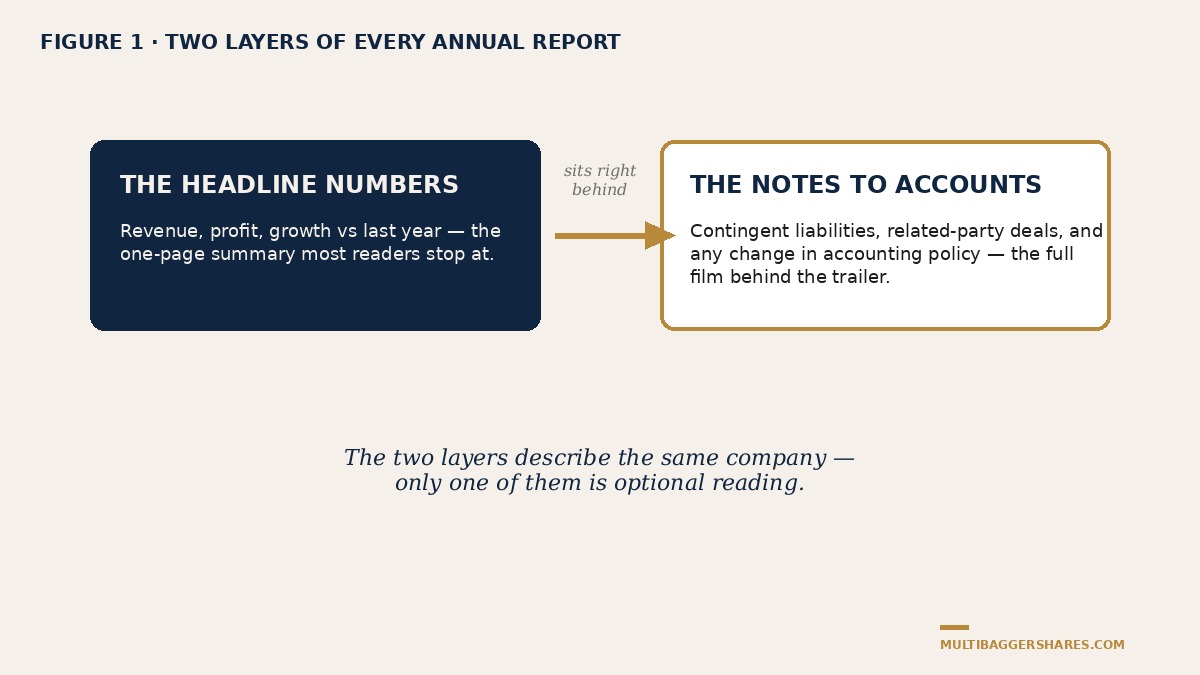
A company’s yearly result works the same way. Every year, a listed company (a company whose shares anyone can buy and sell on a stock exchange) publishes an annual report. Most readers look at three numbers: how much the company sold (revenue), how much it kept as profit, and how that profit compares with last year. That is the one-page summary. But sitting right behind those numbers, in the same document, are pages and pages of “notes to accounts” — what most people simply call the footnotes. Almost nobody reads them. The investors who quietly do the best over twenty and thirty years are very often the ones who do.
This is not a habit reserved for professional analysts with teams of assistants. It takes no special software and no formal accounting degree — only the patience to keep reading for another twenty minutes after most people have already closed the report. That twenty minutes is, quietly, one of the highest-paid habits in long-term investing, precisely because so few people are willing to spend it.
What the footnotes really are
Think of a company’s profit number as a movie trailer. It is true, but it is also chosen — the two most exciting minutes cut out of a two-hour film. The footnotes are the full film. They are not optional extra detail; under Indian company law, a set of financial statements is not even considered complete without them. They are where a company must, by law, spell out the things that do not fit neatly into a single number: money it might have to pay in the future if a court case goes against it (called a “contingent liability” — a debt that only becomes real if something else happens first, like a fire insurance claim that only pays out if there is a fire), deals it has done with its own promoters or their relatives (called “related-party transactions”), and any change in the very rules it used to calculate this year’s profit compared with last year’s.
Here is why that last one matters so much. Profit is not a fact of nature, like the temperature outside. It is an estimate, built on choices: how fast to assume a machine wears out, when exactly to count a sale as “done,” how much to set aside for customers who might not pay their bills. Two perfectly honest accountants, looking at the same business, can arrive at two different profit numbers depending on which reasonable choices they make. The footnotes are where a company has to tell you which choices it made — and, more importantly, whether it quietly changed a choice this year in a way that happened to make profit look better.
Why this works as a filter
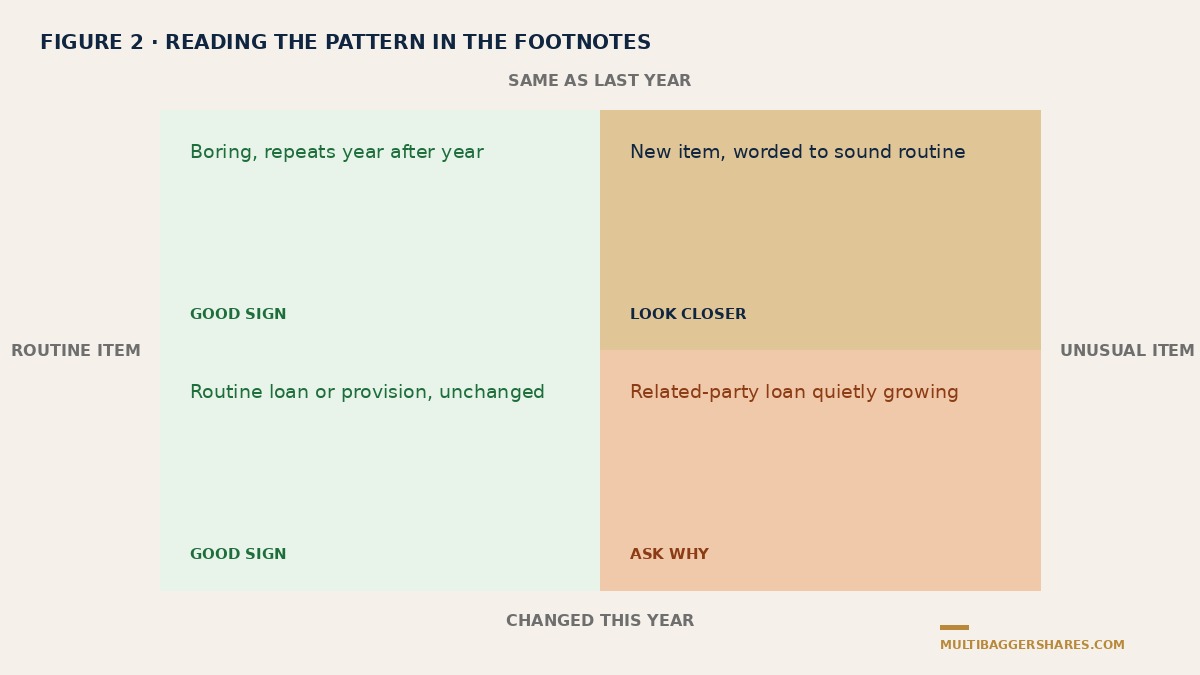
A management team that is running an honest, uncomplicated business has very little reason to hide anything in fine print, for the same reason a landlord renting out a straightforward, well-kept flat has no reason to bury unpleasant terms on page eleven. Their footnotes tend to be short, repetitive from year to year, and boring — the same handful of routine disclosures, worded almost identically each time. That sameness is not laziness. It is evidence that nothing unusual is being managed around.
A management team that is stretching the truth, on the other hand, tends to leave a trail in exactly this part of the report — not because they want to confess, but because the law forces some disclosure even when a company would rather not make one. A contingent liability that quietly grows every year. A related-party loan that keeps getting “extended” instead of repaid. A change in how depreciation (the yearly reduction in the recorded value of a machine or building as it ages) is calculated, introduced in the one year that profit needed a boost. None of these things show up in the headline profit number the way a lie would. They show up as a small, dry paragraph in a note numbered something like “Note 34,” using flat, technical language precisely so that it does not draw attention.
This is also where an auditor’s report earns its keep. An auditor (an independent chartered accountant hired to check that a company’s accounts are fairly presented) will sometimes add a line called a “qualification” or an “emphasis of matter” — a polite but pointed way of saying “we want you to notice this specific thing before you trust the rest.” These lines are almost always short, almost always appear near the notes rather than the headline numbers, and are almost always the single most useful sentence in the entire annual report for a patient reader.
Why even careful people skip this step
If footnotes are this useful, it is fair to ask why so few people bother with them. The honest answer is that they are written to be skipped. They are long, they repeat legal phrasing from year to year, and they are printed in a smaller font at the back of the report, well after the glossy photographs of factories and the chairman’s cheerful letter to shareholders. Reading forty pages of small, dry, repetitive text feels like a poor use of an evening compared with simply checking whether profit went up or down. That feeling is completely understandable — and it is exactly what creates the opportunity for the small number of readers willing to sit through it anyway.
Charlie Munger, Warren Buffett’s long-time partner at Berkshire Hathaway, was well known among investors for treating the footnotes as compulsory reading rather than optional detail — his general view, expressed many times over the decades, was that a person who only reads the headline numbers of a financial statement does not yet understand the business well enough to have an opinion on it. That is a high bar, and it is meant to be. Nobody is expected to clear it for every company they glance at. But for the handful of businesses a long-term investor actually decides to follow closely over years, it is exactly the right bar to aim for.
A real example: what the notes eventually told the world
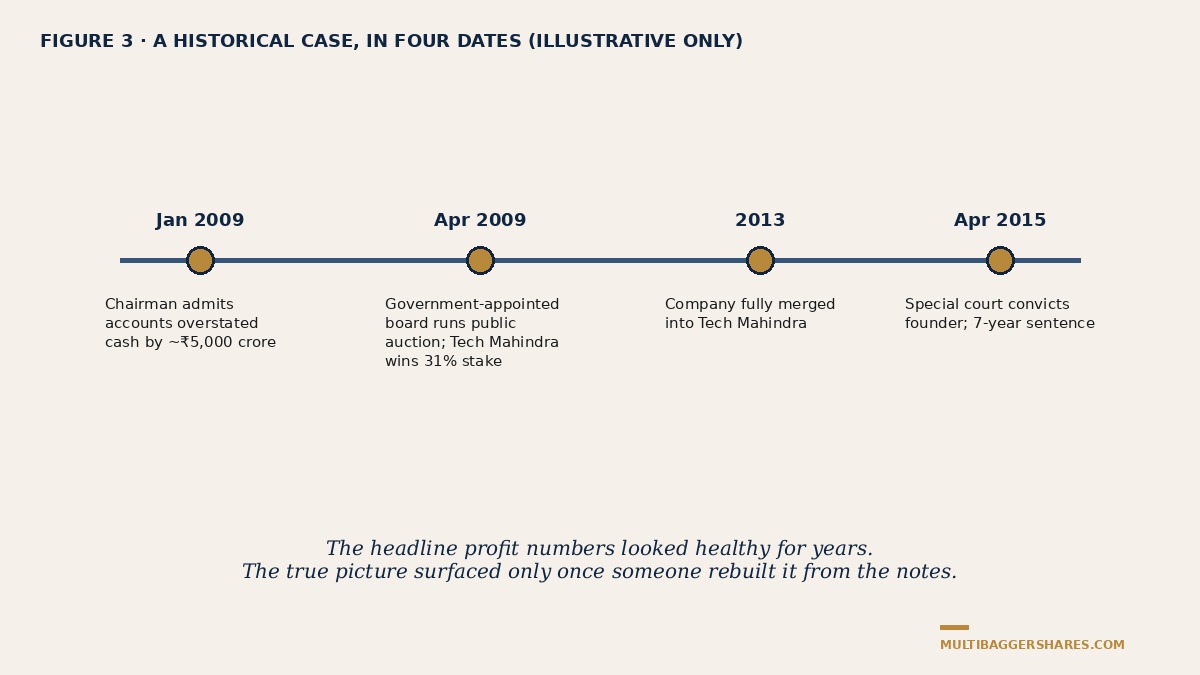
The clearest illustration of this in Indian markets remains the Satyam Computer Services case. On 7 January 2009, the company’s chairman, B. Ramalinga Raju, admitted in a public letter that the company’s accounts had overstated its cash and bank balances by roughly ₹5,000 crore, out of a total fraud of roughly ₹7,000 crore — about $1.5 billion at the time. For years before that letter, Satyam’s headline numbers — revenue growing, profit growing, margins healthy — told a clean story on their own. This is offered purely as a historical case study of why the small print matters, not as commentary on any company operating today.
What came out afterwards is instructive for a very unglamorous reason: forensic investigators and analysts rebuilding the true picture leaned heavily on inconsistencies that careful readers could, in principle, have cross-checked — a company that reported large cash and fixed-deposit balances should also report matching interest income in its notes; large “advances” to related entities should be traceable to something real on the other side. None of this required insider knowledge. It required the unglamorous habit of reading Note after Note and asking whether the small details behind a number actually added up to that number. Few readers did that in real time, which is exactly the point: this is a skill that pays precisely because almost nobody bothers to practise it.
The aftermath is also worth knowing, simply as a matter of record. In April 2015, a special court convicted Raju and several co-accused, and he was sentenced to seven years of rigorous imprisonment. On the business side, the story had a more constructive ending than the numbers alone might suggest: in April 2009, only a few months after the confession, a government-appointed board ran a transparent public auction for the company, which Tech Mahindra won with a bid for a 31% stake. The company was later renamed and, by 2013, fully merged into the Tech Mahindra group — a reminder that even a severe accounting fraud does not have to mean the underlying operating business, its clients and its employees, are automatically worthless; it means the reported numbers cannot be trusted until someone rebuilds the true picture from scratch.
A gentler, everyday example makes the same point without any scandal attached. Two kirana (neighbourhood grocery) shop owners each report making a profit of five lakh rupees this year. One of them explains, in a note nobody asked for, that eighty thousand of that came from a one-time sale of an old refrigerator he no longer needed. The other says nothing extra. If you only look at the headline profit, both shops look identical. Once you read the small print, one of them earned four lakh twenty thousand rupees from actually running a shop, and the other genuinely earned five lakh. That is the entire idea of footnote-reading, at the smallest possible scale.
How you can actually use this
You do not need to become an accountant to benefit from this habit. Three simple checks go a very long way, and none of them require guessing where any stock price is headed — this is about judging the quality and honesty of a business’s reporting, never about whether its shares are cheap or expensive.
- Read the auditor’s remarks first, before the numbers. If an auditor has added any qualification, emphasis, or “key audit matter,” read that one paragraph closely before you read anything else. It is the one part of the report an independent professional is required to write in plain language specifically to flag a concern.
- Compare this year’s related-party note with last year’s. A loan to a promoter’s other company that keeps rolling over year after year, growing slightly each time, is a pattern worth noticing — not because it is automatically wrong, but because patterns that repeat quietly are exactly what footnotes are for.
- Notice when an accounting policy changes. Companies are required to disclose any change in how they calculate depreciation, revenue recognition, or provisions. A change that happens to arrive in a difficult year, and happens to help profit, deserves a second look — even if the explanation given sounds perfectly reasonable.
- Check whether cash and debt actually make sense together. A company that reports a large cash balance in one note while also paying a surprisingly high rate of interest on its borrowings elsewhere in the same report is describing something that does not quite add up — either the cash is not as freely usable as it looks, or the two notes are not telling a fully consistent story. This single cross-check, comparing one note against another rather than reading either in isolation, is one of the simplest and most reliable habits a patient reader can build.
None of this is about becoming suspicious of every company. Most footnotes, in most annual reports, are exactly as boring as they should be — which is itself useful information. The value of this habit is that it costs you almost nothing in the ninety-nine years out of a hundred when there is nothing to find, and it can save you a great deal in the one year when there is.
Key takeaways
- The headline profit number is a summary, not the whole story — the notes to accounts are where the full story legally has to appear.
- Boring, repetitive footnotes from year to year are usually a good sign; sudden new items or quietly growing ones deserve a closer look.
- An auditor’s qualification or “emphasis of matter” is often the single most useful sentence in an entire annual report.
- Related-party transactions and changes in accounting policy are the two footnote items worth checking most consistently, year after year.
- This habit is about judging the honesty and quality of a business’s reporting — never about predicting or timing its share price.
— Manish Goel · multibaggershares.com
Manish Goel is a Chartered Accountant and Principal Officer of Multibagger Securities Research & Advisory Pvt. Ltd. (MSRAPL), a SEBI-registered Investment Adviser, Registration No. INA100007736. This content is published by MSRAPL for education only and is not personalized investment advice.
Disclaimer: This article is published by multibaggershares.com for education and general information only. It is not investment advice, investment research, or a recommendation to buy, sell or hold any security. Any companies named are discussed only as illustrative examples. Markets carry risk; please do your own research or consult a qualified professional before making any investment decision. |