The Only Chemist Inside the Hospital: How to Judge a Business Protected by a Permission Others Cannot Get

The Tea Stall and the Wedding Hall: How Often a Business Has to Be Right
September 22, 2026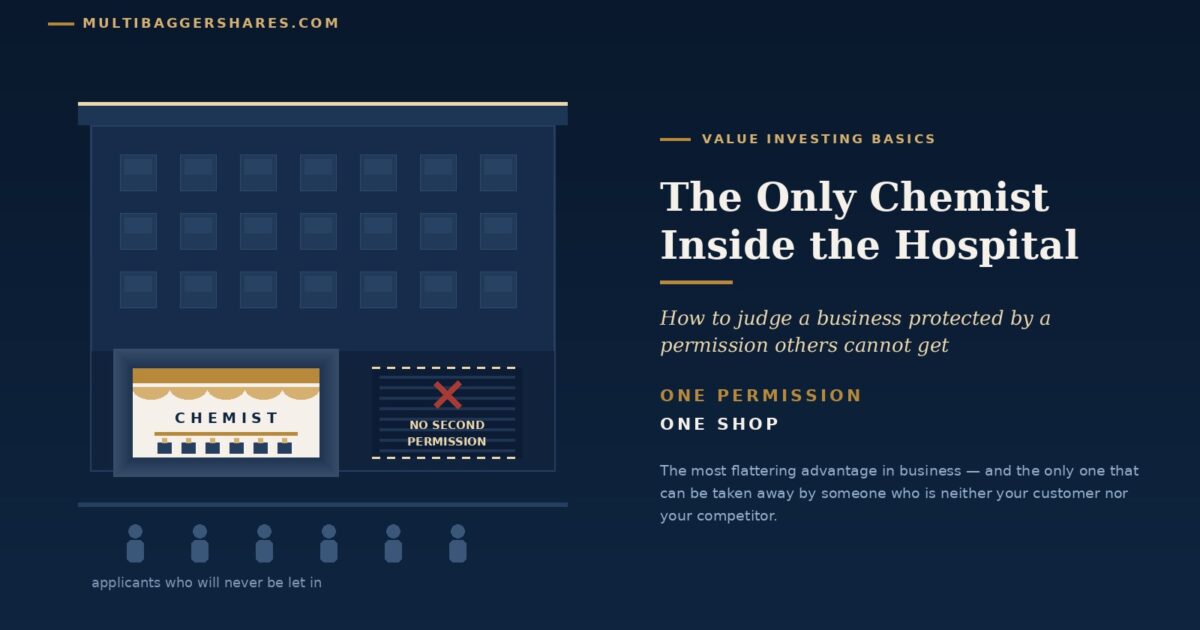
Walk into a large hospital in any Indian city and look for the chemist shop on the ground floor. There is usually exactly one. Its shutter is up at two in the morning. Its prices are the printed prices. Nobody argues with the man behind the counter, and almost nobody walks out of the gate to compare rates at the shop across the road, because a relative is upstairs and the injection is needed now.
Now ask a plain question. What is actually protecting that shop?
It is not the brand, because you did not choose it by name — you chose it by being in that building. It is not service, because there is a queue. It is not price, because there is no discount. It is not even location in the ordinary sense, since a shop fifty metres outside the gate stands on the same road, pays lower rent, and sells the same strips of medicine.
What protects that shop is one piece of paper. At some point the hospital gave one chemist the right to trade inside the building, and it never gave a second. Everything else about that business — the full prices, the calm queue, the profit — follows from that single permission.
This is a real and very common kind of business advantage, and today we are going to learn to recognise it and, more importantly, to judge it. It deserves care for two reasons. It is the most flattering advantage a business can have, because the numbers look wonderful while it lasts. And it is the only advantage that can be taken away from a company by somebody who is not its customer and not its competitor.
What it really means
Start with one term. A barrier to entry is anything that stops a new rival from setting up next to a profitable business and copying it. Without a barrier, profit is an advertisement: a shopkeeper earns well, the neighbours notice, two more shops open on the same lane, and within a year everybody is earning a little less than before. The barrier is what stops that. Investors often call a strong barrier a moat — the water around an old fort, which does not fight for you but makes you much harder to reach.
Broadly, a business can keep rivals at a distance in three different ways.
It can be better — cheaper to run, faster to deliver, more reliable. It can own something rivals cannot copy quickly — a name people trust, a recipe, a network of dealers, a size that makes each unit cheaper. Or it can hold a permission that rivals are simply not allowed to have.
That third one is different in kind from the other two, and it is worth pausing on why. The first two advantages are earned from customers and built by the company itself. The third is granted by a third party who is neither: a government department, a regulator, a court, a municipality, an airport authority, a state excise office, or in our example a hospital’s estate office. Somebody with the power to decide who may trade, and who may not.
The family is larger than the word “licence” suggests. It includes a licence (permission to carry on a trade), a permit (usually narrower and shorter — a route, a season, a load), a concession (permission to build and run something, collect money from it for an agreed number of years, and then hand it over), a lease over land or a mineral deposit, a registration or certification from a regulator saying a factory is fit to make a particular product, and a quota capping how much anybody may sell. They are legally very different documents. For our purpose they do the same job: they decide how many players the field is allowed to hold.
Why it works
The reason a permission is so powerful is that it switches off the ordinary correction mechanism of business.
Think again about the lane of shops. High profit invites imitation; imitation increases supply; extra supply pushes prices and margins back down towards ordinary. That loop is the single most reliable force in commerce, and most good businesses are quietly losing a race against it every year. A permission moat does not win the race. It removes the track. However fat the profit inside the hospital becomes, no second chemist can open next to the first, because the decision is not the market’s to make.
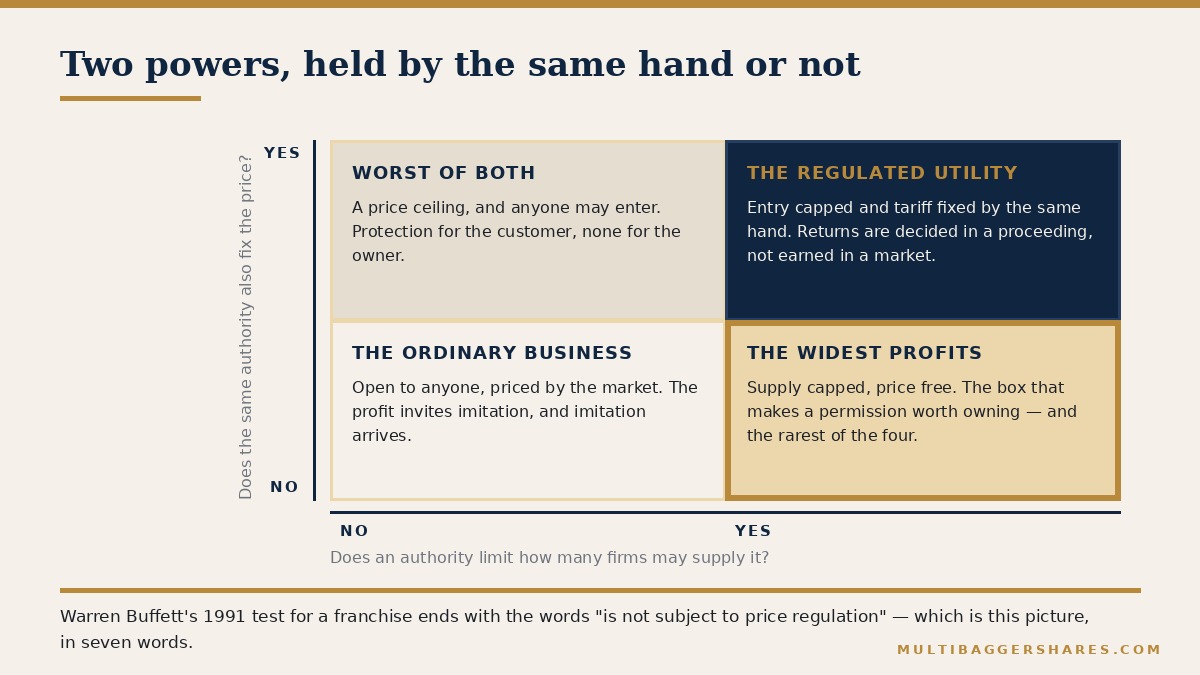
Warren Buffett put this in unusually exact words in his 1991 letter to Berkshire Hathaway shareholders. He said an economic franchise arises where a product or service is needed or desired, is thought by customers to have no close substitute, and — his third condition — “is not subject to price regulation.” Read that list slowly, because our hospital chemist satisfies all three: the medicine is needed, at two in the morning there is no substitute, and nobody caps what the shop may charge above the printed rate structure it already enjoys.
But notice what Buffett’s third condition quietly warns us about. A permission usually comes from an authority. Authorities that have the power to limit how many firms may supply something very often also have the power to decide what those firms may charge. When the same hand holds both powers, the wonderful business becomes a merely safe one. That is the first of four things worth checking, and it is where most beginners go wrong: they see the protection and stop reading.
Four questions to ask of any permission
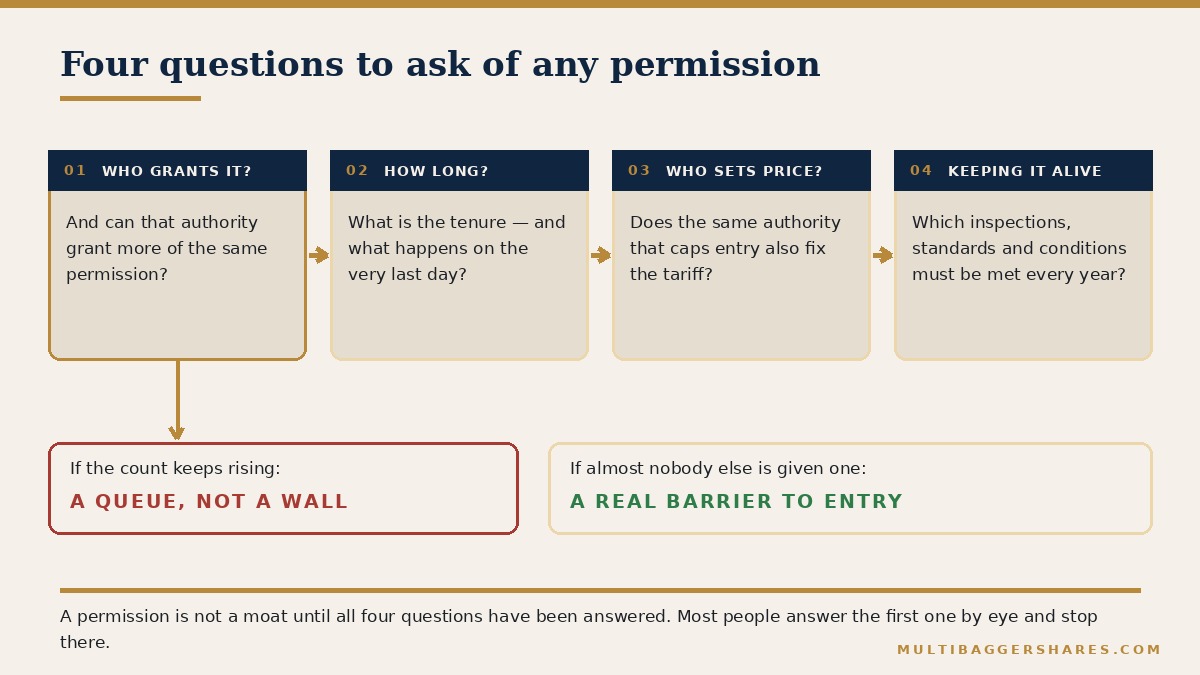
One: who grants it, and can they grant more? This is a counting question, and it has a surprisingly easy answer, because authorities publish what they issue. Count the new permissions granted in the last five or ten years. If the count keeps rising, what the company holds is a place in a queue, not a wall — a head start that anyone patient and compliant will eventually be given too. If the count is tiny, the wall is real.
India offers a clean illustration. On 2 April 2014 the Reserve Bank of India finished a round of applications for new full-service bank licences. Twenty-five applications were considered, from some of the largest industrial houses in the country. Two were granted in-principle approval: IDFC and Bandhan, the Kolkata microlender. Twenty-three houses with money, lawyers and long experience were told no. That is what a real wall looks like from the outside, and it explains why an old banking licence is spoken of as an asset in its own right. Compare that with the shop-and-establishment licence your neighbourhood grocer holds: also a permission, also compulsory, but granted to everyone who applies properly, and therefore worth nothing as a defence.
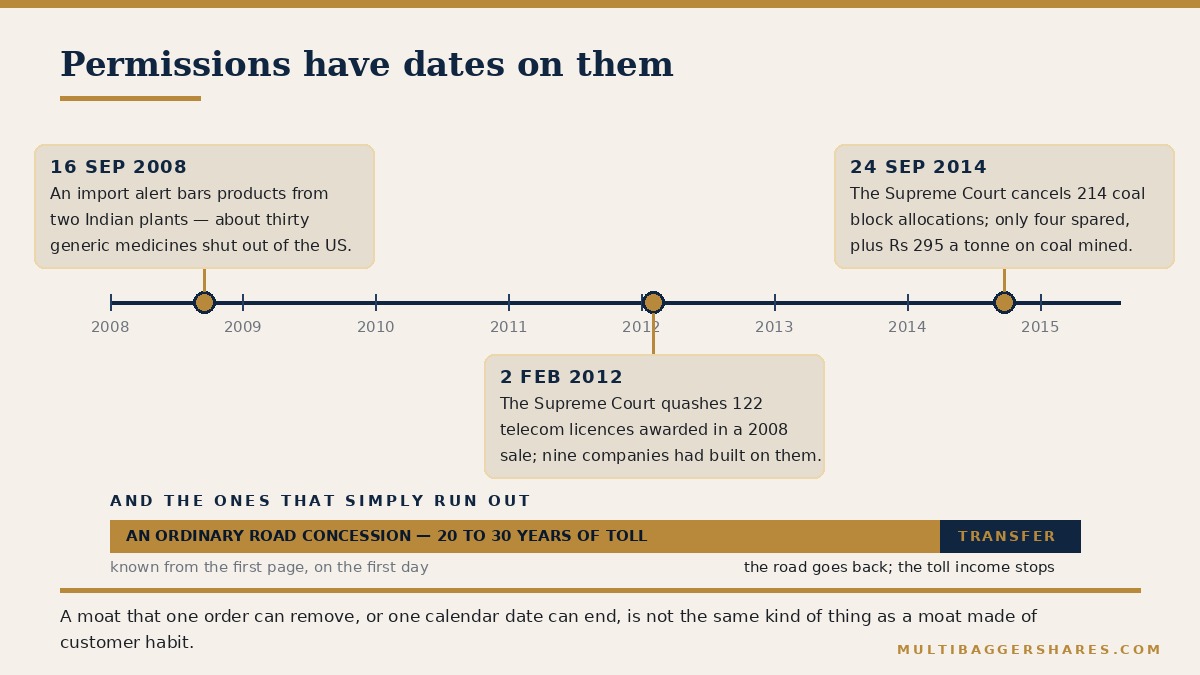
Two: how long does it last, and what happens on the last day? Many permissions carry an expiry date, and a surprising number of investors read the profit and never read the date. The clearest case is a road. Under the build-operate-transfer model used for Indian highways, a private builder finances and constructs a stretch of road and is allowed to collect toll from it for an agreed period — commonly twenty to thirty years. At the end of that period the maintained road is transferred back to the authority, and the builder’s toll income from it stops. Nothing has gone wrong when this happens; it is the deal, written on the first page, on the first day.
So the honest way to describe such a business is not “a company that earns this much every year.” It is “a company collecting a known number of remaining instalments, after which this particular stream ends and the money must be put to work somewhere new.” When you meet a business built on concessions, find the tenure of each one and find out what happens at renewal: is it automatic on good behaviour, is it re-auctioned to the highest bidder, or is it purely at the authority’s discretion? Those three answers describe three completely different businesses wearing the same clothes.
Three: does the same authority that limits supply also decide the price? This is Buffett’s third condition turned into a practical check, and Figure 2 lays out the four possibilities. Where an authority caps the number of suppliers and leaves pricing alone, profits can be wide and stay wide. Where the authority caps entry and sets the tariff — the position of most regulated utilities — the returns are not really earned in the market at all; they are decided in a proceeding, revisited periodically, and usually set at a fair-but-modest level, because the whole point of the regulation is to stop a protected supplier from charging what the traffic will bear. Such a business can be steady and dull and perfectly respectable. It is not a franchise in Buffett’s sense, and it should not be admired as one.
Four: what must the company keep doing to keep it? Permissions almost always come with conditions attached — inspections to pass, standards to maintain, minimum service to provide, a share of revenue to hand over. The conditions are where the danger lives, because a permission that is the whole business is also a single point of failure for the whole business.
On 16 September 2008 the American drug regulator issued warning letters to Ranbaxy Laboratories and put products from two of its Indian plants, at Dewas and Paonta Sahib, under an import alert, barring the commercial import of around thirty generic medicines into the United States. The company still owned the factories, the staff, the machines and the know-how. What it had lost was permission to sell in its largest market from those sites, and no amount of manufacturing skill could substitute for it. Years later those plants had still not resumed shipping to America. When you find a company whose earnings depend on a regulator’s continuing approval of a specific factory, the inspection record is not a footnote. It is the business.
When the permission is taken back
The most useful lesson in this whole subject comes from two Indian cases, both decided in the Supreme Court, and both worth knowing by date.
On 2 February 2012 the Court quashed 122 telecom licences that had been awarded in a 2008 sale, holding that the process of allocation had been flawed. The operators were allowed to keep services running for a limited period so that ordinary subscribers were not cut off, pending fresh auctions. Nine companies had paid, planned, built and hired against those pieces of paper.
On 24 September 2014 the same Court cancelled 214 coal block allocations. A month earlier, on 25 August 2014, it had held that all 218 blocks allotted between 1993 and 2010 were illegal, having been given out in what the judgment called an “ad hoc and casual” manner. Four blocks were spared — one each to the national power and steel producers and two attached to ultra mega power projects. Forty-two blocks whose end-use plants were already running, or nearly running, were given a six-month window, with cancellation taking effect from 31 March 2015. On top of that, an amount of ₹295 per tonne was levied on coal already mined from those blocks. Companies that had treated cheap captive coal as a permanent structural advantage discovered in a single hearing that it was a permission, and that permissions can be revisited.
Draw the right conclusion, not the dramatic one. The lesson is not that businesses built on permissions should be avoided; some of the steadiest enterprises in the world hold licences, and every bank, hospital, airport, pharmacy and liquor shop in India operates on one. The lesson is narrower and more useful. How a permission was obtained is part of its quality. A permission won in an open, published, competitive process, held by a company with a clean compliance record, is a far sturdier thing than one obtained quietly on favourable terms — because the second kind invites exactly the review that ends it, sometimes fifteen years later.
How you can use this
None of this requires a model or a calculator. It requires reading the parts of an annual report that most people skip, with five specific questions in mind.
Find the permissions and list them. Companies that depend on approvals normally set them out — the plant registrations, the regulator certifications, the concession agreements, the excise or mining licences. Write down the issuing authority and the expiry date of each. A business with one permission and a business with forty small ones are not exposed in the same way.
Read the risk factors honestly. A company protected by a permission always names that permission among its principal risks, because it must. That section is the management’s own admission of where the business would break, written in dull compliance language, and it is free.
Count the new entrants. Look up how many comparable permissions the authority has issued in the last five years. This one check separates a wall from a queue faster than anything else, and the data usually sits on a regulator’s website.
Check the compliance record. Inspection outcomes, notices, suspensions, penalties, conditions imposed. For a business whose licence is its moat, this is the equivalent of a factory’s safety record — boring until the day it is the only thing that matters.
Then ask the last question out loud. If this permission disappeared tomorrow, what would the rest of the business be worth on its own merits — its products, its people, its customers, its name? If the honest answer is “very little,” you have not found a company with a moat. You have found a company with a relationship with one authority. It may still be a fine business for years. But you should be able to say that sentence to yourself in plain words, rather than calling it a moat and moving on.
The chemist inside the hospital is a good business. Just remember what it is: a good business for as long as the hospital keeps saying yes, and for exactly as long as it never says yes to anybody else.
Key takeaways
- A permission moat is a barrier made of paper — a licence, permit, concession, lease or approval that stops rivals from entering, granted not by customers but by an authority.
- Count before you admire. If the authority keeps issuing more of the same permission, the company holds a place in a queue, not a wall.
- Read the expiry date. Concessions end, and the honest description of such a business is a known number of remaining instalments, not a profit that repeats forever.
- If the same authority caps entry and also fixes the price, returns are decided rather than earned — a safe business, not a franchise.
- The hand that grants a permission can withdraw it, so how it was obtained and how it is being maintained are part of the quality of the business, not a footnote.
— Manish Goel · multibaggershares.com
Disclaimer: This article is published by multibaggershares.com for education and general information only. It is not investment advice, investment research, or a recommendation to buy, sell or hold any security. Any companies named are discussed only as illustrative examples. Markets carry risk; please do your own research or consult a qualified professional before making any investment decision.