The Tea Stall and the Wedding Hall: How Often a Business Has to Be Right

The Forty Kinds of Biscuit: Why the Best-Selling Product Often Pays for the Worst One
September 21, 2026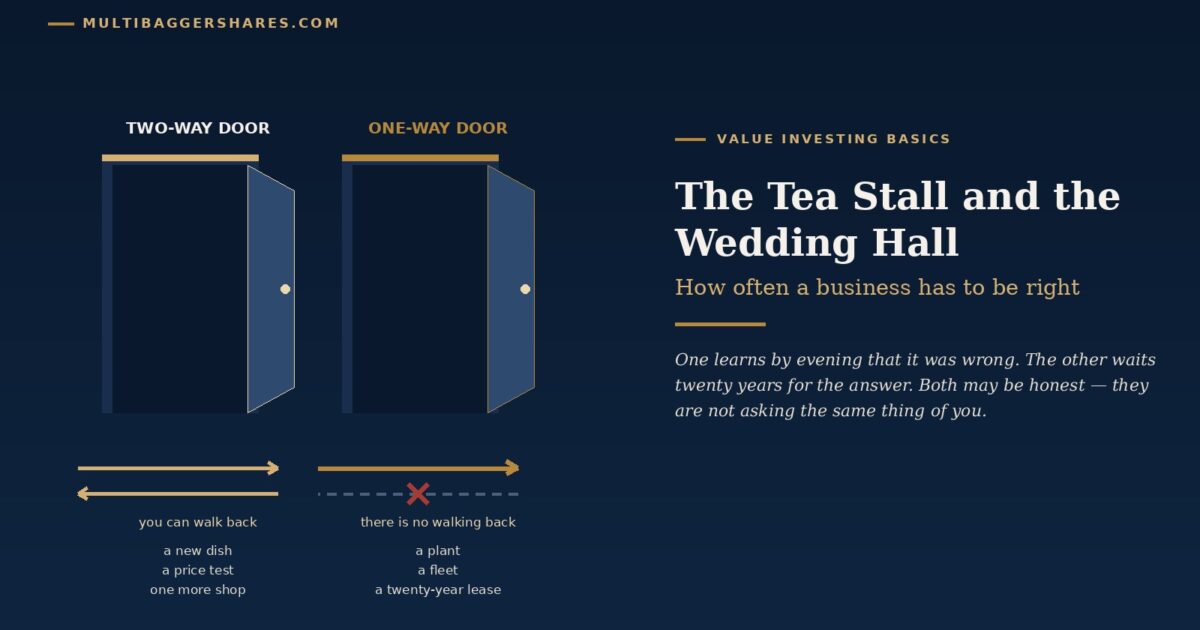
Two families live on the same street.
The first runs a tea stall outside the railway station. Every morning the owner decides how much milk to order, how many packets of biscuits to keep on the shelf, whether to put the samosa tray out at four o’clock or at five. He makes perhaps twenty small decisions before noon, and he gets several of them wrong. By evening he knows exactly which ones, because the unsold milk is standing there in front of him. Tomorrow he orders differently. The mistake cost him forty rupees and one day.
The second family spent everything they had building a wedding hall on a plot at the edge of town. They made one decision — that plot, that size, that road — and they made it once. If the town grows the other way, they will find out slowly, over years, and there will be nothing they can do about it. A hall cannot be picked up and carried to a better road.
Both families may be equally honest, equally hard-working, equally clever. But they are not running the same kind of risk at all. And if you were putting your savings into one of them, you would want to know which.
That is what this letter is about. When you look at any business, ask two plain questions: how often does this business have to be right, and how quickly does it find out when it is wrong? Almost nobody asks them, and they tell you more about how much you are trusting management than any ratio on the page.
Doors that open one way
The clearest description of this idea comes from a shareholder letter. A shareholder letter is the annual note the head of a company writes to the people who own it. Sometimes it is boilerplate. Sometimes it is the most useful page in the whole annual report.
In the 2015 letter to Amazon’s shareholders, its founder Jeff Bezos split decisions into two kinds. Some, he wrote, are “consequential and irreversible or nearly irreversible – one-way doors”. Walk through, dislike what you find, and you cannot get back to where you started. He called these Type 1 decisions, and said they must be made slowly and carefully.
Most decisions, he went on, are nothing like that. They are changeable. They are two-way doors. If you make a poor one you do not have to live with it for long — you open the door and walk back through. Those are Type 2, and they should be made quickly, by one person or a small group, without a committee.
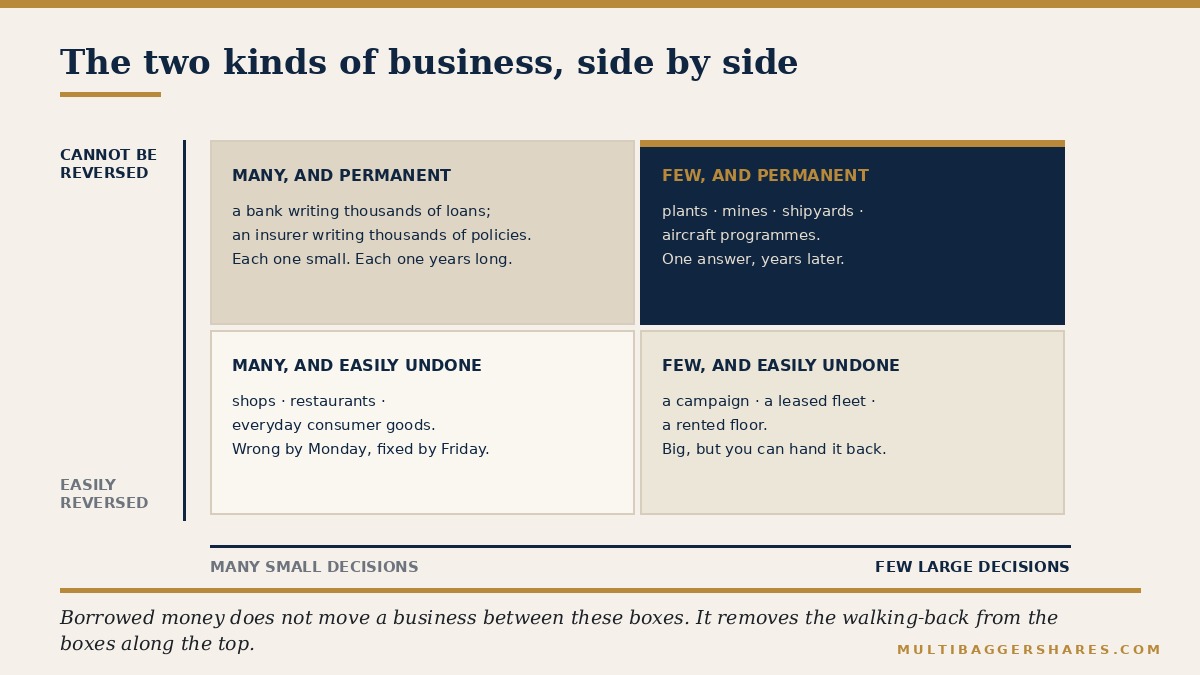
That is a useful split for running a company. It is even more useful for judging one, because businesses are not evenly mixed. Some are built almost entirely out of two-way doors. Others are built out of one-way doors and very little else.
A restaurant chain adding a new dish is opening a two-way door. It goes on the menu in twenty outlets, and within three weeks the kitchen knows whether anybody orders it. If nobody does, it comes off again, and the whole mistake cost a few weeks of ingredients and some printing.
A cement company choosing where to build a plant is opening a one-way door. The limestone is where the limestone is. The plant takes three or four years to build, costs more than the company earns in several years, and then sits on that spot for thirty. There is no walking back through that door, only living with what is on the other side.
Why finding out quickly is worth so much
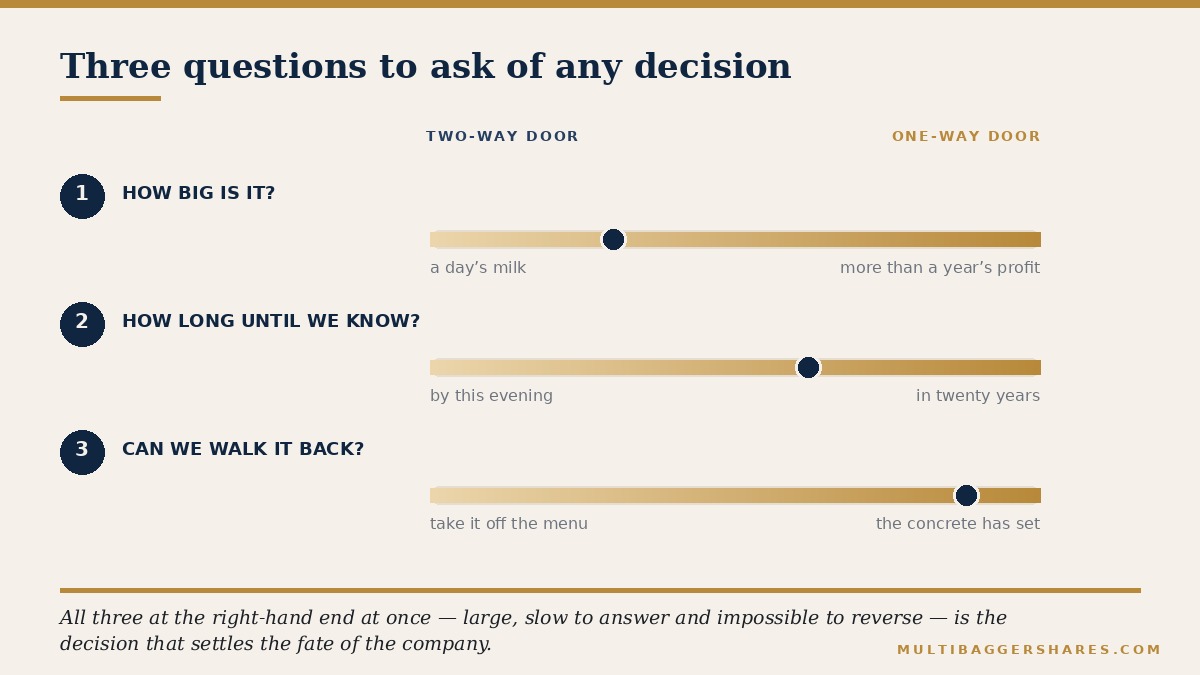
Put the two questions together and you get a simple way to think about how much damage a mistake can do. It depends on three things: how big the decision was relative to the whole company, how long before anyone can tell whether it worked, and how much it costs to undo.
The middle one is the one people forget, and it is the one that does the most work.
A business that learns within a day that it was wrong can afford to be wrong constantly. Every error is caught while it is still small. The tea stall has made ten thousand mistakes in its life and none of them mattered, because each was corrected the next morning. The stall gets better not because the owner is wise, but because reality keeps telling him the answer and he keeps listening.
A business that learns after ten years has no such luxury. It has to be right the first time, using a forecast of a world that does not exist yet. And the people who made the decision will often be retired before anyone can say whether they were right.
This is not the same thing as saying one kind of business is risky and the other is safe. The tea stall can be destroyed by a landlord or a new station entrance. The wedding hall may turn out to sit on exactly the road the town grows towards, and earn beautifully for forty years. The point is about the shape of being wrong, not the chance of it.
A plane that answered its question twenty-one years late
The clearest example in modern business history is an aircraft.
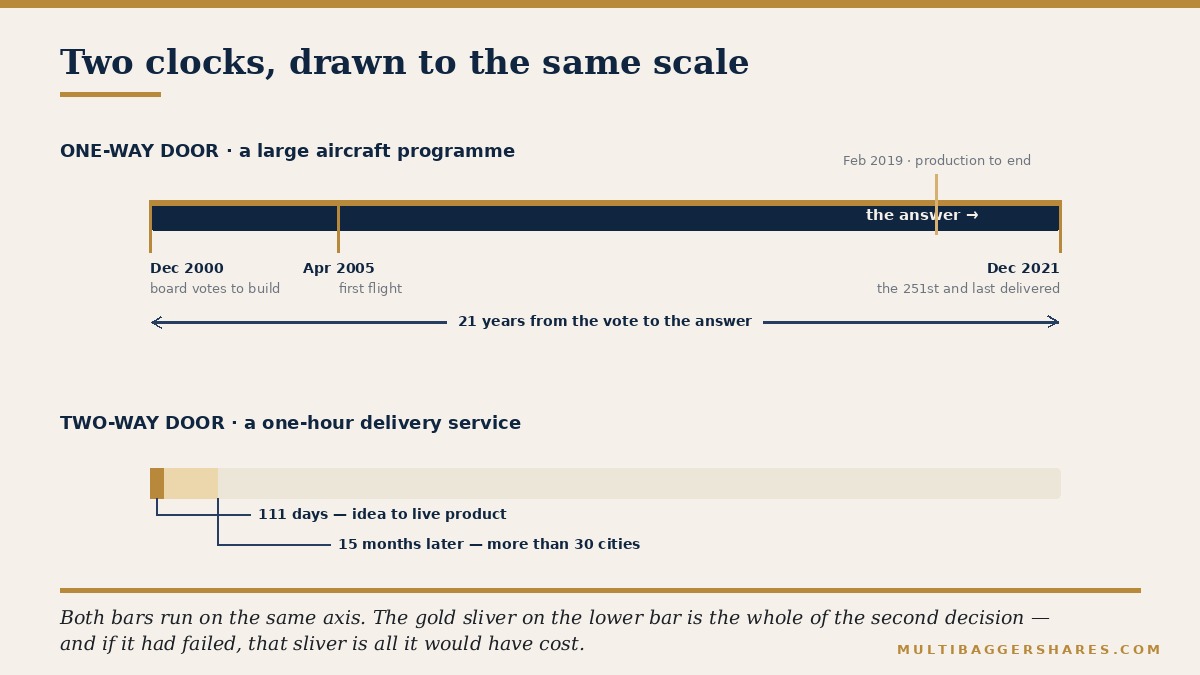
Airbus began studying a very large airliner in 1988 and announced the project in 1990, to challenge the Boeing 747 on long routes. It presented the design, then called the A3XX, in 1994. On 19 December 2000 the Airbus board voted to actually build it, as the A380, at a projected cost of 9.5 billion euros, with fifty firm orders from six launch customers.
The whole thing rested on one belief about the future. Airbus thought air travel would keep running on the hub-and-spoke model — passengers funnelled into a handful of giant airports and then carried onward in very large aircraft, the way a railway junction gathers people from small towns. It tested that belief seriously, with over two hundred focus groups. Boeing looked at the same question and concluded travel was moving the other way, towards point-to-point flying: more direct routes, smaller planes, no junction in the middle.
The aircraft first flew on 27 April 2005 and was certified in December 2006. The cost did not stay at 9.5 billion euros. Wiring problems and a two-year delay pushed the provisioned figure to roughly 18 billion, and later estimates of what the programme really cost ran to around 25 billion dollars.
In February 2019 Airbus announced it would stop building the aircraft, after its largest customer dropped an order for thirty-nine of them. The total number ever expected to be delivered was 251. The last one was handed over on 16 December 2021. To recover its development cost Airbus would have needed more than 90 million dollars of profit on each aircraft; at the list price the programme was not covering even its production cost by the end.
Now notice the shape of it. One door, opened once, in December 2000, on a judgement about how human beings would choose to fly in 2020. The answer came back twenty-one years after the vote. Nobody involved was foolish; they did a decade of analysis. They guessed wrong about one thing, and the business gave them no cheap way to find out early and no way at all to walk back.
Ask the awkward question. If you had owned a piece of that company in 2003, what could you have watched? Sales? The plane did not exist. Customer response? Not yet. That is what a one-way-door business feels like from the outside. You are not tracking a business. You are waiting for a verdict.
A company that missed twice on purpose
Set against that, look at the two-way-door end of the range — and the same 2015 letter is a good place to find it, because Amazon describes its own failures in it.
Before the marketplace that lets outside sellers list their goods on the site, Amazon tried two other ways of doing the same thing, called Auctions and zShops. Both missed. The company says so plainly in the letter. It kept the idea and changed the method, and by 2015 close to half the items sold on Amazon were being sold by other people’s businesses.
The same letter describes a service called Prime Now, offering delivery within the hour. It went from an idea to a live product in 111 days. In that time a small team built the app, found a warehouse in the city, chose which items to stock, hired and trained people, and launched before the holidays. Fifteen months later it was running in more than thirty cities.
Bezos is honest in the same letter about what this kind of approach means arithmetically. If you take every bet that offers a one-in-ten chance of paying a hundred times your money, you should take it every single time — and you will still be wrong nine times out of ten.
You can only run a business that way if being wrong is cheap and quick to discover. Two public failures did not damage Amazon, because each was a two-way door: small to try, fast to read, simple to close. That is not bravery. It is structure.
And the letter is careful about the reverse error too. In a footnote, it observes that any company which habitually uses the light, quick process on decisions that are genuinely one-way goes extinct before it ever gets large. Amazon opens plenty of one-way doors of its own — warehouses, data centres, whole new countries. The skill is telling the two kinds apart, not preferring one.
The mistake each kind of business makes
Each end of this range has its own characteristic failure, and both are easy to spot once you know the shape of them.
The one-way-door business fails by pretending its door is a two-way door. It builds the plant “and we will see how it goes”. It buys the fleet, signs the twenty-year contract, enters the new country, talking all the while as though any of it could be undone next year. When a company says it will “evaluate” a commitment it has already poured concrete on, you are watching this mistake happen.
Borrowed money makes it fatal. Debt does not turn a two-way door into a one-way door — that is not what it does. What it does is remove the walking-back from doors that already open one way. Without debt, a bad plant is a bad plant and the company limps on and earns its way out over a decade. With enough debt, the same bad plant ends the company, because the interest does not wait for the plant to come good. A business full of one-way doors and full of borrowings is the single most reliable way companies disappear.
The two-way-door business fails in the opposite direction. It becomes slow. It sends a decision about a biscuit flavour through four committees, because that is how it handles decisions about factories. Nothing gets tried, and a business whose whole advantage was speed of correction gives that advantage away. From the outside this looks like caution. It is closer to paralysis.
There is a third case worth watching for, because it is the sneaky one: a business that converts itself from one kind to the other without announcing it. A shop chain is a two-way-door business, until it signs twenty-year leases on a hundred sites, at which point it is not. A manufacturer is flexible, until it builds tooling that can only make one product for one customer. Read the commitments, not the description.
How you can use this
None of this needs a spreadsheet. It needs about twenty minutes with an annual report and a willingness to ask childish questions.
One. Find the money the company spent on plants, machines, land and buildings during the year — usually shown as capital expenditure, often shortened to capex. Then ask a question almost nobody asks: how many separate decisions is that number? Two hundred crore spent on one plant is one decision. The same amount spent opening ninety shops is ninety decisions, each of which teaches the company something before the next one is signed.
Two. For any big commitment, ask what has to be true for it to work, and when you will know. If the honest answer is “in 2035”, you are not making an investment judgement, you are extending trust. That may be perfectly reasonable. Just be clear that is what you are doing.
Three. Judge each kind of business on the right evidence. A company that makes one enormous decision every five or six years has made only a handful in its whole history, so go and look at all of them. Did the last plant fill up? Did the last acquisition get quietly written down? A company that makes a thousand small decisions a month cannot be judged that way. There you want consistency, not brilliance: do sales at the same shops keep creeping up, and does a bad product get pulled quickly or left sitting because nobody wants to admit it?
Four. Look for hidden locking-in: long leases, contracts that must be paid whether or not the company uses what it bought, machines built for a single buyer.
Five. Put the two things together whenever you see them together. Heavy borrowings plus decisions that cannot be undone is the combination to be careful about — not because either one is wicked, but because together they remove every second chance.
Six. Finally, be fair. This lens does not tell you which business is better. Great fortunes have been built at both ends — in cement and steel and shipping just as much as in shops and soap and software. It tells you what you are required to be sure about. At one end you are betting on a habit of correction, which you can watch year after year. At the other you are betting on a few judgements made by particular people at particular moments, and you will wait a long time to learn whether they were good.
There is one last reason this belongs in the quality lane. A company that knows which of its own doors open one way behaves differently. It slows down on the big ones and speeds up on the small ones. It says out loud which assumption a large project rests on. It does not dress up an irreversible commitment as an experiment. You can hear that in the way management writes, long before it shows up in any number.
A separate letter on this site looked at how a business behaves after something has gone wrong. This one is the question underneath it: how often the business is exposed to being wrong at all, and whether it will even be told. Nothing here is a comment on anyone’s shares; the companies named appear only because their history is public and well documented.
Key takeaways
- Ask two questions of any business: how often does it have to be right, and how quickly does it find out when it is wrong? The second one does most of the work.
- Bezos’s split is the clearest language for it. A one-way door cannot be reversed, so it deserves slow deliberation; a two-way door is changeable, so it should be decided fast and cheaply. Whole businesses, not just decisions, lean one way or the other.
- The Airbus A380 is the one-way door in its purest form — a board vote in December 2000 on how people would fly twenty years later, 251 aircraft delivered, the last on 16 December 2021, against a development cost estimated near 25 billion dollars.
- Amazon could miss publicly with Auctions and zShops, and build Prime Now in 111 days, because at that end mistakes are small, quick to read and easy to close. Its own 2015 letter warns that using that light process on genuinely irreversible decisions kills companies before they get large.
- Debt does not create one-way doors; it removes the walk-back from doors that already open one way. Heavy borrowings plus irreversible commitments is the combination that has ended more companies than any other.
— Manish Goel · multibaggershares.com
Disclaimer: This article is published by multibaggershares.com for education and general information only. It is not investment advice, investment research, or a recommendation to buy, sell or hold any security. Any companies named are discussed only as illustrative examples. Markets carry risk; please do your own research or consult a qualified professional before making any investment decision.