When More Growth Makes You Poorer: Why Growth Only Counts When It Earns Its Keep

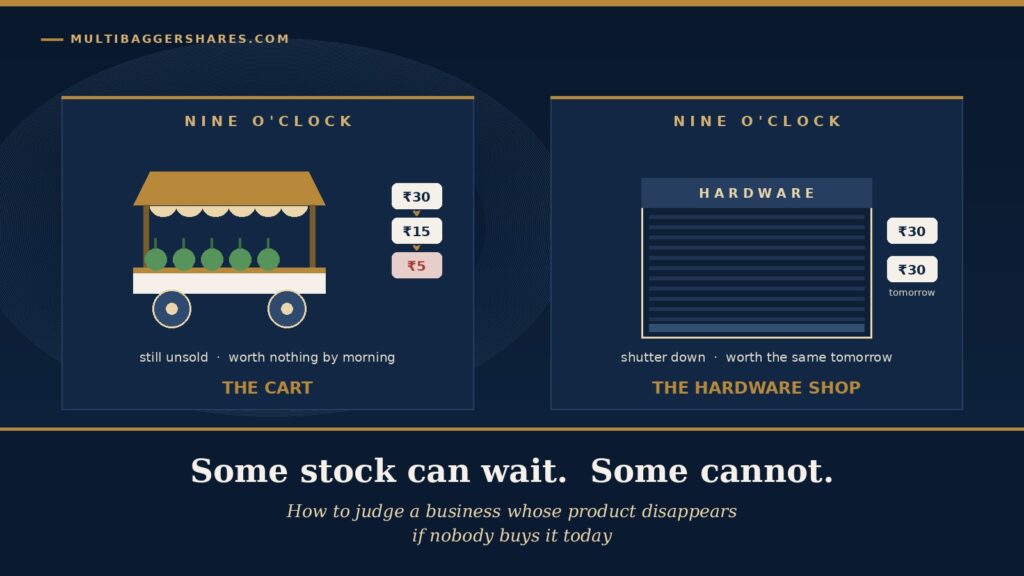
The Cart That Must Be Empty by Nightfall: How to Judge a Business Whose Stock Cannot Wait
September 24, 2026
Value Investing Basics
There is a bakery two lanes from my house that makes one thing well: a plain butter biscuit, sold loose by weight. Two years ago the owner opened a second shop across town. Then a third, in a mall food court. Then a fourth. Every time I passed, the queue looked longer than the one before. By any normal measure — more shops, more staff, more biscuits sold — the business was growing.
Then, this year, three of the four shops quietly shut. The owner had borrowed to fit out each new outlet, and two of them never sold enough biscuits to cover their own rent, let alone repay what was borrowed to open them. The business had grown. It had not become more valuable. In fact it had become less valuable, because growth had eaten cash faster than it made cash.
That gap — between a business simply getting bigger and a business becoming worth more — is one of the most useful and most overlooked ideas in investing. This letter is about how to tell the two apart, using nothing more than arithmetic you already know.
What it really means
Every business that grows needs fuel. The fuel is capital (money put into the business to buy machines, open branches, build inventory, or fund the wait between paying suppliers and collecting from customers). That capital has to come from somewhere: money the business already earned and kept back (retained profit), money borrowed from a bank (debt), or money raised from new shareholders (equity).
Whichever source it comes from, that capital is not free. Even retained profit has a cost, because it is money the owners could otherwise have taken out and put to some other use — a fixed deposit (FD, a bank deposit that pays a fixed rate of interest for a fixed period), another business, or simply a safer investment. Investors call this the cost of capital (the minimum return a business must earn on the money it uses, to make using that money worthwhile at all).
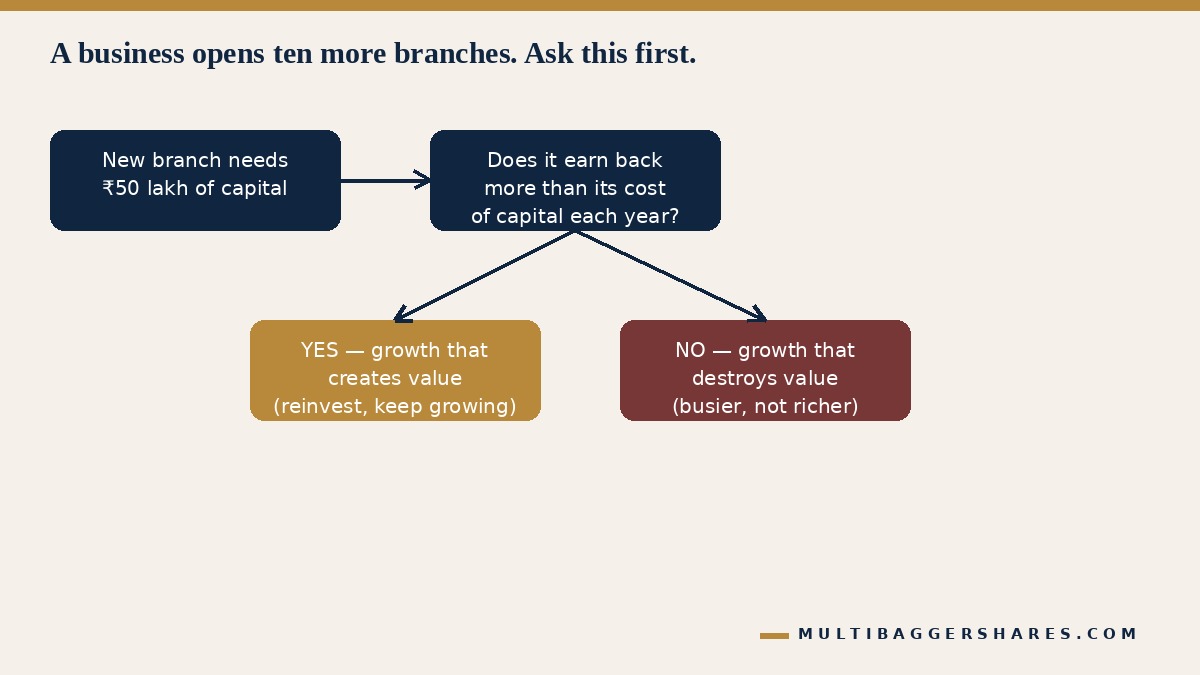
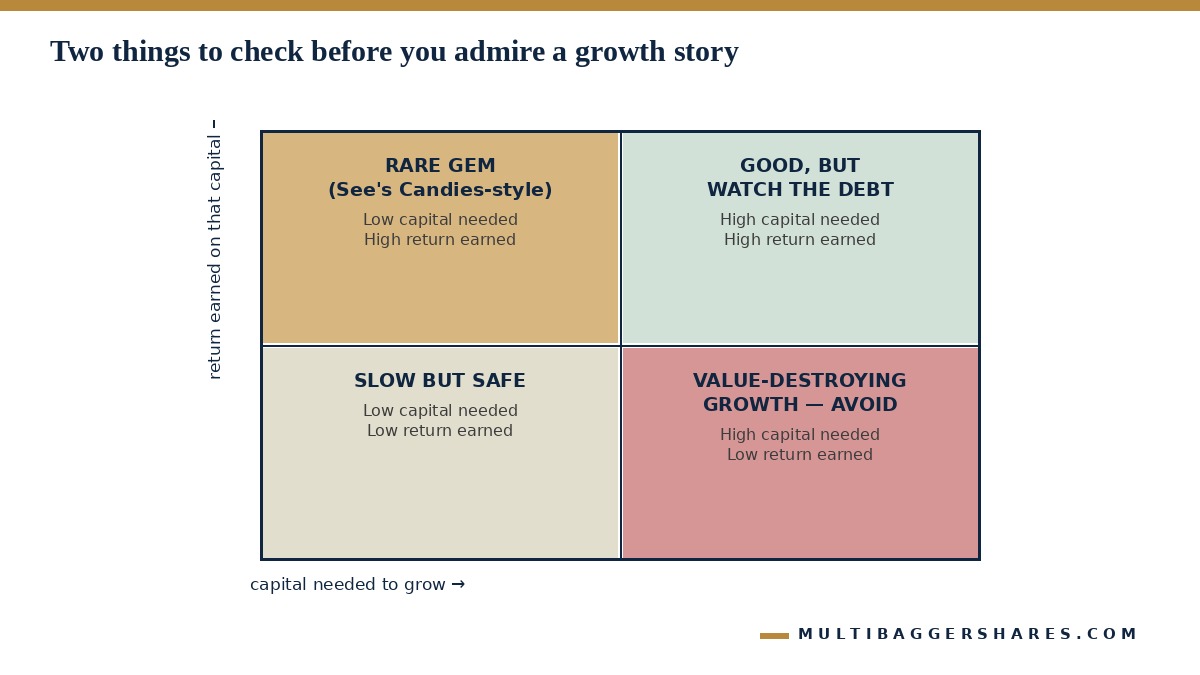
So the test for any growth is not “is the business getting bigger?” The test is: does each new rupee of capital put into that growth earn back more than its own cost of capital, year after year? If yes, growth is a gift — it makes the whole business worth more than the capital that went in. If no, growth is a leak — it makes the business bigger and, at the very same time, worth less.
Warren Buffett, the American investor whose annual letters to Berkshire Hathaway shareholders have taught two generations of value investors, put a very plain test on this in 1984. He wrote that a company should hold back its profits, rather than pay them out to owners, only when there is good reason to expect that “for every dollar retained by the corporation, at least one dollar of market value will be created for owners.” Notice what the test does not say. It does not say retained profit should merely grow the company. It says it must be worth at least as much to the owner sitting still as it would have been in the owner’s own hands. Anything less, and growth is quietly transferring value away from the very people it is supposed to serve.
Why it works
This idea works because capital is not a passive ingredient. It is a scarce resource with a price tag, exactly like flour or steel or diesel. A shopkeeper who never asks “what does this flour cost me, and what will I sell the biscuit for?” will eventually go broke no matter how many biscuits leave the counter. A business owner — or a shareholder, who is a part-owner — who never asks “what does this capital cost, and what will it earn?” will eventually find the business bigger and poorer at the same time.
There is a second, quieter reason this matters: compounding runs in both directions. Charlie Munger, Buffett’s long-time partner at Berkshire Hathaway, often pointed out that if a business can keep reinvesting profit at a high rate of return for a long time, the value of that business compounds (grows on top of its own past growth, like a snowball that packs on more snow with every turn down the hill) at roughly that rate of return, almost regardless of the price you first paid for it. The reverse is equally true. A business that keeps reinvesting at a rate below its cost of capital compounds its own mediocrity. Every year of “growth” buries the original mistake a little deeper under more capital, more debt, and more distance from the day someone finally asks whether it was worth doing.
This is also why the fundamental ratio bank (the standard set of numbers analysts use to judge a business, such as ROCE — return on capital employed, the profit earned per rupee of total capital used in the business, both borrowed and owned) exists. ROCE, and its cousin ROE (return on equity, the profit earned per rupee that belongs to the owners alone), are simply ways of putting a number on the question this letter keeps asking: for the capital tied up here, how much is coming back out?
A real example or two
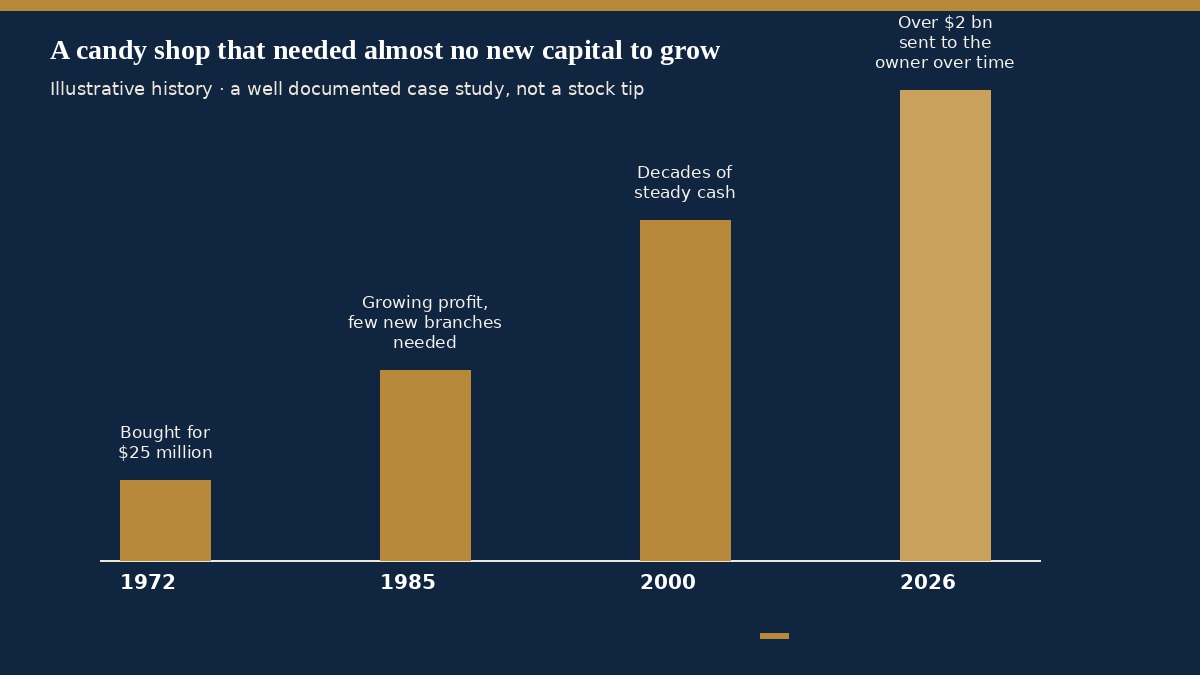
In 1972, Berkshire Hathaway bought a Californian sweet shop chain called See’s Candies for about $25 million. At the time, See’s owned only about $8 million of net tangible assets (the factories, shops and stock left after subtracting what the business owed) and made roughly $2 million of after-tax profit a year — a return of about 25% on those tangible assets, which is an unusually high number for any ordinary business.
What made See’s remarkable was not just that first year’s return. It was that the business barely needed any further capital to keep earning at that rate. Munger later observed that it takes almost no capital to open a See’s store. A new shop needed little more than a counter, a sign and a supply of chocolate — not a fresh factory, a fresh warehouse, or a fresh mountain of debt. Over the following decades, See’s sent Berkshire well over two billion dollars of cumulative pre-tax profit, almost all of which Berkshire was free to invest elsewhere, precisely because so little of it ever had to be poured back into See’s just to keep it running.
Now hold that against a very different, and very public, Indian story. Kingfisher Airlines began flying in 2005 and, within a couple of years, expanded aggressively — taking over another airline, adding routes, and building a much larger fleet, largely funded by borrowing. Airlines are a capital-hungry business at the best of times: every new aircraft, every new route, every new lease is real money committed up front, against ticket revenue that is famously thin and unpredictable. By the time Kingfisher Airlines stopped flying in 2012, it owed its lenders more than seven thousand crore rupees, and the business had not earned anywhere near enough, on any of that borrowed capital, to justify how much of it had been put in. The airline had grown its network for several years. It had not grown its worth. This is not a comment on any airline flying today, or on the airline industry as a whole — it is simply one of the most thoroughly documented examples in Indian markets of growth funded by capital that never earned its keep.
Set side by side, See’s Candies and Kingfisher Airlines are not really stories about candy or aeroplanes. They are the same lesson told twice, once by a business the lesson rewarded and once by a business the lesson punished.
How you can use it
You do not need a finance degree to run a version of this test on any company whose growth story excites you. A few plain checks, taken from the company’s own annual report and investor presentation, go a long way.
First, look at how fast profit is growing compared with how fast the company’s borrowings and total capital employed are growing. If capital employed is growing much faster than profit, year after year, the business is spending more to get less — a pattern worth questioning rather than admiring.
Second, watch the debt-to-equity ratio (total borrowings divided by the owners’ own money in the business) over several years, not just one. A rising ratio, alongside rising “growth,” often means the growth is being financed by lenders rather than earned by the business itself.
Third, ask what kind of growth it is. Growth from opening new branches, new factories or new routes needs real fresh capital every single time. Growth from selling more to the same customers, raising prices without losing them, or simply using an existing factory more fully needs very little fresh capital at all. The second kind of growth is, almost always, the more valuable kind — the kind Peter Lynch, the American fund manager known for his plain-English investing books, liked to call growth you get for free.
Fourth, and simplest of all: does profit, and eventually free cash flow (the cash left over after a business pays for its own operations and the equipment it needs to keep running), actually rise alongside the growth — or does the company keep needing fresh loans or fresh share issues just to keep the story going? A growth story that must be constantly re-funded from outside is telling you, in the plainest possible language, that it is not paying for itself.
None of this requires predicting the future or building a spreadsheet model of tomorrow’s cash flows. It only requires patience to read a few pages of what a company has already reported, and the discipline — the kind investors like Rakesh Jhunjhunwala and Radhakishan Damani were known for in their long careers in Indian markets — to sit quietly with a business rather than be swept along by the excitement of its headline growth numbers.
It also helps to compare a company against itself over time rather than chasing a single impressive year. A five-year view of ROCE, alongside a five-year view of how much fresh capital was added each year, tells you far more than either number alone. A company whose ROCE has held steady or improved while its capital base grew has almost certainly been growing the right way. A company whose ROCE has slipped every year while its capital base ballooned is, in effect, paying more and more for less and less — even if its revenue chart, taken on its own, looks impressive on a screen.
Key takeaways
- Growth is not automatically good. It is good only when the fresh capital it uses earns back more than that capital costs, year after year.
- Watch capital employed and debt alongside profit. If capital and borrowings are rising faster than profit, the business may be getting bigger while becoming worth less.
- Capital-light growth (more sales from existing branches, pricing power, fuller use of existing capacity) is usually far more valuable than growth that needs a fresh building, fleet or factory for every step forward.
- See’s Candies (bought by Berkshire Hathaway in 1972) and Kingfisher Airlines (grounded in 2012) sit at opposite ends of this same lesson — one needed almost no fresh capital to keep earning well, the other needed enormous fresh capital and never earned enough on it.
- Before you get excited about any growth story, ask the one-line question this whole letter is built on: for every fresh rupee this growth uses, how much is coming back?
— Manish Goel · multibaggershares.com
Disclaimer: This article is published by multibaggershares.com for education and general information only. It is not investment advice, investment research, or a recommendation to buy, sell or hold any security. Any companies named are discussed only as illustrative examples. Markets carry risk; please do your own research or consult a qualified professional before making any investment decision.