Three Honest Reasons to Sell a Stock — and Why “It Went Up” or “It Went Down” Isn’t One of Them

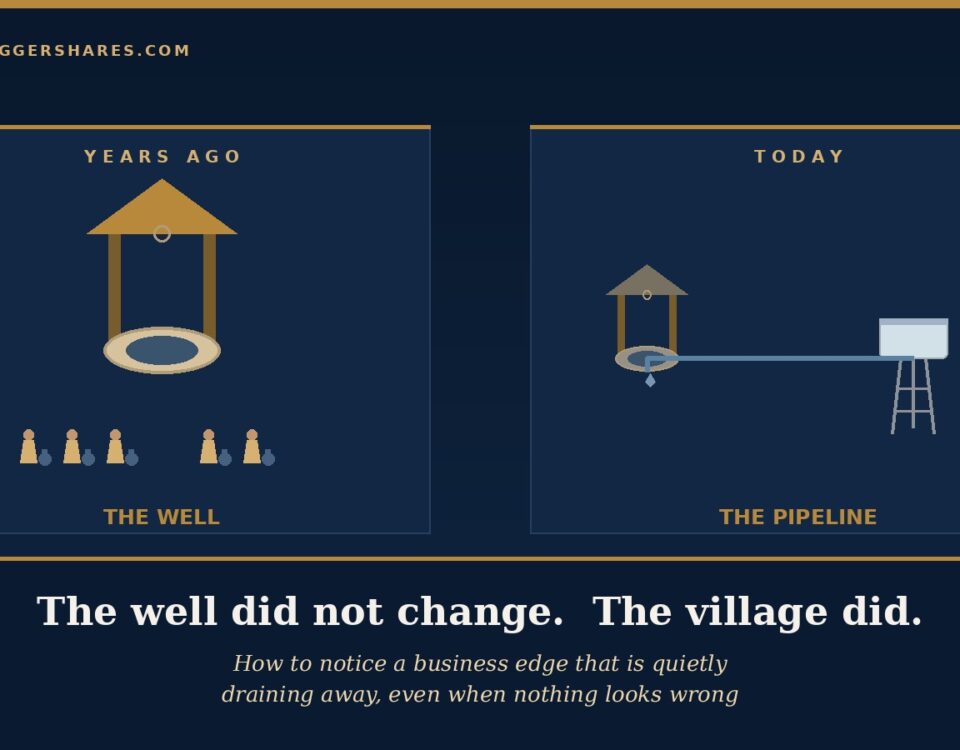
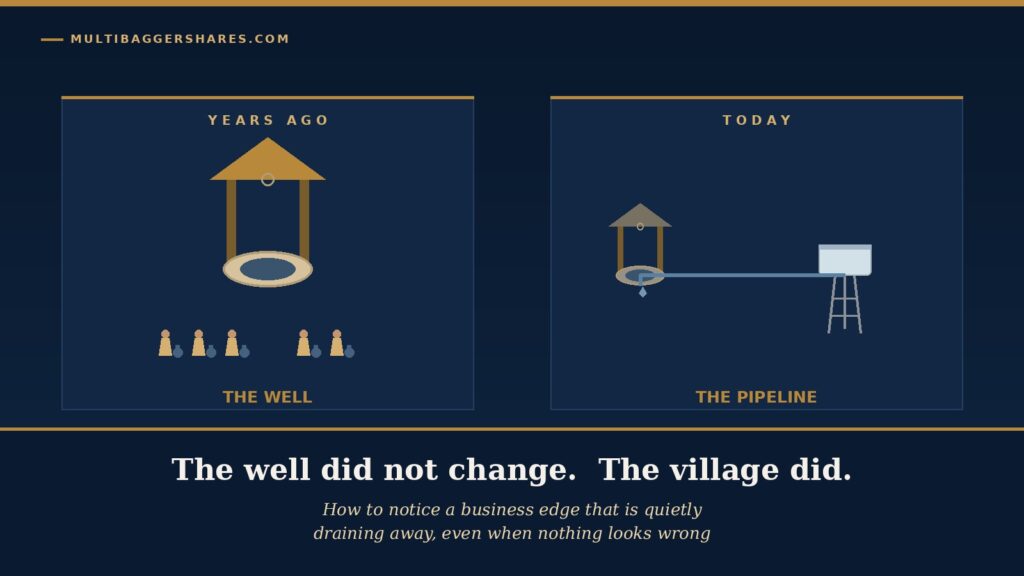
The Well That Everyone Used, Until Nobody Did: How to Notice a Business Edge That Is Quietly Draining Away
September 27, 2026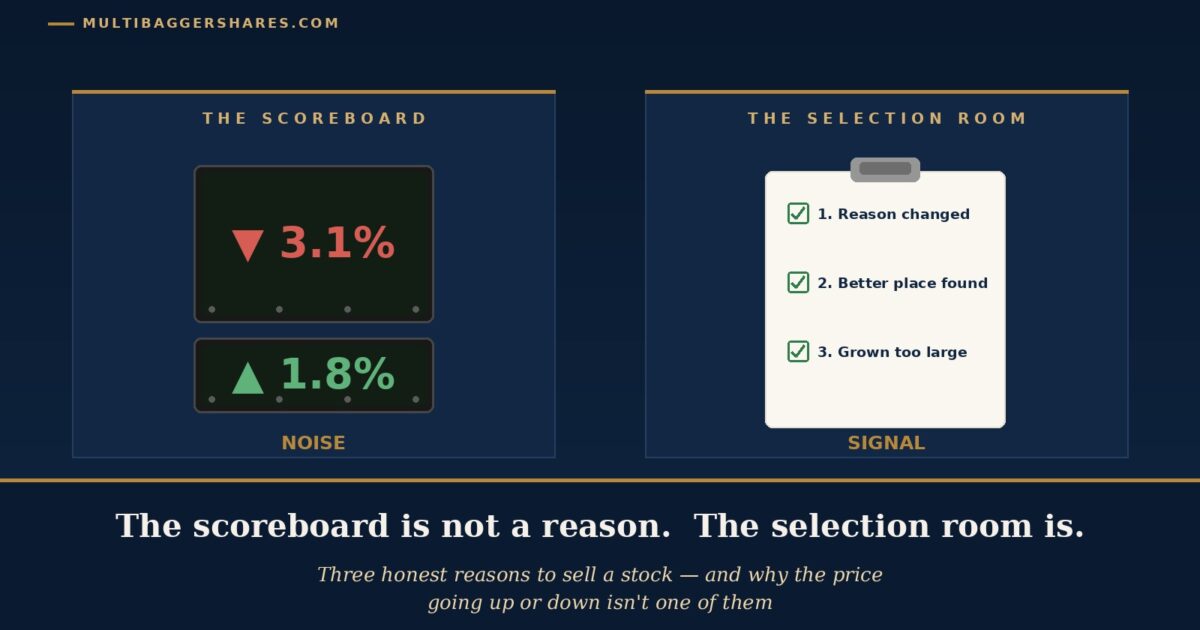
Picture a domestic cricket team’s selection committee sitting down the evening after a match in which the team’s opening batter played a chanceless innings of fifty runs. For the next match, on a pitch expected to turn sharply from the first hour, the committee drops that same batter and brings in a specialist player of spin who managed only a first-ball duck in the previous game. On the scoreboard alone, this looks backwards: the team dropped its best recent performer and kept its worst one. Ask the committee why, and the answer has nothing to do with either player’s last score. The specialist reads turning pitches better than anyone else in the squad, and that is precisely the skill the next match will demand. The fifty and the duck were both, for this particular decision, beside the point.
The committee is not being clever or contrarian for its own sake. It has simply learned, over many matches, that a single score is a small, noisy sample of a player’s true ability, and that the team’s actual need on a given day — pace on a bouncy pitch, spin on a turning one, a steady hand chasing a low target under lights — rarely lines up neatly with whoever happened to do well or badly last time out. A good selector could, in principle, explain every single decision in one clear sentence that has nothing to do with the previous scoreboard. That habit, more than any amount of talent for spotting good players, is what separates a committee that wins consistently from one that lurches from week to week, rewarding and punishing whoever happened to have a good or bad day most recently.
This is exactly the confusion that trips up newer investors when it comes to selling a stock. A rising or falling share price gets treated as if it were, by itself, an instruction — sell because it has fallen and something must be wrong, or sell because it has risen and surely will not rise further. A price is a scoreboard number. It tells you what somebody else was willing to pay a moment ago. On its own, exactly like a single match score, it tells you nothing at all about whether the business behind that price still deserves a place in your portfolio tomorrow.
What actually counts as a reason
Selling discipline (the habit of deciding when to exit a holding on purpose, rather than by reflex) really just means separating two very different things that a falling or rising price can trigger. One is a reaction: a feeling, usually anxiety or excitement, that arrives the instant a number on a screen changes. The other is a decision: a conclusion you reach because some actual fact about the business, or about your own situation, has changed. What follows are three honest reasons that belong firmly in the second category. None of the three requires you to calculate whether a share is cheap or expensive, or to guess where its price is headed next. Each one is about a fact, not a number on a scoreboard.
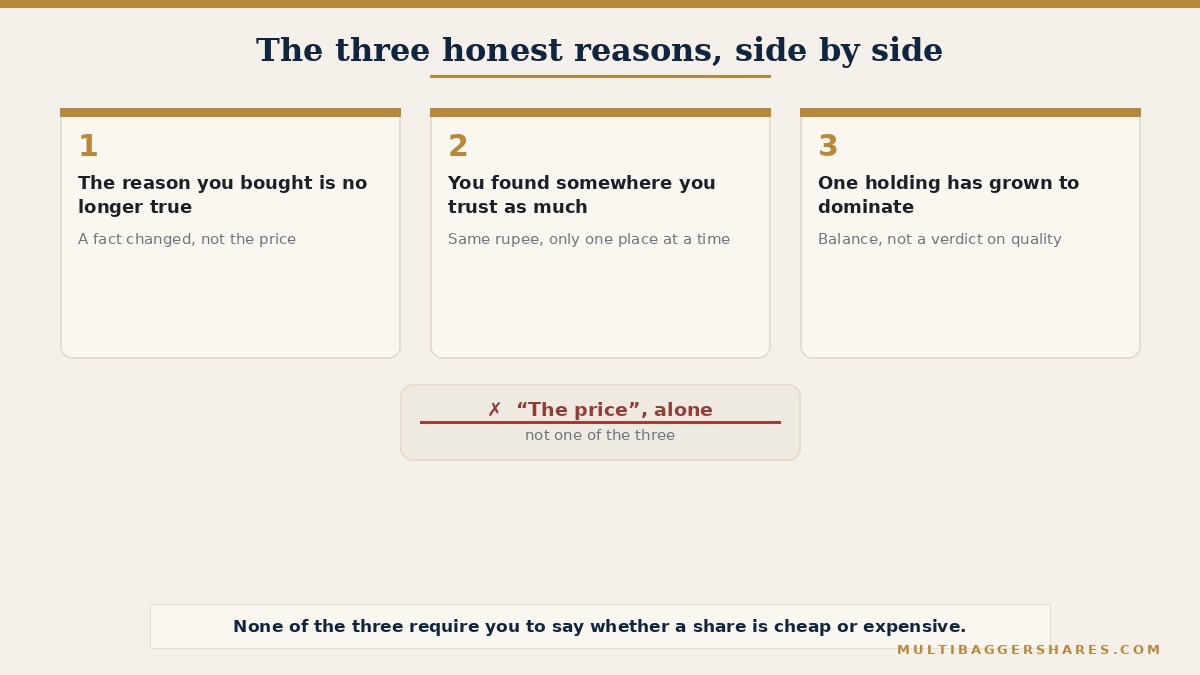
Reason one: the sentence you wrote down when you bought is no longer true. A thesis (the one-sentence reason you expect a business to do well, ideally written down at the time you buy) is the anchor for every later decision about that holding. If the sentence was “this company’s costs will keep falling faster than its rivals’,” and a later annual report shows the opposite has been true for two years running, the sentence has broken. That is a reason to sell. Crucially, it is a reason that exists whether the share price that week has gone up, gone down, or not moved at all — because what changed was the fact, not the number.
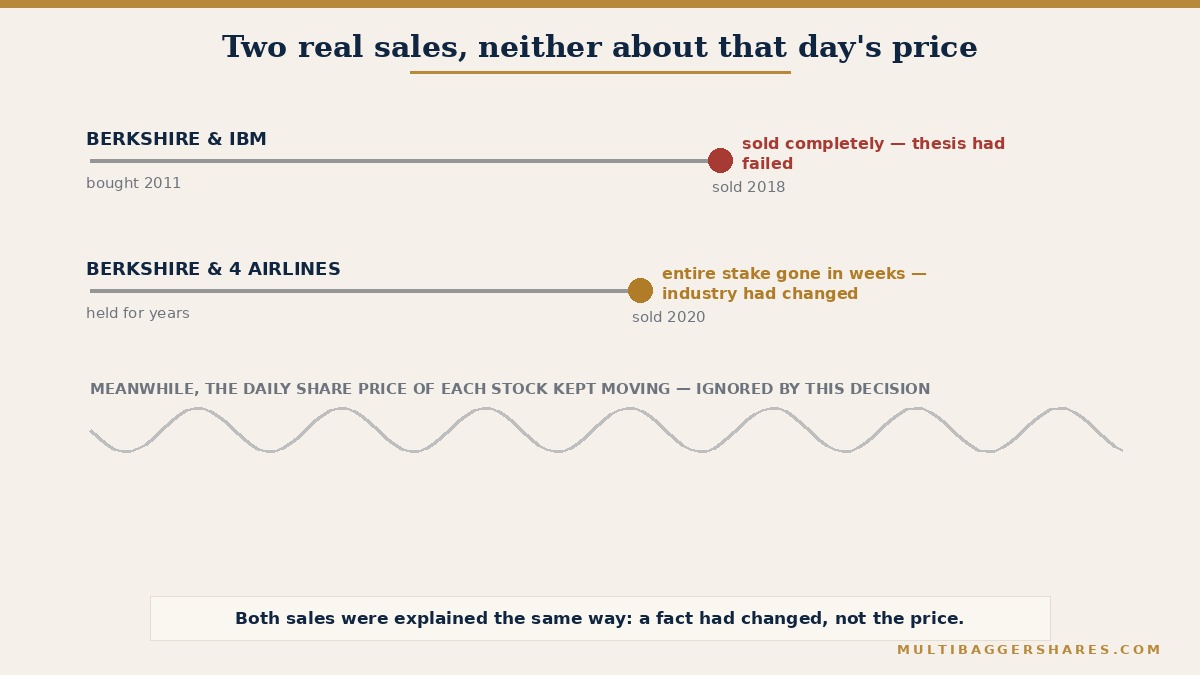
Two real, well-documented examples show how this looks in practice, at a scale far larger than any individual investor’s portfolio. Warren Buffett’s Berkshire Hathaway began building a large stake in IBM in 2011, reasoning that the company’s shift toward higher-value corporate technology services would keep it central to how large businesses ran their computing. Over the following years, IBM struggled to grow revenue and profit at anything like the pace Berkshire had expected, as faster-moving rivals took share in cloud computing. By May 2018, Buffett confirmed that Berkshire had sold its entire IBM position, later saying plainly that he had valued the business more highly than it deserved. The sale was not a reaction to that week’s IBM share price. It was an admission that the original one-sentence reason for owning the stock had not held up.
The second example moved far faster. Berkshire had built sizeable stakes in the four largest United States airlines over several years, reasoning that consolidation had finally made the industry’s economics durable. When the coronavirus pandemic brought global air travel to a near-standstill in 2020, Buffett did not wait to see whether airline share prices would recover. Within weeks, Berkshire sold its entire stake in all four airlines, and Buffett told shareholders directly that the world had changed for the industry and that buying into it had been a mistake. Notice what did not feature anywhere in that explanation: a prediction about where airline share prices were headed next. The fact on the ground had changed. That was reason enough, immediately, regardless of price.
Two more honest reasons, neither one about price
Reason two: you have found somewhere you understand and trust at least as well, for the same rupee, and you do not have an unlimited number of rupees. Every investor operates under a constraint that is easy to forget in the moment: money committed to one holding cannot simultaneously fund a second one. Opportunity cost (what you give up by keeping money where it already is, instead of moving it somewhere else) is a legitimate, price-independent reason to sell one holding in order to buy another — provided the new holding is genuinely one you understand and trust as well as, or better than, the one you are leaving. It is a poor reason when the pull is really just the excitement of something newer and less familiar; the test is whether you could write as confident a one-sentence thesis for the new holding as you once wrote for the old one.
Reason three: one holding has quietly grown to dominate the whole portfolio, simply by doing well. Concentration risk (the danger of having too much of your total wealth riding on the fortunes of a single business) can build up entirely on its own, with no new buying at all. A holding that once made up a comfortable one-tenth of a portfolio can grow, purely through strong performance, to make up half of it. Continuing to hold all of it at that point is not the same decision you made originally; it is a new, considerably larger bet, made by default rather than on purpose. Trimming such a position is not a verdict on the business’s quality. It is closer to admitting that a football team’s squad has become worryingly dependent on a single player and would benefit from a bit more balance, regardless of how well that one player has been performing.
Even Berkshire Hathaway, a company famous for holding wonderful businesses for decades, has acted on this kind of reasoning. In 2024, Berkshire sold more than half of its enormous stake in Apple. At that year’s annual shareholder meeting, Buffett explained that one motivation was his expectation that corporate tax rates in the United States were likely to rise in the future, making it sensible to realise some gains at the tax rate in force at the time. He continued to describe Apple, in the very same meeting, as an excellent business. The lesson is a clean one: a large sale is not automatically a verdict that something is wrong with the company. Sometimes the honest reason belongs to the seller’s own circumstances, not to the business at all.
The one “reason” that is not actually a reason
It is worth being direct about what does not belong on this list. “The price has fallen, so something must be wrong” is not, by itself, a reason — unless you can point to the specific fact behind that fall and show that it breaks your original one-sentence thesis, in which case it has simply collapsed back into reason one. A falling price with no identifiable broken fact behind it is exactly the kind of noise the selection committee ignored when it looked past a single match’s score. The same is true in the other direction: “it has already gone up a lot, so it must be done going up” is a feeling about a number, not a fact about a business, and feelings about numbers are precisely what selling discipline exists to filter out.
Selling to relieve the plain discomfort of watching a red number on a screen is an understandable human impulse, and it is worth naming honestly rather than dressing it up as strategy. So is selling out of a restless itch that a holding has “already had its run” and a newer, more exciting story must be next. Both are treating a symptom — anxiety in one case, boredom or greed in the other — rather than asking whether an actual fact about the business or about your own situation has changed. The three honest reasons above are the filter that keeps a real decision separate from a passing feeling.
It is worth adding one honest caveat about reason two. Opportunity cost is easy to state as a principle and easy to abuse in practice, because almost any newer, more exciting story can be dressed up as “something I understand and trust more.” A useful, slightly uncomfortable check is to ask whether you would still want to make the switch if you were not allowed to look at either holding’s recent share price while deciding — that is, whether the case for the new holding rests on the business itself, or quietly on the fact that it has been moving nicely lately while the old one has not.
How you can use this
Borrow the habit that a well-run selection committee already has, and that Berkshire’s public explanations for IBM, the airlines and Apple all happen to share: a reason stated in one plain sentence, independent of that day’s price. When you buy a holding, write down, in one sentence, why you expect it to do well. Keep that sentence somewhere you will actually look at again — a notebook, a simple spreadsheet, even the notes app on a phone. Before you sell anything, write a second one-sentence answer to a single question: which of the three reasons applies here? If your honest answer is “the price,” on its own, you likely have not found a reason yet, and choosing to wait is a perfectly respectable decision in that moment, not a failure of nerve.
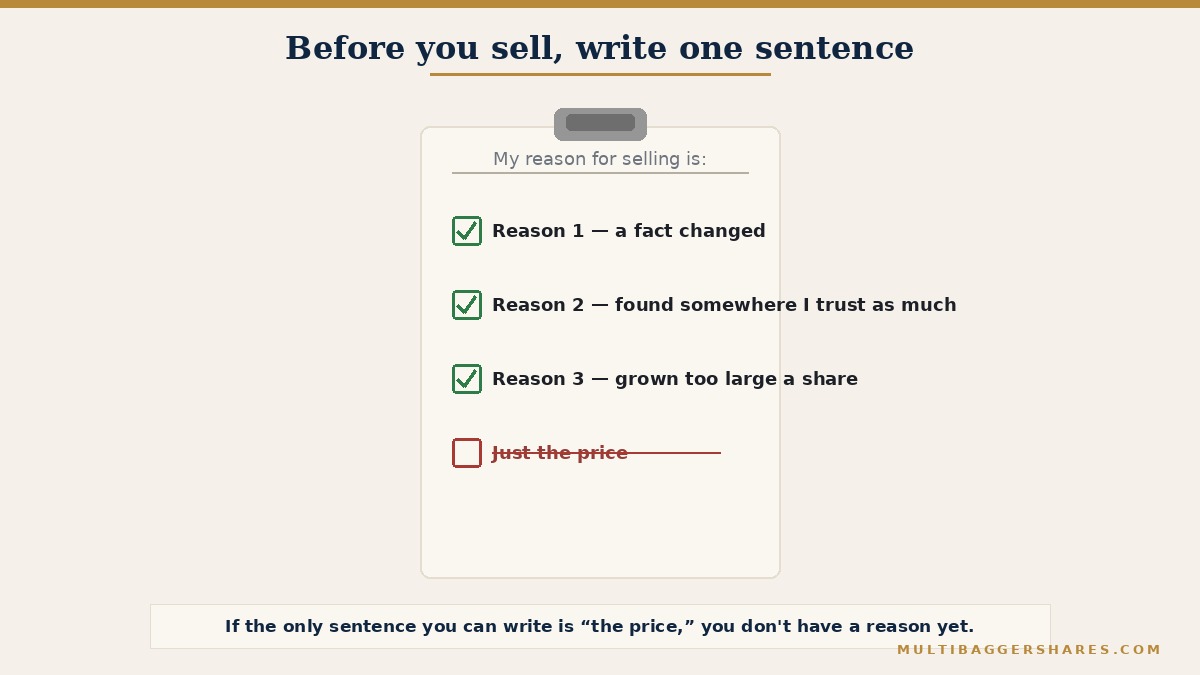
Most years, for most holdings you already own, none of the three reasons will apply, and the correct action is simply to keep holding, entirely unbothered by whatever the scoreboard did that week. The habit only pays for itself in the rare year when a real reason does show up — and by then, having practised writing one honest sentence at a time rather than reacting to a number, you will actually recognise it. The selection committee that keeps a clear, one-sentence reason for every decision does not get every call right either. It simply stops confusing the scoreboard with the reason, and that turns out to be most of the discipline that matters.
Key takeaways
- A share price is a scoreboard number — what someone else paid a moment ago. On its own it says nothing about whether the business behind it still deserves a place in your portfolio.
- Reason one to sell: the one-sentence reason you bought is no longer true. Berkshire exited IBM completely by 2018 and sold its entire stake in four U.S. airlines within weeks in 2020 — both times naming a broken thesis, not that week’s price, as the reason.
- Reason two: you found somewhere you understand and trust at least as well, for the same rupee, and money can only be in one place at a time.
- Reason three: one holding has grown to dominate the whole portfolio simply by doing well. Trimming it is about balance, not a verdict — Berkshire itself sold over half its Apple stake in 2024 for reasons unrelated to Apple’s quality as a business.
- Before selling anything, write your reason in one sentence. If the only sentence you can write is “the price,” you probably don’t have a reason yet, and waiting is a perfectly fine choice.
— Manish Goel · multibaggershares.com
Manish Goel is a Chartered Accountant and Principal Officer of Multibagger Securities Research & Advisory Pvt. Ltd. (MSRAPL), a SEBI-registered Investment Adviser, Registration No. INA100007736. This content is published by MSRAPL for education only and is not personalized investment advice.
Disclaimer: This article is published by multibaggershares.com for education and general information only. It is not investment advice, investment research, or a recommendation to buy, sell or hold any security. Any companies named are discussed only as illustrative examples. Markets carry risk; please do your own research or consult a qualified professional before making any investment decision. |