One Kitchen, One Oven: How to Judge a Business That Makes Everything in One Place

The Mango Tree Test: Raamdeo Agrawal’s Three Simple Questions for Judging a Business
September 29, 2026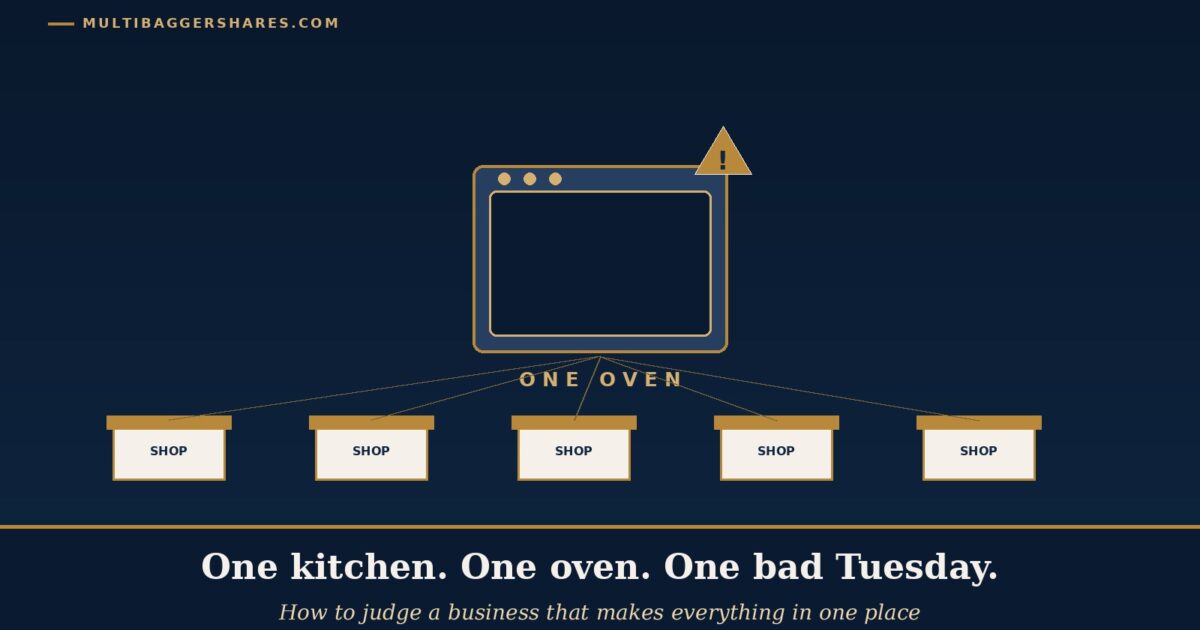
There is a sweet shop in almost every Indian town that is famous for one thing. Perhaps it is the kaju katli (a diamond-shaped cashew sweet). Perhaps it is the jalebi (a crisp, syrup-soaked spiral). People queue for it in the weeks before Diwali. Behind the counter, everything is made in one small kitchen with one big oven. The owner is proud of it. One oven, one team, one recipe, one quality standard.
On an ordinary day, this looks like a strength. Everything is under one roof. The owner can walk in and taste the batch himself. Nothing is wasted on trucks and middlemen. Costs are low and quality is steady.
Now imagine a Tuesday in October. A water pipe above the kitchen bursts and the floor floods. The oven has to be checked before anyone can use it again. It might take three days. It might take three weeks. Orders are piling up for the festival. Every day the oven stays cold, customers walk to the next shop, and some of them may never walk back.
Nothing about the sweets changed. The recipe is as good as it was last week. What changed is that the shop was depending on a single place, and that place stopped. Today’s letter is about that idea, and about how you can look for it in any business you are studying.
What it really means
Investors have a plain name for this. They call it concentration risk (the danger that comes from having too much of something important in one basket). A business can be concentrated in many ways. It can depend on one product, one customer or one supplier. Some of those we have looked at in earlier letters.
Today is about the simplest kind to picture: one place. It could be one factory, one big warehouse, one port, one mine or one data centre (a building full of computers that keep a service running). If most of what the business sells passes through that one place, then the fortunes of the whole business rest on it.
Notice what we are not saying. We are not saying that a single factory is bad. Plenty of wonderful small businesses run from one site, and there are real advantages: lower costs, closer control, one culture. The question is not “how many places?” on its own. The question is whether the owners have thought about the day the place stops, and whether the business could live through it.
Think of a kirana shop (a small neighbourhood grocery) that keeps all its stock in one godown (storage room) at the back. If the godown is fine, no problem. But a careful shopkeeper also knows two things: how much he has in savings if the godown is closed for a month, and which neighbouring shop would let him borrow stock in an emergency. Those two answers are the real strength of the shop, not the godown.
Why this matters for a long-term owner
A long-term investor is really buying a stream of future years. Warren Buffett often says that the aim is to own good businesses for a very long time (he has described his favourite holding period as forever). Over ten or twenty years, an ordinary business will meet at least one bad day. A flood, a fire, a strike (workers stopping work together), a change in a local law, a road that is shut for weeks. You cannot predict which one, or when. You can only ask whether the business would still be standing.
This is where quality comes in. A high-quality business is not just one that earns well in good years. It is one that survives the bad days without having to do something desperate. Desperate things include borrowing at high rates, selling shares cheaply to raise cash, or dropping prices to win back customers.
There is also a quieter cost. When a business is forced to stop, it does not only lose the sales of those days. Its fixed costs (bills that must be paid whether or not anything is sold, like salaries, rent and loan instalments) keep running. It is like a taxi driver whose taxi is in the garage. The EMI (monthly loan instalment) on the taxi does not pause.
That is why debt (money borrowed that must be repaid on a fixed schedule whatever happens) and the one-place question belong together. A business with one factory and very little debt can wait out a bad month. A business with one factory and a heavy loan may not be able to. The same flood ends up meaning two completely different things.
Two real examples
Let us look at two real pauses. We describe them only as history and as lessons. Nothing here is a view on any company as an investment.
Thailand, October 2011. Heavy monsoon flooding reached two industrial parks in Thailand, Bang Pa-in and Navanakorn. Western Digital, a large maker of computer hard drives, told the market on 17 October 2011 that its factories there had been hit. It said the flooding would have a significant impact on its operations and on its ability to meet customer demand in the December quarter. In its later quarterly report to the US regulator, the company said it had suspended production at all of its Thailand manufacturing facilities. Its revenue for the quarter to December 2011 was about 2.0 billion dollars, against about 2.5 billion a year earlier, a fall of roughly 19 per cent.
Notice one thing. The company’s other sites in Malaysia, Singapore and the United States were still working. Even so, the business felt the pause, because a large part of what it made had passed through the flooded place. One place can reach a very long way.
Chennai, December 2015. After unusually heavy rain, roads in Chennai were flooded. On 2 December 2015, three carmakers with big plants in and around the city, Hyundai, Ford and Renault, suspended operations. Their stated reason was the safety of their people and roads that could not be used. The pause was meant to be temporary, and they said they would resume once conditions improved. Chennai is sometimes called India’s Detroit (after the American car city), because so many car makers and parts makers cluster there. A cluster is a strength on a normal day. On a flood day, it means many businesses are stuck together.
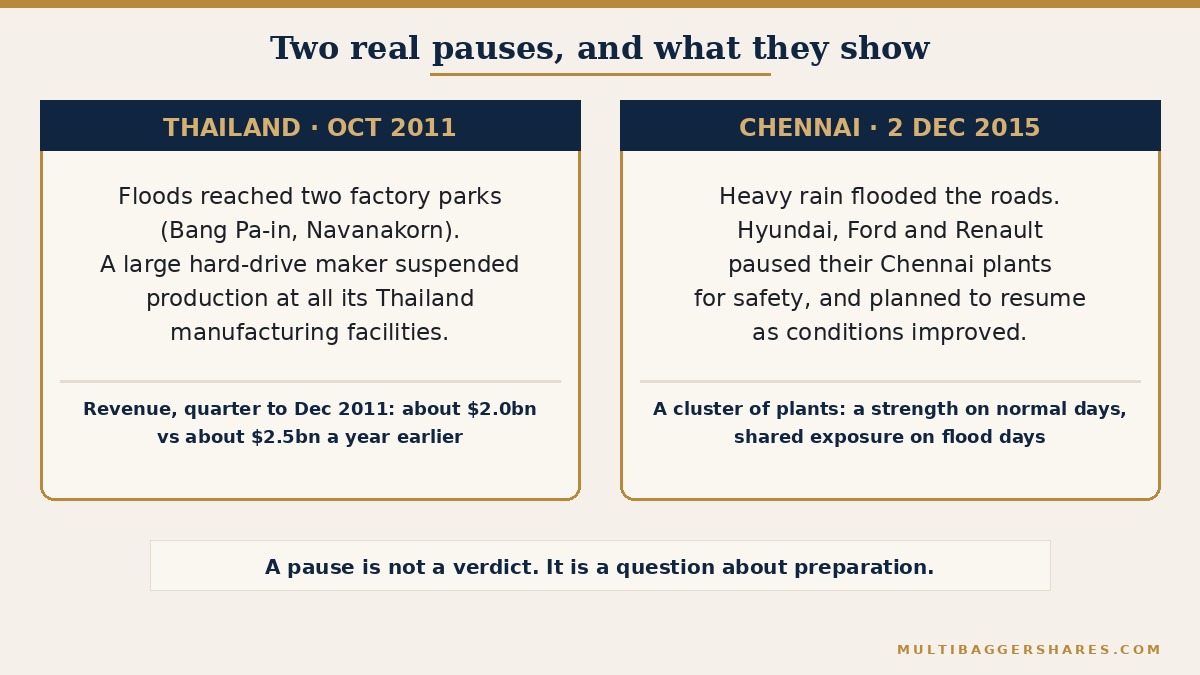
Please read these examples carefully. A pause is not a verdict on a company. Companies recover, and well-prepared ones often recover quickly. What the examples give you is a set of questions to ask. How much of the business sat in the affected place? How long did it stop? What was the cushion? The best businesses answer those questions before the flood, not after it.
The one-oven test: four simple questions
You do not need a spreadsheet for this. You need a company’s annual report (the yearly book a company publishes for its owners) and a little curiosity. Here are four questions, in order.
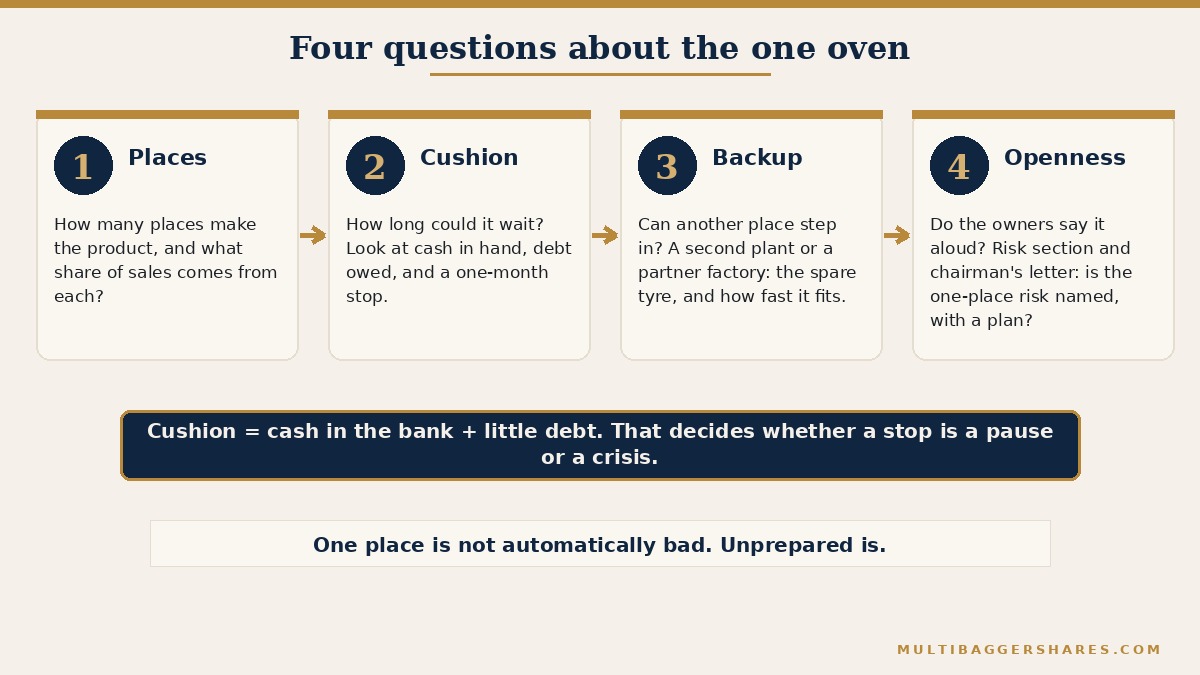
Question one: how many places make the product? Look for a section called properties or manufacturing facilities, and for words like “our plants are located at”. Count the sites. Then ask what share of the sales comes from each one. A company with ten small plants that each make a tenth of the output is very different from one with ten plants where one makes almost everything.
Question two: how long could it survive if the main place stopped for a month? Look at the cash it holds (money in the bank that can be used at once), how much debt it owes and when the payments fall due. Businesses with plenty of cash and little debt can afford to wait. This is the same logic as a family keeping six months of expenses in the bank in case a job is lost.
Question three: could another place take over, and how fast? A second plant that can make the same thing is like a spare tyre. It sits idle most days and looks like a waste. On the bad day it is the most valuable thing in the boot. Some businesses also have arrangements with other manufacturers (called contract manufacturers, who make products for other companies) who can step in. Ask how long it would take to switch, because a spare that takes six months to fit is not much of a spare.
Question four: do the owners talk about it openly? Read the part of the annual report on risks, and the chairman’s letter. Honest owners say plainly, “Most of our output comes from one site, and here is what we have done about it.” They talk about insurance (a contract in which another company pays for certain losses), about backup plans and about what they would do on day one. If the risk is never mentioned at all, that is a small warning sign about how much the owners have thought about it.
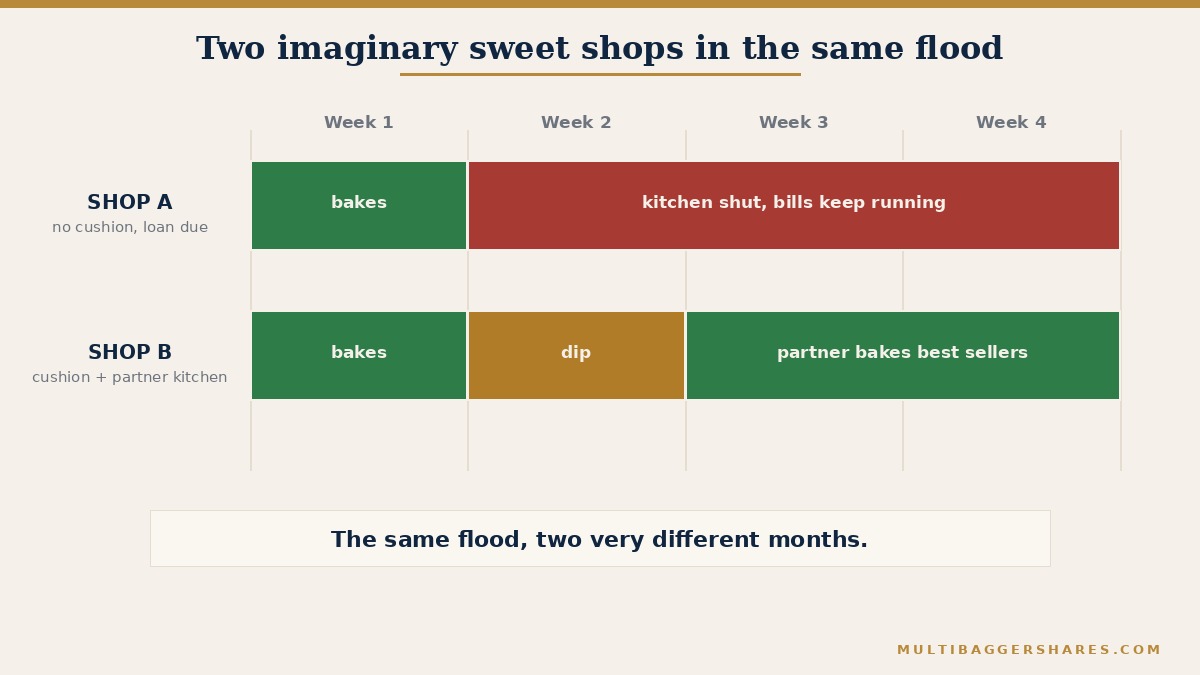
Look at the picture above. Two imaginary sweet shops both make everything in one kitchen. The same flood shuts both for a fortnight. Shop A has no savings and a loan to repay. By the end of the month it is in deep trouble. Shop B has a cash cushion and an understanding with a neighbouring kitchen that will bake its best sellers for a fortnight. Shop B loses some sales but keeps its customers. On the day before the flood, the two shops looked identical from the street. That is exactly why the test is worth doing.
A word of balance
It is easy to take a good idea too far. If you decide that every business with one plant is dangerous, you will miss many fine, focused companies. Spreading production over many places has its own costs. More sites mean more managers, more rent and more chances for quality to slip. Some products can only be made well in one place, because of a special skill or a special piece of machinery.
So treat the one-oven test as one lens among many. It does not tell you what a business is worth, and it does not tell you what to do with any share. It tells you something quieter and more useful: how the business is likely to behave when life stops going to plan. Andy Grove, who led the chip maker Intel, named his 1996 book Only the Paranoid Survive. The sweet shop owner does not have to be paranoid. He only has to be prepared.
How you can use it
Pick one business you know well, perhaps one you have used as a customer. Open its latest annual report and spend fifteen minutes on the four questions. Write your answers on a sheet of paper in your own words. Do not worry if you cannot answer all four. Every blank is useful, because it shows you the edge of your circle of competence (the area of business you truly understand).
Next, try the same questions on a business you already admire. You may find that the reason you admire it is exactly the answer to question two or three. Many of the businesses that seem calm from outside are calm because someone built a cushion long before the storm.
Finally, use it in your own life. Ask what your own “one oven” is. For many families it is a single income. The same four questions apply: how many places does the money come from, how long could we manage if it stopped, what could take over, and have we talked about it openly? Investors who practise on businesses often find they are practising on their own lives too.
Key takeaways
- Concentration in one place, one factory, one warehouse or one port, is a risk that stays invisible on ordinary days and decides everything on the bad one.
- One place is not automatically a weakness. The real question is whether the owners have prepared for the day it stops.
- Cash and debt matter most. The same flood is a short pause for a business with savings and little debt, and a crisis for one with a heavy loan.
- Use the four questions: how many places, how long could it survive a month-long stop, could another place take over, and do the owners talk about it openly?
- A pause is not a verdict. Thailand in 2011 and Chennai in 2015 are lessons about preparation, not judgements about any company.
— Manish Goel · multibaggershares.com
Manish Goel is a Chartered Accountant and Principal Officer of Multibagger Securities Research & Advisory Pvt. Ltd. (MSRAPL), a SEBI-registered Investment Adviser, Registration No. INA100007736. This content is published by MSRAPL for education only and is not personalized investment advice.
Disclaimer: This article is published by multibaggershares.com for education and general information only. It is not investment advice, investment research, or a recommendation to buy, sell or hold any security. Any companies named are discussed only as illustrative examples. Markets carry risk; please do your own research or consult a qualified professional before making any investment decision. |