The Month the Money Runs Short: What Families Never Stop Buying, and Why It Matters to a Business

The Three Sieves: How Chandrakant Sampat, India’s Original Value Investor, Narrowed a Whole Market to a Handful
October 8, 2026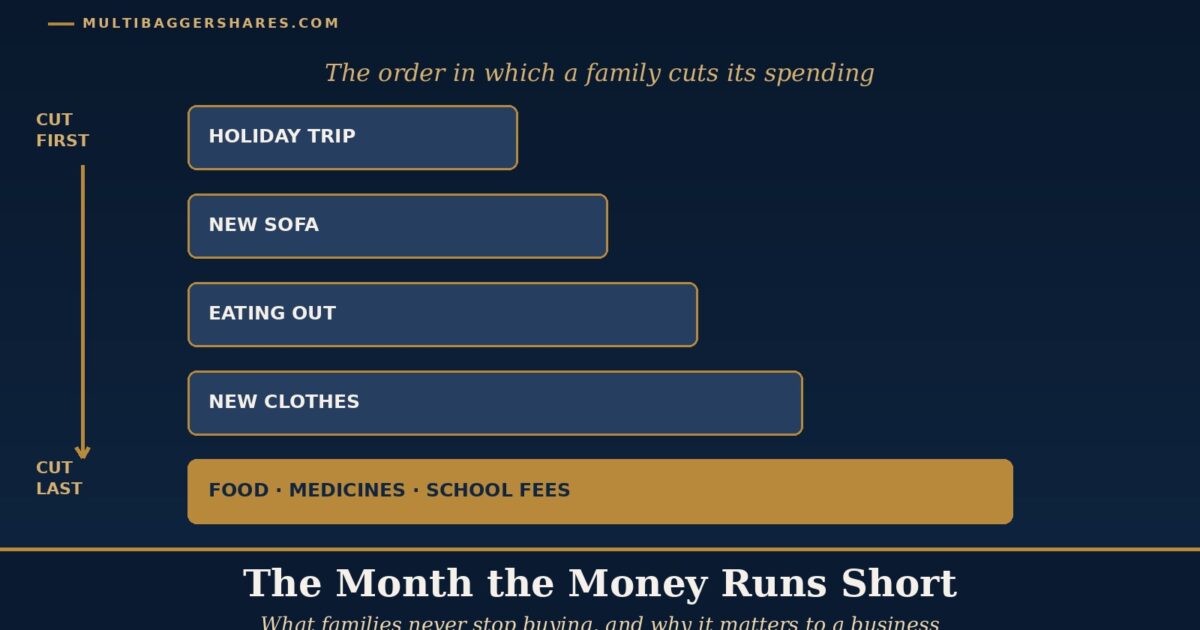
Picture the Sharma family in Pune. The father’s salary normally arrives on the first of the month. One month, it comes three weeks late. What happens in the house? Nobody sits down and writes a plan. It simply happens. The Sunday dinner at the restaurant is cancelled. The new sofa is put off to next year. The holiday booking is forgotten.
And what does not change? The atta (wheat flour) still gets bought. So do the dal, the milk and the medicine for grandfather. The school fee is paid. The phone is recharged. Even in the tightest month, these things keep going.
This small family story holds a big lesson for anyone who owns a share of a business. The company that sells the sofa and the company that sells the atta both go through the same tight month. But they feel it in very different ways. Today we will look at why, how to see the difference, and where this idea stops being useful.
What it really means
Every family, rich or poor, quietly sorts its spending into buckets. We can call them three. The first bucket holds the must-haves: food staples, medicines, school fees, electricity. These are bought even when money is short, because going without them hurts at once. The second bucket holds the things that can wait: new clothes, a replacement for an old fridge that still works, the latest phone. The third bucket holds the nice-to-haves: eating out, holidays, a new sofa, jewellery.
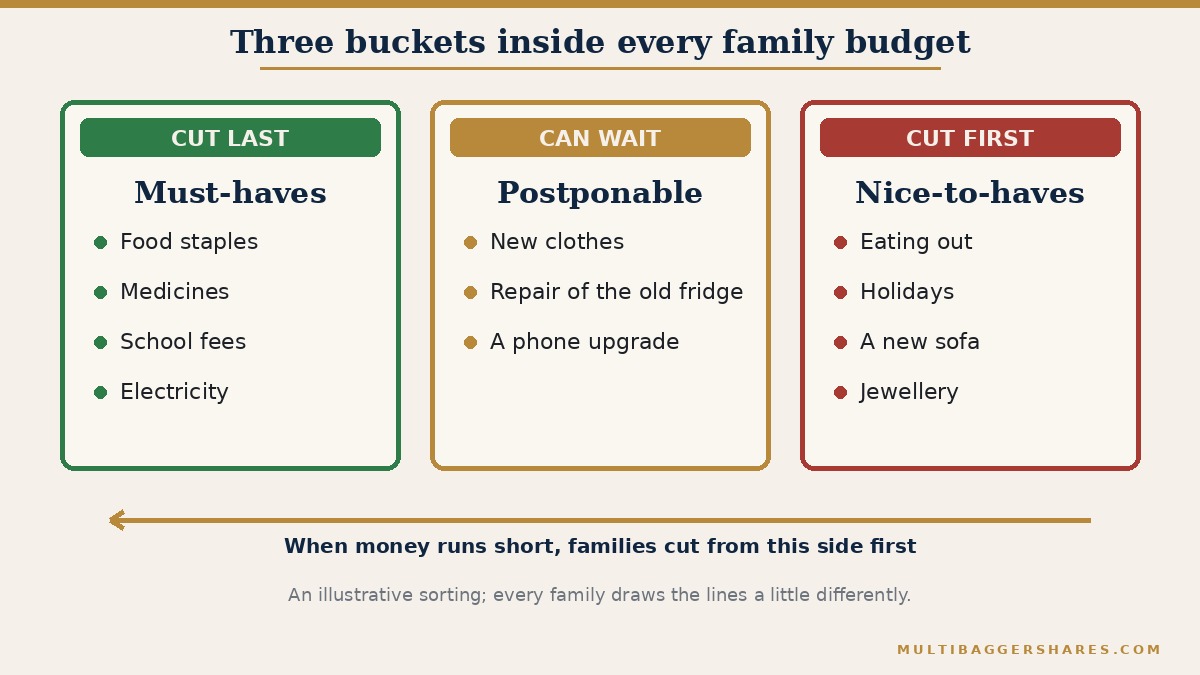
When money runs short, the third bucket is emptied first, then the second. The first bucket is protected until the very end. This is not a rule written by any government. It is just how people behave when they have to choose.
Economists noticed this long ago. In 1857, a German statistician named Ernst Engel studied how families spent their money. He found that as a family’s income rises, the share of that income spent on food falls, even though the rupees spent on food still go up. Turn it around and you see the same thing: a family with less money keeps food high on its list. Food is protected. This pattern is still called Engel’s law.
Now we can say what steady demand means. Demand (how much customers want to buy from a business) is steady when it does not fall much in a bad time. A business that sells first-bucket goods usually has steady demand. A business that sells third-bucket goods usually has demand that jumps around, high in good times and low in bad times.
One caution before we go on. The buckets are not the same for every family, and they change with time. A mobile recharge was once a want. Today, for most people, it is close to a need. A single company can also sell in more than one bucket. So the first job is to ask honestly, product by product, which bucket a customer would put this in when money is short.
There is also a fourth kind of spending that is easy to miss: the big, once-in-many-years purchase, such as a house, a car or a wedding. People plan these for years, and they can delay them for years. When money runs short, these are put off at once, even though they feel important. So a business that lives on such purchases, however respected, will see its sales swing a great deal from one year to the next.
Why it works
Why does steady demand matter so much to the owners of a business? The answer lies in costs that do not go away. A fixed cost (a cost that arrives every month whether or not you sell anything, such as rent, salaries and electricity) is like a school fee. It must be paid in good months and bad months alike. A variable cost (a cost that rises and falls with sales, such as the price of the goods you buy to resell) moves up and down with what you sell.
Let us take two imaginary shops. Both have the same costs. For every Rs 100 of sales, they spend Rs 50 on buying goods, and they also pay Rs 30 in fixed costs. So in a normal year, each shop keeps Rs 20 of profit from Rs 100 of sales.
Shop A is a provision store. It sells atta, dal, soap and tea. Shop B sells sofas and furniture. Now a hard year arrives, and families have less money. At Shop A, sales slip from Rs 100 to Rs 97. People still need their atta. Shop A pays Rs 48.50 for the goods and Rs 30 in fixed costs, so it keeps about Rs 18.50. A small dip.
At Shop B, sales fall from Rs 100 to Rs 60. People are putting off the sofa. Shop B pays Rs 30 for goods, and the same Rs 30 in fixed costs. It keeps nothing at all. Sales fell by two-fifths, but the profit did not fall by two-fifths. It disappeared. That is what fixed costs do to a business with unsteady demand.
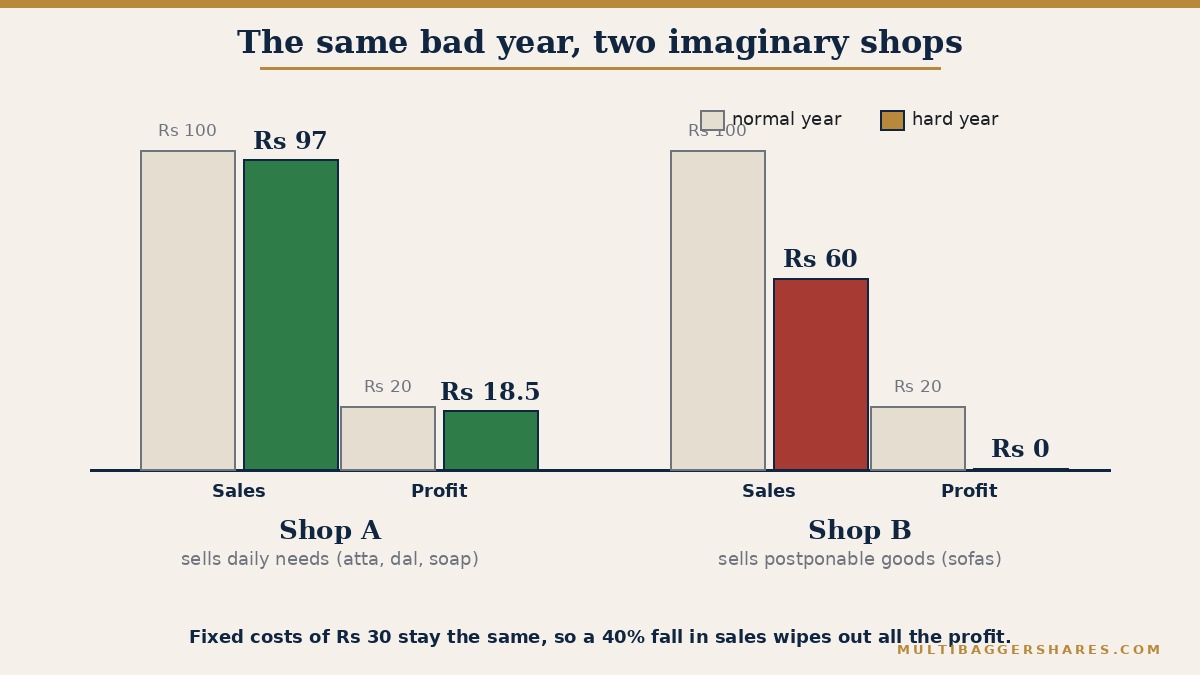
These are imaginary numbers, chosen to make the sums easy. Real businesses are messier. But the shape of the story is real. The fixed costs sit there like a heavy stone on a see-saw. A small fall in sales is manageable. A big fall can wipe out the profit, and if it lasts, it can force the shop to borrow just to pay the rent.
Loan instalments are fixed costs too. Suppose Shop B had also borrowed money to build a bigger showroom. The bank does not care that sofas are selling slowly. The instalment arrives on the same date every month. This is why unsteady demand and heavy borrowing make such a dangerous pair. One makes the profit swing up and down, and the other makes sure the bills do not.
There is a second reason steady demand is valuable, and it is about calm. When you know roughly what will be sold next year, you can plan. You buy the right amount of stock. You hire the right number of people. You do not need to borrow in a hurry. A business that is not fighting for its life every few years can keep reinvesting and keep growing, and that is how compounding (earning returns on your past returns, like a snowball rolling downhill) is allowed to do its quiet work.
A third reason is that the business gets time. It is often said that the most important thing for an investor is to survive the bad years and be there for the good ones. A business with steady demand finds it easier to survive, so it is more likely to be there when the good years come back.
A real example or two
Nature once ran this experiment for us, on a very large scale. On 25 March 2020, India began a 21-day nationwide lockdown to slow the spread of the Covid virus. Almost everything stopped. But shops selling food, groceries, milk and vegetables were allowed to stay open, and so were chemists. At the same time, restaurants were closed for dining in, and air travel was suspended.
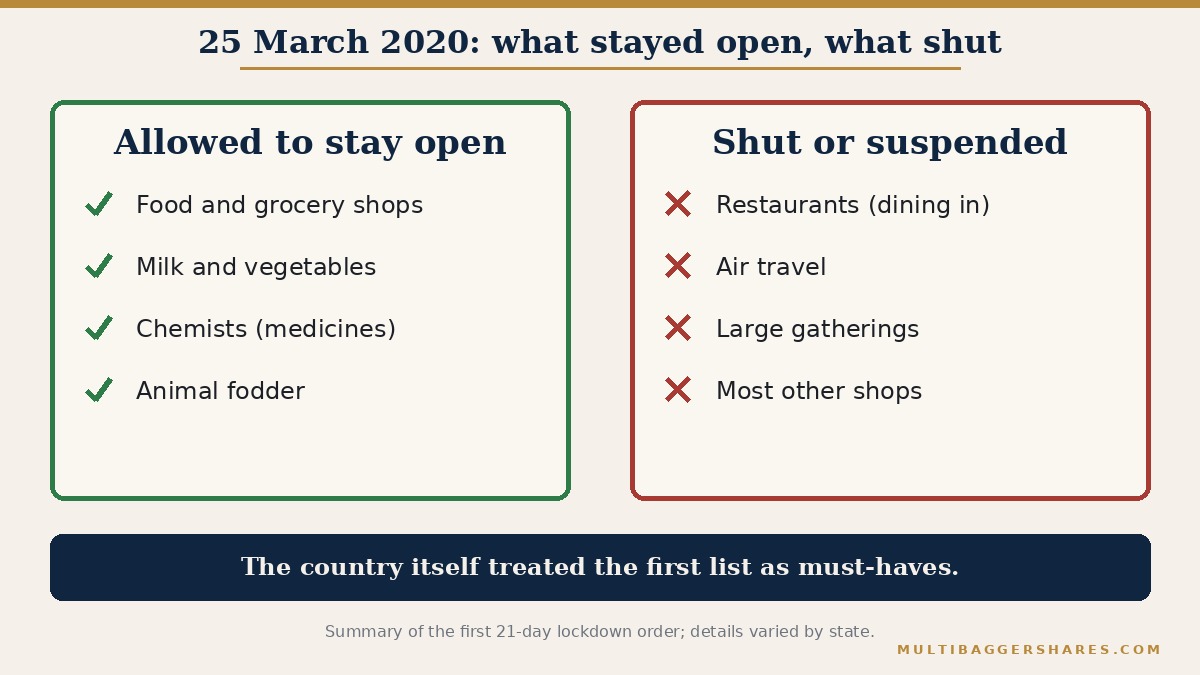
Think about what that meant for the buckets. The first-bucket sellers were told to stay open because the country could not do without them. The third-bucket sellers were told to close. We do not need any company’s numbers to see the point. It is enough to see which kind of demand the country itself treated as a must.
Warren Buffett, the American investor, gave a plain test for a strong business in his 1991 letter to the owners of Berkshire Hathaway. He said an economic franchise (a business with a lasting position that rivals cannot easily attack) comes from a product or service that, in his words, is needed or desired, is thought by its customers to have no close substitute, and is not subject to price regulation. Notice the first test: needed or desired. He did not say only needed. A well-loved brand can make a want feel like a need, but that takes many years of earned trust, and it is rare.
His other two tests carry a warning that is worth pausing on. Suppose a hundred mills in your town all sell the same wheat flour. Everyone needs flour, so sales are steady. But because customers see no difference between one mill and another, the mills fight on price, and each earns only a thin profit. If the government also caps the price, the profit gets thinner still. Need protects the sales. It does not, by itself, protect the profit.
None of this means that a business selling nice-to-haves is a bad business. A good hotel, a good jeweller or a good furniture maker can earn fine profits over many years. But the owner of such a business has to be extra careful about the things within his control. He should keep his borrowing small, keep spare cash for the lean years, and keep his fixed costs light. The sofa seller who does this can wait out the tight months. The one who does not may be gone before the good months return.
How you can use it
You can use this idea at your kitchen table, with a company’s annual report beside you. Here is a simple order of questions.
First, ask the Sharma question. If a family’s money ran 20 percent short, would they stop buying what this company sells, delay it, or carry on? Be honest, and ask it for each main product. Put it in the must-have, can-wait or nice-to-have bucket.
Second, check the record. Free websites show about ten years of numbers for most listed companies. Find the worst year in that stretch. For many businesses it was the year after the global crisis of 2008, or the year after the pandemic hit in 2020. Then look at sales: did they fall a little or a lot? Look at profit: did it stay positive? And look at the operating margin (the share of each rupee of sales that is left as profit from the main business, before interest and tax). If that margin held up in the worst year, the demand was probably steady.
Third, look at the stone on the see-saw. Ask how big the fixed costs are. A business with a lot of rent, salaries and loan instalments to pay has less room for a bad year. A business with steady demand can carry heavy fixed costs more safely, but a business with unsteady demand and heavy fixed costs is the hardest case of all.
Fourth, read what the managers wrote about the weak year. Most annual reports have a section where the managers explain how the year went (it is often called the management discussion). In a bad year, notice the tone. Do they explain plainly what fell, by how much, and why? Or do they blame the weather, the government and the world? A team that speaks plainly about a weak year is usually a team that understands its own customers.
Fifth, remember the limits. Steady demand is only one thing a good business has. It says nothing about whether the company earns a good return on its money, whether it has too much debt, or whether its managers are honest. A steady business can still be a poor one if rivals keep its profits thin. We have said before that dull can be beautiful, but dull and thin-margined is not beautiful. Use this idea as one lens, and keep the other lenses you have already learned.
Last, notice what this lesson leaves out. It does not ask whether a share is priced high or low today. It only asks a quieter question: when the tight month comes, and it always does, will the people who buy from this business keep buying? That is a question about the business, not about the market’s mood. This is a lesson in how to think, not advice about any share.
Key takeaways
- Families protect some spending, such as food, medicines and school fees, and cut other spending first when money runs short.
- A business that sells the protected kind has steadier demand, so its sales fall far less in a bad year.
- Fixed costs turn a small fall in sales into a large fall in profit, which is why steady demand matters so much.
- Check the record: in the worst year of the last ten, did sales, profit and operating margin hold up?
- Need protects sales but not profit, so ask about rivals and price limits as well, and never use this one idea alone.
— Manish Goel · multibaggershares.com
Manish Goel is a Chartered Accountant and Principal Officer of Multibagger Securities Research & Advisory Pvt. Ltd. (MSRAPL), a SEBI-registered Investment Adviser, Registration No. INA100007736. This content is published by MSRAPL for education only and is not personalized investment advice.
Disclaimer: This article is published by multibaggershares.com for education and general information only. It is not investment advice, investment research, or a recommendation to buy, sell or hold any security. Any companies named are discussed only as illustrative examples. Markets carry risk; please do your own research or consult a qualified professional before making any investment decision. |