The Three Sieves: How Chandrakant Sampat, India’s Original Value Investor, Narrowed a Whole Market to a Handful

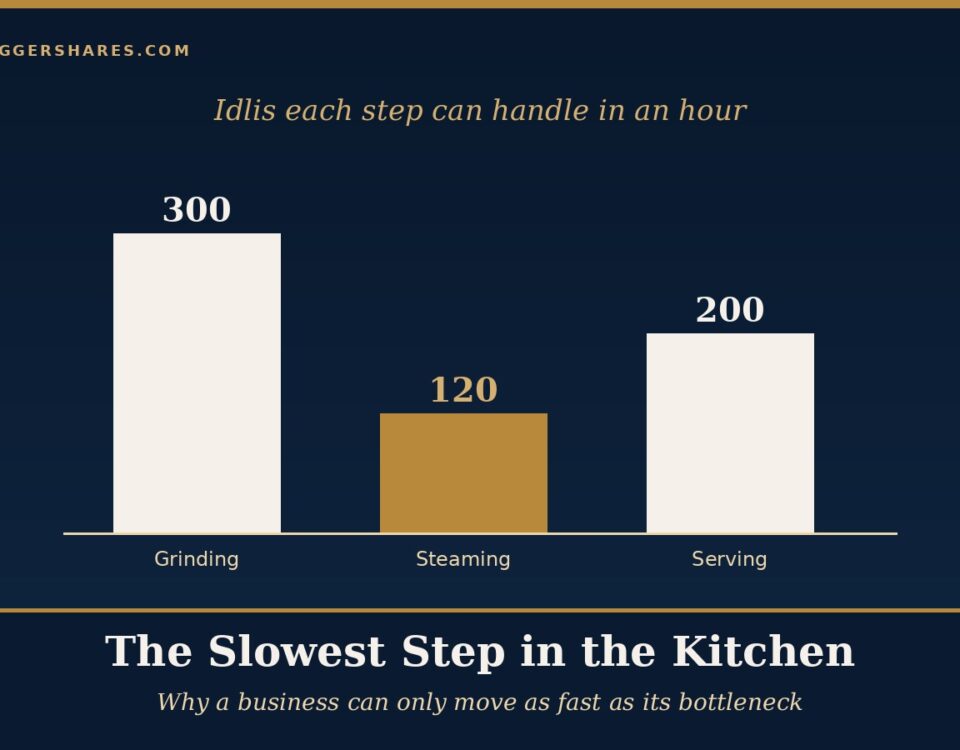
The Slowest Step in the Kitchen: Why a Business Can Only Move as Fast as Its Bottleneck
October 7, 2026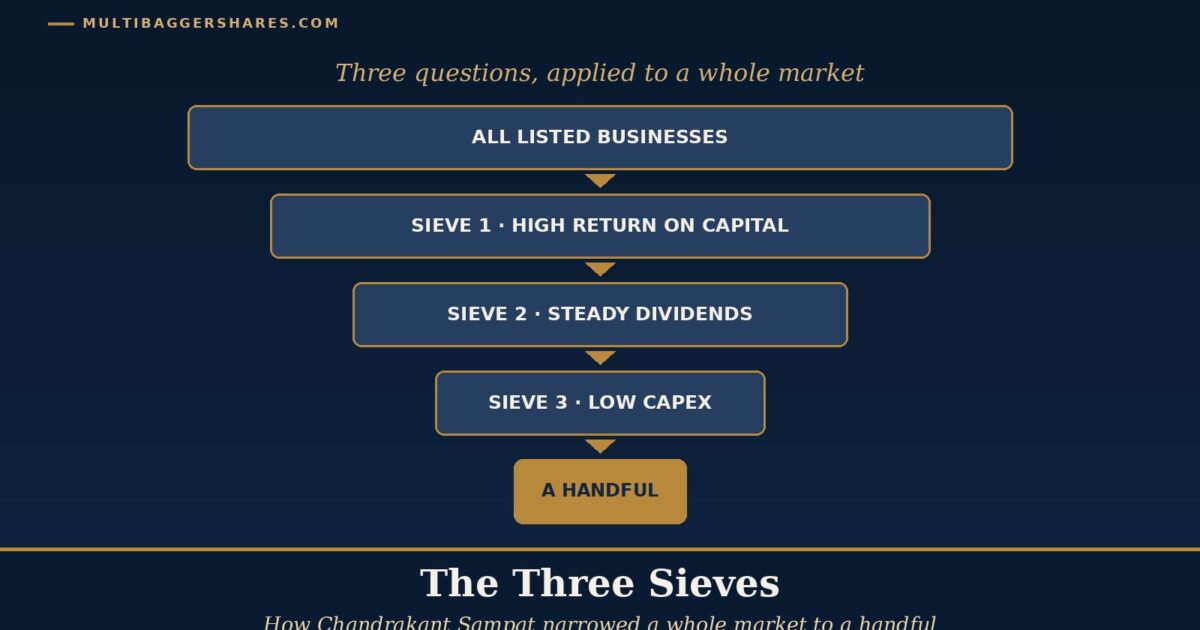
Think of how flour is made at home. The wheat is ground, and then it goes through a sieve (a round tray with a fine mesh, called a chhalni in many Indian homes). The fine flour falls through. The husk and the tiny stones stay behind. Nobody argues with the sieve. It simply keeps what you do not want out of the dough.
One of India’s earliest and best-loved value investors worked in much the same way. His name was Chandrakant Sampat. He lived in Mumbai, he never chased attention, and he is remembered by many people in the market as an original teacher of value investing in India (value investing means looking for good businesses and being patient, instead of chasing whatever is popular today). A great many investors who came after him say that he shaped their thinking.
He did not read the market like a gambler reads a racing form. He had a few plain questions, and he put the whole market through them, one question after another, like three sieves. What stayed on the last sieve was a very small handful of businesses. Those were the ones he studied closely.
Let us look at his three sieves, why they work together, and what you and I can learn from them. We will use two imaginary flour mills to keep the numbers easy.
What it really means
Here are the three questions, as people who knew him have described them. They are not magic words. They are simply three places where a good business tends to show itself.
The first sieve is a high return on capital employed (this tells you how many rupees of yearly profit a business earns for every 100 rupees of money tied up in it, in its buildings, machines and stock). Think of two farmers. One earns Rs 30 a year from every Rs 100 he has put into his land and tools. The other earns Rs 10. Both work hard. But the first farmer’s money is simply working harder. Sampat is reported to have looked for businesses earning at least 25 percent a year on the money tied up in them.
The second sieve is a good record of paying dividends (a dividend is a share of the profit that a company pays out to its owners, in cash). Profit on paper is easy to show. Cash that actually reaches the owners year after year is harder to fake. A business that has paid dividends steadily for many years has had real cash to give.
The third sieve is low capex. Capex is short for capital expenditure (the money a company spends on buying or replacing its machines, buildings and other long-lasting things). Some businesses must keep pouring money into new equipment just to stay in the race. Others can run for years on small repairs. Sampat preferred businesses that did not need to be fed all the time.
Each question alone is useful, but the three together are powerful. A high return means the business earns a lot from the money in it. Low capex means it does not have to keep putting new money in. And steady dividends show that the extra cash really does come out. Put them together and you describe a business that earns a lot, needs little, and shares the rest.
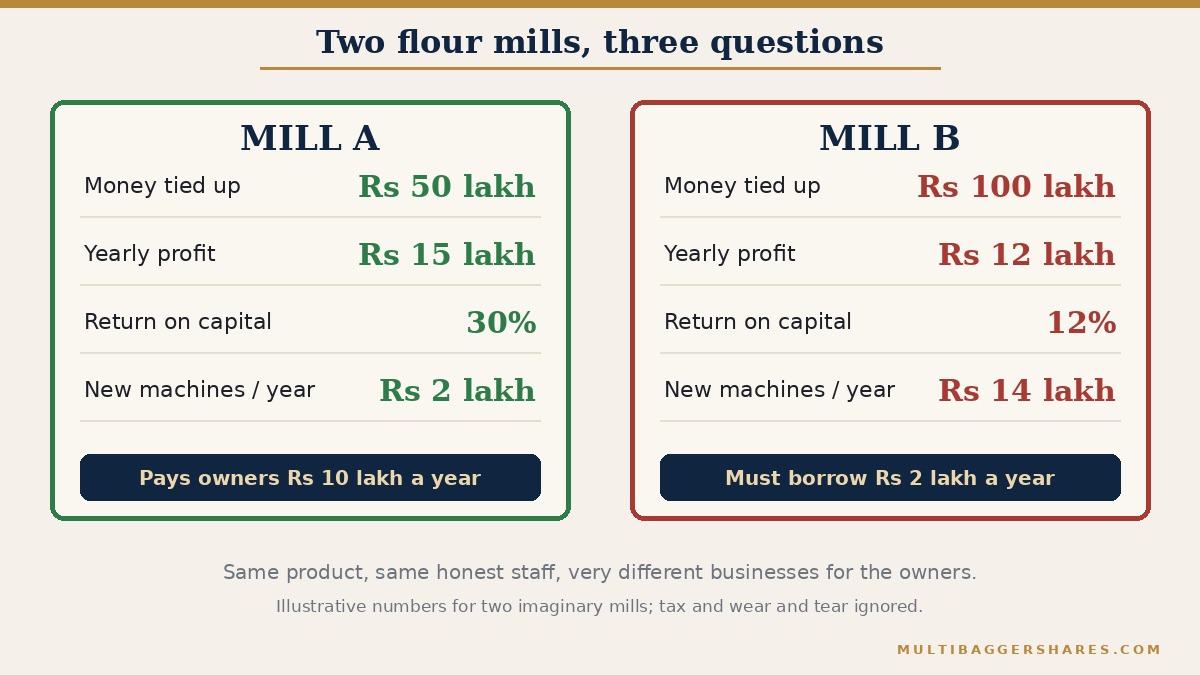
Now the two mills. Mill A has Rs 50 lakh of the owner’s money in it. It makes Rs 15 lakh of profit a year. That is Rs 30 for every Rs 100, or 30 percent. Each year it needs about Rs 2 lakh for repairs and small new machines. So about Rs 13 lakh of free cash is left, and the owner pays himself Rs 10 lakh in dividends and keeps Rs 3 lakh as a cushion.
Mill B has Rs 1 crore (Rs 100 lakh) in it. It makes Rs 12 lakh of profit a year, which is only 12 percent. To keep up with rivals it must purchase new machines worth about Rs 14 lakh every year. That is more than the whole profit. So there is no cash to share, and the owner must borrow about Rs 2 lakh every year to keep going. These are imaginary numbers, and we have ignored tax and wear and tear to keep the arithmetic simple.
Both mills grind flour. Both employ honest people. Yet they are very different businesses for the people who own them.
Why it works
Look at where the money goes in each mill over ten years. Mill A’s owners receive about Rs 10 lakh a year, which adds up to roughly Rs 1 crore. That is twice the Rs 50 lakh they first put in, and they still own the mill. Mill B’s owners receive nothing in all that time, and the mill has borrowed about Rs 20 lakh, not counting the interest.
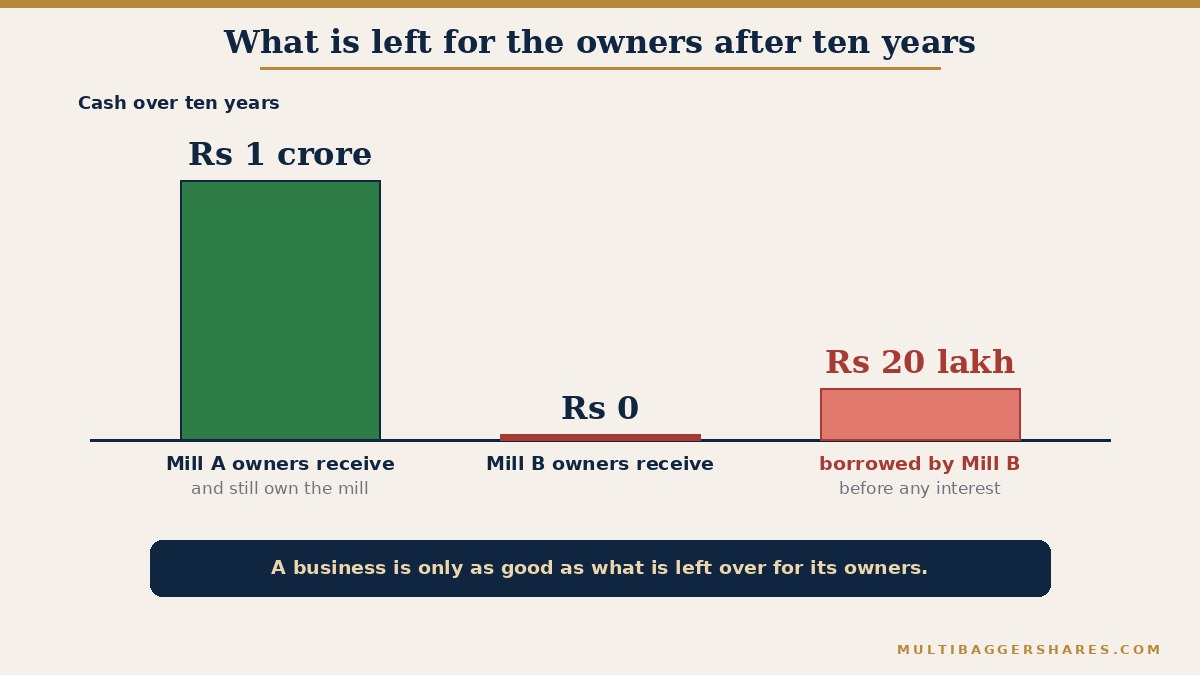
This is the quiet secret behind the three sieves. A business is only as good as what is left over for its owners. Profit is the number we see on the first page. Cash that can be taken out without hurting the business is the number that matters. The three sieves are a simple way to look for the businesses where that left-over cash is large.
There is a second reason the sieves work, and it is about honesty. A stated plan costs nothing. Any manager can say that the company will be careful with money. But a company cannot fake years of dividends, or fake a low need for new machines. These show up in the record. Sampat is reported to have judged companies by what they did, not by what they said they intended to do. He was influenced by the management writer Peter Drucker, who taught people to look at results and actions.
A third reason is that sieves save time. There are thousands of listed companies. Nobody can study them all. Three clear questions remove most of the crowd quickly, so that the little time you have goes to the few businesses that might be worth understanding well. A sieve does not pick the winner. It only clears away what you should not spend your evening on.
A real example or two
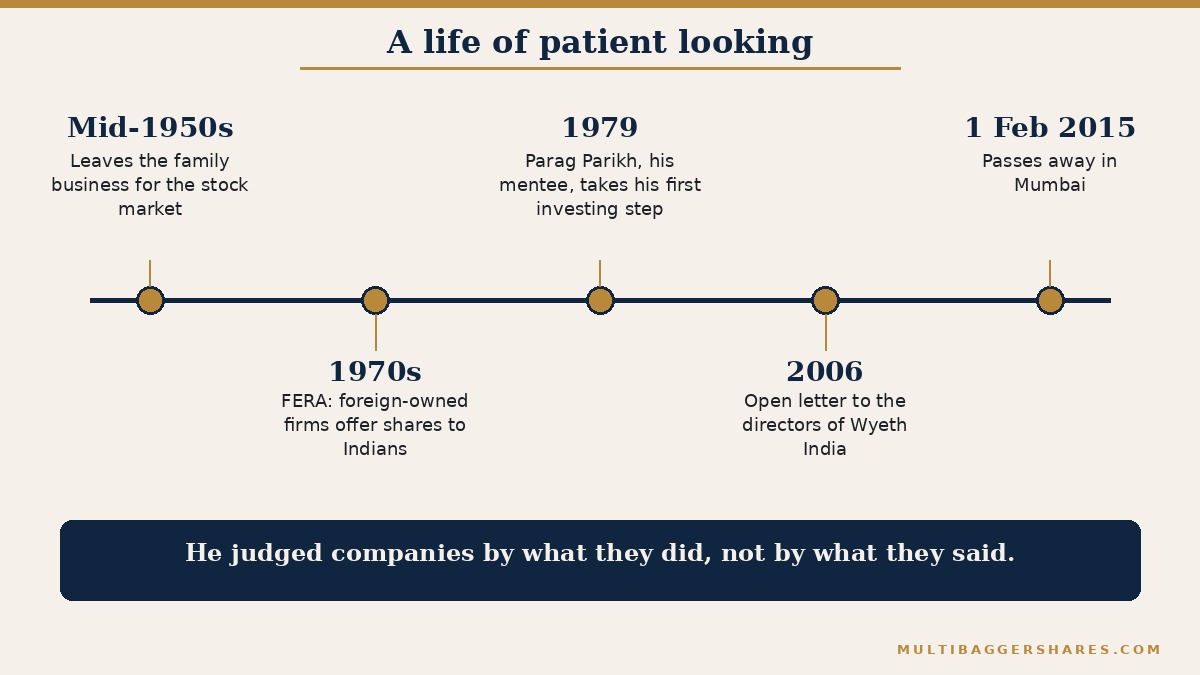
Chandrakant Sampat left his family’s business in the 1950s and began investing in the mid-1950s, when the stock market was a small and quite different world. He learned on his own. He was a patient man, and people who met him describe a simple, disciplined life. He travelled by public transport even though he owned cars, and he jogged along Marine Drive.
In the 1970s, a law called the Foreign Exchange Regulation Act, or FERA, pushed many foreign-owned companies working in India to reduce their ownership and offer shares to Indians. A number of these companies were well run, with strong brands, and many people had not yet looked at them closely. Sampat is reported to have invested in two of them in that decade: Hindustan Lever, which is now Hindustan Unilever, and Indian Shaving Products, which is now Gillette India. We mention them only as a piece of history, to show the kind of business his sieves tended to find, everyday products used by millions, made by companies with strong returns and modest needs for new machinery.
He also cared about how companies treated their ordinary owners. In 2006, he wrote an open letter to the directors of Wyeth India, objecting to a decision to move the marketing rights of a drug to another Indian company in the same group. You do not need to agree with every detail to see the principle. Watching what a company does, and speaking up when its actions do not match its words, was part of how he worked.
Sampat also passed on what he knew. Parag Parikh, who later founded an investment firm of his own, has written that Sampat was his mentor, whom he called Chandrakant Kaka. Parikh has described how, as a student in the mid-1970s, his own plan to start a business did not work out. Sampat read his report and gently told him that his passion for stocks and analysis might suit him better. Parikh took his first investing step in 1979.
Sampat was not perfect, and nobody is. In his later years he worried that loose money and heavy borrowing around the world were building a bubble (a rise in prices that is not backed by real earnings). A tribute written by a friend noted that he may have misjudged the timing of that worry. A good filter helps you look in the right places. It cannot tell you what the world will do next year.
How you can use it
You do not need a mill or a mentor to borrow his three sieves. All you need is the annual report of a company, or a free website that shows its numbers. Take your time, and ask each question in order.
Question one: how much does this business earn on the money tied up in it? Look for the return on capital employed (profit before interest and tax, divided by the money tied up in the business). Check it for many years, not just the latest one. One good year can be luck. A good record across ten years is a habit. The 25 percent that Sampat is reported to have looked for is one yardstick, not a law. What matters is whether the number is high compared with similar businesses, and whether it has stayed high.
Question two: has the company paid dividends steadily? Look at the last ten years. A company that pays something every year, and a little more as it grows, is telling you the cash is real. Be careful, though. A dividend paid out of borrowed money is not the same thing. So check the next question as well.
Question three: how much does it spend on capex each year, compared with the profit it makes? You can find this in the cash flow statement (the statement that shows the real cash coming in and going out). If the spending on new machines is a small part of the profit, the business can grow and pay owners at the same time. If it swallows all the profit, the business is on a treadmill.
After the three sieves, do the part no filter can do. Read what the company actually makes and sells. Ask whether you could explain the business to a friend in one or two sentences. Ask who the customers are, and why they keep returning. A sieve gives you a short list. It never gives you understanding.
Notice what these questions leave out. They do not ask whether a share price is high or low today. They only ask whether the business itself is of good quality. That is the quiet lesson of Sampat’s life. He is remembered less for any one company than for the habit of asking plain questions, and then having the patience to wait.
He is quoted as saying, in a magazine interview, that we have become clever but the wisdom is missing. Three plain sieves and a lot of patience are a small step towards that wisdom. They are not a promise of anything, and this is a lesson in how to think, not advice about any share.
Key takeaways
- A filter is like a sieve: it does not choose the winner, it quickly clears away most of what is not worth your time.
- Chandrakant Sampat is reported to have used three plain questions: a high return on capital, a steady record of dividends, and low spending on new machines.
- Together they describe a business that earns a lot on little money and shares the extra cash with its owners.
- Judge a company by what it does year after year, not by what it says it will do.
- A filter gives you a short list, never understanding, so read the business itself, and remember that no rule predicts what the world will do next.
— Manish Goel · multibaggershares.com
Manish Goel is a Chartered Accountant and Principal Officer of Multibagger Securities Research & Advisory Pvt. Ltd. (MSRAPL), a SEBI-registered Investment Adviser, Registration No. INA100007736. This content is published by MSRAPL for education only and is not personalized investment advice.
Disclaimer: This article is published by multibaggershares.com for education and general information only. It is not investment advice, investment research, or a recommendation to buy, sell or hold any security. Any companies named are discussed only as illustrative examples. Markets carry risk; please do your own research or consult a qualified professional before making any investment decision. |