Who Is Standing at the Counter? How to Judge the Quality of the People a Business Sells To

The Milkman’s Map: Why Customers Packed Close Together Make a Business Cheaper to Run
October 4, 2026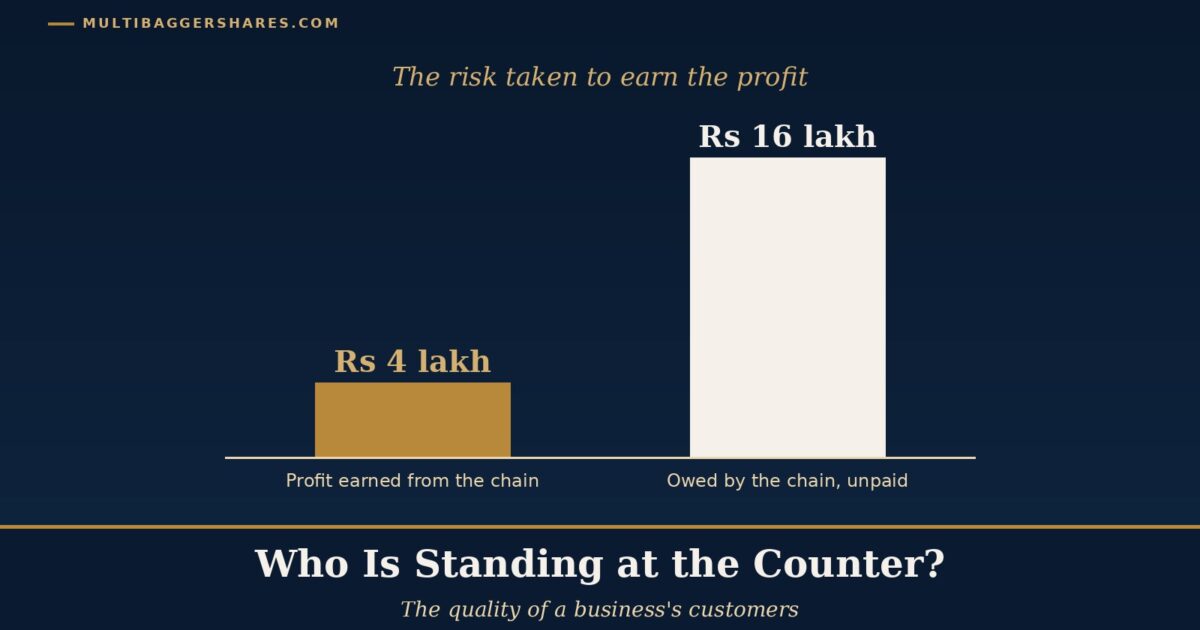
Kavita runs a small pickle company in Nashik. Last year she sold pickles worth Rs 1 crore (one crore is ten million rupees). Her profit was about ten per cent of that, so roughly Rs 10 lakh (one lakh is one hundred thousand rupees).
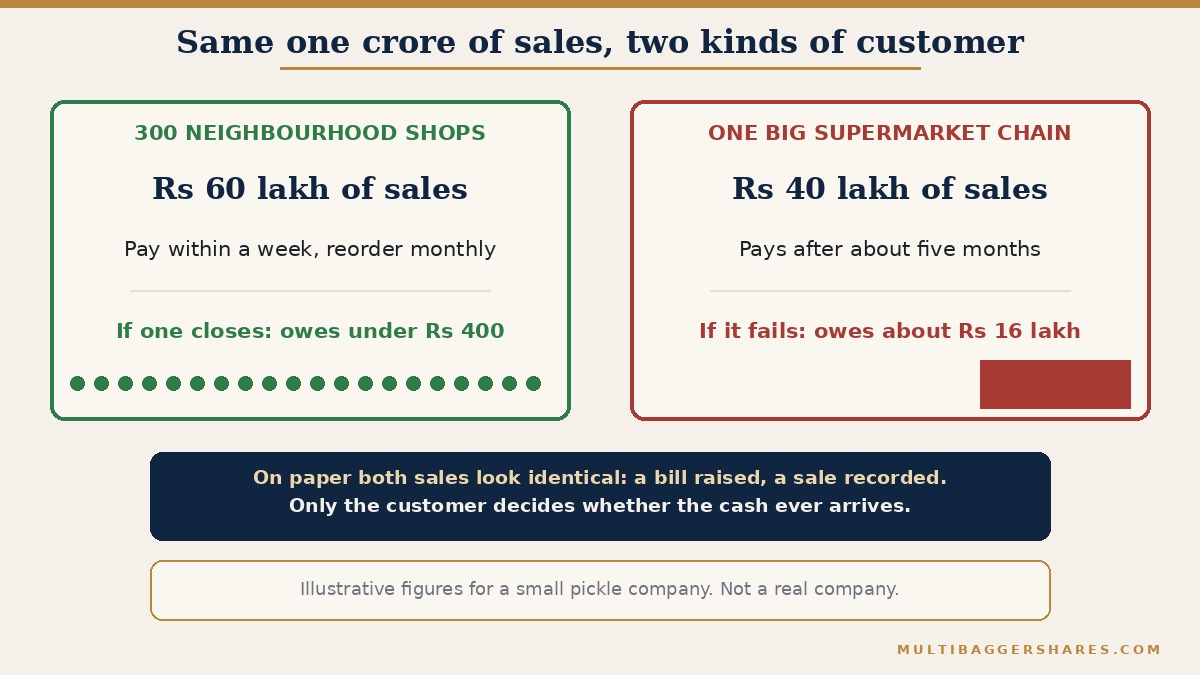
But that one crore came from two very different kinds of customer. Three hundred neighbourhood grocery shops (kirana shops) bought Rs 60 lakh worth. They pay within a week, and they reorder every month, because shoppers ask for her mango pickle by name. One big new supermarket chain bought the other Rs 40 lakh. It orders in huge lots, and it pays after about five months.
On paper, both sales look the same. Pickle goes out, a bill is raised, and a sale is recorded. At the end of the year the accounts show one crore in sales and Rs 10 lakh in profit. Nothing in that number tells you who was standing at the counter.
Then the chain gets into trouble and stops paying. By then it owes Kavita about five months of its buying, which comes to roughly Rs 16 lakh. Her profit from the chain was only about Rs 4 lakh. She risked Rs 16 lakh to earn Rs 4 lakh.
Kavita did not get hurt because her pickle was bad. She got hurt because she never looked closely at who was buying it. That is today’s lesson: the quality of a business’s customers matters almost as much as the size of its sales.
What it really means
A business makes money in two steps. First it makes a sale. Then it collects the cash. Many people think the two happen together, but they often do not. A sale is only a promise to pay, and the promise is kept later.
The money that customers owe a business but have not yet paid is called receivables (think of it as the business’s “customers owe me” list). If a customer never pays, that money is called a bad debt (a debt that has to be written off as lost). Both words sound heavy, but the idea is plain. Selling is easy. Getting paid is the part that proves the sale was real.
So what makes a customer good? Think of a tenant renting your flat. On the agreement, every tenant pays the same rent. But one tenant pays on the first of every month and stays for ten years. Another pays late, argues about repairs, and may disappear owing three months. The rent is identical. The tenants are not.
A good customer has four qualities. First, the customer can pay, and does so on time. Second, the customer comes back, because the need is regular. Third, the customer stays for reasons beyond the lowest price, such as habit, trust or convenience. Fourth, the customer is paying with money the customer has earned, not with money the seller lent.
A business with many customers of this kind is like a tree that fruits every year. A business that depends on weak customers is like a crop that grows well in one good season and then fails. Both look healthy in the good season. Only one will feed you for decades.
Why it works
Customer quality is easy to miss because accounts record profit when the sale is made, not when the cash arrives. A weak customer can make this year’s profit look wonderful and then take it away next year. The profit was real on paper. The cash never came.
Strong customers do the opposite, and the effect builds up like a snowball rolling downhill. When customers pay quickly, the business does not have to borrow to fund its own working. When customers come back every month, the owner can plan purchases, hire with confidence and avoid costly discounts to chase new orders. Every rupee collected sooner is a rupee that can be used again.
Customers who stay for habit or trust are also harder to steal. Kavita’s shops do not switch pickle makers for a small discount, because their own shoppers ask for her mango pickle. A customer who buys only on the lowest price will leave for a one per cent cheaper offer. Over many years, that difference in loyalty adds up to a very different business.
There is also a quieter benefit: predictability. When a business knows that most of its customers are steady, it can survive a bad quarter without panic. A business that depends on one or two big, slow payers lives from one phone call to the next. The owner cannot sleep, and a wise investor does not enjoy owning that kind of worry.
Here is a piece of arithmetic worth keeping in your head. Kavita earns about ten paise of profit on every rupee she sells. To win back a loss of Rs 16 lakh, she would need to sell about Rs 1.6 crore of fresh pickle at the same margin. That is more than the whole of last year’s sales. A bad debt is expensive because the profit on a sale is thin, and the loss on an unpaid sale is the full price.
Slow payment also works like a hidden loan. When a buyer says “I will pay in 150 days”, the buyer is really asking the seller to act as the buyer’s bank, and a bank that does not charge interest is a poor bank. The seller must find the money to buy raw material and pay wages for five months before a single rupee comes back. If the seller borrows to bridge the gap, the interest quietly eats the profit.
A real example or two
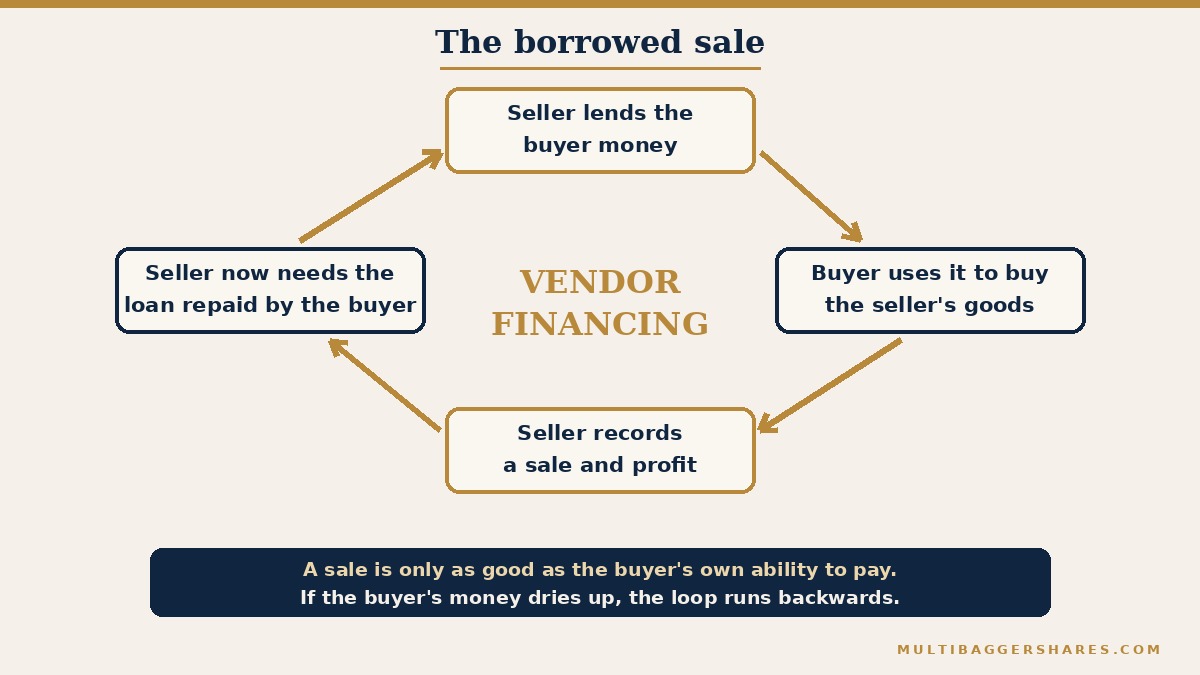
Our first example comes from the telecom boom of the late 1990s. Many new phone and internet companies wanted to build networks. They needed expensive equipment, and many of them could not easily borrow the money. So some equipment makers did something unusual. They lent money to their own customers, so that the customers could buy the equipment.
This is called vendor financing (the seller lends the buyer the money to buy the seller’s own goods). It is like a furniture shop lending you the money to buy its sofa. The sale is real. But whether it will ever be paid for depends on whether you can repay the loan.
Lucent Technologies, then one of the world’s largest makers of telecom equipment, was one such supplier. In its annual report for the year ended 30 September 2000, Lucent said it had made commitments to extend credit to customers of up to about $6.7 billion, and that about $1.3 billion of that had already been advanced and was outstanding. A year later, in its annual report for 2001, it wrote that its service provider customers were facing slowing revenue growth and reduced access to capital.
Look at what those two sentences tell us. Many of Lucent’s buyers were companies whose survival depended on being able to borrow. When the borrowing dried up, the buyers’ ability to pay was in doubt, and so was the value of the sales made to them. Many things went wrong for the telecom industry in that period, and customer quality was only one of them. We tell this story as history, not as a verdict on any share.
Now return to Kavita. Suppose ten of her three hundred shops closed tomorrow. Each shop buys about Rs 20,000 of pickle a year, and each pays within a week. So each owes her only about a week of orders, which is under Rs 400. Ten closures cost her about Rs 4,000. Compare that with the Rs 16 lakh at risk from one supermarket chain. The first kind of customer is spread thin and pays fast. The second is concentrated and pays slowly.
The word for the second problem is concentration (leaning too heavily on one or a few customers). It is the same idea as keeping all your eggs in one basket, except here the basket is somebody else’s balance sheet.
How you can use it
You do not need to be an accountant to check customer quality. You only need to ask four plain questions while reading a company’s annual report. Think of them as questions you would ask if you were buying a small shop and wanted to know who the regulars were.
Question one: how many customers does the business have, and does any single one matter too much? The accounting rules ask a company to say when one customer gives it ten per cent or more of its revenue. If you see a customer that big, treat it like Kavita’s supermarket chain. Ask what happens if that one buyer leaves or stops paying.
Question two: how long do customers take to pay, and is the wait getting longer? Indian companies now show their trade receivables (the money customers owe) grouped by how long it has been owed. If more money sits in the older groups from year to year, that is a warning. A good customer base does not drift towards slower and slower payment.
Question three: is the company lending to its own customers? Look for loans or advances given to customers, dealers or channel partners (the middle businesses that carry goods to the final buyer), or very long credit periods offered just to win orders. If sales are growing quickly but the cash coming in from operations is not, ask who is really paying for the growth.
Question four: why do customers stay? Look for repeat orders, a brand shoppers ask for by name, and goods that customers need again and again. Philip Fisher, the author of Common Stocks and Uncommon Profits, urged investors to talk to customers directly, which he called scuttlebutt (collecting honest opinions from people who deal with the business). You can do a small version yourself. Ask a few shopkeepers or buyers whether they would switch for a small discount.
A fair word of balance is needed here. Big is not the same as bad. A large customer with a strong balance sheet that pays on time can be a wonderful customer, and some of the best businesses sell mostly to a few large, careful buyers. Slow payment can also have an innocent reason, such as a customer that is a government body with long but reliable payment cycles. The point is not to avoid every big or slow customer. The point is to know who they are and to ask whether the business is being paid fairly for the risk it carries.
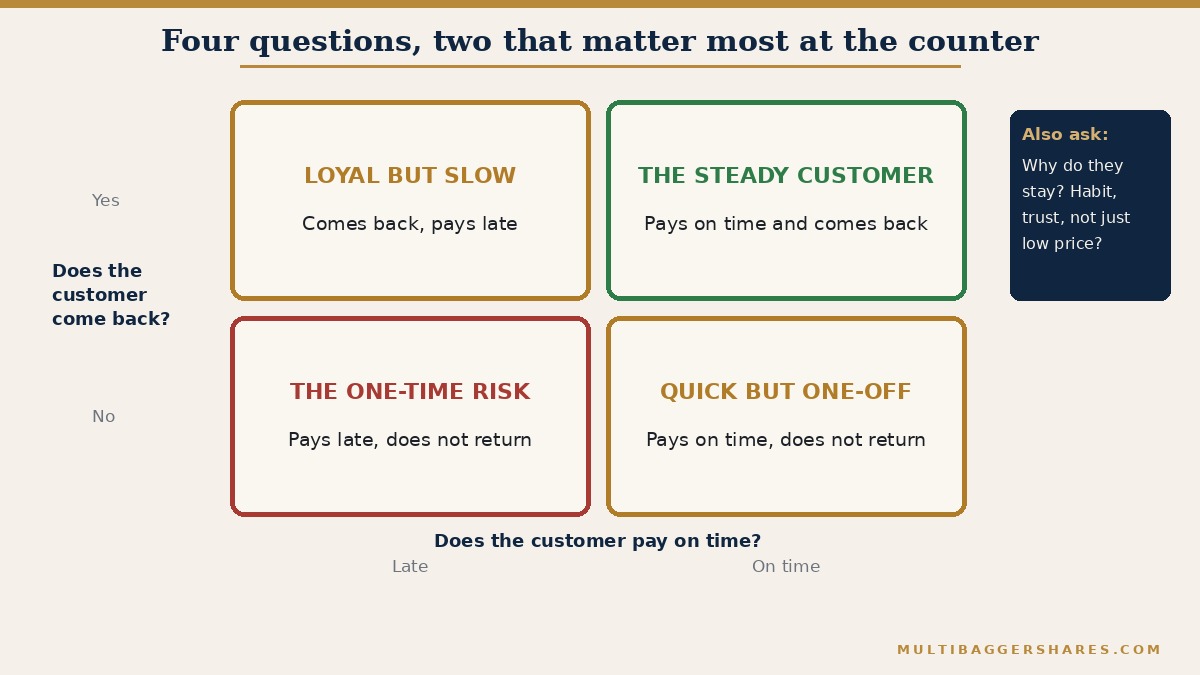
Notice what these questions avoid. They do not ask whether a share is cheap or costly. They only ask whether the business is selling to people who will pay and return. A wonderful product sold to poor customers can still make a poor business. An ordinary product sold to steady customers can quietly do very well for years.
When you meet a business that looks excellent, take one more minute before you move on. Ask who is standing at the counter. Learning to ask that question, and to read the answer in the notes behind the numbers, is one of the most useful habits a long-term investor can build.
Key takeaways
- A sale is only a promise to pay, so the quality of the customer decides whether a reported sale ever becomes real cash.
- A good customer can pay, pays on time, comes back, and stays for reasons beyond the lowest price.
- When a seller lends money to its own buyers (vendor financing), the sale is only as good as the buyer’s ability to repay.
- Leaning on one slow-paying customer (concentration) can put several years of profit at risk to earn a small slice of it.
- Check four things in the annual report: how many customers matter, how long they take to pay, whether the company funds them, and why they stay.
— Manish Goel · multibaggershares.com
Manish Goel is a Chartered Accountant and Principal Officer of Multibagger Securities Research & Advisory Pvt. Ltd. (MSRAPL), a SEBI-registered Investment Adviser, Registration No. INA100007736. This content is published by MSRAPL for education only and is not personalized investment advice.
Disclaimer: This article is published by multibaggershares.com for education and general information only. It is not investment advice, investment research, or a recommendation to buy, sell or hold any security. Any companies named are discussed only as illustrative examples. Markets carry risk; please do your own research or consult a qualified professional before making any investment decision. |