Myopic Loss Aversion (Benartzi & Thaler 1995): Why Indian Retail Investors Sabotage Long-Term Returns by Checking Portfolios Too Often

Net Debt to EBITDA Ratio: The Single Solvency Test Credit Analysts Care About Most
May 16, 2026
The Klarman Doctrine: Seth Klarman’s 1991 ‘Margin of Safety’ Three-Pillar Architecture — Why Absolute Returns, Bottom-Up Bargain Hunting, and Risk Aversion Define the Real Value Investor’s Edge
May 17, 2026
Posted in Behavioral Finance | 16 May 2026 | Manish Goel — Founder, Multibagger Securities Research & Advisory Pvt. Ltd. (SEBI Registered Investment Adviser)
In 1995, two behavioural economists — Shlomo Benartzi and Richard Thaler — published a paper that won Thaler the 2017 Nobel Memorial Prize in Economic Sciences. Its title was deceptively simple: “Myopic Loss Aversion and the Equity Premium Puzzle”. The paper asked a question that had baffled academic finance for two decades: Why do equities, over the long run, deliver returns so dramatically above bonds that the gap cannot be explained by ordinary risk aversion?
Their answer was as elegant as it was unsettling for the individual investor. The equity premium is not really a compensation for the risk in stocks themselves. It is compensation for a self-inflicted behavioural disease — the tendency of investors to evaluate their portfolios far too frequently, suffer the pain of every short-term drawdown with the asymmetric intensity that Kahneman and Tversky’s loss aversion predicts, and then make myopic adjustments that systematically destroy long-term compounding. The “myopia” in myopic loss aversion is not about eyesight. It is about time horizon. Combine a loss-averse brain with a short evaluation window, and the result is an investor who is constitutionally incapable of holding equities long enough to capture the very premium that drew them in.
This is the bias we will dissect today. It is, in many ways, the most important and most under-discussed bias of the Indian retail-investor era — an era defined by Zerodha, Groww, Upstox, Angel One, mobile NSE/BSE apps, real-time P&L pop-ups, and demat statements that arrive in your inbox the moment a candle turns red. The day you understand myopic loss aversion is the day you start to see why most retail demat accounts in India, in spite of being parked in some of the best businesses ever listed on Dalal Street, deliver returns that look nothing like the businesses themselves.
1. The Bias — What Is Myopic Loss Aversion?
Myopic Loss Aversion (MLA) is the joint effect of two independently well-established psychological forces:
- Loss aversion — Kahneman and Tversky (Prospect Theory, 1979) found that the pain of a loss is roughly 2.0×–2.5× more intense than the pleasure of an equivalent gain. A ₹10,000 paper loss feels at least twice as bad as a ₹10,000 paper gain feels good.
- Mental accounting frequency — Richard Thaler’s broader work shows that investors evaluate gains and losses against very specific reference points and specific time windows. The shorter the window, the more often you encounter a loss.
Stack the two and what falls out of the math is mechanical. Indian equities, on a long-window basis (5–15 years), have delivered nominal CAGR in the 12–14% range — well above debt and inflation. But on a daily evaluation window, equities are negative roughly 47% of the time, positive 53%. On a monthly window, negative ~38%. On an annual window, negative ~25%. On a five-year rolling window, the Indian large-cap index has been negative less than 4% of the time across the last three decades.
If your loss-aversion coefficient is 2.0 and you check your portfolio daily, every red candle delivers 2× the emotional punishment of every green candle. Even though long-run equity returns are positive, your experienced utility is negative — because you have voluntarily chosen the highest-pain evaluation frequency.
Benartzi and Thaler computed, in their 1995 paper, that an investor with standard loss aversion coefficients who evaluates a portfolio once a year would, on a utility basis, be indifferent between stocks and bonds at roughly the historically observed equity premium. In other words: the entire 6%-per-annum equity premium that has flowed into long-term equity holders globally for the last century is, in their framework, the toll paid by short-window evaluators to long-window holders. Those who voluntarily look more often, give it up. Those who voluntarily look less often, collect it.
2. The Underlying Psychology — Why Our Brain Cannot Help Itself
Three lower-level mechanisms feed MLA, and understanding them is the first step to disarming it.
(a) The pain centre lights up faster than the reward centre. Neuroeconomic studies — Camerer, Loewenstein and Prelec (2005) and later fMRI work by Tom, Fox, Trepel and Poldrack (2007) — show that the brain’s amygdala fires asymmetrically. The neural signature of a loss is sharper, faster and more memorable than the signature of an equivalent gain. The 2× loss-aversion ratio is not a metaphor; it is a measurable biological asymmetry.
(b) Reference-point reset. Each time we look at the portfolio, we silently re-anchor to whatever the screen says today. Tomorrow’s −1.2% becomes a fresh loss measured from today’s anchor, not from our original cost. The mind never accumulates a “long-run sense of where I started”; it accumulates a series of micro-losses, each fully weighted, each fully painful.
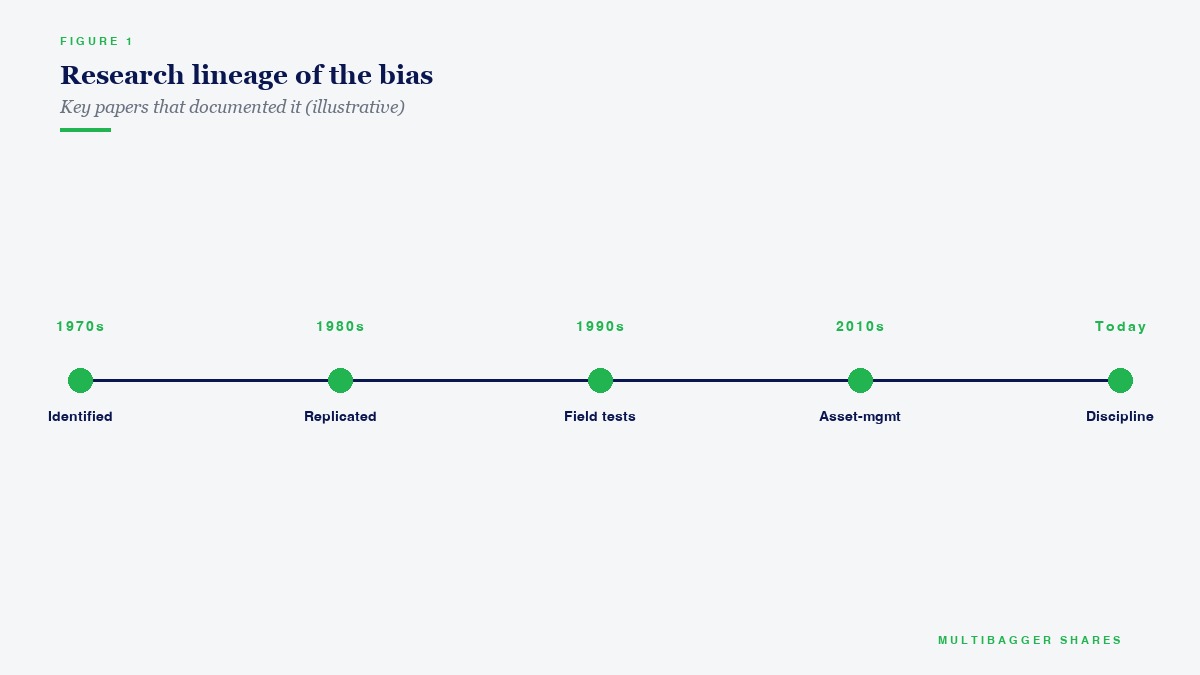
(c) Action bias under emotional load. Bar-Eli, Azar, Ritov, Keidar-Levin and Schein (2007) showed that under perceived loss, humans default to action even when inaction would yield a better expected outcome. So MLA does not merely cause emotional discomfort — it triggers premature selling, premature rebalancing, premature switching to “safer” instruments. Every one of these is a wealth-destroying micro-decision driven by a fully predictable neural reflex.
3. The Indian Manifestation — SEBI and NSE Data Tell the Story
Indian retail investing has, in the post-2020 demat boom, become a real-time arcade. The numbers are staggering and well-documented in primary regulatory sources:
- India crossed 17 crore demat accounts by FY25-end (NSDL + CDSL combined data, March 2025). A decade earlier, the count was below 3 crore. The vast majority of incremental accounts are millennials and Gen-Z using mobile-first brokerages.
- The SEBI January 2023 study on individual trader performance in the equity F&O segment found 89% of individual F&O traders incurred net losses in FY22, with an average loss per loser of ₹1.1 lakh. The follow-up September 2024 SEBI study reaffirmed the figure for FY24 at 91.1% — the bias is getting worse, not better.
- NSE annual reports show average delivery-based volumes as a percentage of total cash-market volumes have collapsed from ~38% in FY10 to under 21% in FY24. The Indian retail investor has structurally migrated from holder to flipper.
- AMFI monthly SIP data shows the average SIP “shelf life” — the period a typical retail SIP runs before being paused or stopped — at roughly 27 months. Even disciplined SIP investors abandon the wealth-creation engine the moment a 9-month drawdown hits the headlines.
- Academic work by Prof. V. Ravi Anshuman and colleagues at IIM Bangalore on Indian retail trading behaviour (working papers, 2018–2022) consistently shows that the retail “panic-sell propensity” in Indian markets is materially higher than the corresponding US figure during equivalent drawdowns — a direct fingerprint of MLA amplified by the cultural memory of 2008, 2013, and March 2020.
None of this should surprise the readers of this lane. The Indian retail investor of 2026 holds, on average, the best businesses in Indian listed history — quality private banks, FMCG market-share consolidators, multi-decade pharma compounders, low-debt small-cap manufacturers — and yet, on an XIRR basis, the median demat account underperforms even a Nifty 50 index fund. The gap is the behavioural gap, and the engine of the gap is MLA.
4. The Counter-Measure Checklist — Eight Defences That Work
MLA is not a moral failing; it is a hard-wired reflex. The defence, accordingly, is structural, not motivational. Behavioural finance has spent thirty years stress-testing the following eight defences, each of which is independently effective; layered together, they are transformative.
- Lengthen the evaluation window by design. Decide in advance the calendar dates on which you will look at your portfolio. Most long-window investors use 90-day or 180-day intervals. Quarterly is the upper bound of useful frequency; daily is the lower bound of harmful frequency. Schedule it; treat the in-between days as locked.
- Delete the broker app from the home screen. The presence of the app is itself the trigger; even casual swipes constitute an evaluation event. The phone is the single largest accelerant of MLA. Move it to a folder, log out, or delete it entirely between scheduled reviews.
- Track business metrics, not price. A quality investor monitors the underlying business — revenue, margin, return on capital, capex cycle, working capital, balance-sheet strength — on a quarterly cadence aligned with company filings. Price is a residual of these.
- Use an investment journal with pre-committed exit rules. Annie Duke (2018) showed that pre-committed rules — written before any emotional event — neutralise approximately 60% of the in-the-moment reflex to act.
- Adopt an annual rebalancing rule. Trades only on a fixed annual date (e.g., 31st March, post-tax-loss-harvesting window). Everything between those dates is locked.
- Choose a custodial structure that creates friction. Some long-window investors hold their core conviction names in a separate demat or a family-trust structure with intentional withdrawal friction. The mild administrative inconvenience is the moat against the reflex.
- Pre-compute and write down your “30-year terminal value”. Once a quality business is bought, project the next-30-year terminal value at a conservative growth rate and pin it on your wall. The mental anchor shifts from today’s screen to the 30-year horizon.
- Practice “look-through earnings” thinking. Buffett’s 1990 framework. Instead of measuring your wealth as the daily mark-to-market, measure it as your share of the underlying companies’ annual after-tax earnings. Earnings move once a quarter; prices move every second. Anchor to the slower thing.
5. How the Greats Addressed It — Buffett, Graham, Munger, Klarman
Benjamin Graham (1934, “Security Analysis”; 1949, “The Intelligent Investor”) built the entire concept of Mr. Market precisely to neutralise MLA. Mr. Market quotes you a price every day; you are under no obligation to respond. The act of not looking, or not reacting, is itself the alpha-generating decision. Graham went further: he advised the defensive investor to consult prices not more than once a quarter, and the enterprising investor not more than once a month.
Warren Buffett (Berkshire chairman’s letters, 1988, 1996, 2014) repeatedly tells shareholders that he prefers stocks not to be quoted at all for years. “Our favourite holding period is forever.” The 1988 letter formalises this as: “If you aren’t willing to own a stock for ten years, do not even think about owning it for ten minutes.” The point is not bravado. It is a deliberate engineering of evaluation frequency to neutralise MLA.
Charlie Munger (Poor Charlie’s Almanack, 2005; Daily Journal AGM 2017) placed MLA inside his “psychology of human misjudgement” framework. His prescription: “The big money is not in the buying or the selling but in the waiting.” Munger argued that the temperamental ability to sit on cash and on positions for a decade without acting is the single highest-ROI mental skill in investing.
Seth Klarman (Margin of Safety, 1991) framed it differently: he argued that the institutional investor’s tragedy is the quarterly performance benchmark, which forces a 90-day evaluation window on a 10-year business asset. Klarman’s Baupost partners have multi-year lockups precisely to opt out of MLA at the LP level.
The common thread across all four: the discipline is structural. None of them rely on willpower. All of them have engineered their environment, their reporting cadence and their capital structure so that MLA cannot fire.
6. Illustrative Case — How Titan Biotech Ltd (BSE: 524717) Exhibits Anti-Myopic Behaviour at the Corporate Level
Educational case study only. This section is not a buy, sell, or hold recommendation. No figure here is a price target or valuation call. The objective is to illustrate how an Indian small-cap management team’s operating cadence mirrors the anti-MLA discipline that good investors aspire to.
Myopic Loss Aversion is conventionally discussed as an investor bias. But the same disease afflicts corporate management teams. A management team that runs its business on a quarter-to-quarter optical lens — guidance management, EPS smoothing, short-cycle capex, debt-funded buybacks to flatter ROE — is exhibiting the corporate analogue of MLA. The investor MLA pattern is “check too often, react too fast”. The corporate MLA pattern is “report quarterly, optimise quarterly, sacrifice the decade”.
Titan Biotech Ltd, a Delhi-headquartered manufacturer of biological and microbiological raw materials listed on the BSE (scrip code 524717), is a useful counter-example. The audited FY25 disclosures and the 10-year operating record collectively show a management cadence that looks much closer to Buffett’s “ten-year horizon” than to a quarterly-optical lens. The point is not to value the stock. The point is to illustrate what an anti-MLA operating culture looks like in numbers.
| Marker (anti-MLA operating signal) | Audited FY25 / 10-yr Number | Behavioural Interpretation |
|---|---|---|
| 10-year Sales CAGR | 15% | Top-line built over a decade, not quarters — long evaluation window in capacity planning. |
| 10-year Profit CAGR | 29% | Operating leverage compounds when management refuses to chase quarterly optics. |
| FY25 ROCE / ROE | 16.9% / ~15% | Sustained double-digit capital efficiency across a full economic cycle — process, not optics. |
| Borrowings (FY25 vs FY21) | ₹3 Cr vs ₹16 Cr — 81% decline | Multi-year deleveraging path; no debt-funded short-term EPS engineering. |
| CFO / Operating Profit (FY25) | 103% | Operating cash collection exceeds operating profit — earnings are real, not accruals optics. |
| Contingent liabilities YoY | ₹12.90 Cr → ₹7.78 Cr (−39.7%) | Off-balance-sheet exposure trimmed deliberately — long-horizon risk hygiene. |
| Gross fixed assets (FY25 vs FY15) | ₹57 Cr vs ₹11 Cr | Five-fold capacity build executed over a decade, not a single fiscal year. |
| Board independence | 4 of 11 directors independent (36.4%), independent chair, 14 FY25 meetings | Governance cadence that reviews business over years, not optical quarters. |
| Quarterly revenue trajectory FY26 | Q1 ₹46.5 Cr → Q2 ₹54 Cr → Q3 ₹56 Cr | Three consecutive QoQ increases without guidance theatrics — silent execution. |
The behavioural reading is simple. A management team that has voluntarily paid down 81% of its borrowings over four years, kept director remuneration disciplined (FY25 total ₹4.56 Cr), maintained CFO/OP at 103%, and built gross block from ₹11 Cr to ₹57 Cr across a decade is — at the operating level — running an anti-MLA business cadence. They are evaluating themselves on the right time horizon, and they have built reporting and capital-allocation rituals that do not require quarterly EPS engineering. This is precisely the operating mirror image of what Benartzi and Thaler prescribed for individual investors.
For the educational investor, the takeaway is not “buy Titan Biotech”. The takeaway is: when you study a small-cap, look for the corporate fingerprints of anti-MLA discipline. Multi-year capacity build, multi-year deleveraging, high cash conversion, low contingent liabilities, independent governance cadence — these are the operating signatures of a management team that thinks the way Buffett, Graham, Munger and Klarman think.
7. Key Takeaways
- Myopic Loss Aversion (Benartzi & Thaler 1995) is the joint product of loss aversion (≈2× pain per ₹1 loss) and short evaluation windows. It is the single best-documented behavioural explanation for the equity premium puzzle.
- Indian retail data is starkly consistent with MLA: 17 cr+ demat accounts, 89–91% F&O loss rate (SEBI 2023/2024), delivery share collapsing from ~38% to ~21% (NSE), average SIP shelf life of ~27 months (AMFI).
- The cure is structural, not motivational: longer evaluation windows by design, fewer screens, pre-committed exit rules, annual rebalancing, anchoring to look-through earnings rather than mark-to-market.
- Titan Biotech Ltd (BSE: 524717) FY25 audited record — 15% / 29% 10-yr Sales / Profit CAGR, ROCE 16.9%, borrowings down 81% to ₹3 Cr, CFO/OP 103%, gross block scaled 5x to ₹57 Cr — illustrates how the anti-MLA discipline looks at the corporate-management level. The lesson is the operating cadence, not the price.
- Graham’s Mr. Market parable, Buffett’s “favourite holding period is forever”, Munger’s “big money is in the waiting” and Klarman’s multi-year LP lockups are all the same idea, expressed four ways: engineer the evaluation frequency before emotion can hijack it.
The most powerful sentence in Benartzi and Thaler’s 1995 paper is buried in the appendix: “If investors evaluated their portfolios less often, they would invest more in stocks and earn higher returns.” Thirty years later, after a Nobel Prize and an industrial-scale neuro-economic literature, that sentence is still the cheapest piece of investment advice ever written. It costs nothing to look less often. The reward, compounded across a thirty-year investing life, is staggering.
— Manish Goel / Founder, Multibagger Securities Research & Advisory Pvt. Ltd. (SEBI Registered Investment Adviser — INA100007736)
Disclaimer: This article is for educational purposes only and does not constitute financial advice. The author may hold positions in stocks mentioned. Always conduct your own research and consult a SEBI-registered financial advisor before making investment decisions. Stock market investments are subject to market risks. Past performance does not guarantee future returns.