The Glossy Brochure: Why the Tone of a Company’s Annual Report Is Not Evidence

Don’t Buy the Poorer Cousins: Why the Leader and the Also-Ran in the Same Growing Field Rarely Share the Same Fate
October 19, 2026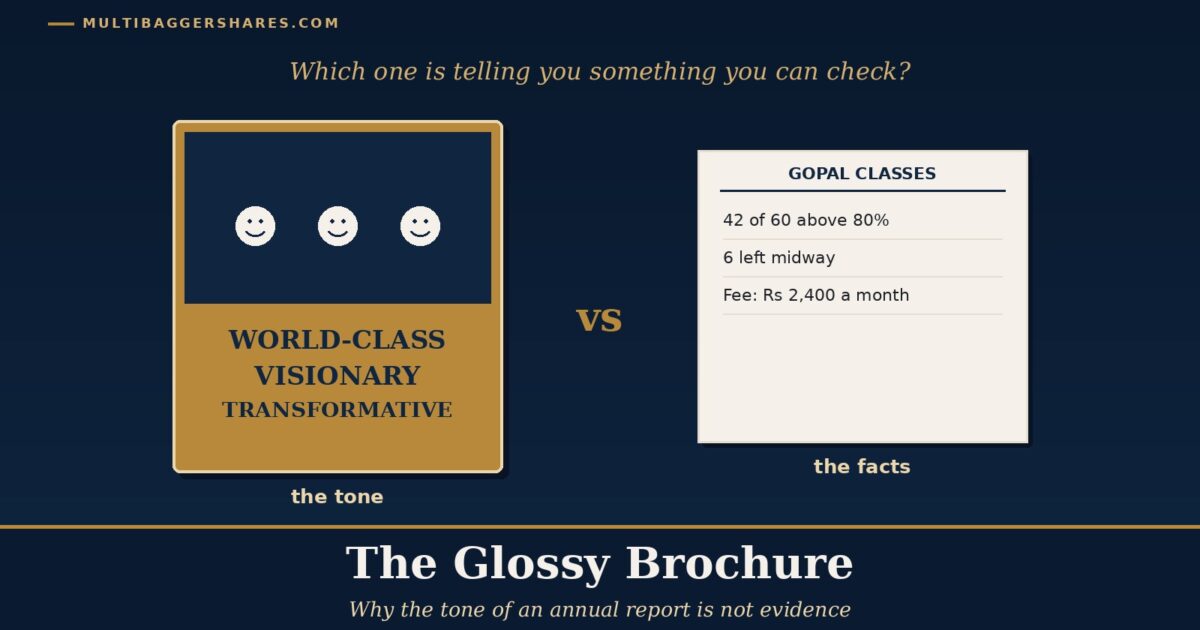
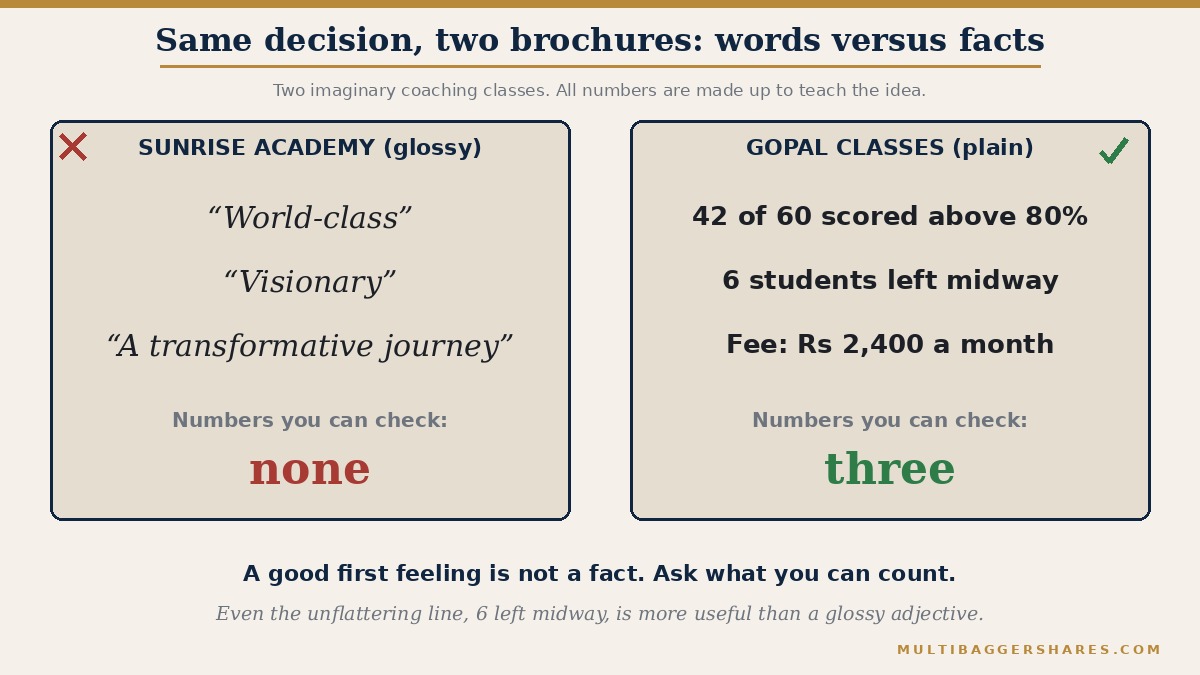
Imagine that your cousin is choosing a coaching class for her son. She has two brochures on the table. The first, from Sunrise Academy, is printed on thick glossy paper. It has photographs of smiling students and big words: “world-class”, “visionary”, “a transformative journey”. The second, from Gopal Classes, is a single plain sheet. It says: “Last year, 42 of our 60 students scored above 80 percent. Six students left midway. The monthly fee is Rs 2,400.”
Which brochure would you trust more? Most of us feel a small pull towards the glossy one. It looks successful. It sounds sure of itself. It makes us feel that the people behind it know what they are doing. But if we stop and think, we notice something odd. The glossy brochure has told us nothing we can check. The plain sheet has told us three things, and one of them, the six students who left, is not even flattering.
This small picture is the key to today’s lesson. Every listed company sends its owners a yearly book called the annual report (a long document in which a company tells its shareholders how the year went). Some of these books are plain. Many are glossy brochures. And a warning about them has been sitting in a famous investing book for more than sixty years.
What it really means
The book is Common Stocks and Uncommon Profits, written by the American investor Philip A. Fisher and first published in 1958. Fisher gives a short list of five “don’ts”, which are mistakes he wanted investors to avoid. The third one is easy to remember. In the words commonly quoted, it says: don’t buy a stock just because you like the “tone” of its annual report.
What is “tone”? Tone is the feeling a piece of writing gives you. A report can sound calm, proud, humble, excited or worried, in exactly the way a person can. The tone of an annual report comes mostly from two places. One is the chairman’s letter (a message at the start of the report in which the head of the company speaks to the owners). The other is the section where management explains the year in its own words.
Now notice who writes these pages. In summaries of Fisher’s idea, it is often pointed out that much of this text is shaped by public relations people (professionals whose job is to leave readers with a good impression of the company). That is not a crime. It is simply their job. But it means that the report is partly a sales tool, and a sales tool is built to make you feel good.
So Fisher’s point is not that annual reports are bad, or that managers lie. Most do not. His point is narrower and more useful. How a report makes you feel is not information about the business. Feelings cannot be checked. Numbers can.
Why it works
The first reason is that words cost nothing, and numbers cost something. Anyone can write “our business is strong and our future is bright”. It takes no effort and it can never be proved wrong. But a number, such as the profit for the year, has to match the accounts, which are checked by an auditor (an outside professional who examines a company’s books). Numbers can be tested. Adjectives (describing words like “excellent” or “robust”) cannot.
The second reason is that tone is easiest to control when the news is bad. Think of a doctor’s waiting room. A gentle, reassuring voice tells you very little about whether the report in the doctor’s hand is good or bad. In the same way, a calm and confident chairman’s letter can sit on top of a poor year. Companies rarely use harsh words about themselves. A bad year is usually described in soft language, such as “challenging” or “a period of consolidation”. If you let the soft language settle your mood, you have been managed, not informed.
The third reason has to do with us. Human beings are easily moved by confidence. We like people who sound sure. We tend to trust a smooth speaker over a hesitant one, even when the hesitant one is right. A glossy annual report plays on this habit. Fisher’s warning is, at heart, a reminder to protect our own judgement from a pleasant voice.
The fourth reason is the simplest. The writers of the report know you will read the front pages first. That is where the photographs, the headlines and the confident letter live. The hard facts, such as how much cash the business really received and how much it owes, are usually deeper inside, in tables and in small print. A reader who stops at the front has read the advertisement, not the company.
There is also a quieter cost to trusting tone. Once you have decided that a management team sounds capable, you stop looking for evidence against it. Each later piece of good news seems to confirm your first feeling, and each piece of bad news seems like a small accident. Psychologists call this a halo (a glow from one good first impression that colours everything that follows). A glossy report is an excellent way of creating that glow on the very first page.
A real example, told only as history
Let us look at one well-known story from the past. It is told here only as history, to make a point, and not as a view on any company today.
In the late nineties and the year 2000, an American energy company called Enron was admired all over the world. Fortune magazine named it “America’s Most Innovative Company” for six years in a row, from 1996 to 2001. For the year 2000, Enron reported revenue (the total amount a company sells in a year, before any costs are taken away) of about 101 billion US dollars. By that measure it was one of the largest businesses in America.
On 2 December 2001, Enron filed for bankruptcy (a legal step a company takes when it cannot pay what it owes). One of the most admired names in business was gone within the same calendar year as the last of those awards.
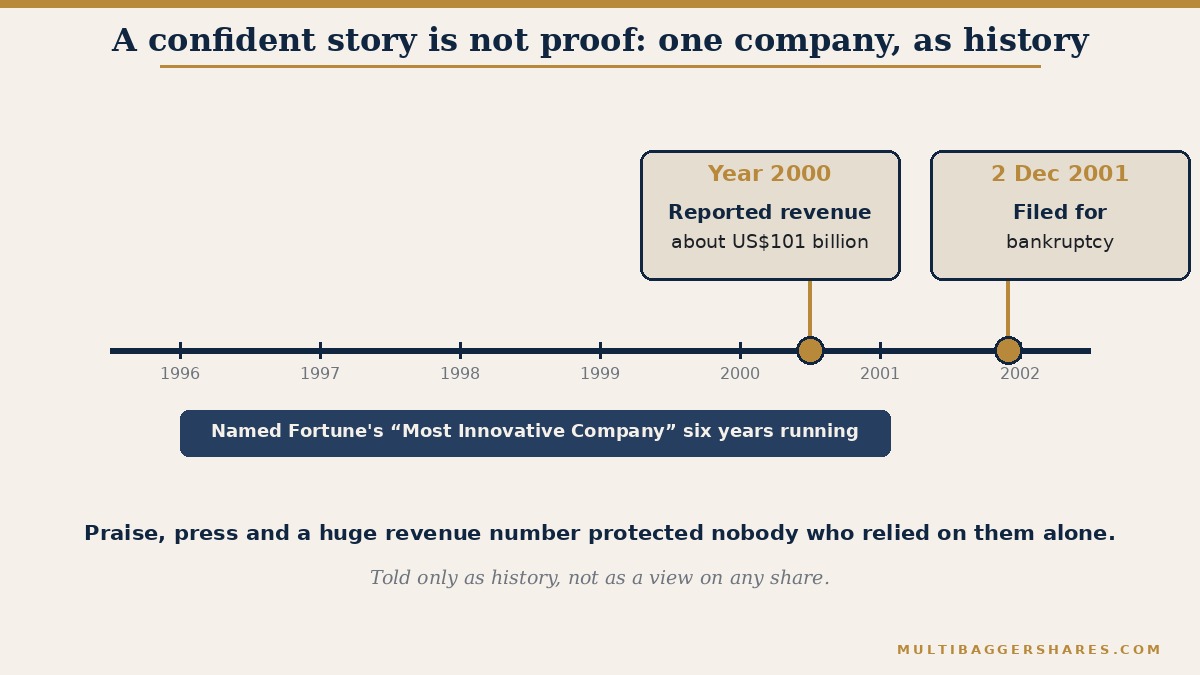
Please read this example carefully, because it is easy to take the wrong lesson from it. We are not saying that a glossy tone was the cause of the collapse. Many things went wrong. The narrower point is this. A confident story, praise from the press and a huge revenue number did not protect anyone who relied on them alone. If a reader’s only reason for trusting a company was the confident way it spoke about itself, that reader had no real reason at all.
Now bring the idea closer to home. Think of a restaurant whose menu is covered in beautiful photographs. The photographs tell you what the owner wants you to imagine. They do not tell you how clean the kitchen is. A wise diner looks at how many people from the neighbourhood eat there again and again. In the same way, a wise reader of an annual report asks: what has the business actually done, year after year, that I can count?
How you can use it
Here is a simple way to read an annual report without being carried away by its tone. It does not need special training. It needs a notebook, a pencil and a little patience.
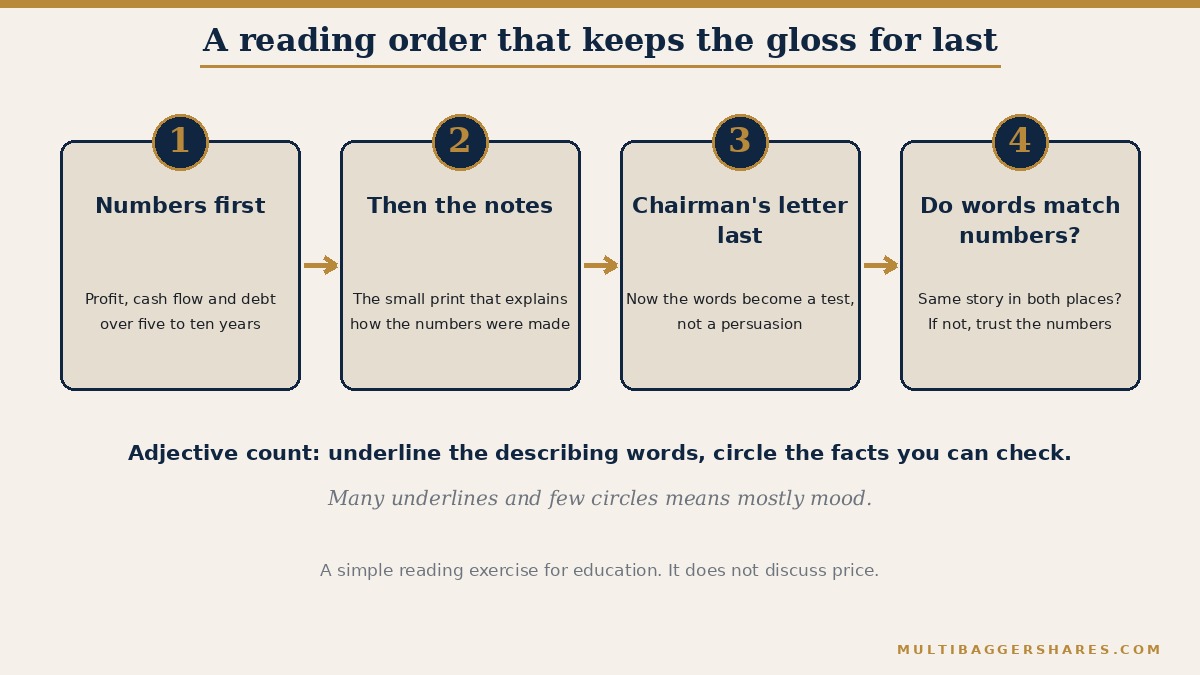
Step one is to read the numbers first. Before you read a single word of the chairman’s letter, look at the plain figures for the last five to ten years. Look at profit (what is left after all costs), at cash flow (the money that really came into the bank, not just profit written on paper) and at debt (money borrowed that must be repaid with interest). Write them in your notebook, year by year. You are looking for a pattern. Is the business steady? Does the profit turn into cash? Is the debt growing faster than the business?
Step two is to read the notes behind the numbers. Every report has pages of small print that explain how the figures were arrived at. These pages are dull, and that is precisely why they are useful. Nobody puts a smile on a table of figures.
Step three is to read the chairman’s letter last. By now you already know how the year went. The letter becomes a test instead of a persuasion. Does it describe the same business you saw in the numbers? Or does it describe a different, happier business?
Step four is to try the adjective count. Take a pencil and underline the describing words in the letter, such as “strong”, “excellent”, “record” and “robust”. Then circle every sentence that gives a number you can check. This is a simple exercise of our own, not something Fisher prescribed, but it makes the point quickly. A letter with a great many underlines and very few circles is mostly mood. A letter full of circles is mostly information.
Step five is to look for plain talk about problems. A trustworthy letter tells you what went wrong this year, in simple language, with a number attached. It might say that sales fell in one area, that a plant ran below its usual level, or that a promise made last year was not met. When a letter has no bad news at all across several years, that is a reason to look harder, not a reason to relax. Every real business has bad news now and then, just as every school has a few students who leave midway.
It also helps to keep a small file for each company you follow. Every year, paste the key lines of the chairman’s letter at the top and the five or six numbers beneath. After three or four years you will have a very clear picture of whether the words and the figures walk together. The file costs nothing and takes ten minutes a year. It turns reading from a mood into a record.
Step six is to compare year with year. Put last year’s letter next to this year’s. If the same warm phrases appear every year, whatever happened in the business, then the words are decoration. If the letter changes its language when the numbers change, it is closer to the truth.
A few cautions are worth keeping in mind. First, a well-written report is not a bad sign. Some honest companies simply write well. The idea is only to stop the writing from doing your thinking. Second, a plain report is not automatically a good sign either. Plain words with weak numbers are still weak numbers. Third, remember the limits of the exercise. Reading past the tone is one habit among many. It does not tell you how good a business is on its own. It only helps you to avoid one common trap.
Finally, remember what this lesson is not. It is not a list of companies, and it does not say what to do with any particular share. It is a habit of reading. The next time you open an annual report and feel pleased by its photographs, pause for a moment and say to yourself: “That is the brochure. Where is the plain sheet?” Then go and find it.
This article is for education only. It does not tell you what to do with any particular investment.
Key takeaways
- An annual report is partly a sales tool; how it makes you feel is not information about the business.
- Philip Fisher’s 1958 book lists, as one of five “don’ts”, buying a stock just because you like the tone of its annual report.
- Words cost nothing and cannot be checked; numbers must match audited accounts, so read the numbers first and the chairman’s letter last.
- Try the adjective count: many underlined describing words and few checkable numbers means mostly mood.
- A confident story, press praise and a huge revenue number protected nobody who relied on them alone, as Enron’s history shows.
— Manish Goel · multibaggershares.com
Manish Goel is a Chartered Accountant and Principal Officer of Multibagger Securities Research & Advisory Pvt. Ltd. (MSRAPL), a SEBI-registered Investment Adviser, Registration No. INA100007736. This content is published by MSRAPL for education only and is not personalized investment advice.
Disclaimer: This article is published by multibaggershares.com for education and general information only. It is not investment advice, investment research, or a recommendation to buy, sell or hold any security. Any companies named are discussed only as illustrative examples. Markets carry risk; please do your own research or consult a qualified professional before making any investment decision. |