Related Party Transactions Decoded

Survivorship Bias: The Invisible Statistical Trap That Makes Indian Investors Overestimate Returns, Chase Past Winners, and Ignore the Graveyard of Failed Stocks — How to Think Clearly About Market Data and Build a Truly Resilient Portfolio
April 9, 2026
Page Industries: How Jockey’s Indian Licensee Turned ₹1 Lakh Into ₹94 Lakh Over 19 Years — The Timeless Wealth Creation Lesson Every Indian Investor Must Study
April 10, 2026
Every year, thousands of Indian retail investors lose money not from bad markets — but from companies where insiders quietly siphon value through Related Party Transactions (RPTs). It is one of the most under-researched, most dangerous, and least understood risks in Indian small-cap investing. And it is precisely here that Titan Biotech Ltd (BSE: 524717) delivers a masterclass in governance.
When Manish Goel evaluates any small-cap for potential inclusion in a concentrated, conviction-based portfolio, Related Party Transactions are one of the first things he examines. A single bad RPT disclosure can disqualify an otherwise financially strong company. Because bad governance eventually destroys all the value that good operations create. This post is a deep-dive into why RPTs matter, how to read them, and exactly what Titan Biotech’s clean RPT track record reveals about the trustworthiness of its management.
What Are Related Party Transactions — And Why Should Every Indian Investor Care?
A Related Party Transaction (RPT) is any commercial or financial transaction between a listed company and its related parties — which includes promoters, directors, key managerial personnel, their family members, subsidiaries, and entities in which they have significant interest.
Under the Companies Act 2013 (Section 188) and SEBI’s LODR Regulations (as amended in 2022), listed companies are required to disclose all material RPTs to shareholders. “Material” transactions above certain thresholds require approval from the Audit Committee and in some cases the shareholders through special resolution.
RPTs are not inherently bad. A company may legitimately buy raw materials from a promoter-owned supplier, or lease space from a director. The question is: are these transactions conducted at arm’s length (fair market prices) — or are they being used to transfer wealth from minority shareholders to the promoter group?
This practice of using RPTs to move money out of a listed company is called “tunnelling” — and it is devastatingly common in Indian small-caps. A promoter who holds 55% of a company stands to gain 100% of whatever is funnelled through a related-party deal, while minority shareholders collectively bear 100% of the loss while only receiving 45% of the profits. This asymmetry makes RPT tunnelling one of the most effective wealth-destruction mechanisms in Indian markets.
The 5 Most Common RPT Tunnelling Techniques in Indian Small-Caps
Before we examine Titan Biotech, let us understand exactly how promoters misuse RPTs. This knowledge is your shield:
1. Overpriced Procurement: The listed company buys goods or services from a promoter-owned entity at above-market prices. The listed company’s profits are suppressed, while the promoter’s private company makes windfall margins.
2. Underpriced Sales: The listed company sells goods to a related party at below-market prices, again transferring value from the listed entity to the private promoter company.
3. Inter-Corporate Loans: The promoter uses the listed company as a personal lending institution — borrowing money at zero or below-market interest rates through related party companies. This is essentially using shareholder money as a free ATM.
4. Excessive Remuneration: The promoter draws a salary, commission, or sitting fees from the listed company that is disproportionate to the company’s profitability. In some cases, total promoter family remuneration exceeds 15-20% of net profit.
5. Asset Sale/Transfer at Non-Market Prices: Fixed assets like land, machinery, or intellectual property are sold to or bought from related parties at manipulated valuations, benefiting the promoter at the expense of shareholders.
SEBI’s Tightened RPT Framework: India’s Governance Revolution
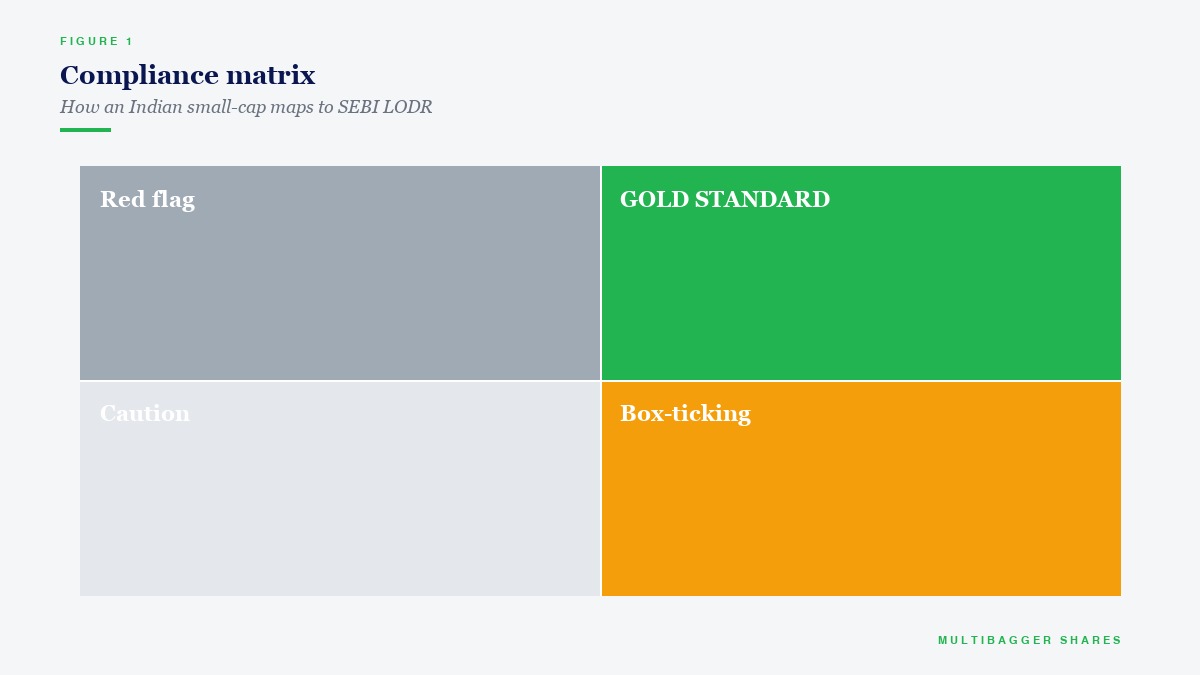
In 2022, SEBI significantly amended the LODR Regulations to close RPT loopholes. Key changes included:
- The definition of “related party” was expanded to include all persons and entities in a promoter’s “group” — making it harder to route transactions through intermediate vehicles
- All RPTs (not just material ones) now require prior approval of the Audit Committee
- Material RPTs above ₹1,000 crore or 10% of annual consolidated turnover (whichever is lower) require shareholder approval by special resolution
- No related party can vote on resolutions approving transactions with themselves — minority shareholders now have a real veto
- Half-yearly disclosures of all RPTs are now mandatorily published on the company’s website
These are excellent regulations. But SEBI can only mandate disclosure — it cannot make companies follow the spirit of the law. The real test of governance quality is what a company discloses voluntarily, how modest its related-party dealings are, and whether the transactions are genuinely arm’s length. This is where Titan Biotech shines.
Titan Biotech’s RPT Profile: Minimal, Disclosed, and Arm’s Length
Titan Biotech Ltd is promoted by the Pramod Kumar Goel family, who have built this company over decades from a small-scale gelatin manufacturer into one of India’s leading biotech ingredients companies with exports to over 100 countries. The promoter family currently holds 55.78% of the company (as of December 2025), and this stake has steadily increased — a sign they are buyers, not sellers.
What does Titan Biotech’s RPT profile look like? Here is the summary picture drawn from annual report disclosures:
This is the profile of a company where management is genuinely aligned with minority shareholders. No loans to related parties means no risk of the company being used as a personal bank. No guarantees means no hidden liability exposure to promoter group companies. Minimal remuneration means management is creating wealth through share ownership, not through salary extraction.
The Director Remuneration Test: 3.6% vs Industry Average of 8-15%
One of the most practical RPT stress tests for Indian investors is the “Management Take Rate” — total promoter/director remuneration as a percentage of net profit. This tells you how much of the value created for shareholders is being diverted to the management team before it reaches investors.
In FY2025, Titan Biotech reported a net profit of ₹18 crore. Total director remuneration from the company stands at approximately ₹0.65 crore — which is roughly 3.6% of net profit. Compare this to the practices of many Indian small-cap promoters who draw 10-20% of profits as remuneration, or who have multiple family members on the payroll simultaneously.
Titan Biotech’s management is wealth-aligned with shareholders. They own 55.78% of the company’s equity — so the best way for them to maximise their personal wealth is to maximise the company’s value, not to extract it through salary. This is the classic owner-operator alignment that creates the best compounding conditions for minority investors.
No Subsidiaries: Why Titan Biotech’s Simple Corporate Structure Is a Governance Superpower
One of the most powerful governance signals at Titan Biotech is something most investors completely overlook: the company has zero subsidiaries — listed or unlisted.
Complex corporate structures with multiple subsidiaries, associate companies, and step-down subsidiaries are breeding grounds for RPT abuse. Money can be routed across entities in opaque ways, making it nearly impossible for minority shareholders or even auditors to trace where cash is flowing. Some conglomerates have dozens of related entities, creating a governance maze that benefits insiders at the expense of public shareholders.
Titan Biotech operates as a single clean entity. Every rupee of revenue comes in, every rupee of cost goes out, all at the listed company level. There is no below-the-surface plumbing. What you read in the annual report is the complete picture of the business. For value investors who depend on clean financial statements for analysis, this simplicity is pure gold.
The Zero-Loan Test: How Titan Biotech Passes With Flying Colours
Between FY2020 and FY2025, Titan Biotech has consistently reported zero loans and advances to related parties. Zero guarantees extended on behalf of related parties. Zero unsecured loans from promoter entities. This is a five-year clean slate on the most critical RPT risk metrics.
Notice the trend: as Titan Biotech’s own borrowings have steadily declined toward zero, there has been no temptation to use the growing cash pile as a related-party ATM. The cash that the business generates is staying inside the business — building reserves, funding capex, and strengthening the balance sheet. This is the hallmark of management that thinks like long-term business owners, not short-term extractors.
The Governance Scorecard: Titan Biotech vs. The Universe of Indian Small-Caps
Let us put numbers to what “good governance” looks like versus the Indian small-cap universe as a whole. Industry studies and SEBI’s own enforcement data suggest that RPT violations are widespread in small-cap companies, particularly in the pharma, chemicals, and manufacturing sectors.
The Value Investing Connection: Why Governance Is Not Optional
Benjamin Graham defined investment as “an operation which, upon thorough analysis, promises safety of principal and a satisfactory return.” Notice he put safety of principal first. That safety doesn’t just come from buying at the right price — it comes from buying companies where the people running the business are aligned with you, not against you.
Warren Buffett has said that he looks for three things in a manager: intelligence, energy, and integrity. And if they don’t have the last one, the first two will kill you. Clean RPT disclosures are objective, documentable proof of integrity in action. They show that when managers faced the temptation to use the company’s resources for personal benefit, they chose not to.
This is why, at Multibagger Shares, we never advocate wide diversification — buying 30-40 stocks to protect yourself from governance failures means you’ve already admitted you don’t know your companies well enough. Warren Buffett himself said: “Wide diversification is only required when investors do not understand what they are doing.” Peter Lynch called it “di-worse-ification.”
A concentrated portfolio of 8-15 deeply researched quality companies — where each company has been stress-tested on governance including RPT analysis — will always outperform a diversified basket in the long run. Titan Biotech is a textbook example of a company where the deeper you look, the more comfortable you become, not less.
What This Means for Long-Term Investors in Titan Biotech
As of April 10, 2026, Titan Biotech’s financials reflect a business that is genuinely operating in the interests of all shareholders:
- FY2025 Revenue of ₹156 crore — growing at 18% CAGR over 5 years
- Net Profit of ₹18 crore in FY25, with 26% profit CAGR over 5 years
- Latest quarter (Q3 FY26, Dec 2025) revenue of ₹56.51 crore — annualised run rate of ₹225+ crore if sustained
- Q3 FY26 operating margin of 19.16% — highest in recent quarters
- ROCE of 17.7% and ROE of 13.4% — strong returns on capital deployed
- Balance sheet debt of just ₹3 crore against a net cash position exceeding ₹35 crore
- Zero RPT loans, zero pledging, minimal remuneration — governance passing every test
The combination of accelerating revenue growth, expanding margins, clean governance, and zero debt creates a business quality profile that is extraordinarily rare among Indian small-caps. Most companies offer one or two of these qualities. Very few offer all of them simultaneously. And almost none deliver all of them while maintaining such an exemplary Related Party Transaction record.
The Checklist Every Investor Should Run Before Buying Any Small-Cap
Based on everything we have discussed, here is a practical RPT checklist that every Indian investor should apply before investing in any small-cap company:
Titan Biotech answers “Yes” or “No ✅” to every single one of these questions. This is the governance foundation that makes deep, concentrated investing possible — and gives long-term shareholders the confidence to hold through short-term volatility without losing sleep.
Conclusion: Governance Is the Foundation — And Titan Biotech’s Passes Every Test
Related Party Transactions are the hidden variable in Indian small-cap investing that separate great long-term investments from the ones that ultimately disappoint. You can find a company with excellent revenue growth, expanding margins, zero debt, and growing exports — but if management is quietly siphoning value through RPTs, none of that financial quality will translate into long-term wealth for minority shareholders.
Titan Biotech’s clean RPT record — built over more than a decade of consistent disclosures, zero loans to related parties, minimal director remuneration relative to profits, and zero promoter pledging — is not an accident. It is a reflection of a management culture that views minority shareholders as genuine partners in the business.
For investors who are serious about fundamental analysis, governance must be examined with the same rigour as financial ratios. And when a company like Titan Biotech scores perfectly on both dimensions — strong fundamentals AND excellent governance — it deserves a prominent place in any concentrated, quality-first portfolio.
Disclaimer: This article is for educational purposes only and does not constitute financial advice. The author may hold positions in stocks mentioned. Always conduct your own research and consult a SEBI-registered financial advisor before making investment decisions. Stock market investments are subject to market risks. Past performance does not guarantee future returns.