The Understudy: How to Tell Whether a Business Has Prepared for the Day Its Leader Leaves

The Promise Ledger: How to Check What a Company Said Last Year Against What It Actually Did
August 15, 2026
The Same Shop, One Year Later: How to Tell Real Growth From Just Opening More Doors
August 20, 2026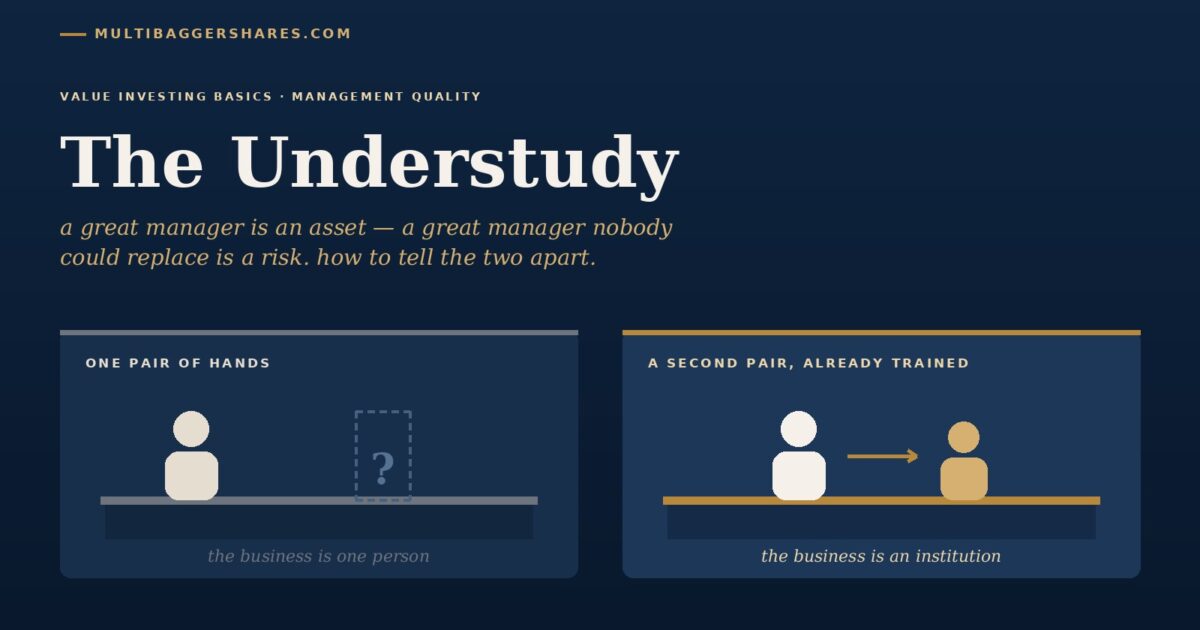
Value Investing Basics
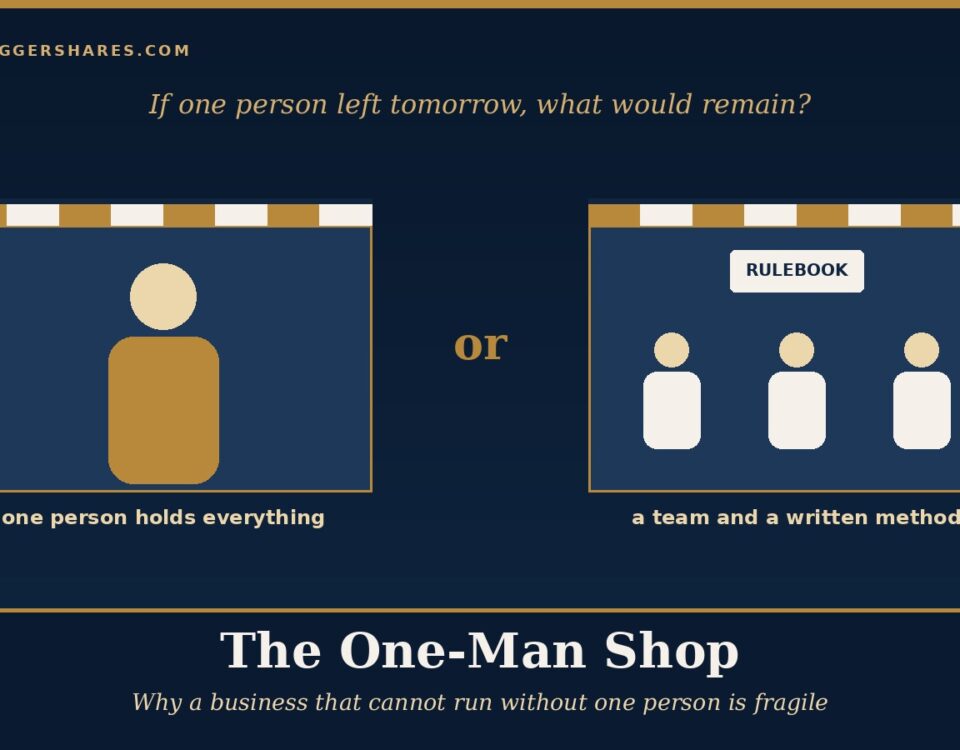
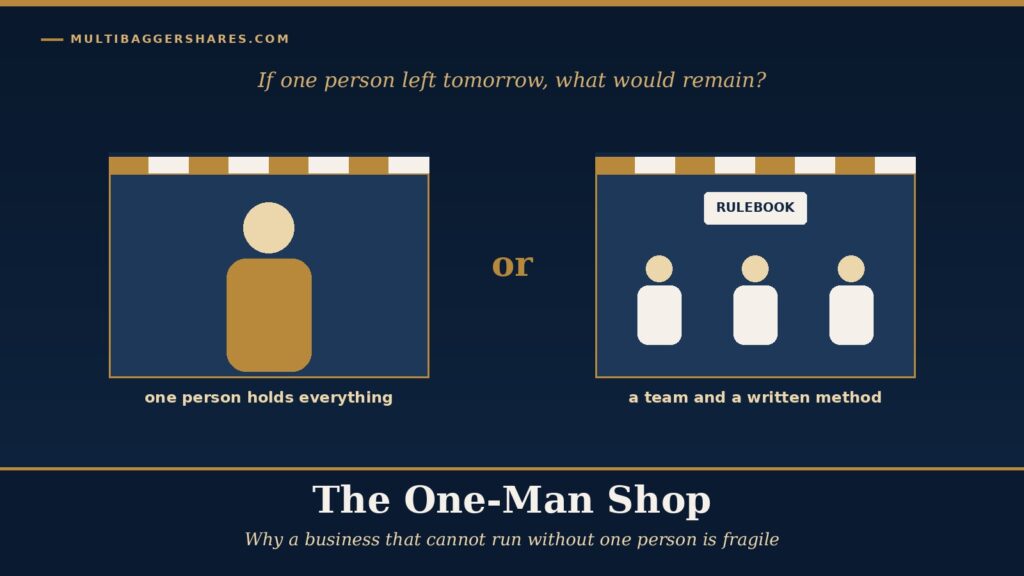
There is a shop like this in almost every Indian neighbourhood. One man behind the counter,
and the whole business inside his head. He knows which family takes atta on credit and settles on the
seventh of the month. He knows the flat on the second floor will only use one particular brand of oil.
He knows which supplier will answer the phone on a Sunday. The shelves are full, the shop is busy, and
the books are largely in his memory.
Then one week he is unwell, and his nephew sits at the counter. Nothing quite works. The credit
customers are asked to pay cash and take offence. Two deliveries go to the wrong door. The regulars
begin drifting to the shop two lanes away, and some of them do not come back. In seven days, a business
built over twenty years quietly loses a slice of its trade.
That shop was never quite as good as it looked. It was one capable man, doing an excellent job,
surrounded by shelves. The shelves were not the business. He was.
Listed companies can have exactly the same problem, and from the outside it is much harder to
see. The annual report shows growing revenue (the total money a business collects from customers before
any costs are taken out), a respected chief executive, and a photograph of a confident-looking board.
None of that tells you what happens on the day the person at the top walks out. But there is a way to
find out, and it is not difficult. It takes an afternoon, once a year, and no special training.
What succession really means
Succession planning is the company’s answer to one plain question: who does this job next, and
how do we know they can do it? Nothing more complicated than that.
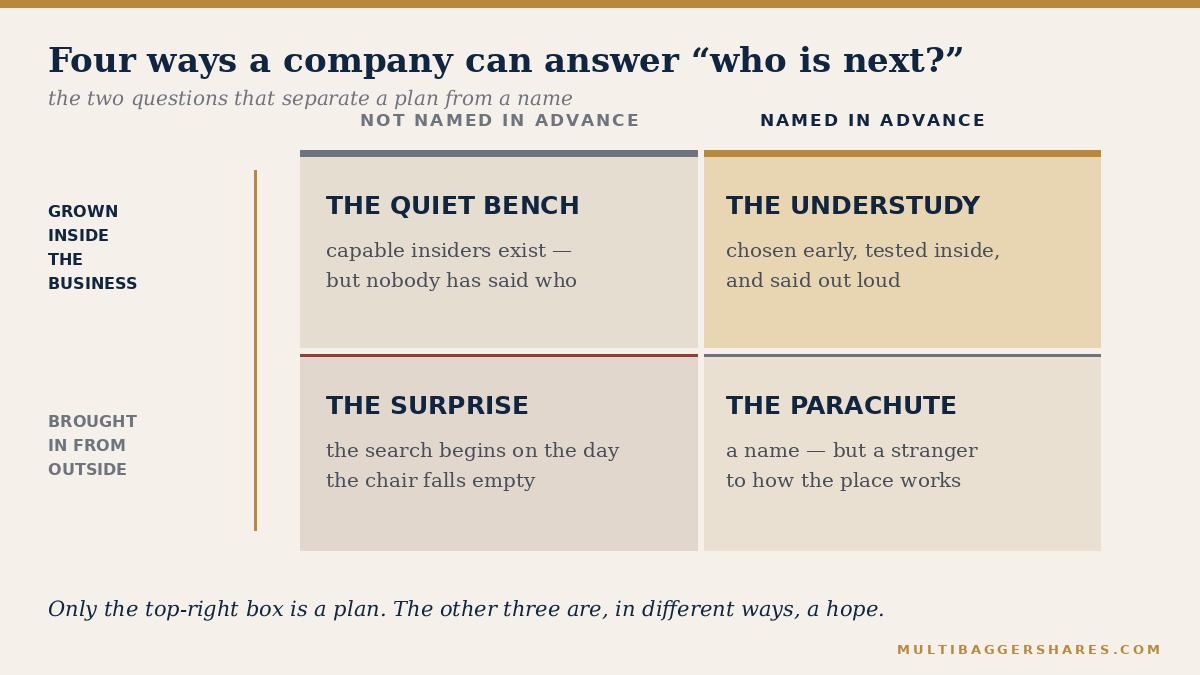
The important word in that sentence is plan. A name on its own is not a plan. Any board
can produce a name in an afternoon. A plan means the person has been chosen in advance, given real
responsibility, watched while they use it, and — this is the part that separates a serious company from
a careless one — made visible to the people who own the business before the handover happens.
It is also not only about the chief executive (the person who runs the company day to day and
answers to the board). A large business runs on perhaps ten or fifteen people: the person who controls
the factories, the one who manages the money, the one who holds the relationships with the biggest
customers. A company can name a fine successor to the top job and still be dangerously thin one level
below it.
The risk this protects against has a name. Investors call it key-man risk (the danger that a
business depends so heavily on one individual that it would be badly damaged if that person left, fell
ill, or simply lost interest). Key-man risk is not a flaw in the person. It is a flaw in the
organisation around them. Often the very best managers create it without meaning to, because they are
quick, decisive, and it is faster to do the thing themselves than to teach somebody else.
Why it matters more than it looks
When you buy a share you are buying a small piece of a business that will be run, for as long as
you hold it, by people you will probably never meet. If you intend to hold for a decade or two — and
that is where compounding does its work (compounding is earning returns on your past returns, so that
growth builds on growth, like a snowball rolling downhill) — then you are not backing today’s manager.
You are backing today’s manager and everyone who follows them.
Over twenty years, most companies change their chief executive at least once, and often twice.
So the question is not whether a handover will happen. It is whether it will happen the way a relay
baton is passed, or the way a plate is dropped.
What makes this useful for an outside investor is that it can be scored before the
event. Most tests of management can only be marked afterwards, once the results are in. Succession is
different. The preparation is visible years ahead of the day it matters, if you know where to look. A
company that has quietly built a bench is telling you something true about how it thinks — about the
long term, about institutions rather than individuals, about the difference between running a business
and being the business.
Warren Buffett, who has written about this more honestly than most, put the principle in his
2014 letter to shareholders: “Our directors believe that our future CEOs should come from
internal candidates whom the Berkshire board has grown to know well.” Two ideas are packed
into that short sentence. Internal, so the person already understands how the place works. And known
well, so the board is judging years of behaviour rather than a good interview.
There is also a rule behind it. Under the listing rules that apply to companies quoted on Indian
stock exchanges, the board of a listed company is required to satisfy itself that plans are in place for
orderly succession to the board and to senior management. So when a company has nothing whatsoever to
say on the subject, it is not simply being private. It is skipping a duty it already owes you.
Three companies, three different answers
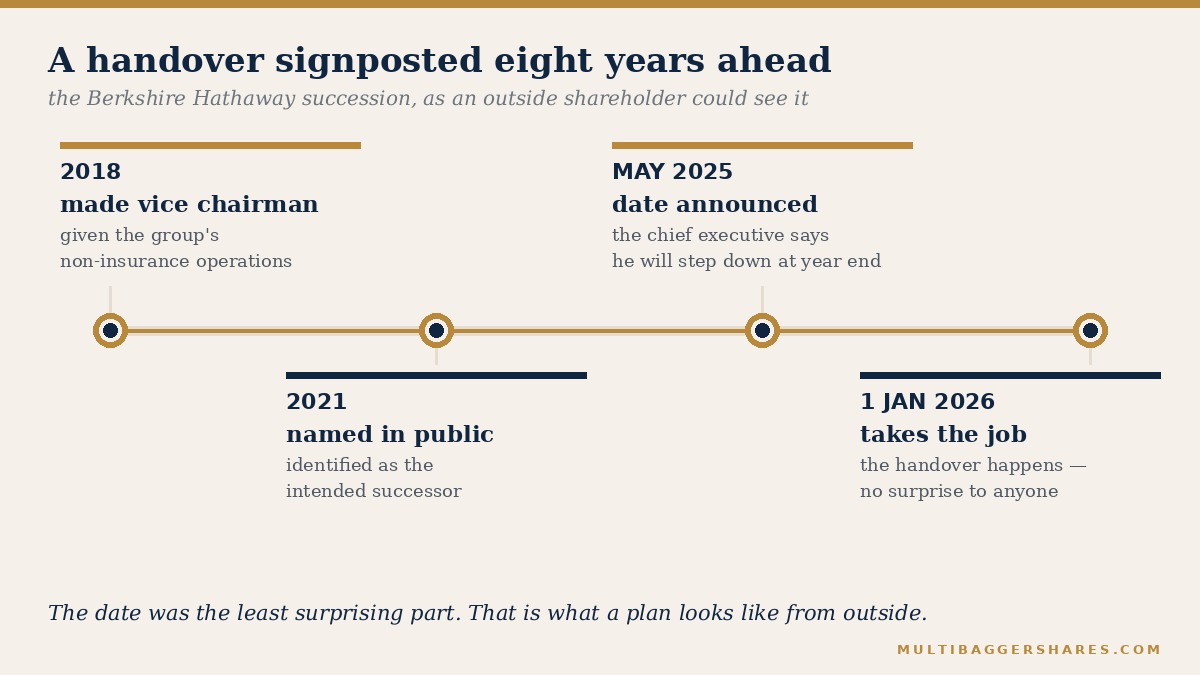
The clearest example of a slow, visible handover is Berkshire Hathaway, the American company
Warren Buffett had run since 1965. In 2018 he promoted Greg Abel, who had spent years running the
group’s energy business, to vice chairman. In 2021 Abel was publicly identified as the intended
successor. In May 2025, at the company’s annual meeting, Buffett announced he would step down as chief
executive at the end of that year. Abel took the job on 1 January 2026, and Buffett stayed on as
chairman. Roughly sixty years under one man, and the handover itself was signposted for about eight
years before it happened. Nobody who owned the shares was surprised on the day.
India has a comparable story. Aditya Puri had led HDFC Bank from its beginnings in the
mid-1990s. Because Indian banking rules set an age limit for the job, the end date was known well in
advance, and the board formed a search committee in late 2019 that looked at both internal and external
candidates. The person chosen, Sashidhar Jagdishan, had joined the bank in 1996 and had been there for
close to a quarter of a century. Puri retired on 26 October 2020, and Jagdishan took over the next day
with the banking regulator’s approval. Again: a long-served insider, identified in public before the
handover, in a role he had been prepared for.
The contrast is instructive rather than damning. Infosys was built and run for years by its
founders, who took turns in the top job. In 2014 the company reached outside for the first time and
appointed Vishal Sikka, who came from a large software firm abroad. He resigned in August 2017 in the
middle of a public disagreement with some of the founders, and the company ran on an interim
arrangement until Salil Parekh started in January 2018. The point is not that hiring an outsider is a
mistake — sometimes it is exactly the right decision, and Infosys has continued to be one of India’s
most significant companies. The point is what the sequence revealed: at that moment there was no
prepared insider ready to step up, and the company spent several months of senior attention on the
question of who was in charge instead of on the business.
None of these three stories is a verdict on the company or on its shares. Read them for one
thing only: how much you could see in advance. In two cases, an ordinary shareholder reading the annual
report could have answered the question “who is next?” years early. In the third, they could
not.
How you can use it
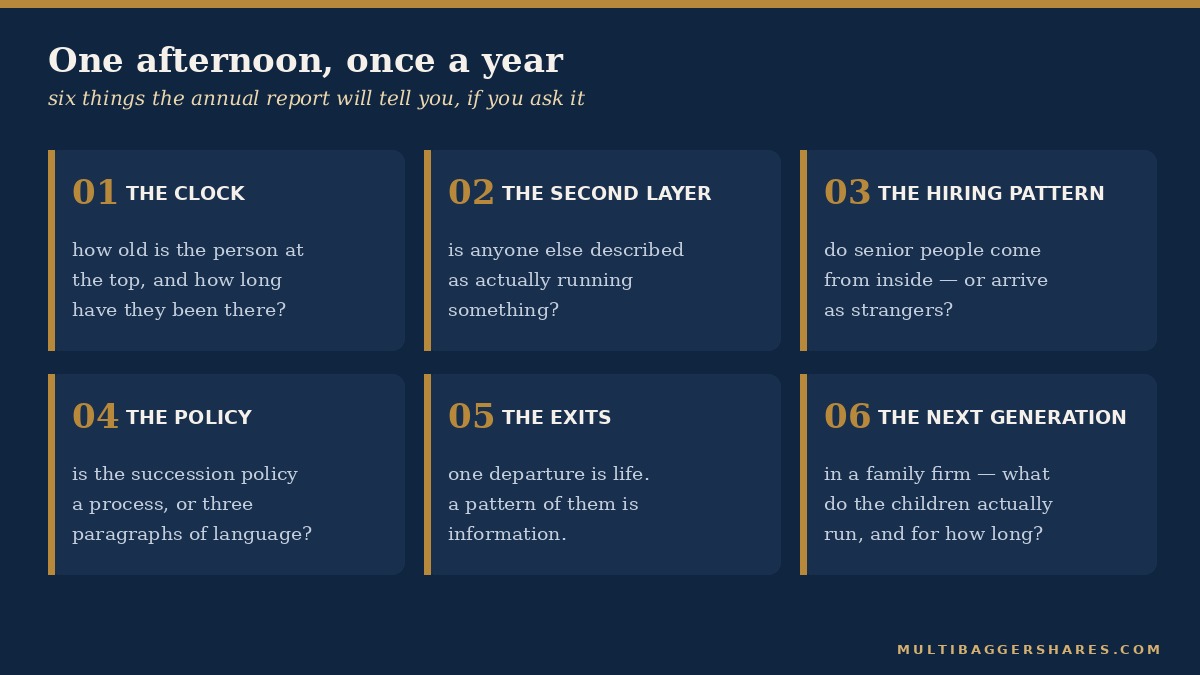
Here is the afternoon’s work. All of it can be done with the annual report, which every listed
company publishes free on its website, and the investor pages of that same website.
Start with the clock. Find who runs the company and how long they have been
there. The annual report lists the age of every director. Someone in their late sixties or seventies
with no visible second-in-command is a different proposition from someone in their forties, however
good both may be. You are not predicting anything. You are just noticing that a clock exists.
Look for the second layer. Read the list of directors and senior management
and ask whether anyone other than the person at the top is described as actually running something. A
chief operating officer, a whole-time director, named heads of the main businesses. If the annual
report gives you one prominent person and then a row of part-time independent directors, you have found
a thin bench.
Check where the last few senior appointments came from. Compare the list of
senior people with the same list three and five years ago; older annual reports sit on the same website.
A company that repeatedly promotes from within is telling you that it grows people. A company that
repeatedly hires strangers into senior roles may have good reasons, but it is not growing them.
Read the succession policy, if there is one. Many Indian companies publish one
under the policies or investor-relations section of their website. Most are short. What you are testing
is whether it describes a process — who identifies candidates, how often the board reviews the list —
or whether it is three paragraphs of pleasant language that could belong to any company in the
country.
Count the exits. Companies must announce it when a senior person resigns.
One departure is life. A pattern of senior people leaving within a year or two of joining usually means
either that the culture is difficult or that there is no real room to grow above them. Both matter to
you.
In a family-run business, ask where the next generation is. In many Indian
companies the promoter (the founding individual or family that controls the business) is also the
manager. Look at whether the children are in the business, what they actually run, and for how long they
have run it. A son or daughter who has managed a real division for a decade is a different signal from
one appointed to the board last year.
And watch the handover itself, if you are lucky enough to see one. The
warning sign is not a new chief executive doing badly for two quarters. It is a departing leader who
cannot let go — who retires from the executive job but stays on with an unusual title and continues to
take the decisions. Then the succession was announced but never actually happened, and the company has
lost the one thing a handover is supposed to buy: clarity about who is responsible.
Write the answers down in a few lines, and look at them again next year. You are not trying to
forecast anything. You are simply making sure that when you say a company is well run, you mean the
company, and not one person in it.
A last word of balance
It is worth saying plainly that a strong founder still at the wheel is usually a good thing, not
a bad one. Many of the finest businesses in India and elsewhere were built by people who stayed for
decades and treated the company as their life’s work. The point of this exercise is not to be suspicious
of them. It is to separate two things that look identical from the outside: a business that is excellent
and has been built to outlive its founder, and a business that is excellent only while its
founder is in the room.
One of those two you can hold for twenty years without thinking about it. The other you can
hold too — but you should at least know which one you own.
Key takeaways
- Succession planning is simply a company’s answer to “who does this job next, and how do we know they can?” — and a name alone is not a plan.
- Key-man risk is a flaw in the organisation, not in the person; the best managers often create it by being quick enough to do everything themselves.
- It is one of the very few management tests you can score before the event, because the preparation is visible years ahead.
- Six things to check in the annual report: the leader’s age and tenure, whether a real second layer exists, where senior hires come from, the published succession policy, the pattern of senior exits, and — in family firms — what the next generation actually runs.
- A founder who stays for decades is usually a strength; the question is only whether the business has been built to outlive them.
— Manish Goel · multibaggershares.com
Disclaimer: This article is for educational purposes only and does not constitute financial advice. The author may hold positions in stocks mentioned. Always conduct your own research and consult a SEBI-registered financial advisor before making investment decisions. Stock market investments are subject to market risks. Past performance does not guarantee future returns.