The Promise Ledger: How to Check What a Company Said Last Year Against What It Actually Did

The Last Mile: Why Getting to the Shop Shelf Is One of India’s Quietest Moats
August 10, 2026
The Understudy: How to Tell Whether a Business Has Prepared for the Day Its Leader Leaves
August 19, 2026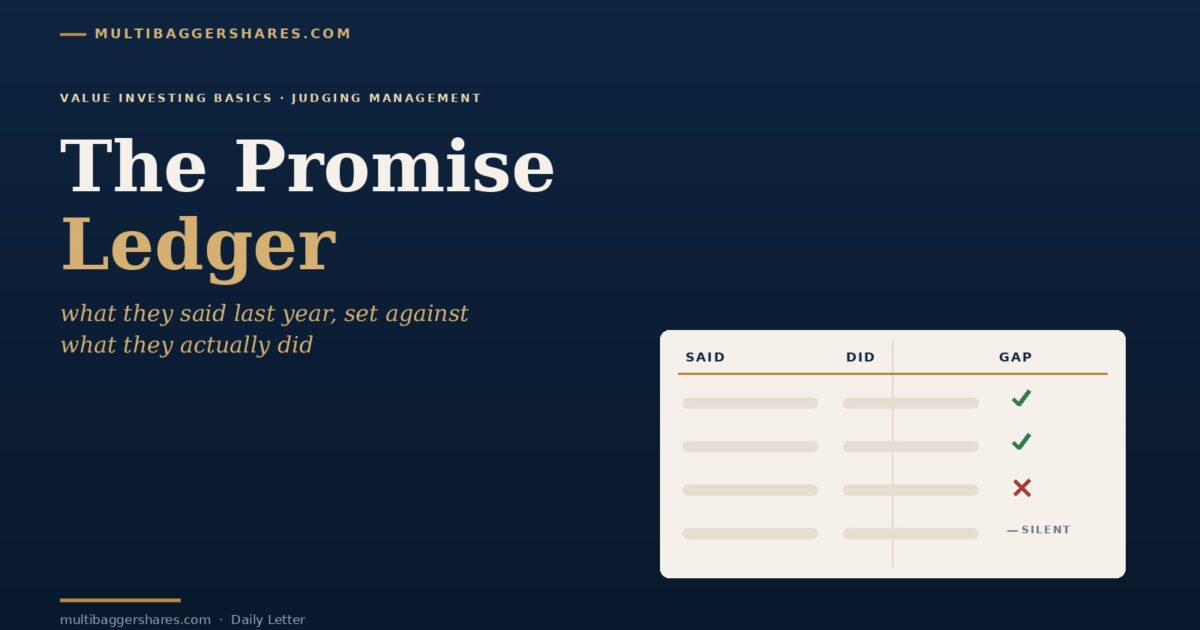
Value Investing Basics
Suppose you hire a contractor to redo your kitchen. He walks around, does some sums, and says: three months, and this much money. You shake hands.
Three months pass. The kitchen is not done. Six months pass. It is done, and it has cost more than he said.
Now a neighbour asks you about him. What do you tell her? You do not describe his tools. You do not describe how confident he sounded on the first day. You say one thing: he promised three months and took six.
That single sentence — what he said, set against what he did — is the most useful thing you know about that man. It is worth more than his brochure, more than his photographs, more than the assured way he talks.
Companies make promises too. Every year, in the annual report (the yearly document a listed company must publish, containing its accounts and its managers’ commentary), and on the earnings call (the meeting where managers explain the results and answer analysts’ questions — in India it is usually called a concall), the people running the business tell you what they intend to do. We will open forty new stores. We will finish the new plant by March. We will bring the borrowings down. We will hold our margins.
And almost nobody writes it down.
That is the whole of today’s letter. Write it down. Come back in a year. Check.
What a promise ledger really is
A ledger is just a book of entries — the kind a shopkeeper keeps, one line per transaction. A promise ledger is the same book, except the entries are promises instead of rupees.
You already keep one, informally, about the kirana shop down the road. When the shopkeeper says “the stock will come on Tuesday”, you note it somewhere at the back of your mind. After a few Tuesdays you know exactly what kind of man he is, and you plan your week around that knowledge rather than around his words. Nobody taught you to do this. What we are doing here is the same thing, done deliberately, on paper, about a business you cannot walk into.
It needs three columns, and only three.
The first column: what they said. Copy the sentence out in the company’s own words, with the date beside it. Not your summary of it. Their sentence.
The second column: what happened. You fill this one in a year later, from the next annual report or the next set of quarterly results.
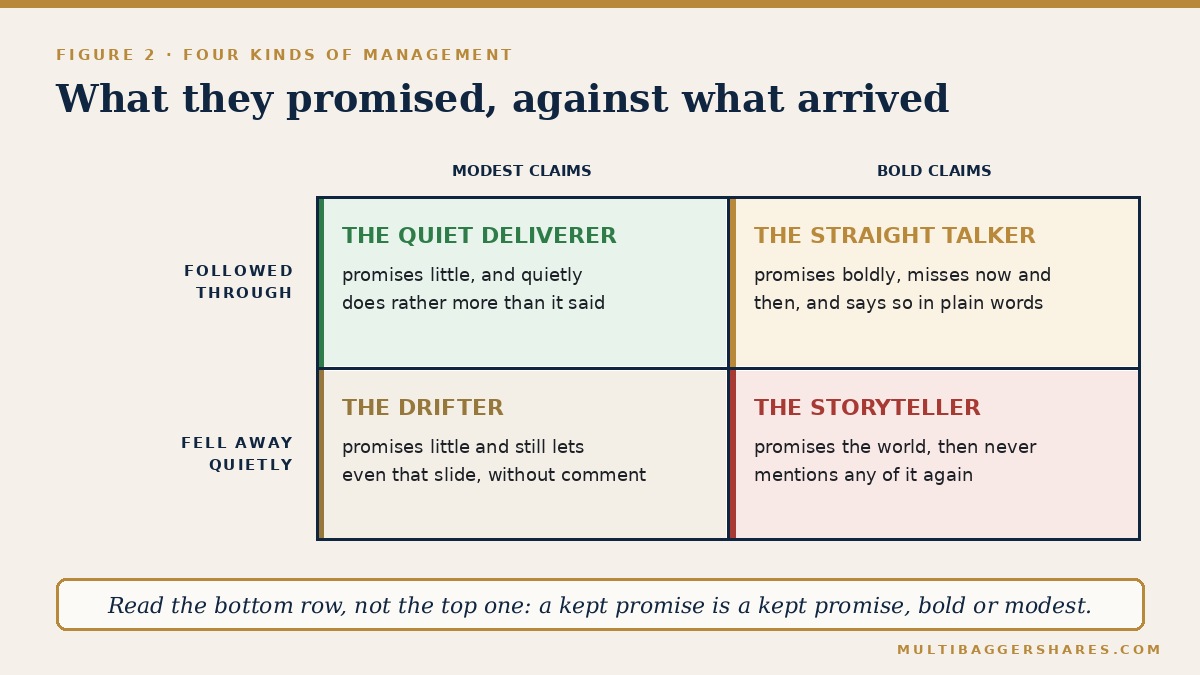
The third column: the gap. Did they beat it, meet it, miss it slightly, or miss it badly? And — this matters far more than the number — did they mention the gap themselves, or did they quietly stop talking about it?
That third column is where the real information lives.
A company that promised forty new stores, opened thirty-six, and says so plainly in the next report has told you something good about itself. A company that promised forty, opened twelve, and then simply never mentions stores again has also told you something. It is just less pleasant to hear.
Notice what you are not doing. You are not measuring accuracy. Nobody forecasts a business perfectly; the monsoon fails, currencies move, customers change their minds, a government changes a rule. You are measuring something quite different: whether the people looking after your money tell you the truth when the truth is inconvenient.
Why it works
There are three reasons, and they build on one another.
First, it is almost the only test of management an outside investor can actually run. You cannot sit in the boardroom. You cannot walk the factory floor or interview the sales head. But you can read what the managers wrote last year, and you can read what happened. Both documents are free, public, and sitting on the company’s own website.
Second, it cannot be dressed up. A photograph in an annual report can be staged. A strategy slide can be redrawn. A quarter’s profit can be flattered by pushing some spending into the next quarter. But the sentence the managing director wrote twelve months ago is fixed. It cannot be edited after the event. In a document full of things that can be arranged, it is the one piece of evidence that does not move.
Third — and this is the deep one — the habit of making public promises changes the behaviour of the people who make them, and not always for the better.
Warren Buffett wrote about precisely this in his 2000 letter to Berkshire Hathaway shareholders. He said that he and his partner Charlie Munger think it is “both deceptive and dangerous for CEOs to predict growth rates for their companies”, because “too often these predictions lead to trouble”. He then set out what kind of trouble. Over the years, he wrote, the two of them had watched many chief executives undertake “uneconomic operating maneuvers” — decisions that actively harmed the business — purely so that they could hit a number they had announced in advance. Others went further, and “played a wide variety of accounting games” to make the numbers.
Read that twice, because it turns the ledger on its head. A company that hits its stated targets exactly, year after year, without a single miss, is not automatically a company with unusually good managers. It may be a company with unusually flexible accounts. Real businesses are lumpy. A record that is too smooth is itself a question worth asking.
Buffett was careful to say that the opposite extreme is not required either. It is perfectly fine, he wrote, for a chief executive to hold internal goals, and even to express some hopes publicly — provided those hopes arrive “accompanied by sensible caveats”. A caveat is simply an honest warning attached to a forecast: here is what we expect, and here is what would have to go right for it to happen.
It helps to remember why this feels unfamiliar. Put money in a fixed deposit and the bank tells you the rate in advance and then pays exactly that, because it has borrowed from you and is obliged to. A share is not a loan. When you own a share you own a slice of a real business, and a real business cannot promise its results the way a bank can promise a rate. So the promise of a company can never be a guarantee. What it can be is a piece of evidence about the person making it — and that is what you are collecting.
So the ledger is not hunting for perfection. It is hunting for candour — the habit of saying the awkward thing out loud, unprompted.
Two ledgers that were kept in public
Most companies would rather you did not keep this book at all. A few keep it themselves, in the open, which tells you a great deal before you have read a single number.
The company that published its own report card. Infosys, the Indian software services company, began giving public guidance in the early 2000s. Guidance is a company’s own published estimate of what the coming quarter’s or year’s results will be — at the time, a rare thing for an Indian company to offer. It then did something rarer still. On its own investor website it put up a page setting every guidance it had ever given against what actually happened, quarter by quarter and year by year, going back to the 2002 financial year.
That page is still there today, and it is not a victory lap. Alongside the good years — the 2003 financial year, where revenue came in roughly sixteen per cent above the middle of the guided range, or 2005, roughly nineteen per cent above — sit the years the company fell short of its own word. In the 2008 financial year revenue landed about three per cent below the mid-point. In 2017, about three and a half per cent below. One quarter of the 2012 financial year came in nearly six per cent under.
The page also records the moments the company changed its own rules. It stopped giving quarterly guidance after the first quarter of the 2013 financial year and moved to an annual figure only. It stopped guiding in rupee terms after the 2018 financial year and switched to constant currency — a way of measuring growth that strips out the effect of exchange-rate movements, so you can see how much of the change came from the business itself rather than from the currency. Both changes are stated plainly on the same page as the misses.
You may think whatever you wish about the company or its shares. But the discipline of publishing your own shortfalls beside your own successes, and leaving them up for twenty years, is uncommon — and it is exactly what the third column of a promise ledger is built to detect.
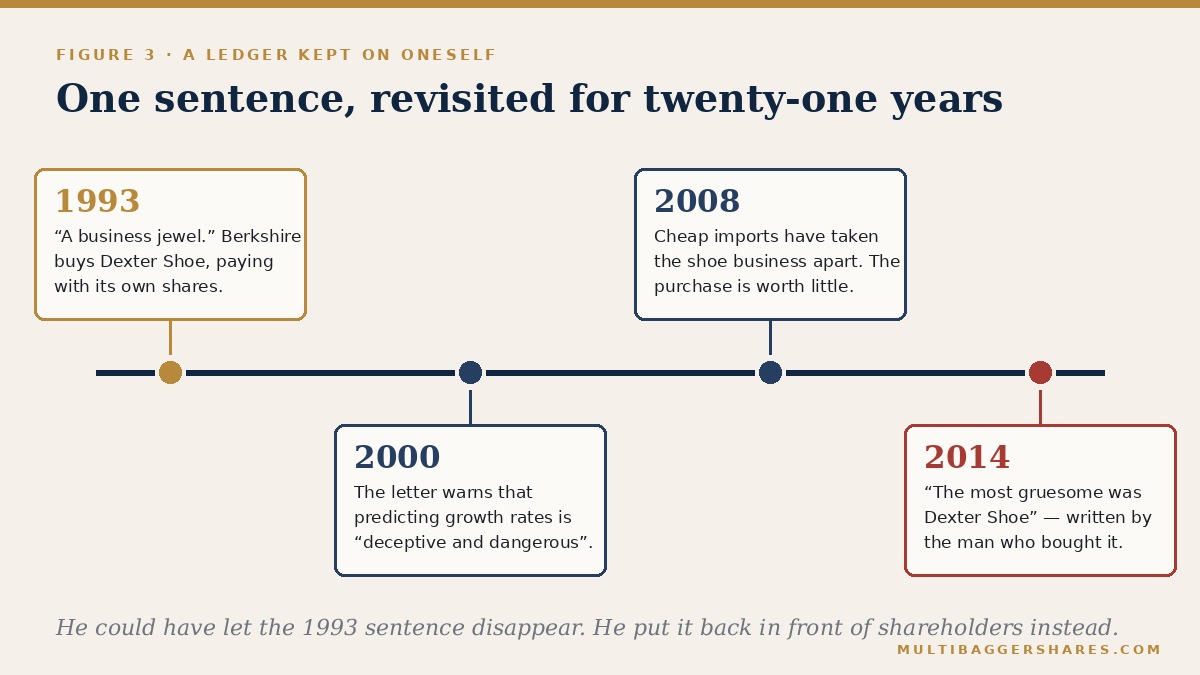
The investor who kept a ledger on himself. In 1993 Berkshire Hathaway bought Dexter Shoe, an American shoemaker, paying with Berkshire shares worth roughly 433 million dollars at the time. In his letter to shareholders that year, Buffett called Dexter “a business jewel”, and wrote: “Dexter, I can assure you, needs no fixing: It is one of the best-managed companies Charlie and I have seen in our business lifetimes.”
He was wrong. Cheap imported footwear took the market apart within a decade, and the American manufacturing business Berkshire had bought ended up worth very little.
Here is the part that matters for us. Buffett did not let that 1993 sentence quietly disappear. He went back to it, in public, again and again, for the next twenty years. He has called Dexter “the worst deal that I’ve made”. Reviewing his own biggest errors in his 2014 letter, he wrote that “the most gruesome was Dexter Shoe”, and that as a financial disaster it “deserves a spot in the Guinness Book of World Records” — because he had paid in Berkshire shares rather than cash, so the true cost of the mistake kept growing for decades as Berkshire itself grew.
Berkshire’s owner’s manual, the short document setting out the principles by which the company reports to its shareholders, contains the rule that sits behind that behaviour. The company undertakes to be “candid in our reporting to you, emphasizing the pluses and minuses important in appraising business value”. And the reason it gives is not politeness. It is self-protection: “The CEO who misleads others in public may eventually mislead himself in private.”
That is the sentence to carry away. A manager who is allowed to bury last year’s promise will, in time, forget he ever made it — and a manager who has forgotten his own mistakes has stopped learning from them.
How you can use it
You can start this afternoon, with one company and about twenty minutes.
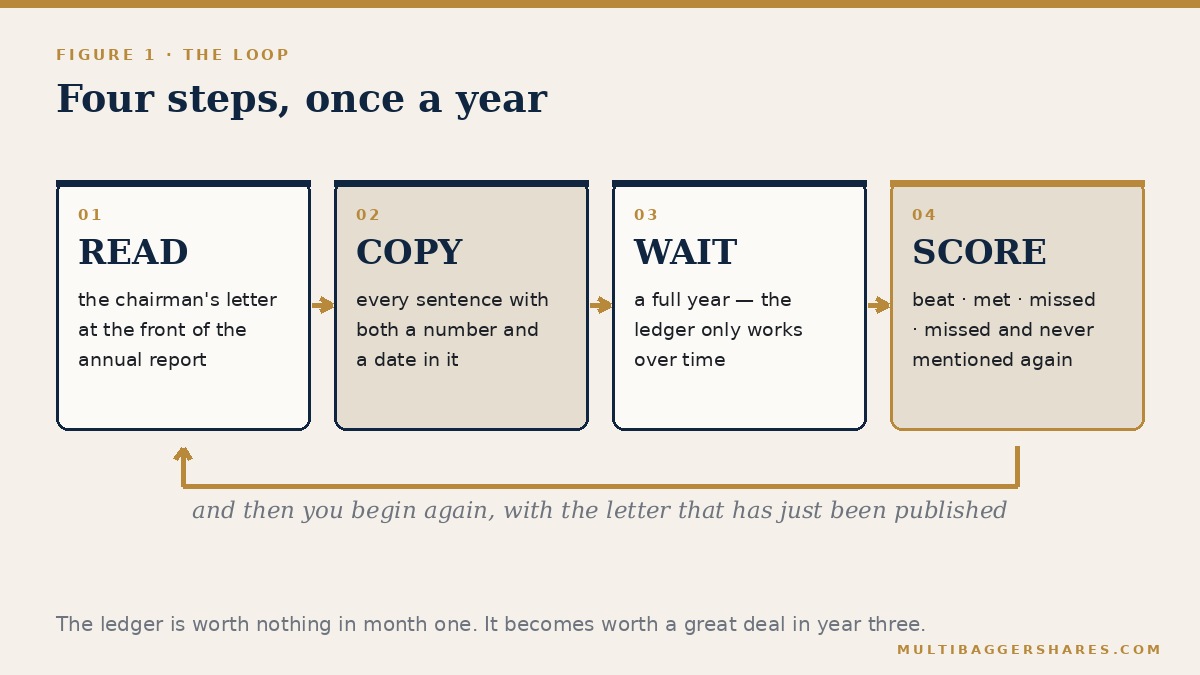
Step one. Pick a business you already follow and find its annual report from a year or two ago. It sits on the company’s own website under “investors”, and on the stock exchange websites. Open the chairman’s or managing director’s letter — the two or three pages at the front written in plain language rather than in accounting.
Step two. Read it with a pen in your hand. Every time you meet a sentence that contains both a number and a date, copy it out. “We expect to commission the new line by the fourth quarter.” “We aim to bring net borrowings down by five hundred crore.” “We plan to add three hundred dealers.” Four or five entries is plenty. Ignore the adjectives: robust, world-class, transformational. Those are not promises, and they cannot be scored.
Step three. Open the most recent annual report and fill in what actually happened. Sometimes this is easy and the company tells you directly. Sometimes the number has simply vanished from the document — and that absence is itself your answer.
Step four. Write one honest line at the bottom. Not a verdict on the share — a verdict on the telling. Something like: three of five delivered, one missed and explained, one quietly dropped.
Then do nothing for a year, and repeat.
A few practical notes, learned the hard way. Judge the explanation, not merely the miss: “the plant was delayed because approvals took nine months longer than we expected” is a real reason, while “market conditions remained challenging” is not a reason at all, it is a phrase. Be generous about genuine bad luck and unforgiving about repetition — one missed deadline is life, four in a row is character. Watch what happens to a promise that is inconvenient rather than one that is merely wrong. And notice who is willing to write the words “I was wrong”. It is astonishingly rare, and it is worth a great deal.
The promise ledger will not tell you what a business is worth. It is not built for that, and it does not pretend to be. It tells you something narrower and, across many years, far more useful: whether the people you have handed your savings to are in the habit of telling you the truth.
Your contractor took six months and told you why. Or he took six months and insisted he had always said six. Those are two entirely different men — and only one of them gets the next job.
Key takeaways
- A promise ledger has three columns: what management said, what actually happened, and the gap — recorded in the company’s own words, with dates.
- It is the one management test an outsider can genuinely run, because last year’s sentence is fixed and cannot be edited after the event.
- A flawless record is a question, not a comfort — Buffett warned that managers chasing announced targets sometimes harm the business or bend the accounts to hit them.
- The third column matters most: whether management names its own shortfall, or simply stops mentioning it.
- Score four or five dated, numbered promises per company each year, and treat a plainly stated “I was wrong” as a real mark of quality.
— Manish Goel · multibaggershares.com
Disclaimer: This article is for educational purposes only and does not constitute financial advice. The author may hold positions in stocks mentioned. Always conduct your own research and consult a SEBI-registered financial advisor before making investment decisions. Stock market investments are subject to market risks. Past performance does not guarantee future returns.