The Owner’s Chair: The Quiet Rights That Come With a Single Share

The Cook and the Tiffin Service: Benjamin Graham’s Two Kinds of Investor
August 8, 2026
The Last Mile: Why Getting to the Shop Shelf Is One of India’s Quietest Moats
August 10, 2026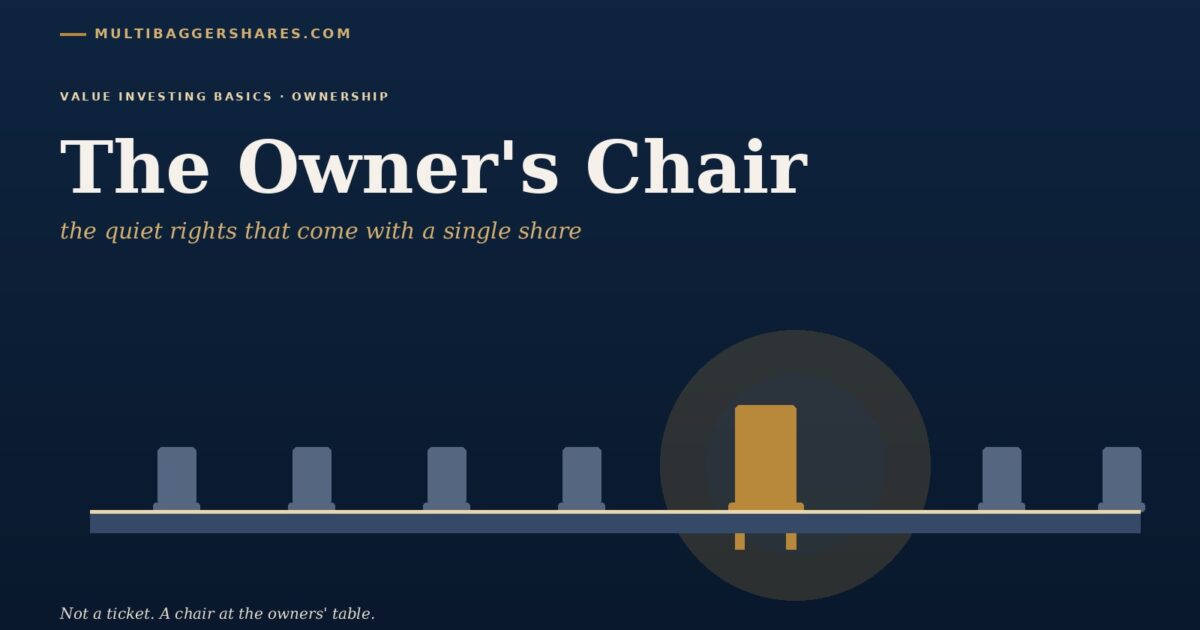
Value Investing Basics
Every spring, on the first Saturday of May, more than forty thousand people fly, drive and queue in Omaha, a quiet city in the middle of America. They fill a stadium before sunrise. They are not there for a concert, or a cricket match, or a film star. They are there to attend a meeting — the annual general meeting (the once-a-year gathering where a company’s owners meet the people who run it) of a company called Berkshire Hathaway. For decades its chairman, Warren Buffett, sat on the stage for hours, answering the owners’ questions one by one. The newspapers long ago nicknamed the event the Woodstock for Capitalists, after the famous music festival, because no other company meeting on earth draws a crowd like it.
Why would anyone cross an ocean for a meeting? Because the people in those seats remember something the rest of us keep forgetting. They are not visitors. They are not customers. Each of them, through their shares, owns a piece of the company. The meeting is not a show they have come to watch. It is their own annual family gathering, and they would no more miss it than a farmer would miss the harvest.
This essay is about the chair those forty thousand people came to sit in — the owner’s chair. Every share you buy comes with one, free of charge. Most investors never notice it, because they are too busy watching a blinking price. India now has more than thirteen crore registered investors (a crore is ten million, so that is over 130 million people — roughly one Indian in ten). Ask yourself honestly: of those thirteen crore, how many have ever read one annual report, or cast one vote? Today, let us walk through the quiet rights that come with a single share — and see why using them makes you a calmer, and usually a better, investor.
What a share really gives you
Start with the word itself. A share is exactly what it sounds like: a share — a small piece — of a real business. If a company is divided into ten crore shares and you hold one thousand of them, you own a genuine slice of that business — of its factories, its brands, its bank balance and its future profits. You are not betting on the company from the outside, the way people bet on a horse. You are a part-owner of it, from the inside. The horse belongs, in a small way, to you.
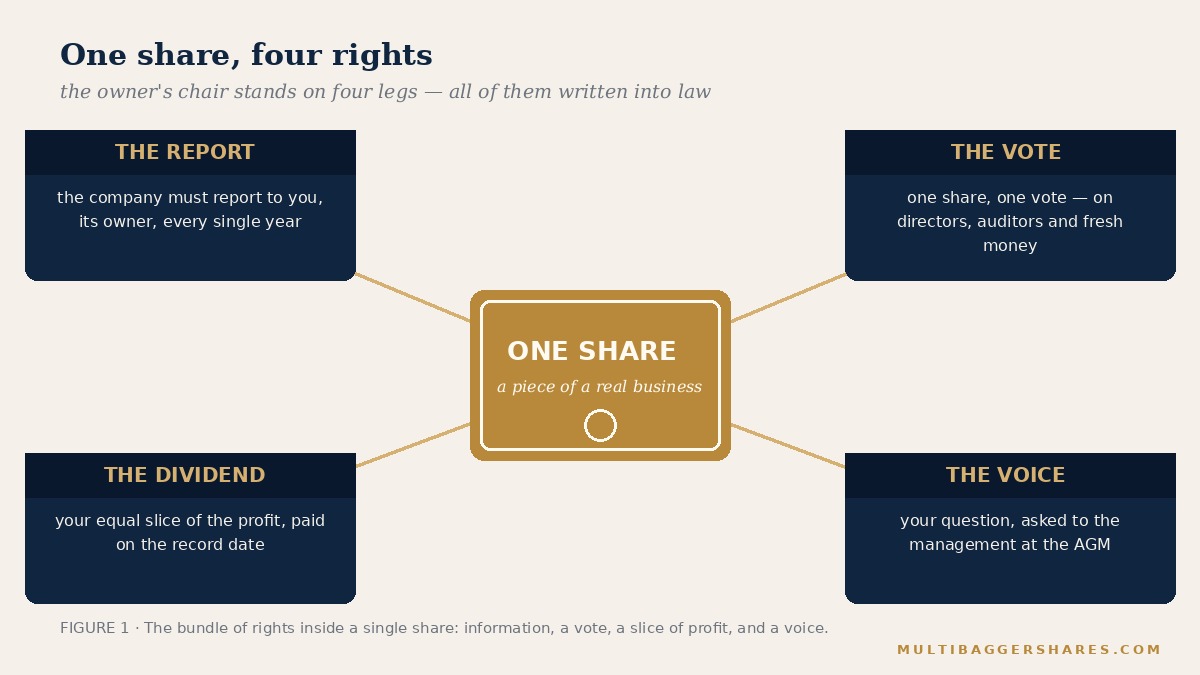
And ownership is not just a warm feeling. In law, every share carries a small bundle of rights. Think of the owner’s chair as standing on four legs.
The first leg is the right to be informed. Once a year, your company must report to you — through the annual report (a document sent to every shareholder, carrying the year’s audited accounts, a description of what the business did, what it plans to do, and a letter from the chairman). It is not junk mail, though millions treat it that way. It is the company reporting to its owners, exactly the way a branch manager reports to the head office. In this relationship, you are the head office.
The second leg is the right to vote. The big decisions of your company — appointing directors (the board members who supervise the management on the owners’ behalf), appointing the auditor (the independent accountant who checks that the books are honest), raising fresh money, changing the rules — must be put to the owners as resolutions (formal proposals that shareholders approve or reject). Voting is by shares, not by a show of hands: one share, one vote. Your fifty shares are fifty votes. Small, yes. But counted — always, and by law.
The third leg is the right to a share of the profit. When your company pays a dividend (a part of the year’s profit paid out to shareholders in cash), it cannot pick favourites. It announces a record date (a cut-off day on which the company checks its register of owners); whoever holds the shares on that day gets paid, straight into the bank account, at the same rate for every share — whether they hold ten shares or ten lakh.
The fourth leg is the right to be heard. At the annual general meeting, you may stand up — these days, often on a video call from your own home — and ask the management a question about your company. Not as a favour. As a right that comes stapled to the smallest holding.
If all this sounds too grand for your two hundred shares, shrink it to something familiar. If you own a flat, you belong to the housing society, and once a year the society holds its general body meeting. You would never dream of skipping the meeting where the repairs, the accounts and the new secretary of your own building are decided. You would read the notice. You would raise your hand. A listed company is simply a much larger housing society, and your shares are the flat. The scale changes enormously. The idea does not change at all.
Why the owner’s mindset works
Benjamin Graham — Warren Buffett’s teacher, and the man investors everywhere call the father of value investing — hid the whole secret in nine plain words: “Investment is most intelligent when it is most businesslike.” Buffett has called those nine words the most important ever written about investing. Notice carefully what they say. Investing goes wrong when it feels like buying a lottery ticket. It goes right when it feels like running a business: knowing what you own, reading its accounts, judging the honesty of the people who run it.
Buffett built his company around that sentence. In 1996 he wrote a small booklet for Berkshire’s shareholders called An Owner’s Manual, and its very first principle begins: “Although our form is corporate, our attitude is partnership. Charlie Munger and I think of our shareholders as owner-partners, and of ourselves as managing partners.” Read that twice. The most successful investor of our age does not treat the people who hold his shares as a crowd holding tickets. He treats them as partners in the firm. And partners, in turn, behave differently from ticket-holders.
Why does the owner’s mindset make you a better investor in practice? For three quiet reasons.
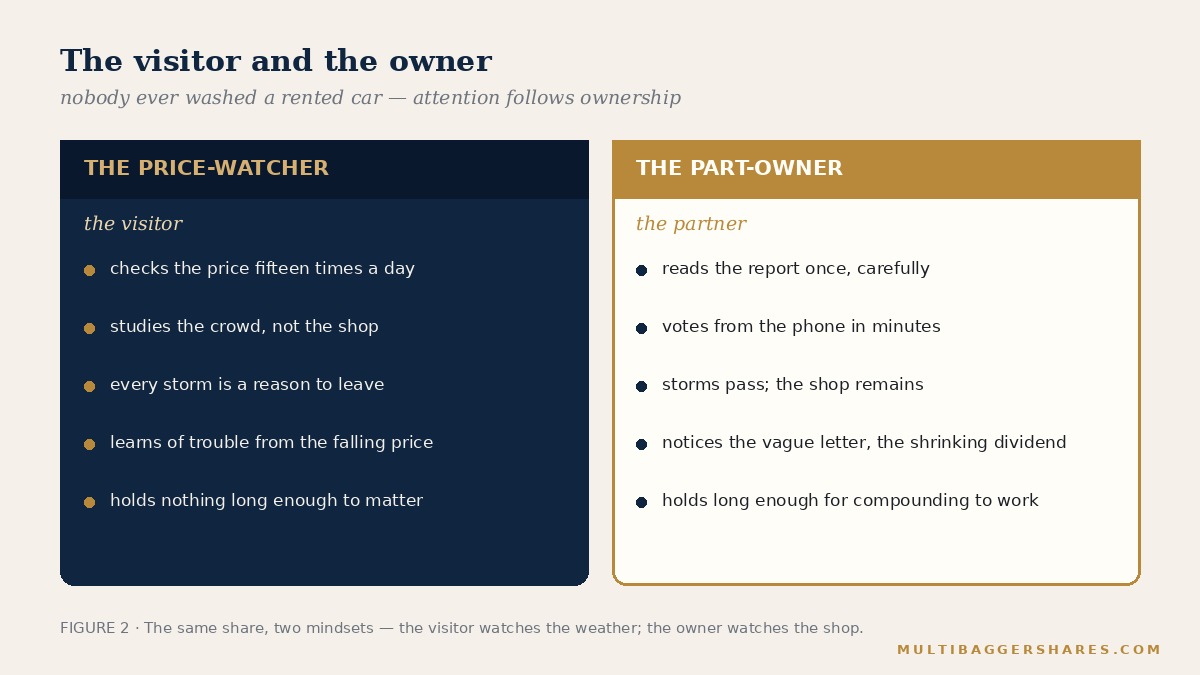
First, owners watch the business; visitors watch the price. A price moves every second, and most of that movement is noise — the shifting moods of strangers. A business changes slowly: customers, products, debts, profits. The investor who reads the annual report once a year usually knows more that matters about the company than the investor who checks its price fifteen times a day. One is studying the shop. The other is studying the crowd outside the shop.
Second, owners hold — and holding is where the money is made. Compounding (earning returns on your past returns — interest on interest, a snowball growing as it rolls downhill) needs years, sometimes decades, to show its full magic. Only people who feel like owners can sit through the market’s storms, because their eyes are on the shop and not on the weather. The moment you feel like a visitor, every storm looks like a reason to leave.
Third, owners notice trouble early. There is an old truth about human nature: nobody ever washed a rented car. We look after what is ours, and we look closely at what is ours. The shareholder who reads the report and attends the meeting notices when the chairman’s letter turns vague, when the auditor begins adding careful warnings, when the dividend quietly shrinks while the profits are being called “record”. The pure price-watcher notices none of this until the price itself falls — by which time the news is already old.
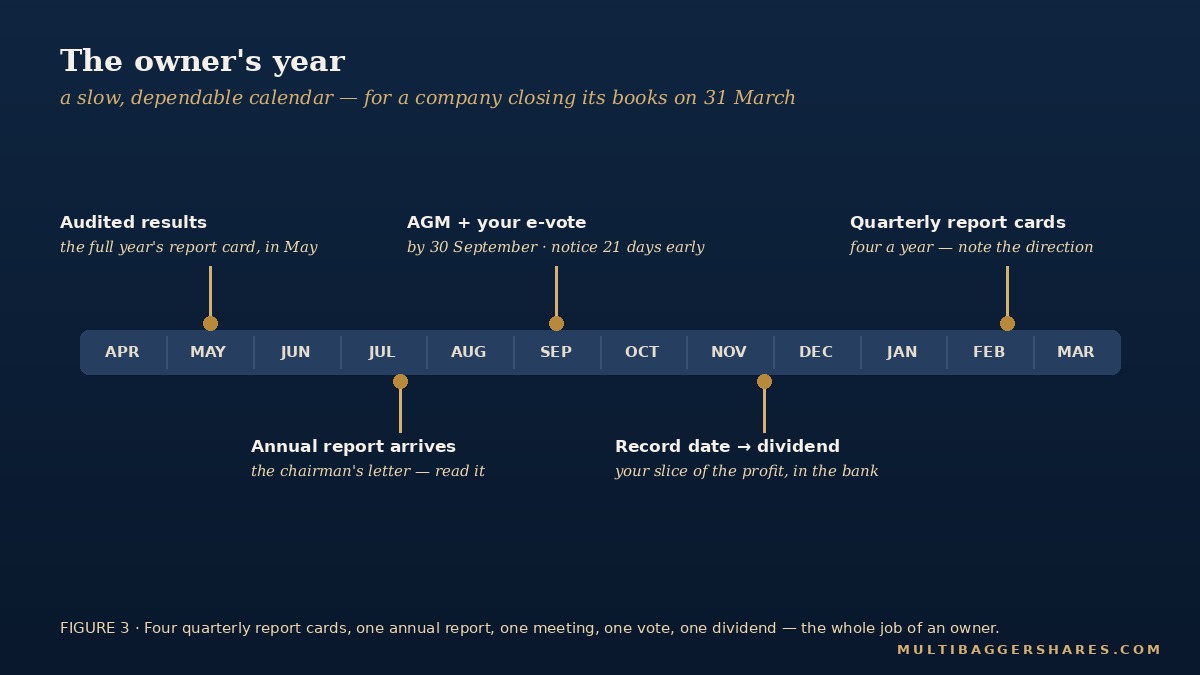
The owner’s year: a small calendar
Ownership even has a rhythm to it, like the farming year. In India, most companies close their books on 31 March — the end of the financial year (the twelve-month period over which a company’s accounts are made up). Around that date, the owner’s calendar turns in a slow, dependable circle.
Four times a year, your company publishes its quarterly results (a short report card of three months’ sales and profits). Read them lightly. Three months is a very short season in the life of a business — a good monsoon or a late festival can bend one quarter without meaning anything at all. Notice the direction over the years, not the jump of the week.
By the summer, the full annual report arrives — these days usually by email. Then comes the annual general meeting itself. The law is specific: a company must hold its AGM within six months of the year-end, which for a March-closing company means by 30 September, and the hundred largest listed companies are required to finish within five months. The notice must reach you at least twenty-one clear days before the meeting, along with every resolution you will be asked to vote upon.
And here is the part many investors still do not know. Since the Companies Act of 2013 and the stock-exchange rules that followed it, every listed company in India must offer remote e-voting (voting online, in the days before the meeting, through the registrar’s or depository’s website). You do not have to travel anywhere, know anyone, or fill any paper form. A schoolteacher in Nagpur with fifty shares casts her fifty votes from her phone in a few minutes, and the results of every resolution are counted and published for the whole world to see.
Then, if the year has gone well, comes the dividend: record date announced, register checked, cash in the bank. And somewhere in between, if you choose, you log into the meeting and simply listen. That is the entire job of an owner. A few evenings a year — less time than many investors now spend watching prices in a single week.
The meeting, by the way, tells you things no number can. Some managements answer the smallest shareholder’s question with patience and a straight face — Berkshire’s meeting famously runs for hours precisely because the questions are allowed to keep coming. Other managements hurry through in half an hour, discourage questions, and treat their owners as a formality to be endured once a year. Both behaviours are information. The way a management treats its small owners in public is very often a preview of how it treats their money in private.
How you can use it
None of this needs special skill, software or money. It needs five small habits, none longer than a cup of tea.
One: when the annual report arrives, open it. Read the chairman’s letter and the first twenty pages — the story of the year in the management’s own words. Half an hour, once a year, for each company you own. Two: when the AGM notice arrives, read the resolutions and cast your e-vote. It is free, it takes minutes, and it slowly teaches you what companies actually ask their owners for.
Three: attend one annual general meeting a year, even if only by video, even if you say nothing. Listen to the tone. Watch how the smallest questions are treated. Four: keep one small page per company — the dividends received, the record dates, the promises made in last year’s letter — and each year, check the promises against what actually happened. Nothing exposes a management, or reassures you about one, quite like its own old promises.
And five — the habit that contains all the others: measure your investing year in reports read, not in prices checked. The price will be there tomorrow. It will be there every second of tomorrow, blinking, whether you look or not. The understanding that makes holding possible comes from the other, quieter documents — the ones addressed to you by name, because you are an owner.
Thirteen crore Indians now hold shares. Most will remain visitors all their lives — watching the blinking number, feeling every wobble, holding nothing long enough for it to matter. A quiet few will take the chair that came free with their very first share: read the letter, cast the vote, bank the dividend, ask the question. The market, over any long stretch of time, has tended to pay the second group for behaving like what they truly are — part-owners of real businesses. So the next time you buy a share, pause for a second and remember what you have actually bought. Not a ticket. A chair. Pull it up to the table, and sit down.
Key takeaways
- A share is not a ticket with a blinking price; it is a small piece of a real business, and it comes with an owner’s chair attached — free.
- The chair stands on four legs: the report that informs you, the vote that counts you, the dividend that pays you, and the voice that lets you ask.
- “Investment is most intelligent when it is most businesslike” — Graham’s nine words, which Buffett calls the most important ever written about investing.
- The Indian owner’s year is simple: quarterly report cards, the annual report by summer, the meeting and your e-vote by September, the dividend on its record date.
- Owners who read and vote hold longer, panic less, and notice trouble earlier than price-watchers ever can.
— Manish Goel · multibaggershares.com
Disclaimer: This article is for educational purposes only and does not constitute financial advice. The author may hold positions in stocks mentioned. Always conduct your own research and consult a SEBI-registered financial advisor before making investment decisions. Stock market investments are subject to market risks. Past performance does not guarantee future returns.