The Cook and the Tiffin Service: Benjamin Graham’s Two Kinds of Investor

Why I Bought Titan Biotech — and Why It’s Up ~650% in 3 Years
August 4, 2026
The Owner’s Chair: The Quiet Rights That Come With a Single Share
August 9, 2026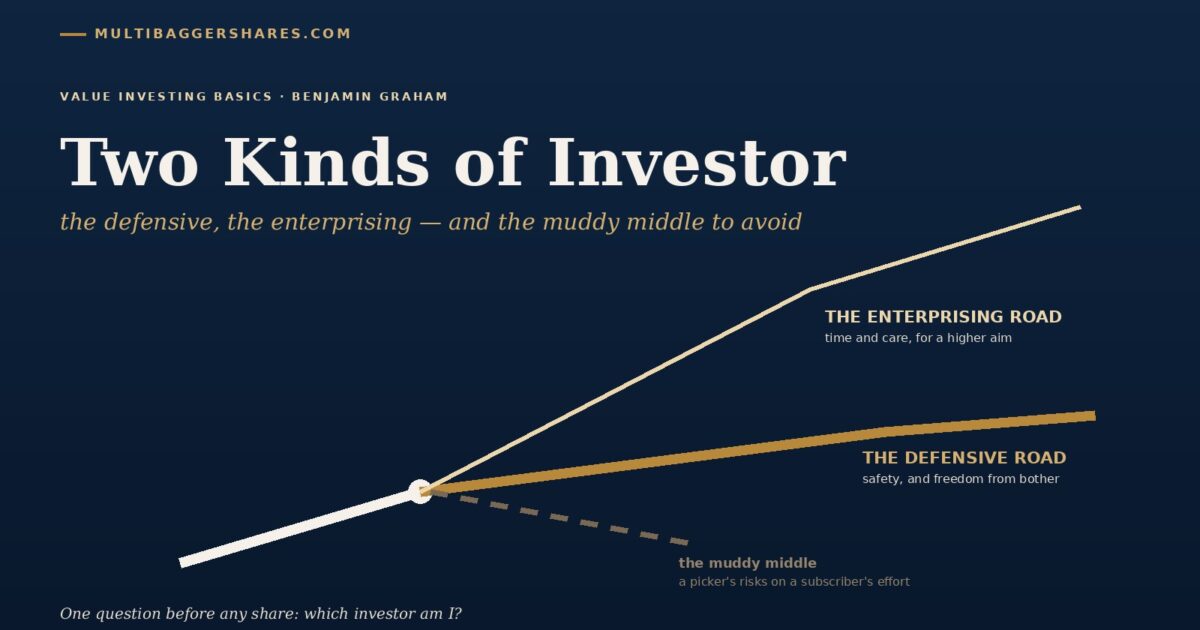
Value Investing Basics
Meera and Asha work in the same office in Pune, and both of them care about eating well. Meera loves to cook. On Sunday mornings she walks to the sabzi mandi herself, picks each tomato by hand, and spends the evening trying a new recipe. She has burnt a few dinners over the years, but she has slowly become good, and her food today is better than most restaurants. Asha has no interest in any of that. She has a demanding job and two small children, so she subscribes to a tiffin service (a dabba service — a home kitchen that delivers a cooked meal to your door every day) run by an aunty with a twenty-year reputation. Asha spent one weekend, years ago, choosing that service carefully. Since then she has barely thought about dinner at all.
Here is the question worth pausing on: which of the two eats well? The answer, of course, is both. Meera pays with her time and gets exactly the food she wants. Asha pays a small fee and gets her evenings back. Neither is wrong. They have simply chosen different roads to the same destination.
Now meet their colleague Rohan. Rohan wants Meera’s results without Meera’s work. He watches half a cooking video, buys whatever vegetables are on discount, guesses at the flame, and serves undercooked dal to his disappointed family. He spends more evenings in the kitchen than Asha ever will, yet eats worse than either woman. Rohan is on no road at all. He is in the muddy middle — taking on a cook’s risks with a subscriber’s preparation.
Money works exactly the same way. Investing (putting your savings into things like shares — small ownership pieces of real companies — so that your money can grow with them) offers the same two honest roads, and the same dangerous middle. The man who first drew this map was Benjamin Graham, the teacher the world calls the father of value investing, whose 1949 book The Intelligent Investor shaped Warren Buffett and almost every serious investor since. Graham said that before you ask which share, you must answer a far more basic question: which kind of investor am I? Today’s lesson is about his two answers — the defensive investor and the enterprising investor — and about why knowing your own road matters more than any clever idea you will ever hear.
What it really means: two kinds of investor
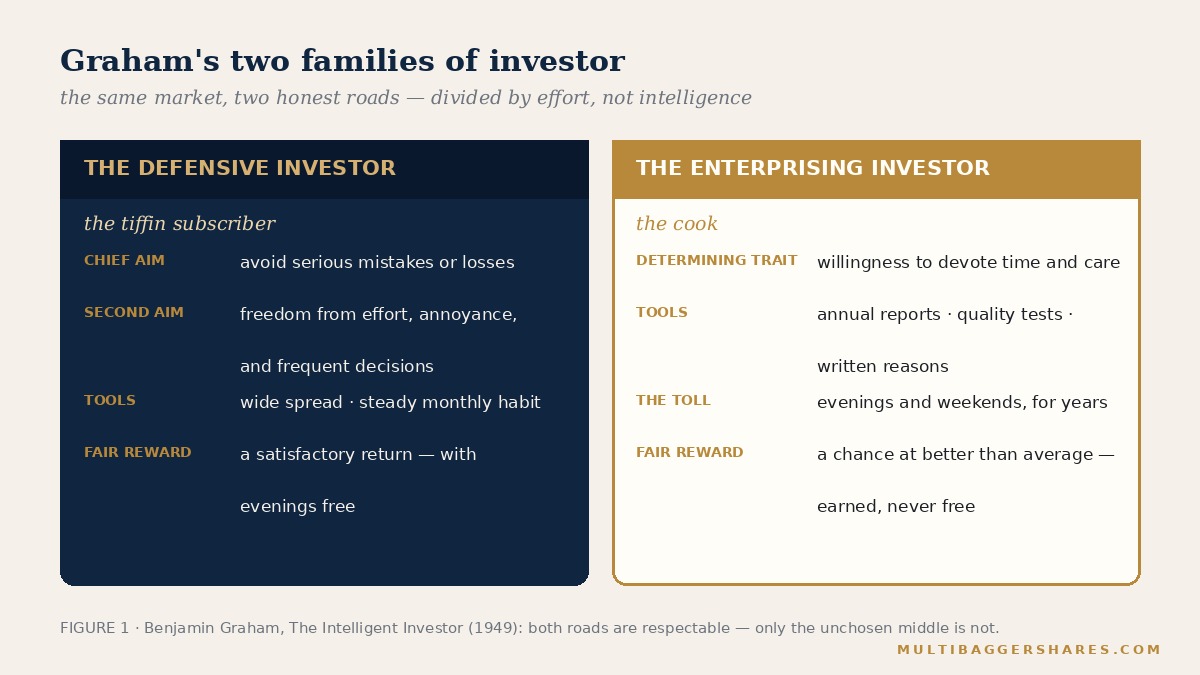
Graham divided all investors into two families, and he defined them with unusual care. The defensive investor (he also called this person the passive investor), Graham wrote, “will place his chief emphasis on the avoidance of serious mistakes or losses. His second aim will be freedom from effort, annoyance, and the need for making frequent decisions.” Read that slowly. The defensive investor’s first goal is not the biggest possible profit. It is safety plus peace — money that grows at a fair rate while its owner gets on with life, the way Asha gets on with her evenings.
The second family is the enterprising investor (Graham also said active or aggressive). Here is Graham’s definition: “the determining trait of the enterprising investor is his willingness to devote time and care to the selection of securities that are both sound and more attractive than the average.” Securities is simply the old formal word for investments such as shares. Notice what the determining trait is. It is not intelligence. It is not courage. It is not the size of your bank balance. It is the willingness to devote time and care — Meera’s Sunday mornings in the mandi, week after week, year after year.
This is the part almost everyone gets wrong, so let it sink in. Most beginners believe the line between investors runs between the brave and the timid, or between the clever and the ordinary. Graham said no. The line runs between those who will do the work and those who will not. Both choices are respectable. A defensive investor is not a failed enterprising investor, just as Asha is not a failed cook. They are simply travellers on different roads, and each road has its own rules, its own tools, and its own fair reward.
Graham then added the sentence that quietly overturns most of what people assume about markets. The return you should expect, he argued, does not depend on how much risk (the chance of losing money) you are willing to stomach. In his words: “the rate of return sought should be dependent, rather, on the amount of intelligent effort the investor is willing and able to bring to bear on his task.” The minimum return goes to the passive investor, who wants safety and freedom from concern. The best possible return goes to the alert and enterprising investor who brings maximum intelligence and skill to the job. Not maximum daring — maximum intelligent effort. Rohan puts in plenty of effort, but none of it is intelligent, so the kitchen pays him nothing. That single idea separates Graham from every casino and every hot-money channel in the world.
Why it works
Why should the reward follow effort rather than appetite? Because choosing individual shares well is real work, and pretending otherwise does not make the work disappear. A company describes itself in its annual report (the yearly booklet in which a business publishes its accounts and explains its year). Reading one properly takes hours. India has thousands of listed companies (companies whose shares the public can buy and sell on a stock exchange). Judging which few of them are wonderful businesses — and then watching them, season after season — is an ongoing job. The enterprising road is open to anyone, but the toll is paid in evenings and weekends. Graham asked the enterprising investor to treat the task, in his phrase, as something businesslike — to run it the way a careful shopkeeper runs a shop: with records, standards, and full attention. His famous line was that “investment is most intelligent when it is most businesslike.”
Now look at what happens in the middle of the road. The half-enterprising investor takes enterprising risks on defensive effort. He buys individual shares — the riskiest way to hold a market — on the strength of a neighbour’s confidence, a headline, or twenty borrowed minutes. He has entered a contest against full-time professionals who read all day, and he has entered it unprepared. This is why the middle is not a compromise but a trap. Half a road does not take you halfway to the destination. It usually takes you somewhere worse than either full road, just as Rohan eats worse than both the cook and the subscriber.
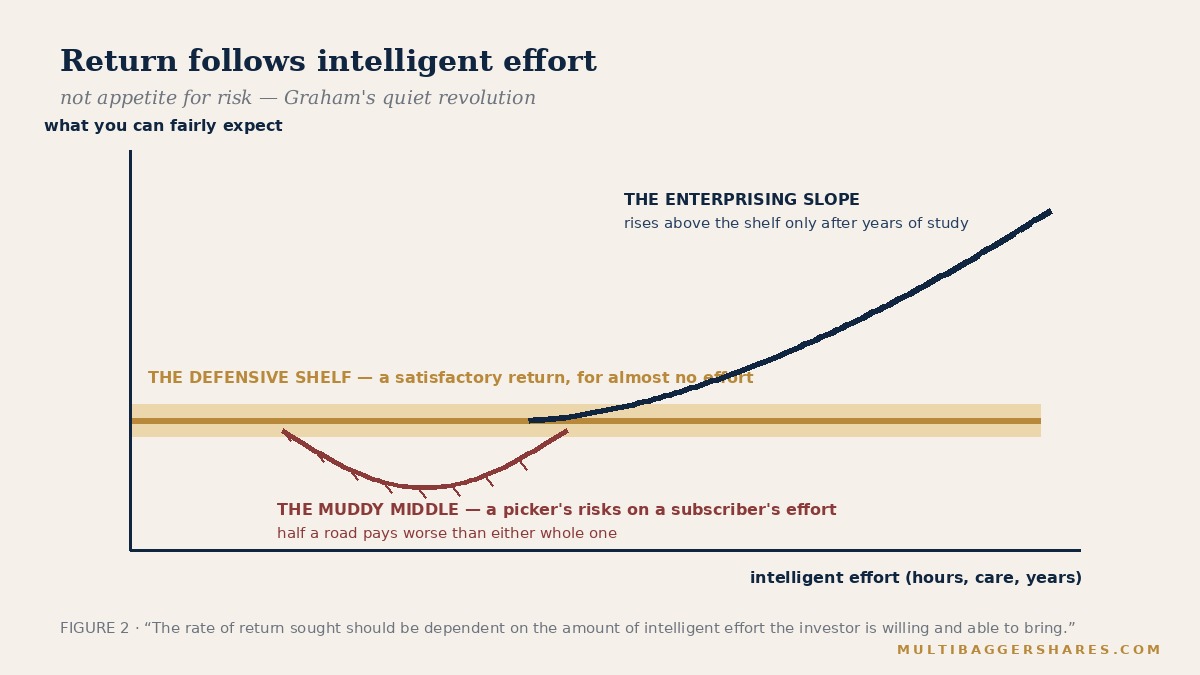
Graham closed his great book with a sentence that every beginner deserves to hear early: “to achieve satisfactory investment results is easier than most people realize; to achieve superior results is harder than it looks.” The satisfactory result is not a consolation prize. It is the honest wage of the defensive road, and it is available to anyone with discipline. The superior result is real too — but it must be earned the way any professional skill is earned, with years of study.
And the defensive road carries a surprising endorsement. Warren Buffett — the most successful enterprising investor alive — wrote to his shareholders in 1993 that “by periodically investing in an index fund, the know-nothing investor can actually outperform most investment professionals.” An index fund is a basket that simply owns all the large companies in a market’s list at once, bought automatically, with no opinions involved. Buffett added, with a smile you can almost hear: “paradoxically, when ‘dumb’ money acknowledges its limitations, it ceases to be dumb.” The defensive investor who admits what she does not know, spreads her money widely across businesses, and stays regular, ends up ahead of most people who are paid to be clever. Knowing your road, it turns out, is itself a form of intelligence.
A real example or two
First, the enterprising road walked honestly. Walter Schloss was one of Graham’s own students, and by worldly measures one of the least glamorous figures in investing history. He worked out of a tiny rented space at a friend’s firm — Buffett joked that the office was “a portion of a closet.” He employed no analysts (professionals hired to study companies), used no computer, and relied on printed sheets of company numbers from a paper service called Value Line. He simply read, filed, and thought, every working day, for decades. When Buffett wrote his famous 1984 essay “The Superinvestors of Graham-and-Doddsville,” he reported Schloss’s record: from 1956 to early 1984 — over twenty-eight years — Schloss’s partnership had compounded at 21.3 percent a year before his fee, 16.1 percent a year for his investors, while the American market index earned 8.4 percent. Those numbers are astonishing, but the real lesson is what they cost. Schloss paid for that extra return with roughly ten thousand quiet working days of time and care. Graham’s toll, paid in full.
Second, the defensive road — chosen, remarkably, by the world’s most famous stock-picker. In his 2013 letter, Buffett revealed the instructions in his own will: the money left for his wife is to be placed about 90 percent in a low-cost index fund and 10 percent in short-term government bonds (loans to the government that can be turned back into cash quickly). Sit with that for a moment. Buffett does not ask his family to imitate him. He asks them to be defensive investors, because the road must fit the traveller, and their lives are meant for other work. If the defensive road is honourable enough for that household, it is honourable enough for yours.
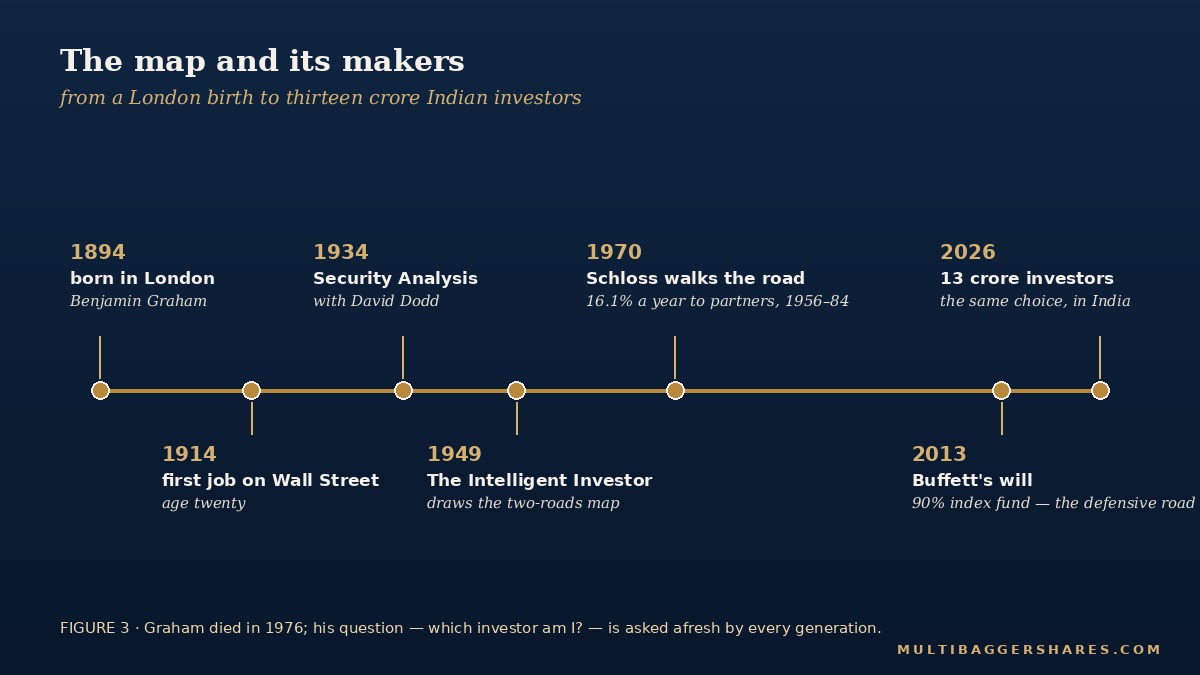
Third, look around our own country. By the middle of 2026, the number of unique registered investors on the National Stock Exchange had crossed thirteen crore. Behind each account is a person with a job, a shop, a farm, a family — a life already full. Most of these thirteen crore, whether they say so or not, are defensive investors by circumstance: they simply do not have Meera’s Sunday mornings to spare for annual reports. There is nothing wrong with that. The trouble begins only when a defensive life wanders onto the enterprising road by accident — a share bought here on a colleague’s whisper, a punt taken there on a glowing headline. That is Rohan’s kitchen. Graham’s map exists so that you never end up there without noticing.
How you can use it
Ask yourself three questions, and write the answers down, because written answers are harder to fool. One: can I give this work several focused hours every week — not this month, but this year and the next and the one after? Two: do I actually enjoy reading about businesses — the way Meera enjoys the mandi — or does the thought feel like homework? Three: have I already done it, quietly, for at least a year, without losing interest? If your honest answers are mostly no, congratulations: you now know your road, which puts you ahead of most of the market. Be a proud defensive investor. Keep the habit steady — a fixed amount, every month, into ownership spread widely across good businesses — ignore forecasts, and judge the result in decades, not weeks.
If your answers are mostly yes, then serve the apprenticeship before you trust yourself with size. Pick one company whose product you use every day. Read its annual report from cover to cover — the first one may take a full weekend, and that is normal. Write one page, in your own plain words, on how the business actually earns its money. Then learn the quality tests one at a time — how much profit the business earns on the money put into it, whether the profit arrives as real cash, how much it owes — the very tests this series of lessons exists to teach. Keep written reasons for everything you buy, the way a shopkeeper keeps accounts. Give yourself years, not months. The enterprising road is a craft, and crafts forgive slow learners far more readily than they forgive impatient ones.
And remember two mercies in Graham’s map. You may walk both roads at once in an honest way: many sensible people keep most of their savings on the defensive road and study the enterprising craft with a small, strictly limited portion — Meera’s kitchen, Asha’s tiffin, one household. And you may change roads as life changes: a busy decade can make a defensive investor of a cook, and a free one can do the reverse. The only rule Graham would beg you to keep is this: never stand in the middle by accident. Choose your road with open eyes, pay its true toll, and collect its honest reward.
Key takeaways
- Benjamin Graham divided all investors into two respectable families: the defensive investor, who wants safety and freedom from bother, and the enterprising investor, whose defining trait is the willingness to devote time and care.
- The dividing line is not courage, intelligence, or wealth — it is honest effort; Graham taught that returns follow the amount of intelligent effort you bring, not the amount of risk you swallow.
- The defensive road is not defeat: a steady, widely spread, low-effort plan earns a satisfactory return that beats most part-time stock-pickers — which is why even Buffett chose it for his own family’s future.
- The enterprising road is real but expensive in time: Walter Schloss earned his extraordinary record with nearly three decades of quiet daily reading, not with tips or thrills.
- The only losing position is the muddy middle — taking a stock-picker’s risks with a subscriber’s preparation — so decide, in writing, which investor you are before you decide anything else.
— Manish Goel · multibaggershares.com
Disclaimer: This article is for educational purposes only and does not constitute financial advice. The author may hold positions in stocks mentioned. Always conduct your own research and consult a SEBI-registered financial advisor before making investment decisions. Stock market investments are subject to market risks. Past performance does not guarantee future returns.