The Moat Made of Distance: Why the Cost of a Truck Protects Some Businesses
Once in 2–3 Years, I Find Just One. I’ve Found It Again.
August 23, 2026
The Shopkeeper’s Cut: What a Company Pays to Sit on the Shelf, and What That Tells You
August 25, 2026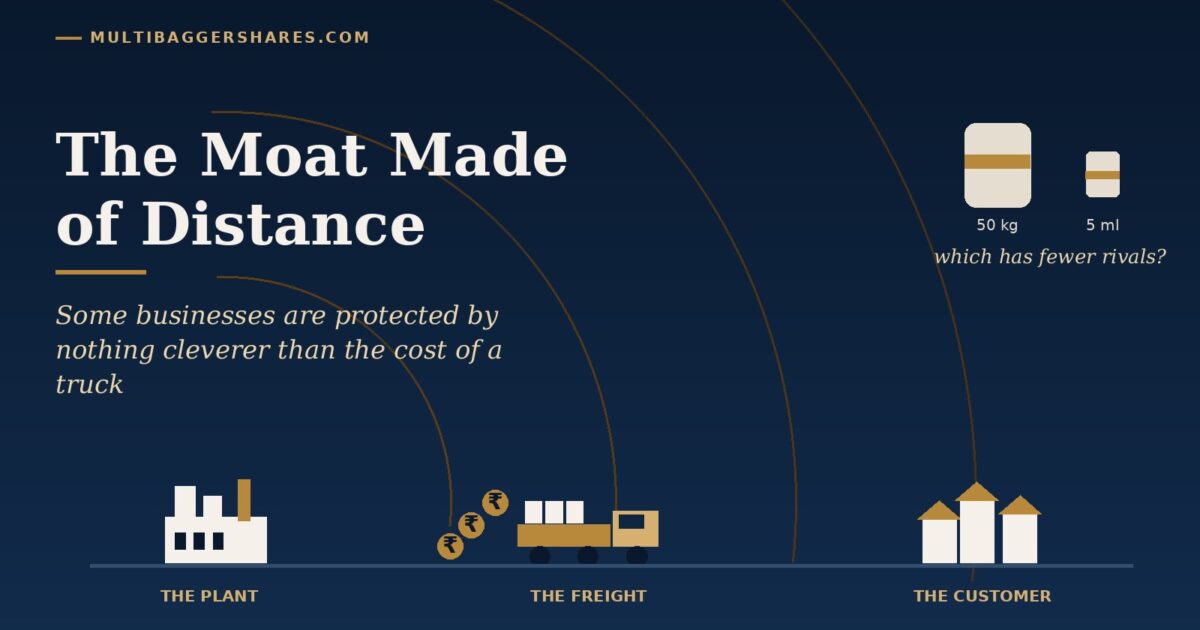
Value Investing Basics
Stand at the counter of any hardware shop in India and you can usually see two things at once. Leaning against the wall, a fifty-kilo sack of cement, priced somewhere around three hundred and eighty rupees. On a hook beside the till, a small sachet of shampoo, priced at two.
Now a question. Which of those two products belongs to a business with fewer competitors?
Almost everyone guesses the shampoo, because shampoo feels like the branded, sophisticated, advertisement-on-television business, and cement feels like grey powder that anybody could make. The answer is the cement. And the reason has nothing whatsoever to do with brand, or technology, or how clever the management is. The reason is that the sack is heavy and the sachet is light.
That sentence contains one of the most useful and least discussed ideas in business quality. Some businesses are protected by a fence they did not build, cannot lose, and never have to pay to maintain. The fence is made of freight. Today, let us learn to see it — and, just as importantly, to see the four things it cannot do.
Value per kilo: the number nobody prints
Start with a single idea, and everything else follows from it. Every physical product has a value-to-weight ratio (how much a kilogram of the thing is worth). Nobody prints this number, but you can work it out in ten seconds from any company’s results.
Take India’s largest cement maker, UltraTech Cement, purely as a descriptive example. For the financial year that ended in March 2026 it reported consolidated revenue of about ₹88,512 crore, and it sold 145.0 million tonnes of grey cement in India. Divide the one by the other and you get roughly ₹6,000 for every tonne. That is the author’s own rough arithmetic, and it is only approximate because the revenue figure also includes other businesses — but the order of magnitude is what matters. Six thousand rupees a tonne is about six rupees a kilo.
Six rupees a kilo. Now hold that against the other things a factory in India might make. A kilo of packaged shampoo is worth a few hundred rupees. A kilo of finished medicine, several thousand. A kilo of smartphones, a few lakh. A kilo of gold jewellery, close to a crore. Cement, brick, sand, gravel and ready-mixed concrete sit at the very bottom of this ladder, and that position is the whole story.
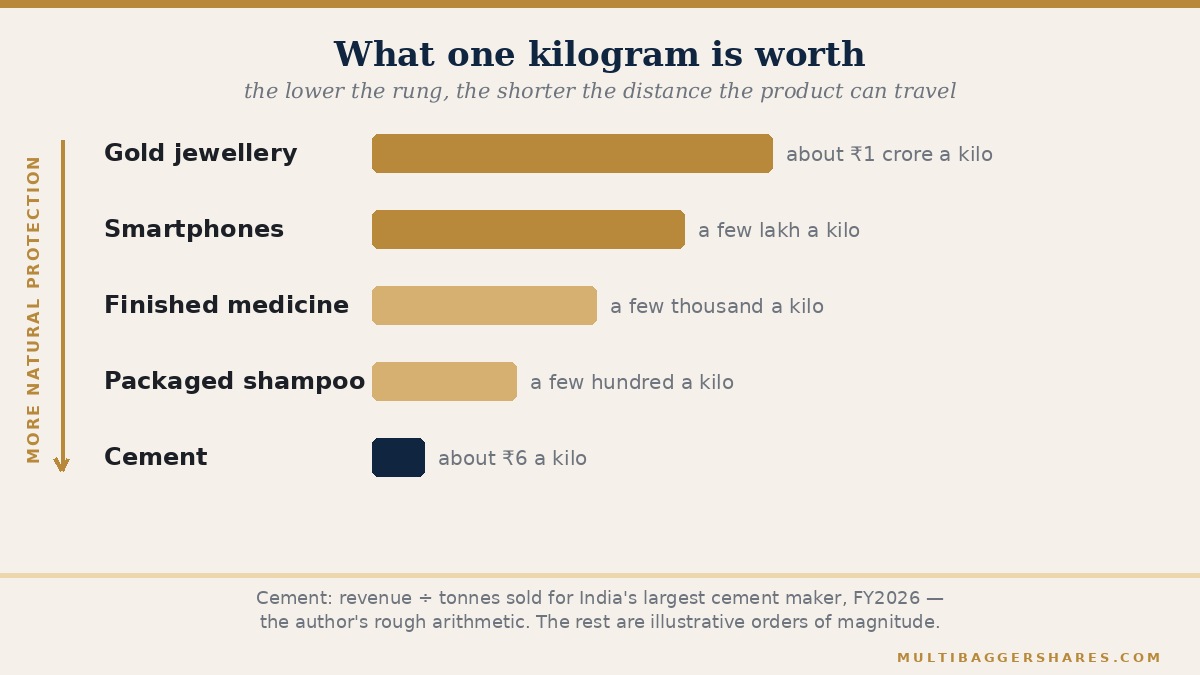
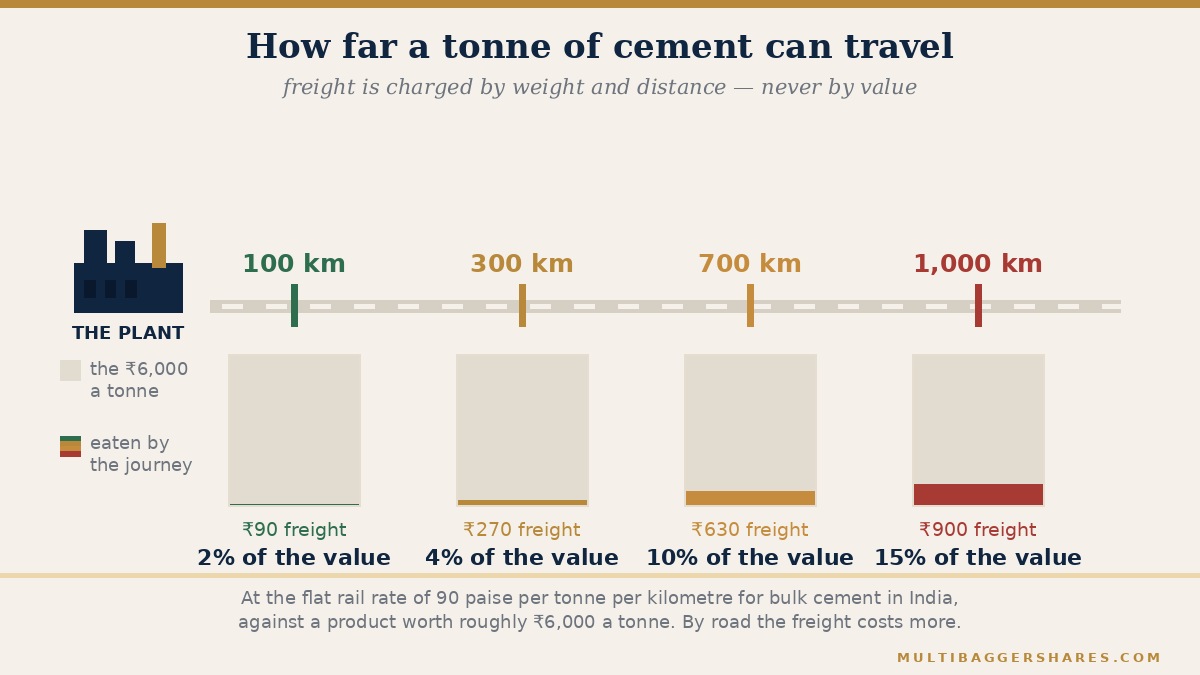
Here is the rule, and it is worth writing down. The lower a product’s value per kilo, the shorter the distance it can travel before the journey costs more than the thing itself. Freight is charged by weight and by distance. It is not charged by value. The lorry does not care whether it is carrying cement or diamonds; it charges for the tonne and the kilometre either way.
Why the truck builds a fence
Put a number on it. In India, the railways have set a flat freight rate of ninety paise per tonne per kilometre for bulk cement — that is the cheap way to move it. On that rate, carrying one tonne of cement a thousand kilometres costs about nine hundred rupees. Against a product worth roughly six thousand rupees a tonne, you have just handed about fifteen paise of every rupee to the journey, using the cheapest mode available. By road it costs considerably more, and roughly three quarters of India’s cement actually moves by road.
You can see the same thing from the company’s side of the ledger. Indian cement makers report a freight and forwarding cost of roughly ₹1,100 to ₹1,250 for every tonne they sell — Shree Cement, which is known in the industry for tight logistics, has been reported at around ₹1,145 a tonne against an average lead distance (the average distance from plant to customer) of about 446 kilometres. Industry bodies put logistics at somewhere between a fifth and a quarter of the total cost of cement in India, and the average haul at around three hundred kilometres.
Sit with what that means competitively. Suppose there is an excellent, superbly managed cement plant seven hundred kilometres from your town. It cannot sell to your town. Not because it is barred, and not because its cement is worse — but because by the time its cement arrives, the freight has eaten the margin. To compete on price in your market it would have to give its entire profit to a lorry driver. So it does not bother. It sells in its own region instead, where the same arithmetic protects it.
That is a real, durable competitive advantage, and notice its strange properties. It requires no advertising budget. It cannot be reverse-engineered. No new technology takes it away. It exists because of physics and geography, and it will be there in thirty years. This is what people are reaching for when they use the word moat (a durable advantage that keeps competitors from taking your business away). Most moats are built. This one is simply there.
The rock pit in Brooklyn
The finest short explanation of this ever written belongs to Peter Lynch, the American fund manager whose book One Up on Wall Street is still one of the best first books an investor can read. In chapter eight, listing the features of what he only half-jokingly calls the perfect company, Lynch says he would rather own a local rock pit than a film studio — because the film studio competes with every other film studio, and the rock pit competes with nobody. “If you’ve got the only gravel pit in Brooklyn,” he writes, “you’ve got a virtual monopoly, plus the added protection of the unpopularity of rock pits.”
Lynch then makes the point that turns this from a curiosity into an investing idea. The owner of such a pit, he says, can raise prices right up to just below the level at which the owner of the next rock pit might begin to think about competing with him — and the neighbour is doing exactly the same arithmetic from the other side. Two quarries, forty kilometres apart, each quietly pricing to the edge of the other’s freight cost, neither one ever attacking. That is not a truce anybody negotiated. It is just what heavy, cheap products do.
If you think this sounds like folksy exaggeration, read what a large listed company says about it in a legal filing, where exaggeration is expensive. Vulcan Materials is one of America’s biggest producers of construction aggregates — crushed stone, sand and gravel. Its annual report to the American regulator states, in plain language, that aggregates have a high weight-to-price ratio which makes transportation expensive relative to the cost of the material, and that in most cases aggregates are therefore produced near where they are used, so that the transportation cost does not exceed the product cost. Roughly four fifths of its shipments go by lorry, straight from the pit to the customer.
Read that again and notice what it really is. That is a company telling its own shareholders, in a document it can be sued over, that the shape of its industry is set by the cost of a truck.
Where else this fence shows up
Once you have the idea, you start seeing it everywhere, and it is a genuinely useful thing to be able to see.
Ready-mixed concrete is the extreme case, because concrete is not only heavy, it is also perishable. For decades the American standard for ready-mixed concrete required the load to be discharged within ninety minutes of mixing beginning; a revision in 2021 replaced that fixed rule with a limit agreed between the buyer and the producer. Either way, a lorry of wet concrete is a clock. That is why concrete plants sit inside the cities they serve rather than in a cheap industrial belt three hundred kilometres away.
Bricks, sand, gravel and glass bottles are the same family: heavy, cheap, and mostly air or earth. Bottled water and soft drinks too — when you ship a crate of soft drink you are mainly shipping water, which is why bottling is a regional business almost everywhere in the world.
And now the mirror image, which is just as important. Consider where distance protects nobody. The aviation industry’s own figures show that air cargo carries something like a third of world trade measured by value, but under one per cent of it measured by volume. Read that sentence carefully: the goods worth flying are a tiny sliver of what the world moves, and an enormous share of what the world pays. Medicines, electronics, precision components, jewellery. If your product is valuable enough to put on an aeroplane, then so is your competitor’s, and your competitor may be on another continent. High value per kilo means a global fight.
So here is a small, practical test you can run on any manufacturer in about two minutes. Open the profit and loss account and find the freight, or freight-and-forwarding, expense. Divide it by revenue. If it comes to fifteen or twenty per cent, you are almost certainly looking at a business with a geography — a home region where it is hard to attack. If it comes to one or two per cent, the business has no such shelter, and whatever protects it must be something else entirely: a brand, a patent, a habit, a switching cost. Neither answer is good or bad. But they are completely different businesses, and they should not be judged by the same yardstick.
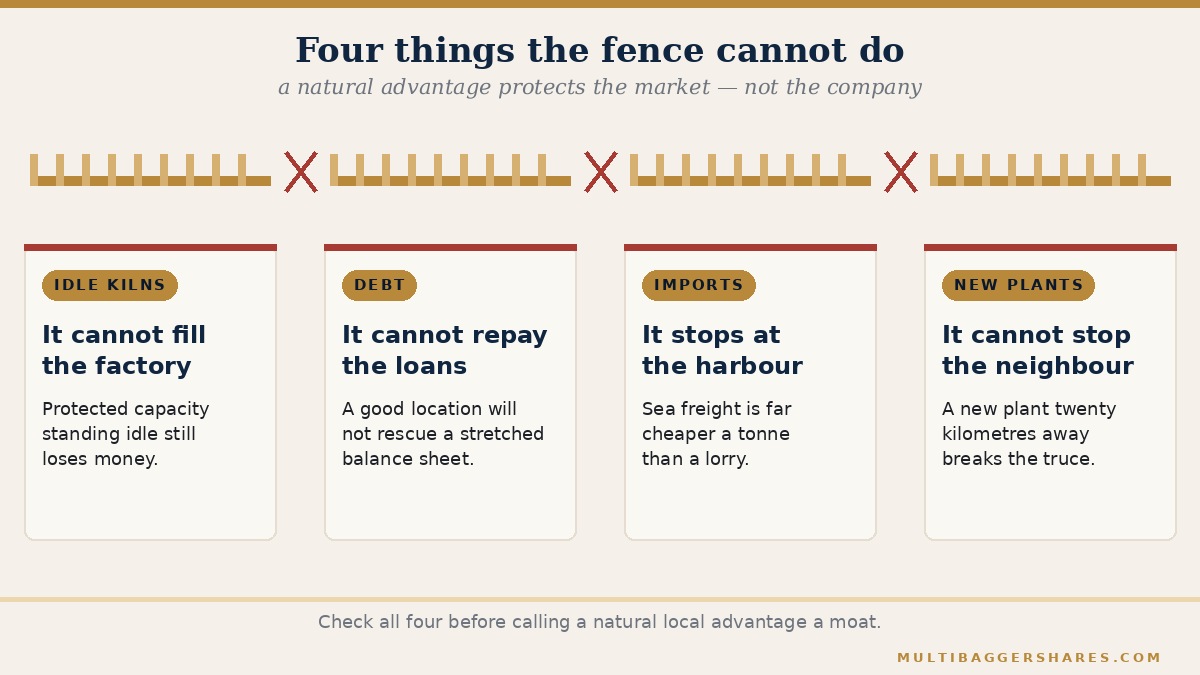
Four things this fence cannot do
Now the discipline. A natural advantage is genuinely valuable and it is also routinely oversold, so let us be honest about its limits. There are four, and each one has flattened real investors.
One: it cannot fill your factory. A fence keeps rivals out of your market; it does not put customers into it. India’s cement industry has installed capacity of roughly 660 to 670 million tonnes a year and has been running at something like seventy per cent of it. That means a great deal of protected capacity standing idle. A plant with an unassailable local position and a third of its kilns cold is a plant losing money in a very well-defended way.
Two: it cannot pay your loans. This is the one that hurts. Binani Cement had real plants — about 6.25 million tonnes of annual capacity in Rajasthan — in a real region, making a product nobody could economically truck in from far away. It still ended up in India’s insolvency process. Its creditors approved UltraTech’s resolution plan of about ₹7,900 crore in May 2018, and the appellate tribunal cleared that plan in November 2018. The geography was fine. The borrowing was not. A moat protects the business; it does not protect the shareholders of a business that has borrowed too much.
Three: it can be breached from the water. Freight economics are set by the cheapest available mode, and shipping by sea is dramatically cheaper per tonne-kilometre than a lorry. A fence drawn by trucks stops at the harbour. Coastal markets can be, and are, supplied by ship from far away. Before you decide a producer is safe, look at a map and ask whether its customers live near a port.
Four: it cannot stop the neighbour. Distance keeps out the competitor three hundred kilometres away. It does nothing at all about somebody building a brand-new plant twenty kilometres away. So the question is never only “who competes here today?” It is also “what is under construction here?” Regional protection plus a wave of new regional capacity equals a price war among neighbours, and everybody in the region loses at once.
You can actually watch this fence in a price list. Because Indian cement is a regional business, its price is a regional price: trade trackers put the national range at roughly ₹340 to ₹430 for a fifty-kilo bag, with southern markets typically running some twenty to forty rupees a bag above the north and centre. A single product, one country, a spread that persists year after year. That spread is the moat made of distance, printed in rupees.
Five questions to ask
None of this needs a spreadsheet model. Five questions, all answerable from a company’s own annual report and investor presentation, both free on its website.
What is one kilo of this worth? Revenue divided by tonnes sold. If the answer is in single-digit or low double-digit rupees, freight is going to shape this industry. If it is in thousands, freight is irrelevant and you must look elsewhere for the protection.
What share of revenue goes on freight? Find the line, do the division, and compare it with two or three competitors. A company that consistently spends less than its peers to move the same product has found something real: better plant locations, a railway siding, a shorter haul.
How far does the product actually travel? Many companies disclose their average lead distance in kilometres. A falling lead distance usually means the company is selling closer to home, which is generally the more profitable place to sell.
Does the company own the raw material where it stands? For this kind of business the asset is often not the factory but the deposit under it — the limestone, the stone, the sand — together with the permission to dig it and its distance from customers. A factory can be rebuilt anywhere. A quarry cannot be moved.
What is being built nearby, and can anything arrive by ship? The two ways this fence gets breached. Both are usually discussed openly in industry reports and in the company’s own commentary, if you read to the end.
There is something quietly reassuring about this whole idea. The very best protections in business are often not clever at all. They are boring, physical and obvious, and they were sitting in plain sight in a sack of cement leaning against a shop wall. You did not need a model to find it. You only needed to notice how much the sack weighed, and how little it cost.
Key takeaways
- Work out value per kilo — revenue divided by tonnes sold. It is the single fastest way to know whether freight will shape an industry.
- The lower the value per kilo, the shorter the distance the product can travel, and the more the nearest producer is naturally protected. Cement at roughly ₹6 a kilo travels a few hundred kilometres; medicine travels the world.
- Read the freight line in the profit and loss account as a percentage of revenue. Fifteen to twenty per cent usually means the business has a home region. One or two per cent means it does not, and its protection must come from somewhere else.
- For these businesses the real asset is often the deposit and the location, not the plant. A quarry cannot be moved; a factory can be built anywhere.
- A natural fence cannot fill idle capacity, cannot repay debt, stops at the harbour, and does nothing about a new plant next door. Check all four before calling it a moat.
— Manish Goel · multibaggershares.com
Disclaimer: This article is for educational purposes only and does not constitute financial advice. The author may hold positions in stocks mentioned. Always conduct your own research and consult a SEBI-registered financial advisor before making investment decisions. Stock market investments are subject to market risks. Past performance does not guarantee future returns.