Work Already Won: How to Read a Company’s Order Book

The Second Act: How to Tell Whether a Business Can Win More Than Once
August 22, 2026Once in 2–3 Years, I Find Just One. I’ve Found It Again.
August 23, 2026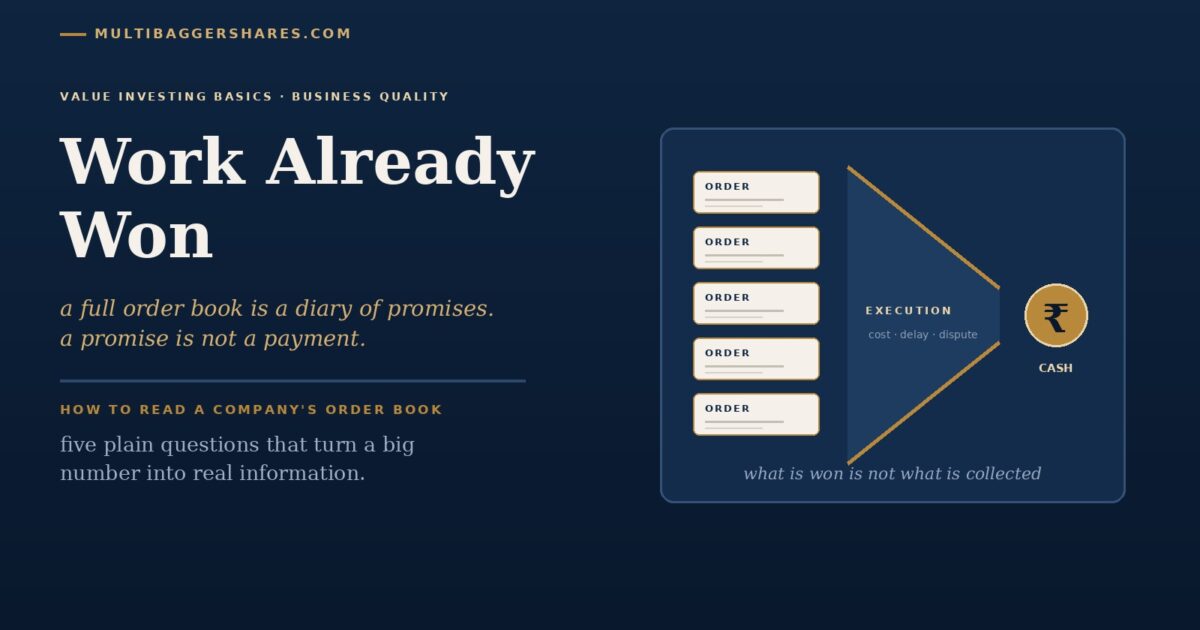
Value Investing Basics
There is a tailor in the market near my old office. Last winter I went in to get two shirts made and he turned his diary around to show me. Every page for the next four months had names on it. Wedding orders, office shirts, a school’s uniform contract. He was, by any reading of that diary, a man with plenty of work.
So here is the question I want you to sit with for a moment. Does a full diary make the tailor a prosperous man?
You already know the answer is it depends, and you already know what it depends on. Can he actually stitch that many shirts in four months, or has he promised more than his two machines can deliver? Did he quote those prices before cloth got dearer? Will the school pay him, and when? And how many of those names are people who booked in a hurry and will quietly never come back? The diary is not the answer. The diary is the beginning of four better questions.
A listed company’s order book is exactly that diary, written at a scale of thousands of crores. And because it is a big, impressive, easily-headlined number, it is one of the most misread figures in Indian markets. Today let us learn to read it properly.
What an order book actually is
An order book — also called a backlog, or an order backlog — is the total value of contracts a company has signed but not yet completed. The word companies use for completing them is execution (doing the work and raising the bill for it). So the order book is work already won and not yet executed.
It only exists in businesses where customers order in advance and the work takes time. Construction and engineering companies have one. So do defence suppliers, shipbuilders, railway contractors, machinery makers, and companies that build power plants. A soap company has no order book at all — you walk into a shop, you pick up the soap, the sale happens in the same second. The longer the gap between “yes, do it” and “here is your money”, the more an order book matters.
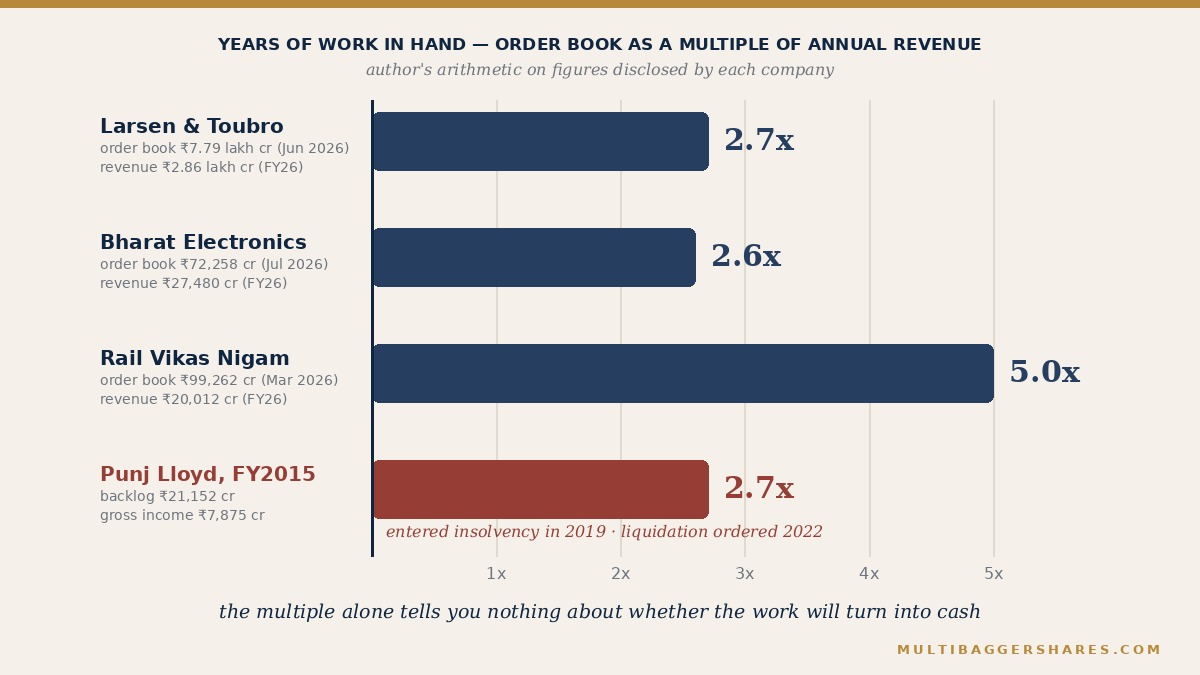
The numbers get large. Larsen & Toubro reported a consolidated order book of about ₹7,78,954 crore as on 30 June 2026. Its revenue for the full year ended March 2026 was about ₹2,85,874 crore. Divide one by the other — that is my arithmetic, not the company’s — and the backlog is roughly 2.7 times a year’s sales. Bharat Electronics reported an order book of about ₹72,258 crore as on 1 July 2026 against annual revenue of about ₹27,480 crore, again roughly 2.6 times. Rail Vikas Nigam reported an order book of about ₹99,262 crore as on 31 March 2026 against annual revenue of about ₹20,012 crore — close to five times a year’s sales.
Hold on to that last one, because it is the honest way to read the number. Not “ninety-nine thousand crore”, which means nothing to a human being. But about five years of work at the current pace. That you can picture.
Why an order book is worth something
Three real things. First, visibility. In investing this word simply means how far ahead you can see. A soap company has to win its customers again every single month. A company with three years of signed contracts already knows, roughly, what it will be doing in 2029. That is a calmer, more predictable business, and predictability is one of the quiet ingredients of quality.
Second, somebody chose them. Big contracts are not handed out casually. To even be allowed to bid, a company usually has to clear what is called prequalification (proving it has done similar work before, has the machines, and has the financial strength to survive the project). A growing order book is a running scoreboard of a company being picked, again and again, by customers who checked first. That is genuine evidence of standing in an industry.
Third, it lets the business plan. Buy steel in bulk. Hire and train people a year ahead. Keep the factory running at a steady rate instead of lurching. Planning is not glamorous, but it is where margins are quietly made.
There is a simple ratio that captures the direction of travel: the book-to-bill ratio. It is orders received during a period divided by revenue billed during that same period. Above 1 means the company is winning work faster than it is finishing it, so the backlog is growing. Below 1 means it is eating into the backlog faster than it is refilling it. Larsen & Toubro reported order inflow of about ₹4,35,590 crore in the year to March 2026 against revenue of about ₹2,85,874 crore — a book-to-bill of roughly 1.5, again my own arithmetic. Rail Vikas Nigam, in the same year, reported standalone order inflow of about ₹5,875 crore against revenue of about ₹20,012 crore — well under 1. Two companies, both with enormous backlogs, moving in opposite directions. The size of the pile told you nothing about that. The flow did.
Four ways a big number can fool you
One: it is not audited, and no two companies have to count it the same way. This surprises people. The headline order book is almost never a line in the audited financial results. It lives in a press release, an investor presentation, or an answer on a conference call. There are genuine rules around the edges — a company must inform the stock exchanges when it bags or loses a materially large contract, and the accounting standard on revenue from customer contracts, Ind AS 115, requires an annual disclosure of the value of work it has committed to but not yet delivered. But the quarterly “order book” figure you read in the newspaper is a self-defined number. One company may count a letter of intent; another may wait for a signed contract. Compare two companies’ backlogs and you may be comparing two different things.
Two: some of it may never happen. Orders get delayed, stalled, foreclosed, or quietly abandoned. The industry has a gentle phrase for this — slow-moving orders — and the good companies tell you the number. In 2023, Larsen & Toubro told analysts that slow-moving projects were under 1% of its order book. Bharat Heavy Electricals, for several years in the middle of the last decade, carried slow-moving orders of roughly 40–45% of its book; in one year it reclassified three projects worth about ₹35,600 crore, around 30% of the whole book, out of that bucket. Same word, wildly different meaning. Always look for the footnote.
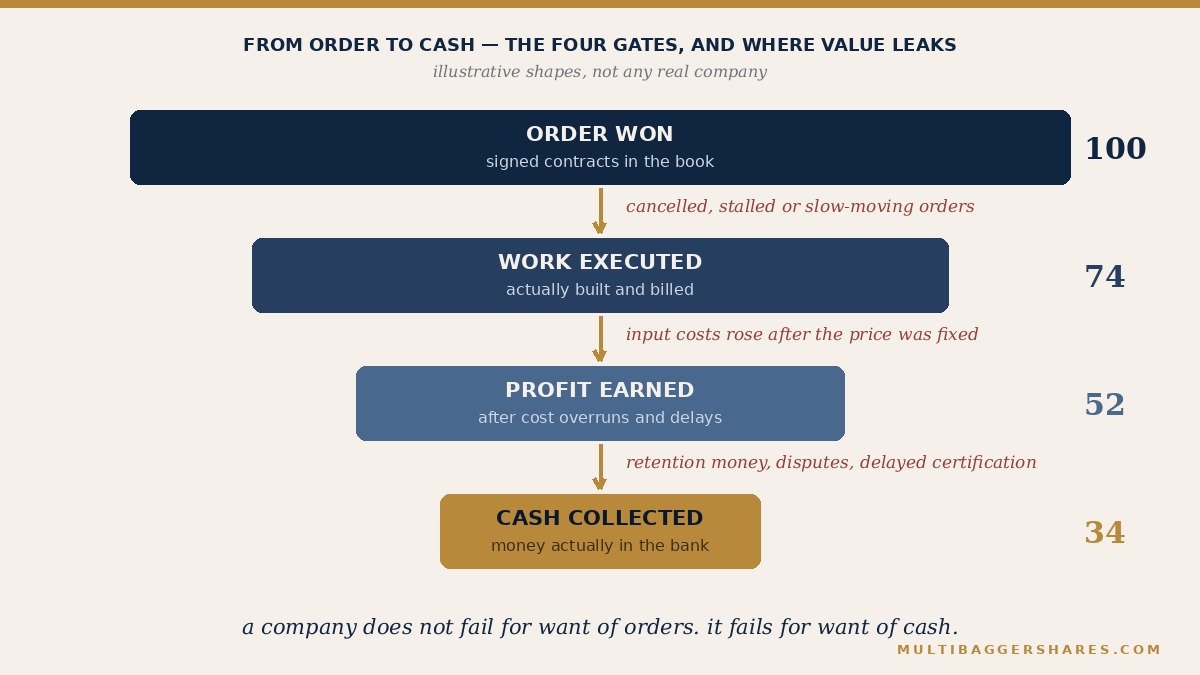
Three: winning work is not the same as earning money. A contract signed in 2024 at a fixed price still has to be built with steel and cement bought in 2027. If input costs run ahead of the price agreed, the order is real and the profit is not. This is why a rising order book alongside a falling operating margin is a combination worth pausing on rather than celebrating. Rail Vikas Nigam, for instance, reported an operating margin in its March 2026 quarter of about 5.8%, down from about 10.4% a year earlier, while still holding that five-year backlog.
Four: earning is not the same as collecting. In long projects the company spends first and gets paid in instalments, often after inspections, certifications and disputes. Work can be completed, revenue can be booked in the accounts, profit can be reported — and the money can sit in the customer’s office for two years. Meanwhile wages and interest have to be paid every month in actual rupees. This is the gap that kills companies, and it is invisible if you only read the order book.
Two companies that had plenty of work and still failed
History teaches this better than any argument I can make. Both of the following are described here purely as documented episodes from the past.
Punj Lloyd was, for a while, one of India’s best-known engineering and construction names, with projects across Asia, West Asia and Africa. In September 2014 it announced an order backlog of about ₹24,679 crore. For the year to March 2015 it reported a backlog of about ₹21,152 crore — against consolidated gross income of about ₹7,875 crore and a consolidated loss of about ₹1,141 crore. Read that again: roughly three years of work in hand, and the company was losing money while holding it.
Its own backlog statements told the story to anyone who read the small print. In its statement for the quarter ended September 2018, the company reported a backlog of about ₹7,026 crore — and carried a footnote excluding orders in Libya of about ₹6,845 crore “which are not seeing traction”. Almost as much work sitting frozen as the entire backlog it was reporting. Five months later, on 8 March 2019, the National Company Law Tribunal in New Delhi admitted the company into insolvency on a petition by ICICI Bank over a default of about ₹854 crore. Total debt at that point was reported at around ₹6,000 crore. Liquidation was ordered on 27 May 2022, and admitted claims from creditors eventually crossed ₹13,380 crore.
IVRCL, a large infrastructure contractor, was admitted into insolvency in February 2018 and ordered into liquidation in July 2019, owing more than ₹14,000 crore. What makes it useful here is a detail reported later that year: even while in liquidation, the company was still carrying an order book of about ₹4,000 crore. The work was there. The company was not.
Neither business collapsed for want of orders. Both collapsed because the distance between an order and a rupee in the bank turned out to be longer than their balance sheets could survive. Warren Buffett put the underlying point about as plainly as it can be put: cash is to a business as oxygen is to an individual — never thought about when it is present, the only thing in mind when it is absent.
How you can use this — five questions
You do not need software or a finance degree for any of this. You need the company’s investor presentation, its annual report, and about twenty minutes.
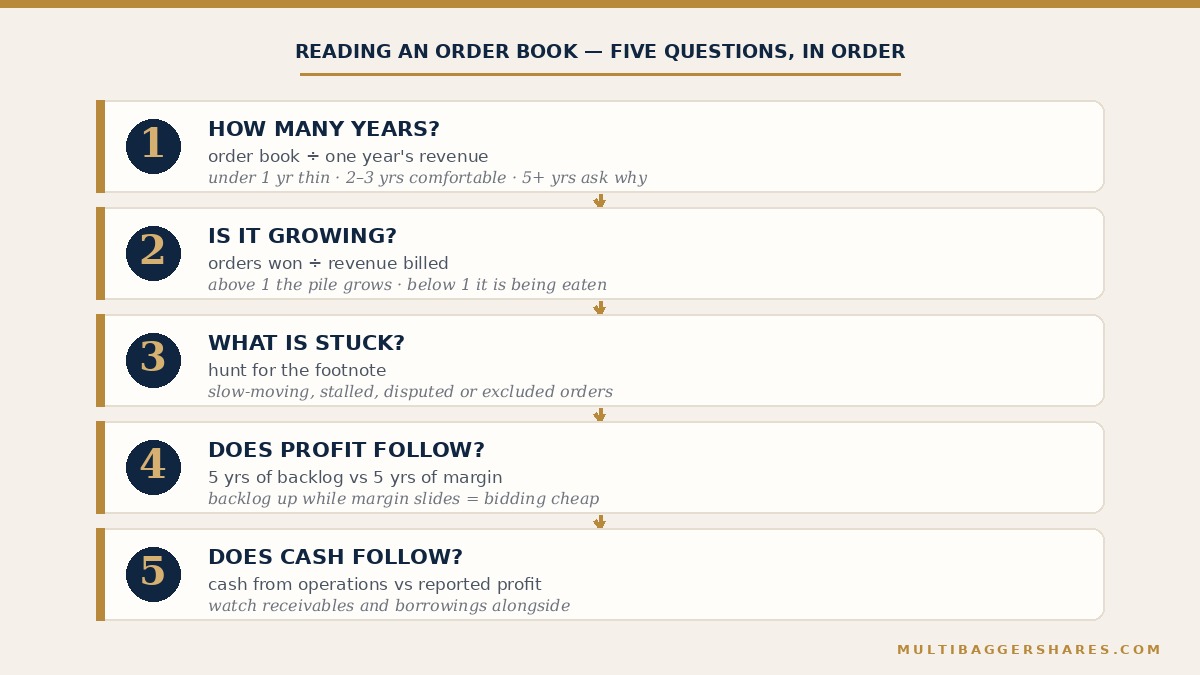
1. How many years of work is it? Divide the order book by the last full year’s revenue. Under one year is thin. Two to three years is comfortable in most project businesses. Above four or five, ask a different question — not “how wonderful” but “why is it taking so long to execute?” A backlog that grows because work is stuck is not strength.
2. Is it growing or shrinking? Write down the order book from the same quarter last year and compare. Then look at orders won during the year against revenue billed — the book-to-bill ratio. A backlog can look enormous for two more years while the inflow behind it has already dried up. The flow tells you the future; the pile tells you the past.
3. What is excluded, and what is stuck? Hunt for the footnote. Does the company disclose slow-moving or non-moving orders? Has it excluded a geography, a client, a disputed project? A company that volunteers this number is showing you something about its own honesty, and that is worth more than the number itself.
4. Does the profit follow the work? Put five years of order book next to five years of operating margin. If the backlog keeps climbing while margins keep sliding, the company may be buying growth by bidding cheap. Winning at any price is not a skill; it is an auction.
5. Does the cash follow the profit? This is the one that matters most and the one almost nobody checks. Compare cash from operations with reported profit over five years, and watch receivables (money billed but not yet received) and debt. If profits rise while cash from operations stays flat and borrowing climbs, the order book is being converted into paperwork rather than money.
Where do you find all this? The order book is usually on slide three or four of the quarterly investor presentation on the company’s website. Slow-moving orders and margin commentary usually come out in the earnings call transcript, which most companies now publish. And large individual contract wins and cancellations are filed with the stock exchanges, so they are on the exchange websites too, free.
A full diary is a good thing. It is a genuine signal that a business has been trusted with work. But it is a promise, and a promise is not a payment. The whole craft of reading an order book is learning to walk the number all the way from the signature to the bank account, and noticing where it leaks on the way.
Key takeaways
- An order book is signed work not yet done. Translate the crores into years by dividing it by one year’s revenue — “three years of work” is a thought you can actually use.
- The headline order book is not audited and is not defined the same way by every company. Treat it as a claim, not as a measured fact.
- Watch the flow, not just the pile: orders won during the year against revenue billed. A huge backlog with collapsing new orders is a business in decline that still looks busy.
- Look for what is excluded — slow-moving, stalled or disputed orders. A company that discloses its stuck orders is telling you something good about itself.
- Follow the money the whole way: order to revenue, revenue to profit, profit to cash. Companies do not fail for want of orders; they fail for want of cash.
— Manish Goel · multibaggershares.com
Disclaimer: This article is for educational purposes only and does not constitute financial advice. The author may hold positions in stocks mentioned. Always conduct your own research and consult a SEBI-registered financial advisor before making investment decisions. Stock market investments are subject to market risks. Past performance does not guarantee future returns.