The Second Act: How to Tell Whether a Business Can Win More Than Once

The Revolving Door: What Staff Turnover Quietly Tells You About the Quality of a Business
August 21, 2026
Work Already Won: How to Read a Company’s Order Book
August 23, 2026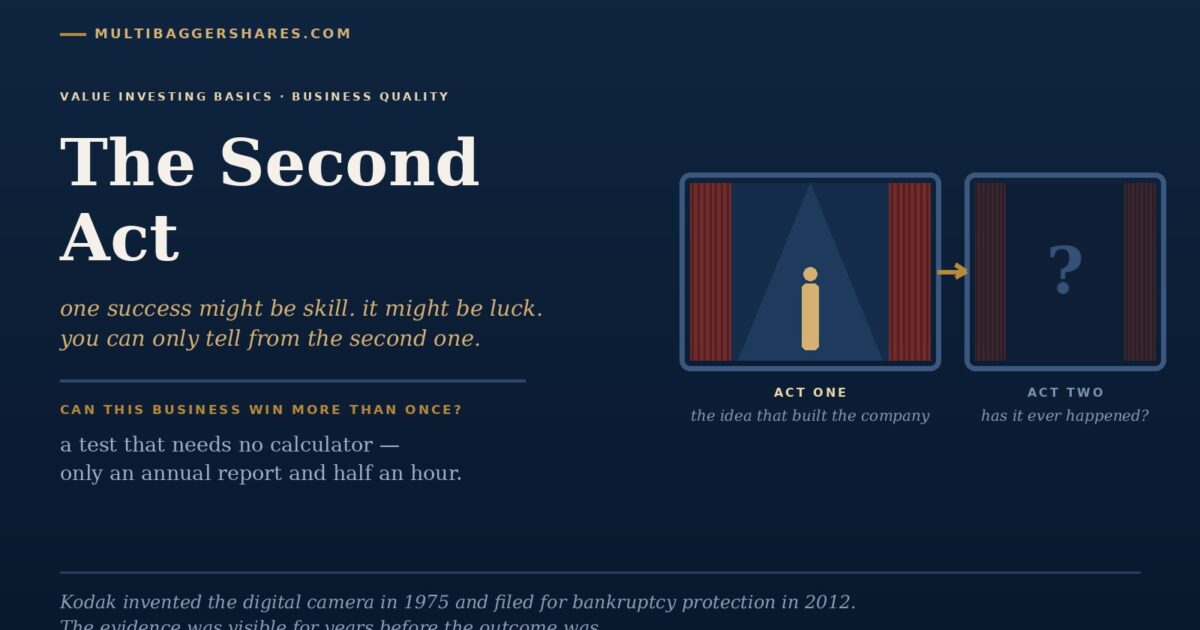
Value Investing Basics
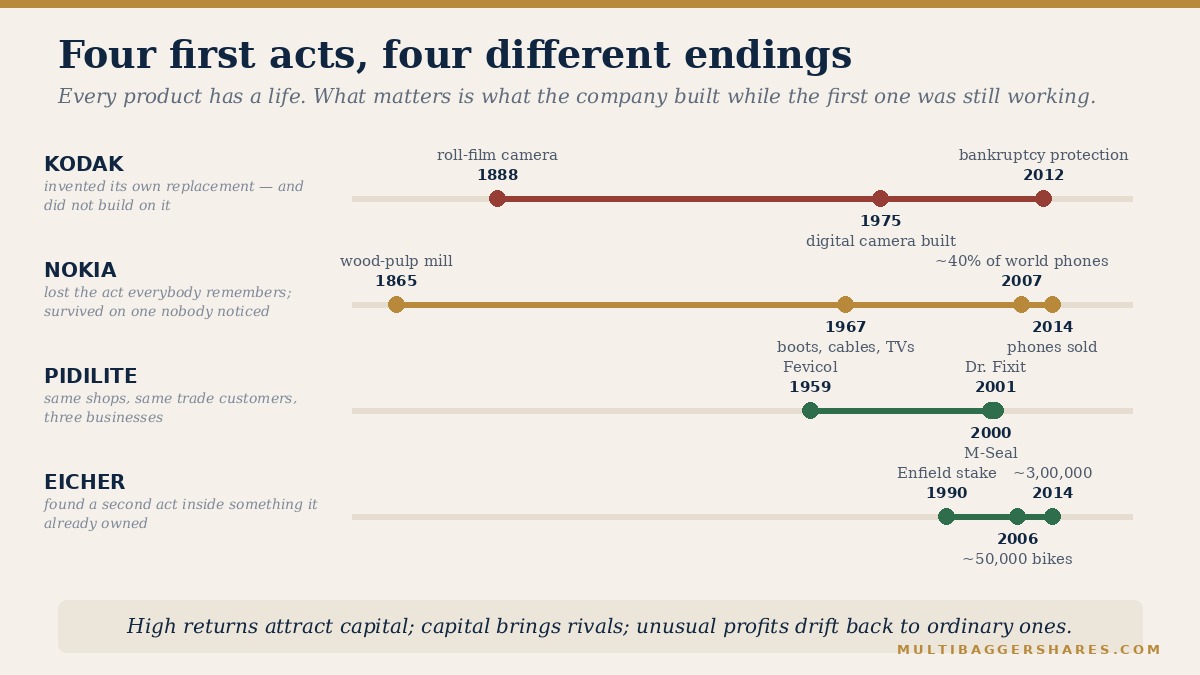
In December 1975, a young engineer at Kodak carried a strange object into a room in Rochester,
New York. It was about the size of a toaster, it weighed nearly four kilograms, and it took a
black-and-white photograph roughly one hundred pixels wide. Taking the picture was quick. Saving it to
a cassette tape took twenty-three seconds. The engineer’s name was Steven Sasson, and he had just built
the first digital camera.
He showed it to the people who ran the company. They were polite. They were also unconvinced.
Kodak at that moment was one of the most admired businesses on earth, and it was admired for one thing:
film. Film was a beautiful business. You sold the camera cheaply, and then the customer came back every
few weeks, for decades, to buy more film and pay to have it developed. Nobody in that room wanted to
hear that the future involved looking at your photographs on a television screen.
On 19 January 2012, Kodak filed for bankruptcy protection in a court in New York. The company
had invented the thing that replaced it, thirty-seven years earlier, and could not bring itself to build
a second business around it.
I tell this story not because it is about technology. I tell it because it is the clearest
example I know of a question that almost no beginner asks, and that experienced investors ask
constantly: has this company ever proved it can win more than once? Call it the second-act test. It
costs nothing to run, needs no calculator, and it quietly separates two kinds of business that look
identical on a page of accounts.
What a second act actually means
Almost every good company you can name was built on one idea that worked. One product, one
service, one route to the customer. That first idea is the whole reason the business exists, and for a
long while it is also the whole reason the business earns money. There is nothing wrong with this. It is
how businesses start.
The second-act question is simply this: since that first success, has the company deliberately
built anything else that also worked? Not announced. Not attempted. Actually built — something that now
brings in a meaningful share of what the company sells, run by the same management, funded out of the
same profits.
Notice how narrow that is. It is not asking whether the company is growing. A company can grow
for years by selling more of the same one thing to more people, and that is genuinely good news while
it lasts. It is not asking whether the company is busy; there is always a press release. It is asking
whether this particular group of people, working inside this particular culture, has demonstrated the
ability to do the difficult thing twice.
You can see the whole idea in a shop on any Indian street. A kirana store opens, sells groceries,
and does well because the owner is honest and the location is good. That is the first act. Ten years
later, some of those shops have added a mobile-recharge counter, then a payments machine, then
home delivery for the flats behind the market — each one built on the same customers walking past the
same door. Others are still selling exactly what they sold on the first day. Both may be perfectly
sound businesses today. Only one of them has shown you what it will do when the market moves.
The reason this matters is uncomfortable and simple. The first success may have been skill. It
may equally have been luck — the right product meeting the right decade. You cannot tell from one
success which of the two it was. You can only tell from the second one. A business that has repeated
the trick has given you evidence. A business that has not is still, honestly, an open question, however
impressive the first act looks.
Why the first act always ends
Every product has a life. Sometimes it is short and obvious, like a fashion. Sometimes it is
so long that it feels permanent, like film photography felt in 1975. But the end always arrives, from
one of three directions. Tastes change. Technology changes. Or — most commonly and least dramatically —
competitors arrive, copy what you did, and compete the profit away.
That third one is worth sitting with, because it is the ordinary fate of almost every good
idea. When a business earns unusually high returns (returns on capital simply means how much profit the
business makes on every rupee the owners have put into it — like the interest rate on a fixed deposit,
but for a whole company), that success is a signal to everybody else. Capital arrives. New factories
get built. Prices come down. The unusual return drifts back towards the ordinary one. Economists call
this mean reversion; the rest of us call it competition, and it is relentless.
A company with only one act is therefore running a race against a clock it cannot see. It may
have five years left, or fifty. A company that has built a second act has done something rarer: it has
converted profits from an ageing idea into an asset with a fresh clock of its own. Terry Smith, the
British fund manager who founded Fundsmith, puts this at the centre of how he defines growth. In the
fund’s owner’s manual he writes that it is not enough for a company to earn a high return; his
definition of growth is that a company “must also be able to reinvest at least a portion of their excess
cash flow back into the business to grow while generating a high return on the cash thus reinvested.”
Strip away the fund-manager vocabulary and it is the same test: can this business find good new places
to put its own money?
Which is why the second act is not really about products at all. It is about a habit. Deciding
to spend today’s comfortable profits on something uncertain, when nobody is forcing you to, is an
unnatural act for any organisation. The businesses that manage it usually manage it repeatedly, because
it is a way of behaving rather than a single decision. The businesses that cannot usually cannot at all,
right up to the day the first act runs out.
Three companies, three answers
Consider Pidilite, a name most Indians know without knowing the company. Its first act was
Fevicol, the white adhesive introduced in 1959, which became so thoroughly the default that carpenters
across the country use the brand name as the word for glue. That alone would have made a fine business
for a generation. But in 2000 the company bought the adhesives and sealants business that owned M-Seal,
the epoxy compound used to stop a leaking tap, and from 2001 it built Dr. Fixit, a range of
waterproofing products for buildings. Different products, different customers, different problems —
sold through the same shops, to the same painters and plumbers and contractors, by a company that
already knew how to reach them. That is what a genuine second act tends to look like: not a leap into
the unknown, but a step sideways onto ground the company already stands on.
Consider Eicher, which for most of its life made tractors and trucks. Between 1990 and 1994 it
took control of Enfield India, the maker of a heavy, old-fashioned motorcycle that was then a slowly
dying business. For years very little happened. Then the company decided to rebuild the motorcycle
rather than manage its decline — and Royal Enfield went from selling roughly fifty thousand motorcycles
a year in the mid-2000s to about three lakh in 2014. A truck company had found a second act inside
something it already owned and had almost forgotten it owned.
And consider Nokia, which is the most instructive of the three because it contains both
answers. Nokia’s history is a long chain of second acts: it began in 1865 as a wood-pulp mill in Finland, and over the
following century the group came to make rubber boots, cables and televisions before it ever made a
telephone. By
the end of 2007 it was selling around forty per cent of all the mobile phones in the world. Then the
smartphone arrived, the first act ended with startling speed, and in April 2014 Nokia completed the sale
of essentially its entire phone business to Microsoft. What is easy to miss is what happened next: the
company did not disappear. It fell back on the network equipment business it had also been building —
the unglamorous machinery that carries phone calls — and is still there today. Nokia lost the act
everybody remembers, and survived on the one nobody noticed.
Kodak, Pidilite, Eicher, Nokia. Four companies, one question, four different answers. And in
every case, the evidence was visible years before the outcome was.
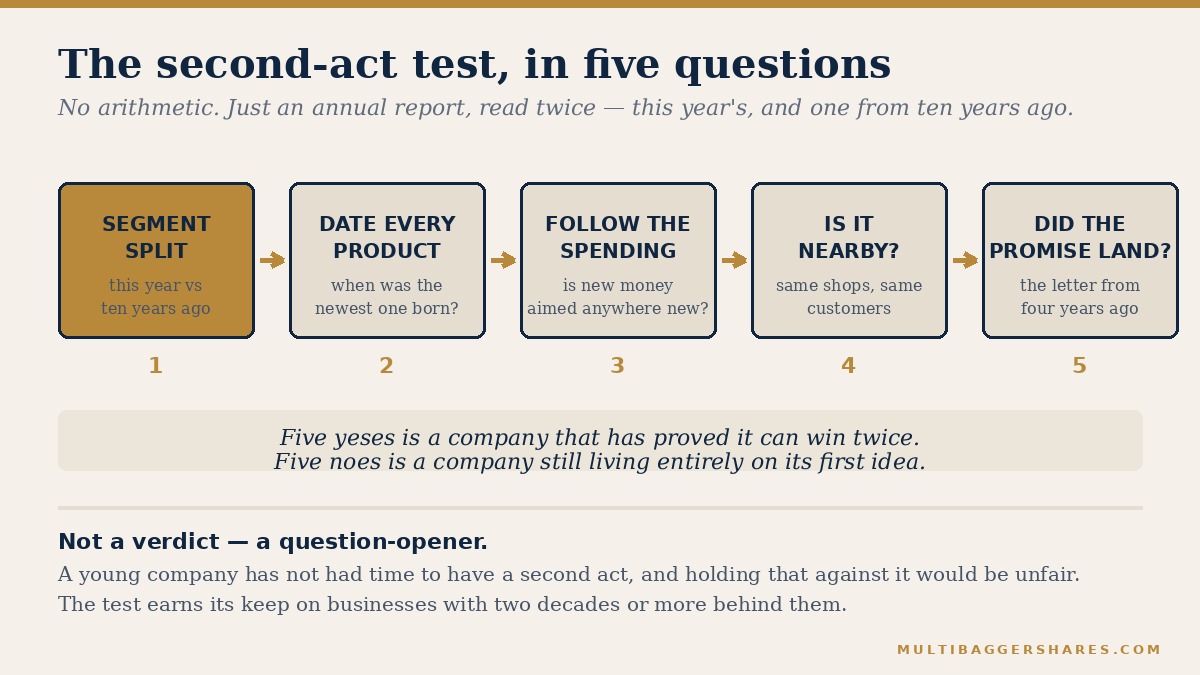
Five checks you can run yourself
None of this requires a spreadsheet. It requires an annual report — the document every listed
company publishes each year, free, on its own website — and about half an hour.
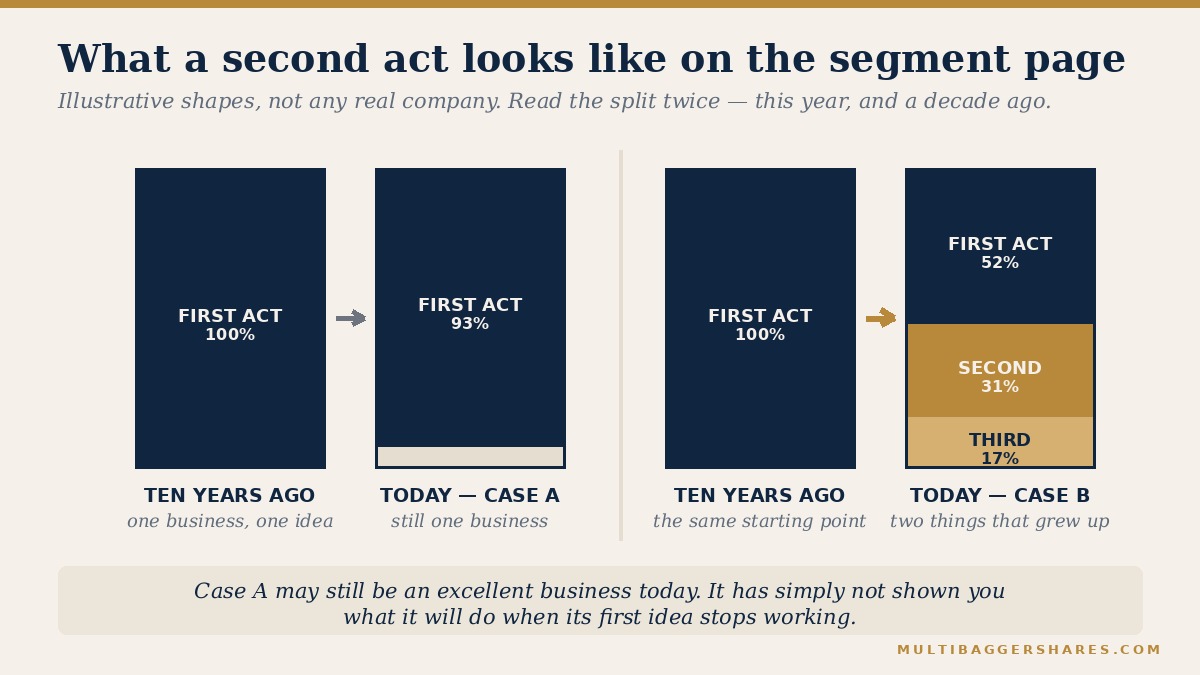
One: find the revenue split. Somewhere in the annual report is a section
called segment information, which breaks the company’s sales into its main businesses. Read it for the
current year and for a year five or ten years ago. If the split looks the same, the company is still
living entirely on its first act. If a segment exists now that barely existed then, someone built
something.
Two: ask how old the newest thing is. List the products or services that
matter today, and next to each write the year it was launched or acquired. If every meaningful item on
the list is older than the youngest person in the office, you have learned something important, and it
is not a small thing.
Three: watch where the money goes. A company that intends to build a second
act has to spend on it — on new plants, new acquisitions, or research. You do not need to analyse those
numbers; you only need to notice whether they exist and whether they are pointed at anything new, which
management will usually describe in plain words in the management discussion section.
Four: check whether the second act is nearby. The successful ones almost
always use something the company already has — the same shops, the same customers, the same factories,
the same reputation. A cement company opening a chain of restaurants is not a second act; it is a change
of subject. Peter Lynch had a blunt name for that kind of wandering, and the record of such adventures
is poor.
Do this on two companies in the same industry and the difference is usually obvious within
twenty minutes. One annual report will describe the same business it described a decade ago, in slightly
warmer language. The other will contain a section that did not exist ten years ago, with real numbers
under it. You have not calculated anything. You have simply read carefully, which is most of what this
work actually is.
Five: read last year’s promises. Find the chairman’s letter from three or
four years ago and see what new business was promised. Then look at today’s numbers and ask whether it
arrived. This is the single most revealing half-hour available to an ordinary investor, and almost
nobody spends it.
Where this test can mislead you
Two cautions, and they matter. The first is that a young company has not had time to have a
second act, and holding that against it would be unfair. A business that is eight years old and doing
one thing extremely well is not failing a test; it is simply not old enough to sit it. The test is most
useful on companies with two decades or more behind them.
The second is that new things are not automatically good things. A company that launches
something every year and quietly closes it every third year is not passing this test — it is failing a
different one. What you are looking for is not activity. It is a second business that grew up, stayed,
and now stands on its own feet. One of those is worth more than a decade of announcements.
And there is a version of this you can use far away from any stock market. When you meet
someone who has done one impressive thing, you cannot yet tell whether they are skilful or fortunate.
When you meet someone who has done two unrelated impressive things, you are looking at something much
closer to evidence. Businesses are the same. The first act tells you what happened. The second act tells
you who they are.
Key takeaways
- Almost every good company was built on one idea that worked. The second-act test asks a narrower
question: since then, has it deliberately built anything else that also worked and is still standing? - One success cannot tell you whether a company was skilful or lucky — only the second one can. Until
then, the quality of the management is an open question, however impressive the first act looks. - Every first act ends eventually, usually not through drama but through competition: high returns
attract capital, capital brings rivals, and unusual profits drift back towards ordinary ones. - The second acts that work are almost always nearby — using the same shops, customers, factories or
reputation. A company wandering into an unrelated business is changing the subject, not repeating the
trick. - You can run the whole test from a free annual report: compare the revenue split with ten years ago,
date every product, see where new money is being spent, and check whether old promises actually
arrived.
— Manish Goel · multibaggershares.com
Disclaimer: This article is for educational purposes only and does not constitute financial advice. The author may hold positions in stocks mentioned. Always conduct your own research and consult a SEBI-registered financial advisor before making investment decisions. Stock market investments are subject to market risks. Past performance does not guarantee future returns.