The Revolving Door: What Staff Turnover Quietly Tells You About the Quality of a Business

The Same Shop, One Year Later: How to Tell Real Growth From Just Opening More Doors
August 20, 2026
The Second Act: How to Tell Whether a Business Can Win More Than Once
August 22, 2026
Value Investing Basics
There is a small restaurant near where I live that I have been going to for about nine years.
The man who brings the water still remembers that I do not want ice. He knows the table I like. When my
mother visits, he asks after her by name. Nobody trained him to do any of that. He simply stayed long
enough to learn it.
Two streets away there is a restaurant that is, on paper, the better business. Brighter lights,
a bigger menu, a smarter fit-out, a landlord who is charging them more because the location deserves it.
I have eaten there perhaps a dozen times. I have never once seen the same waiter twice. Every visit
begins from zero. Every order has to be explained slowly. Something is usually wrong with the bill.
From the pavement, and from a page of financial statements, these two restaurants can look
almost identical. Similar revenue (the total money a business collects from customers before any costs
are taken out), similar rent, similar wages, similar number of chairs. Yet one of them is quietly
accumulating something the other is quietly losing, and after ten years the gap will not be small. What
the first one has is not a secret recipe. It is the same people, still there.
This is a piece of business quality that beginners almost never look for, partly because it
sounds soft and unmeasurable. It is neither. India’s largest listed companies publish the number every
year, and several industries publish it every three months. It has a plain name — staff turnover, or
attrition — and once you know where it lives, you can read it in about ninety seconds.
What the number actually is
Attrition, also called staff turnover or the turnover rate, answers one narrow question: out of
the people who worked here, what share left during the year? If a company began the year with 1,000
employees and 150 of them departed, the turnover rate is roughly 15 per cent. That is the whole
calculation. There is no clever adjustment and no room for interpretation in the arithmetic itself.
Two distinctions do matter, and they are easy to keep straight. The first is between voluntary
and involuntary. Voluntary attrition means the person chose to leave — a better offer, a move to another
city, exhaustion, a manager they could not work for. Involuntary means the company let them go. The two
tell you almost opposite things. A business shedding staff in a bad year is doing something deliberate;
a business whose best people keep resigning is having something done to it. Most companies that publish
a single headline figure are publishing the voluntary one, and will say so in a footnote.
The second distinction is the window. Many Indian companies report on what is called an LTM
basis — last twelve months — which simply means the figure covers the previous year of departures
rather than the last three months multiplied by four. This matters more than it sounds. A quarterly
number bounces around with bonus season, appraisal season and the academic calendar. The twelve-month
version smooths that out, and is the one worth comparing across companies and across years.
One more term you will meet: tenure, which is simply the average length of time people stay.
Turnover and tenure are two views of the same fact. A workplace with 10 per cent turnover is one where
the average person stays about ten years; at 50 per cent, the average stay is nearer two. Sit with that
for a moment, because it is the difference between an institution and a bus stop.
Why the people who leave end up in the profit line
The reason this number belongs in an investor’s hands, rather than only a human-resources
department’s, is that turnover is expensive in ways that never appear as a line item called turnover. It
arrives disguised as other things: weaker margins (the share of each rupee of sales that survives as
profit), slipping delivery dates, a customer who quietly stops renewing.
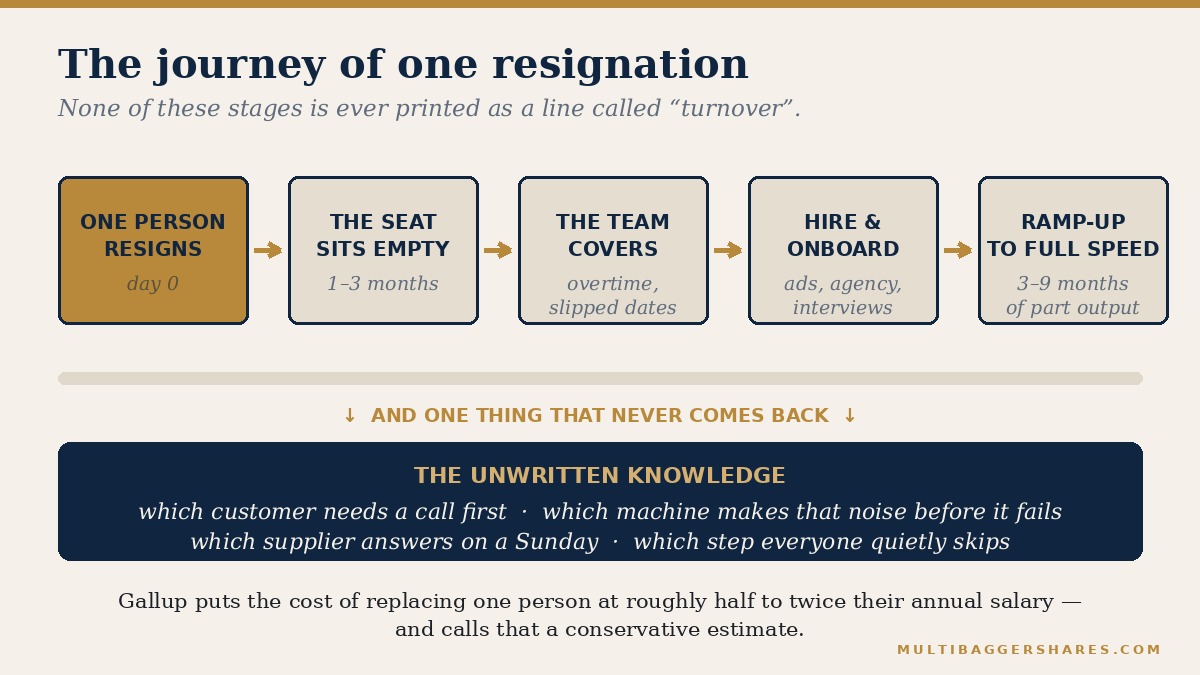
Start with the direct cost, which is the smaller half. When someone leaves you pay to advertise
the role, pay somebody’s time to interview, often pay a recruitment firm, and then pay a salary for
several months to a person who cannot yet do the job at full speed. Gallup, which has studied this
across many industries, puts the total cost of replacing one employee at roughly one-half to two times
that person’s annual salary — and calls even that a conservative estimate. Their split is instructive:
around 40 per cent of salary for a frontline worker, about 80 per cent for a technical professional,
and as much as 200 per cent for a manager or leader. The more judgement a role requires, the more
expensive it is to refill.
Now the larger half, which no accountant can invoice. Think again about the waiter who knows I
do not want ice. Every business runs on thousands of small facts like that — which customer needs a call
before the delivery, which machine makes that noise before it fails, which supplier will answer the
phone on a Sunday, which step of the process everyone quietly skips because it was never necessary. None
of it is written down. It lives in people. When they go, it goes with them, and the company pays to
learn it again.
There is a third cost, and it is the sneakiest. Turnover is contagious. When a good colleague
resigns, everyone who sat near them updates their own estimate of whether this is a good place to be.
Work piles onto whoever remains, which makes staying worse, which makes the next resignation more likely.
Companies rarely have a turnover problem for one year. They have it for three or four, and by the time
it shows up in the numbers you can read, it has usually been true for a while.
Turn all of that around and you can see why the opposite is such a durable advantage. A business
that keeps its people is buying, every year, a workforce that already knows the customers, already knows
the machines, and needs no training budget to do next year’s work. That is a genuine moat — a lasting
advantage that stops rivals from simply copying you — and unlike a factory or a licence, a competitor
cannot acquire it with money. They would have to spend a decade being a better employer, and most
will not.
Two real examples, from two very different worlds
The clearest Indian illustration is the software services industry, because it publishes its
attrition rate every three months and has done so for years. During the hiring frenzy that followed the
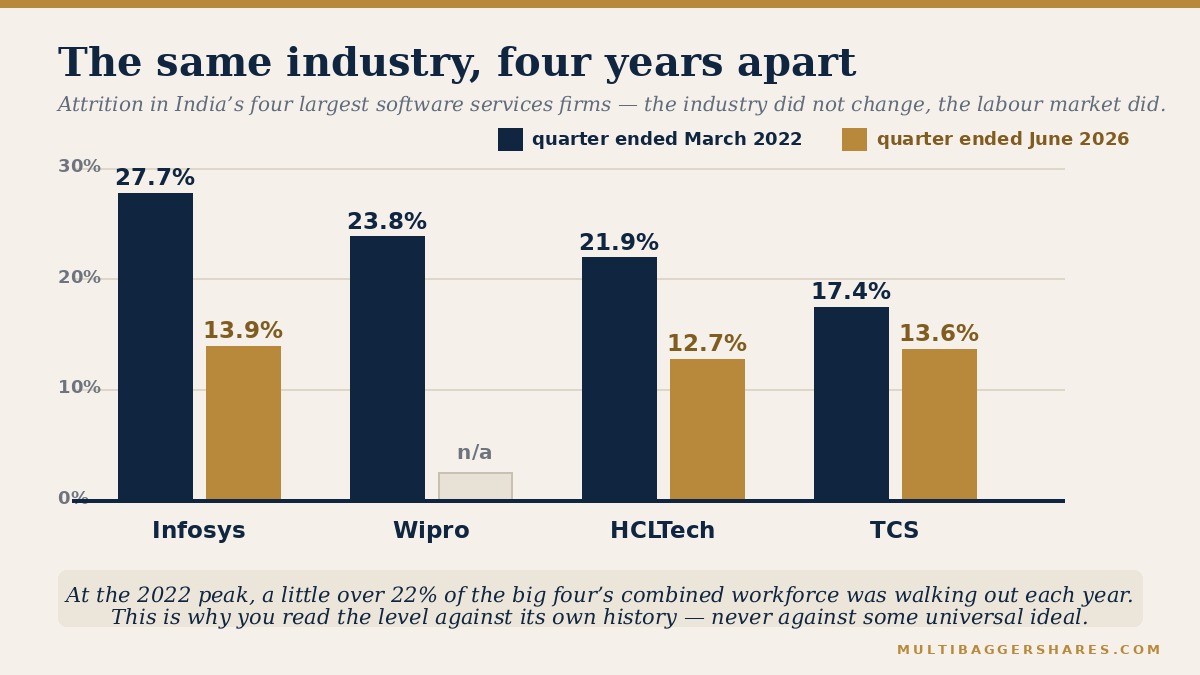
pandemic, the number went somewhere it had never been. In the January–March quarter of 2022, Infosys
reported attrition of 27.7 per cent — the highest among the big four — with Wipro at 23.8 per cent, HCL
Technologies at 21.9 per cent and Tata Consultancy Services lowest at 17.4 per cent. Across the four, a
little over 22 per cent of the workforce was walking out each year.
Picture what 27.7 per cent means on the ground. More than one person in four gone within twelve
months, on projects that take years, for clients who had been promised continuity. The industry’s own
commentary from those quarters is a plain record of what turnover costs: unusually large pay rises to
keep people, benches full of trainees who could not yet be billed, and margins under pressure for
reasons that had nothing to do with demand.
Now look at the same companies four years later. For the quarter ended 30 June 2026, Tata
Consultancy Services reported last-twelve-months attrition in its IT services business of 13.6 per cent
across a workforce of 593,798 people. Infosys reported 13.9 per cent, with headcount of 328,062 — down
by 532 over the quarter, and up by about 4,300 over the year. HCLTech reported 12.7 per cent. The
industry did not become a different industry. The labour market changed, and the number changed with
it, which is precisely why you read it against its own history and against its neighbours rather
than against some universal ideal.
The second example comes from American retailing, an industry where staff turnover of 60 per
cent a year has long been treated as simply the cost of doing business. Costco is the famous exception:
its turnover is widely reported at around 8 per cent, and around 6 per cent among employees who have
been there more than a year. It gets there by paying visibly more than its rivals, promoting warehouse
managers from within, and treating the wage bill as an investment rather than a leak.
This was not an accident of culture, and it is not a small matter of decency. Charlie Munger sat
on Costco’s board from 1997 until his death in November 2023 — more than twenty-five years — and called
the company “one of the most admirable capitalistic institutions in the world”. What he was
admiring was, in large part, this: a business that had worked out that the cheapest employee is not the
one with the lowest wage, but the one you do not have to replace.
The two examples pull in the same direction from opposite ends. In one, a whole industry watched
what happens when people leave too fast. In the other, one company spent thirty years proving what
happens when they do not.
How you can actually use this
Finding the number is the easy part. For India’s thousand largest listed companies, it sits in a
section of the annual report called the Business Responsibility and Sustainability Report — the BRSR —
which every one of them has published each year since the 2022-23 financial year. Look under the
principle dealing with employee wellbeing and you will find turnover rates given as percentages, split
out for permanent employees and permanent workers separately rather than blended into one flattering
average, and usually broken down by gender. Beyond that: quarterly investor presentations in software
and financial services, the management discussion section of the annual report, and the transcript of
the results call, where an analyst will often simply ask.
Reading it well takes a little more care, and four habits cover most of it.
First, never read one year. A single figure tells you almost nothing, because turnover moves
with the whole economy — everybody’s number rose in 2022 and everybody’s fell afterwards. Line up five
years. The shape is the message: falling, flat, or creeping up while the industry’s is coming down.
Second, always compare sideways. Acceptable turnover in software is not acceptable turnover in
cement. Retail and food service run structurally high; heavy manufacturing and utilities run
structurally low. The only comparison that means anything is against direct competitors in the same
year, and against the same company’s own past.
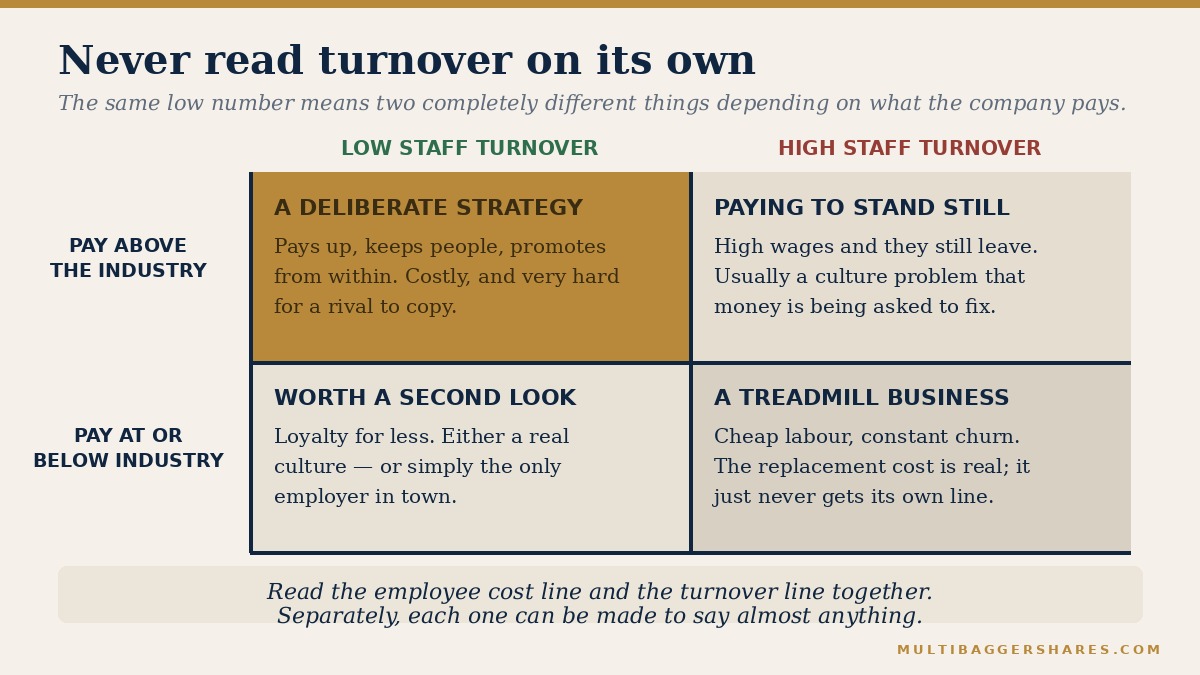
Third, look at the pay alongside it. Two companies with identically low turnover can be entirely
different businesses. One may be paying well and getting loyalty in return. The other may simply be in a
town with no other employer. Read the employee cost line and the turnover line together — they only make
sense as a pair.
Fourth, ask who left, not just how many. Ten per cent turnover that is mostly first-year juniors
is an ordinary business. Ten per cent that includes the head of sales, two plant managers and the
person who ran the largest client relationship is a different company today than it was last year, and
the headline percentage will not tell you the difference. This is not the same as asking who succeeds
the chief executive, which is its own question — this is about the layer beneath, the people who
actually run the thing day to day.
And one honest limit, because every measure has one. Turnover is a lagging signal. It records
what has already happened, not what is about to. It can be low simply because the job market is frozen,
and it can rise for good reasons — a company closing a weak division, or clearing out people who should
have gone years ago. It is a question-opener, not a verdict. When it looks wrong, the useful response is
not a conclusion but a second look: read the pay disclosures, read what management says about it, read
what people who work there say in public.
Which brings us back to the two restaurants. If you could ask their owners only one question
before putting your own money behind either, it would not be about the menu, or the rent, or how many
covers they did last Saturday. It would be simpler and much harder to answer: how many of the people
who worked here a year ago are still here today?
Key takeaways
- Staff turnover — the share of employees who left during the year — is one of the few measures of
business quality that management cannot dress up, and India’s largest listed companies publish it every
year in the BRSR section of the annual report. - Separate voluntary from involuntary departures. People choosing to leave and a company choosing to
let them go are almost opposite signals, even though both raise the same percentage. - Replacing one person costs roughly half to twice their annual salary, and the larger cost is the
unwritten knowledge that walks out with them — it shows up later as weaker margins, not as a line
called turnover. - Read five years, not one, and always compare against direct competitors in the same year. Turnover
moves with the whole economy, so the level matters far less than the direction relative to peers. - Read turnover and employee cost together, and ask who left rather than only how many. Low turnover
bought with good pay and low turnover caused by no alternatives are very different businesses.
— Manish Goel · multibaggershares.com
Disclaimer: This article is for educational purposes only and does not constitute financial advice. The author may hold positions in stocks mentioned. Always conduct your own research and consult a SEBI-registered financial advisor before making investment decisions. Stock market investments are subject to market risks. Past performance does not guarantee future returns.