The Sweet Shop That Took the Box Back: How a Business Behaves When Something Goes Wrong

The Ten-Rupee Part That Stops a Ten-Lakh Machine: How to Judge a Business Nobody Bargains With
September 3, 2026
The Scooter That Sells Twice: What the Second-Hand Price Tells You About a Business
September 5, 2026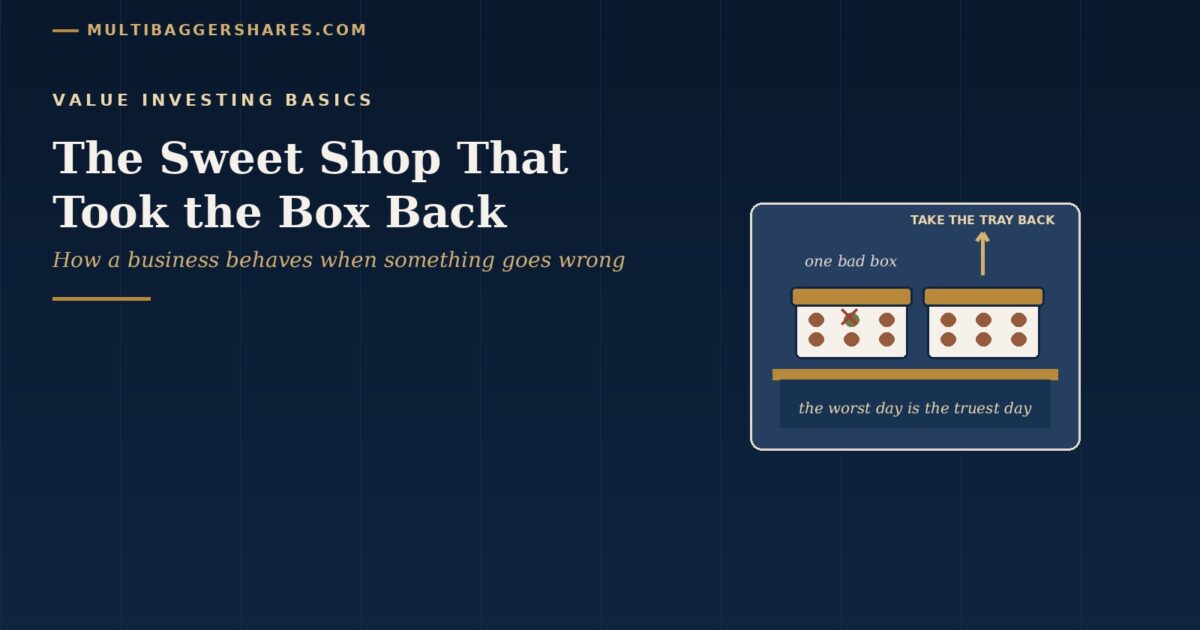
Two sweet shops, one bad box
Picture a small town with two sweet shops on the same street. Both have been there for years. Both make good sweets. One Sunday, a customer walks back into each shop with a box he bought that morning. One of the sweets inside has gone off. It smells wrong. His children will not touch it.
In the first shop, the owner picks up the box, sniffs it, and starts to argue. Perhaps it was kept in the sun. Perhaps the customer is being fussy. After five minutes of back-and-forth, he replaces the one bad piece and says nothing more. The rest of the batch stays on the counter. Other customers keep buying from it all afternoon.
In the second shop, the owner looks at the box, apologises at once, and refunds the whole amount. Then he does something the customer did not ask for. He turns to his helper and says: take the entire tray off the counter, and check this morning’s milk. He loses a day’s sweets. He also loses nothing else.
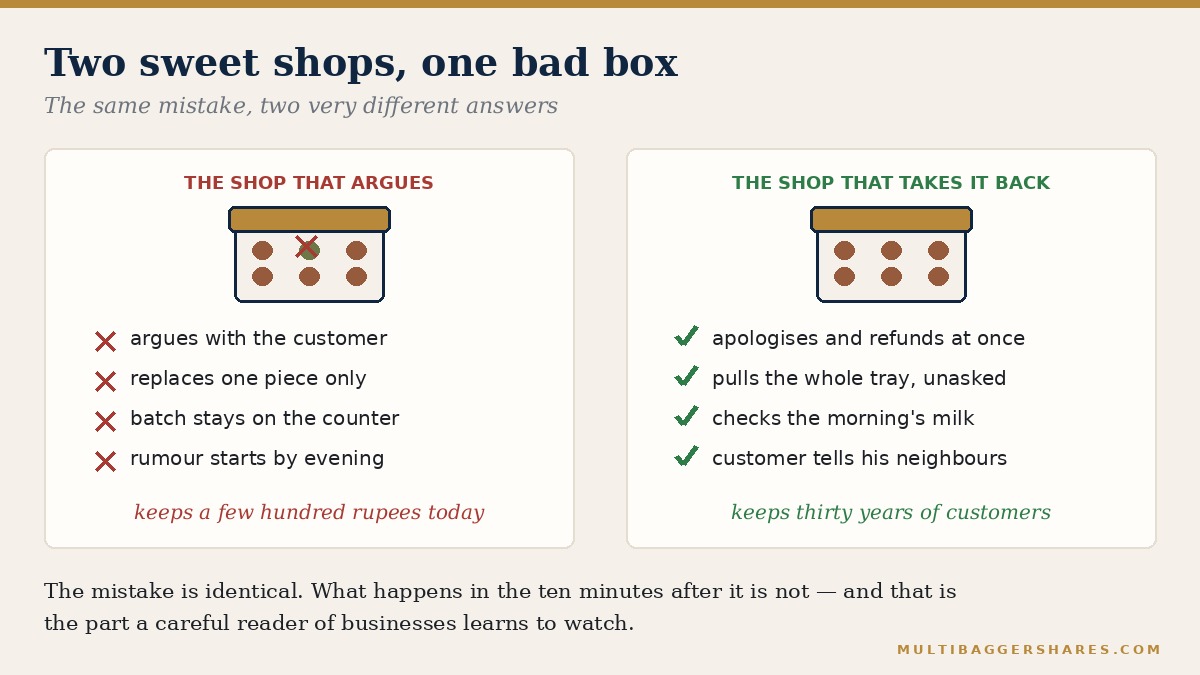
Which shop would you rather own for the next thirty years? Most people answer this in a second, and they answer it correctly. The second shop gave up a few hundred rupees today so that it could keep every customer it has ever earned. The first shop kept a few hundred rupees and quietly started a rumour.
That is the whole idea of this letter. Every business, without exception, will one day sell a bad box. Machines break, suppliers cheat, an employee cuts a corner, a batch goes wrong. The mistake itself tells you very little. What the company does in the days after the mistake tells you almost everything. It is one of the clearest quality signals a beginner can learn to read, and it needs no finance background at all.
What “behaviour after a mistake” really means
Let us be clear about what we are looking at, because it is easy to confuse this with things that only sound similar.
We are not asking whether a company makes mistakes. Every company does. A business that claims it has never had a problem is either very young or not telling you the truth. Nor are we asking whether a company is lucky. Some mistakes are nobody’s fault, like a tampered product or a flood at a supplier’s factory.
We are asking three narrow questions. How quickly did the company admit the problem — before the regulator (the government body that polices that industry) forced it, or after? Who paid for the fix — the company out of its own pocket, or the customer who was left holding the bad box? And what changed afterwards, so that the same mistake does not come back next year?
Notice that none of these questions is about money in the first instance. A recall (when a company pulls a product back from the shops and from customers’ homes because it may be unsafe) costs money today. Denying the problem saves money today. But the customers are watching, and they keep score for a very long time. A company’s reputation (the sum of what its customers believe about it, built up over years of small experiences) is the one asset that never appears on its balance sheet (the page in the annual report that lists what a company owns and what it owes) and is also the hardest to rebuild once it is gone.
Warren Buffett said this more sharply than anyone. On 4 September 1991 — thirty-five years ago today — he sat before a committee of the United States Congress. He had just taken temporary charge of Salomon Brothers, a large Wall Street firm that had been caught breaking the rules in the government bond market. He told the committee what he had told every employee of the firm: “Lose money for the firm, and I will be understanding; lose a shred of reputation for the firm, and I will be ruthless.”
Read that sentence again. A man famous for caring about money was saying, in public, that money was the smaller thing. Losses can be earned back. A lost reputation may never be.
Why it works as a quality signal
There are three reasons why a company’s worst day is such a good window into its quality.
First, it is very hard to fake. Anyone can write a fine paragraph about customer trust in the annual report (the yearly booklet in which a company reports its accounts and explains its year to its owners). Words are cheap. But pulling thirty million bottles off the shelves at your own cost, while your rivals are gleefully filling the empty space, is not cheap. It only happens when the people at the top actually believe what the paragraph says. A crisis is the one moment when a company’s stated values and its real values are forced to meet in public.
Second, it reveals who the company thinks it works for. When something goes wrong, there is always a choice between protecting this quarter’s profit and protecting the customer. A management that chooses the customer, even when it hurts, is telling you how it will behave in a hundred smaller decisions you will never see: how it prices, how it treats suppliers, how honestly it reports its numbers. A management that hides the problem is telling you the same thing about itself, in the other direction.
Third, the market for trust is a market of repeat customers. Think of the kirana shop (the small neighbourhood grocery) that has served the same families for twenty years. It does not survive on any single sale. It survives on the fact that every family comes back every week. A single bad experience, handled badly, can end a twenty-year relationship. A single bad experience, handled well, often makes the relationship stronger than before, because the customer has now seen with his own eyes that the shop will stand behind what it sells. Businesses with repeat customers are among the finest businesses in the world, and this is exactly why.
There is a fourth point, more practical. Companies that own their mistakes usually also fix the underlying cause. Companies that deny their mistakes usually do not, because you cannot fix what you refuse to see. So the honest company has one problem, and the dishonest company has the same problem waiting to happen again.
A real example or two
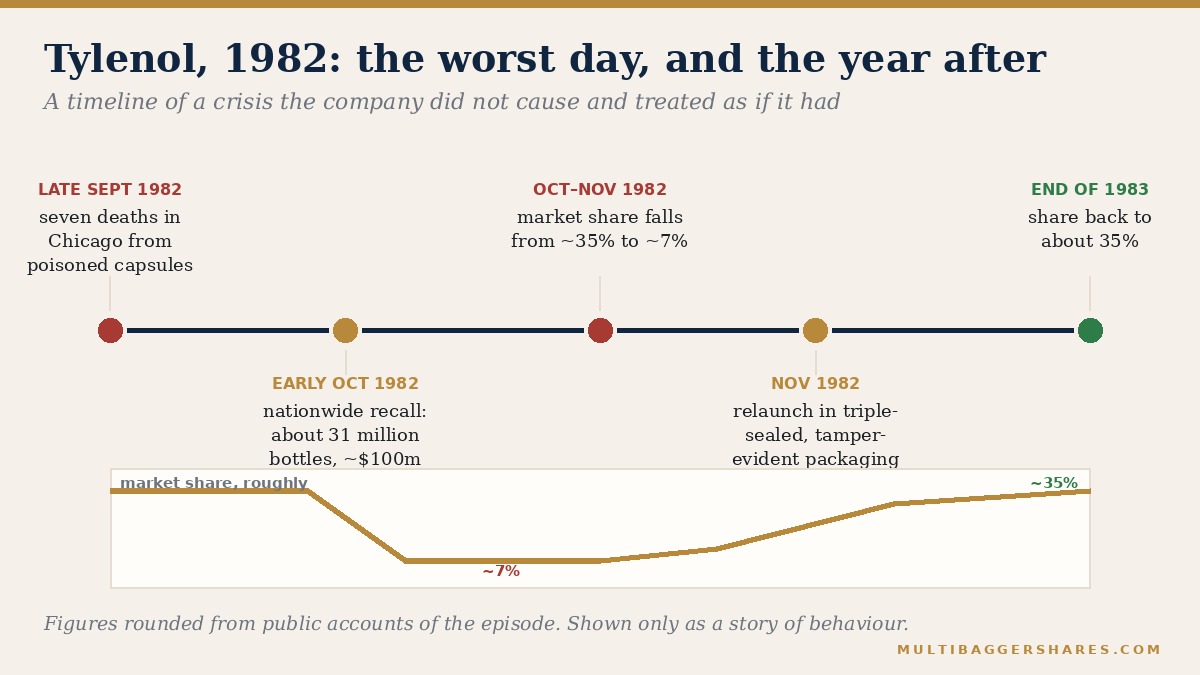
The most famous case in business history happened in the autumn of 1982, in the United States. Tylenol was a painkiller sold by a division of Johnson & Johnson, and it was the market leader, with roughly thirty-five per cent of its market. Market share (the slice of all sales in a product category that one brand captures) is a rough measure of how much customers prefer you over everyone else.
At the end of September that year, seven people in the Chicago area died after taking Tylenol capsules that somebody had opened and laced with cyanide, a poison. The company had not caused this. A criminal had. Nobody was ever convicted. By most standards the company was a victim too.
Here is what Johnson & Johnson did. Within days it told the public to stop taking the product. It then recalled about thirty-one million bottles from shops across the entire country, not just Chicago, at a cost of roughly one hundred million dollars — a very large sum in 1982, and far more than the law required. Its market share fell from about thirty-five per cent to about seven per cent within weeks. Many people assumed the brand was finished.
Then, within about two months, the company relaunched the product in new packaging with three separate seals, so that any tampering would be obvious. This tamper-evident packaging (packaging designed so that you can see at a glance if someone has opened it) became the standard for the whole industry. Customers noticed. By the end of 1983, roughly a year after the deaths, Tylenol’s market share was back to about thirty-five per cent, where it had started.
James Burke, the chairman who took those decisions, later explained that he had not needed a committee to decide. The company had a one-page statement of its values, written by its founder’s son back in 1943, which said the company’s first responsibility was to the patients and doctors who used its products. Burke said that document gave him the argument he needed to persuade shareholders and colleagues to spend the hundred million. The words had been sitting in a frame on the wall for forty years. The crisis was the day they were tested.
Now consider the opposite case, from 2015. Volkswagen, one of the largest car makers in the world, had fitted software to around eleven million diesel cars that could tell when the car was being tested for pollution, and quietly behave better during the test than on the road. This was not an accident. It was a decision. When independent researchers found the gap and the American environmental regulator began asking questions, the company did not come forward. It admitted the cheating only in September 2015, after the regulator went public. The eventual cost in fines, buy-backs and legal settlements ran past thirty billion dollars, several senior managers lost their jobs, and the company’s name became shorthand for the scandal itself.
Put the two side by side. Johnson & Johnson had a problem it did not cause and treated it as if it had. Volkswagen had a problem it did cause and treated it as if it had not. The first company spent a hundred million dollars and kept its reputation. The second saved money for years and then paid three hundred times as much for the privilege.
India has its own well-known episode. In June 2015 the food regulator ordered Maggi noodles, the leading instant noodle brand sold by Nestlé India, off the shelves over concerns about lead levels. The company disagreed with the tests but withdrew the product across the country all the same, destroyed more than thirty-five thousand tonnes of noodles, and came back roughly five months later after fresh testing. Reasonable people still argue about the science. What is not in dispute is that the product returned to the top of its category. Customers had watched what the company did when it was in trouble, and they came back. We mention these companies only as stories of behaviour, not as anything else.
How you can use it
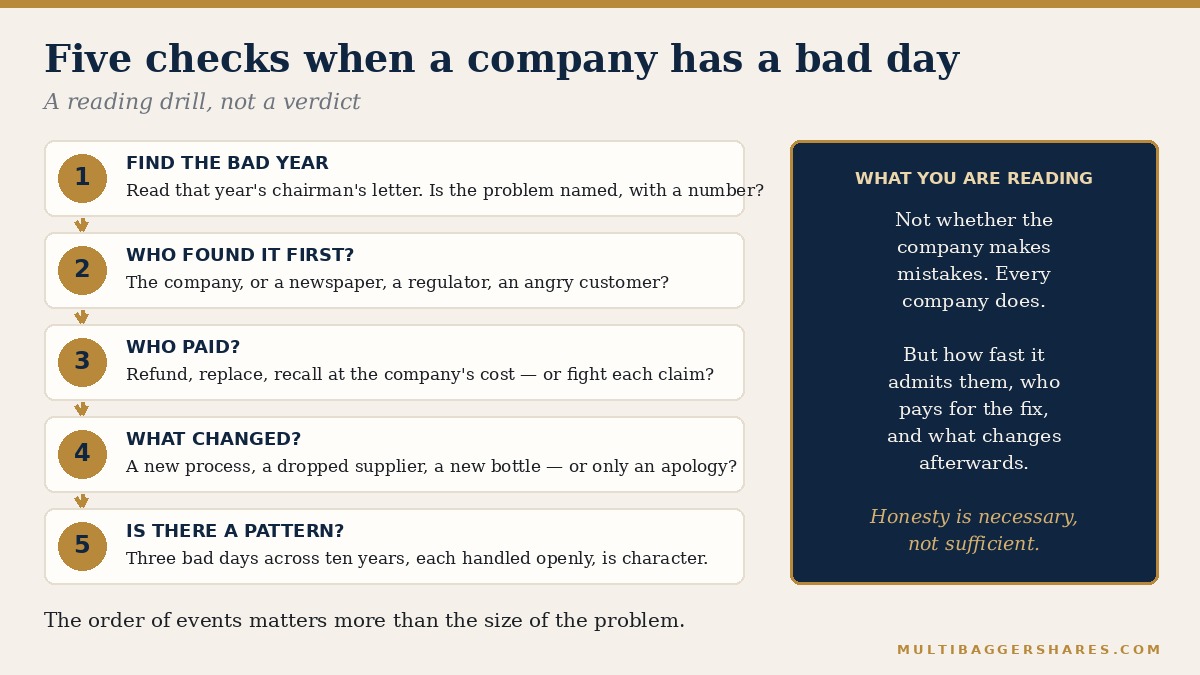
You will not often catch a company in the middle of a Tylenol-sized crisis. But nearly every listed company has had smaller bad days, and the record of those days is in plain sight if you know where to look. Here are five simple checks.
One: find the bad year and read what they said about it. Every company has had a year when profits fell, a plant shut, or a product failed. Find that year’s annual report and read the chairman’s letter and the management discussion (the section where the managers explain the year in their own words). Do they name the problem plainly, put a number on it, and say what they changed? Or is the bad year hidden behind phrases like “challenging environment” and “headwinds” with no admission that anything was their own doing? A company that writes honestly about a bad year is showing you the second sweet shop.
Two: who found the problem first? When a company has had a recall, a product failure, an accounting error or a safety incident, check the order of events. Did the company tell its customers and the stock exchange before anyone made it? Or did a newspaper, a regulator or an angry customer find it, with the company confirming only afterwards? The order matters more than the size of the problem. Companies that go first are usually companies with nothing worse hidden behind the first admission.
Three: who paid? Look at how the cost of the fix was handled. Did the company replace the product, refund the customer, or extend the warranty (the promise to repair or replace a product free of charge for a set period) at its own expense? Or did it fight every claim, delay every payment, and leave customers to absorb the loss? A company that pays quickly is protecting its reputation with money. That is a fair trade and a sign of a management that understands which asset matters more.
Four: what changed afterwards? An apology without a change is just good manners. Look for evidence in the following year’s report: a new testing process, a supplier dropped, an executive replaced, money spent on the cause of the failure rather than on advertising to cover it up. Johnson & Johnson did not merely say sorry. It redesigned the bottle.
Five: look for a pattern, not a single event. One well-handled crisis can be luck or good public relations. Three bad days across ten years, each handled openly, is character. The reverse is also true. A company that has quietly hidden two problems will very likely hide the third. You are reading a habit, and habits show up in repetition.
A word about the limits of this idea. Good behaviour after a mistake is a sign of quality, not a guarantee of it. A company can be honest and still sell a poor product, carry too much debt, or operate in a dying industry. Honesty is necessary; it is not sufficient. It belongs alongside the other questions worth asking about any business: whether it earns good returns on the money put into it, whether it turns its profits into cash, and whether the people running it are capable as well as decent.
Nor should you punish a company merely for having a problem. Every long-lived business has scars. Some of the finest companies in the world have lived through recalls, factory fires, failed products and lawsuits. What sets them apart is not a clean record. It is what they did on the worst day, and the fact that customers stayed.
Above all, do not let this or any single lens decide anything on its own. This letter is about learning to see. It is not about what to do with what you see, which depends on your own situation and which no article can settle for you.
The next time a company you follow has a bad day, do not look away. Watch it closely. Watch whether it argues with the customer or takes the box back. You will learn more in that week than in a year of reading about it when everything was going well.
Key takeaways
- Every business will one day sell a bad box. The mistake tells you little; the behaviour in the days after tells you almost everything.
- Ask three questions: how fast did the company admit it, who paid for the fix, and what changed so it does not happen again.
- Reputation is the one asset that never appears on the balance sheet and is the hardest to rebuild. Buffett in 1991: lose money and I will be understanding; lose a shred of reputation and I will be ruthless.
- Tylenol in 1982 shows the honest path: a recall of about 31 million bottles, a redesigned bottle, and customers back within a year. Volkswagen in 2015 shows the other path.
- Read the bad year in the annual report, check who found the problem first, and look for a pattern across years. Honesty is a necessary sign of quality, not a sufficient one.
— Manish Goel · multibaggershares.com
Disclaimer: This article is published by multibaggershares.com for education and general information only. It is not investment advice, investment research, or a recommendation to buy, sell or hold any security. Any companies named are discussed only as illustrative examples. Markets carry risk; please do your own research or consult a qualified professional before making any investment decision.