The Money That Only Passes Through: How to Tell What a Business Earns From What It Merely Handles

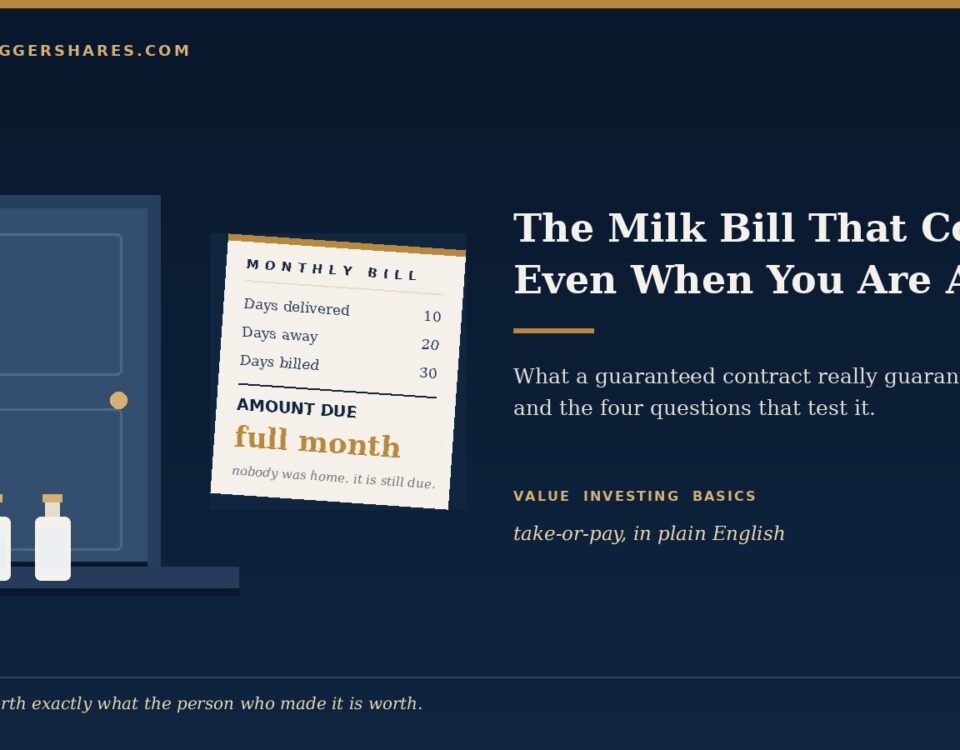
The Milk Bill That Comes Even When You Are Away: What a Guaranteed Contract Really Guarantees
September 17, 2026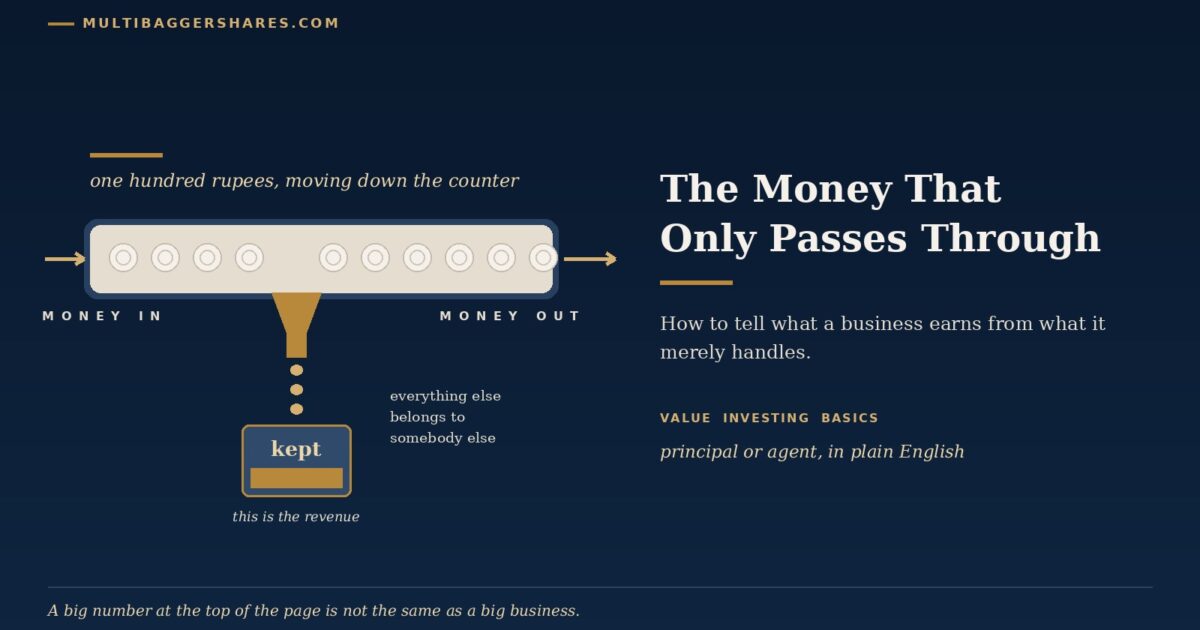
Walk into the wholesale grain market in almost any district town in India and you will find a man sitting cross-legged behind a low desk with a ledger and a set of brass weights. Everybody calls him the arhtiya — the commission agent. Farmers bring their wheat to his yard. He weighs it, arranges the auction, collects the money from the buyer, deducts his cut, and hands the rest to the farmer.
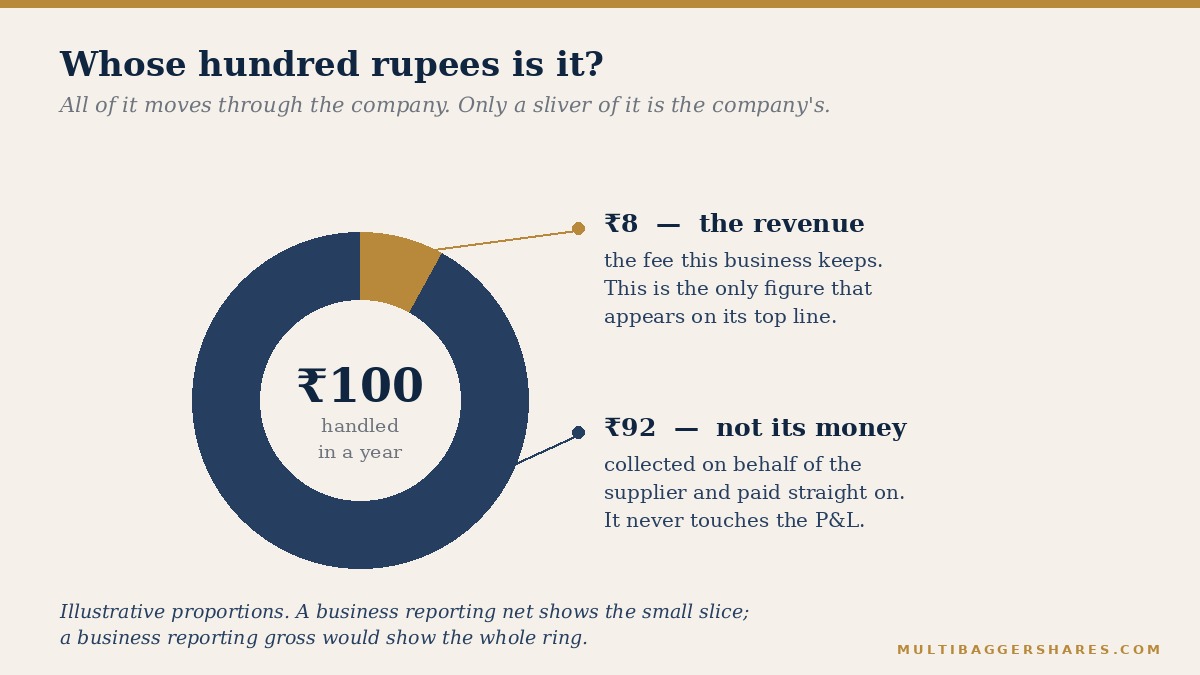
Suppose you asked him how big his business is. He could give you two answers, and both would be honest. He could say that forty crore rupees of grain passed through his hands last season. Or he could say he earned eighty lakh. The first number is forty crore because that much money genuinely moved through his bank account. The second is eighty lakh because two per cent of forty crore is all he was ever entitled to keep.
Only one of those numbers is his business. The other belongs to the farmers. If you confuse the two, you will think he runs a company fifty times larger than he does.
This is not a rural curiosity. It is one of the most common ways an ordinary investor over-estimates a listed company — and owning a share means owning a slice of a company, so the mistake is costly. Today’s letter is about the line at the very top of the profit and loss statement, the one marked revenue (the money a company is allowed to count as its own sales for the year). There is a real rule that decides what is permitted to sit on that line, and once you know it you will never read a top line the same way again.
What “revenue” is actually allowed to mean
Indian listed companies report under Ind AS 115, the accounting standard on revenue from contracts with customers. It is the Indian version of IFRS 15, the standard used in more than a hundred and forty countries, and on this question the two say the same thing. The standard divides every business into one of two roles for each thing it provides.
A principal is a party that controls the goods or services before they are handed to the customer. Control is the ordinary-language idea you would guess: the ability to direct how something is used and to take the benefits from it, including the power to stop anybody else from doing so. A principal records the whole amount the customer pays as its revenue, and the amount it paid its own supplier as a cost. That is called reporting gross.
An agent is a party that arranges for somebody else to provide the goods or services, without ever controlling them. An agent records only the fee or commission it keeps. That is reporting net. And here is the sentence worth committing to memory: the agent reports only its fee irrespective of whether the gross cash flows pass through the agent’s own hands. The forty crore in the arhtiya‘s account changes nothing. His revenue is eighty lakh.
So two companies can put the same profit on the bottom line while one shows a top line fifty times bigger than the other — not because one is fifty times the business, but because one of them is holding somebody else’s money on its way past.
The test the rule actually uses
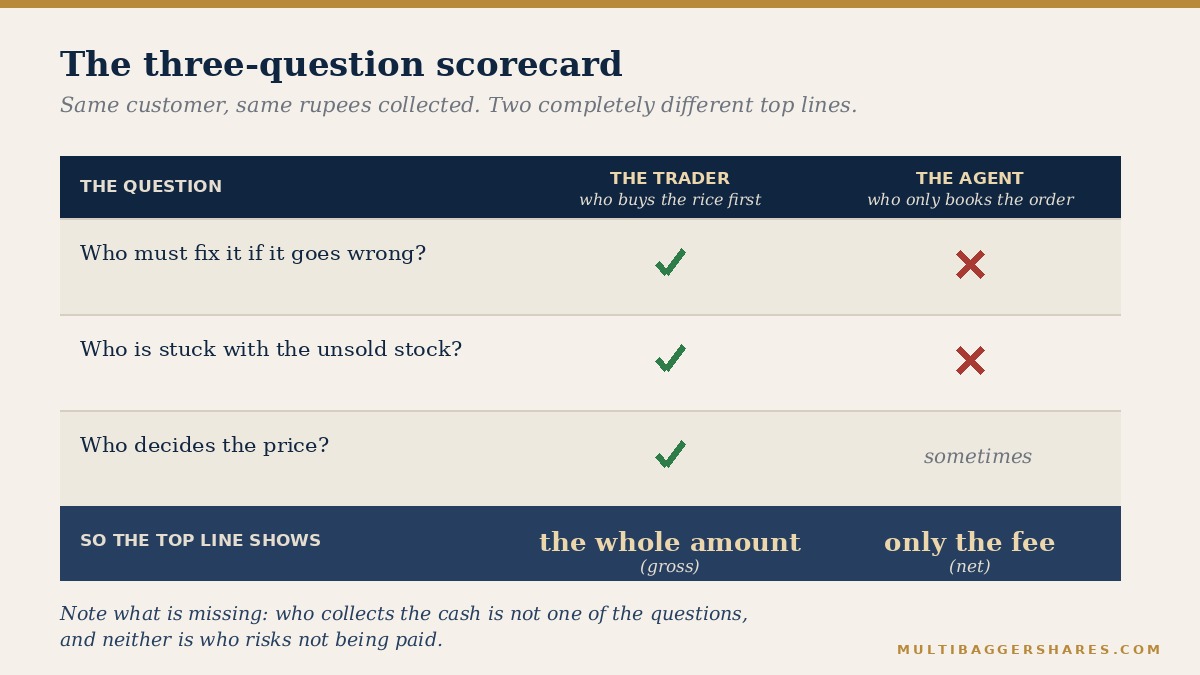
IFRS 15 sets out the assessment in two steps. First, identify exactly what is being promised to the customer. Second, ask whether the company controls that thing before it reaches the customer. If the answer to the second question is genuinely unclear — and it very often is — the standard offers three indicators to help. They are worth learning, because you can apply them to a business you are reading about without any accounting training at all.
One: who is primarily responsible for delivering the promise? If the parcel arrives broken, who has to make it right? If the customer telephones to complain about the product itself and the company says “please contact the manufacturer”, that is the behaviour of an agent.
Two: who carries the inventory risk? Inventory risk means the danger of being left holding goods that nobody wants. A trader who buys a hundred bags of rice and hopes to move them by Friday carries it. A booking website that orders nothing until a customer has already paid carries almost none. Risk is the clearest fingerprint of ownership, because only an owner can be hurt by what he owns.
Three: who decides the price? A business free to set its own price to the final customer is behaving like an owner of the thing being priced. A business that must pass on a price fixed by somebody else is behaving like a messenger. The standard adds a sensible caution here: pricing freedom counts for less when the market is so competitive that everybody charges the same anyway.
One indicator is conspicuously absent, and its absence is instructive. Credit risk — the danger that the customer never pays — is deliberately not a test. The standard-setters concluded it was mostly irrelevant, because agents get stuck with unpaid bills just as often as owners do. Bearing a risk does not by itself make you the owner. It has to be the risk of owning.
None of these is a tick-box. The same business can be a principal for one product and an agent for another in the very same contract, and a travel business is the textbook case. A company that merely arranges a flight is an agent. But a company that buys a block of airline seats in advance, carries them, and then provides them to travellers may well be a principal — same shopfront, same traveller, opposite accounting, because in the second case somebody is stuck with the empty seats.
Three real examples
The first is the clearest, because the company itself prints both numbers in the same document. In its shareholders’ letter for the quarter ended 31 March 2025, Eternal Limited — the company formerly named Zomato — reported that the net order value of its consumer-facing businesses was about 17,440 crore rupees for the quarter. In the audited financial statement a few pages later in the same filing, consolidated revenue from operations for that quarter was 5,833 crore rupees. Customers spent the first figure; the company’s own books recorded roughly a third of it. Neither number is wrong and neither is hidden. They are simply answers to two different questions, and an investor who quotes the larger one as “sales” has misread the business.
The second example is a fee so small you have probably paid it without noticing. When you book a train ticket online in India, the fare belongs to Indian Railways. What the booking company keeps is a convenience fee. A Ministry of Railways press release dated 22 November 2019 records the amounts exactly: fifteen rupees plus GST per ticket for non-air-conditioned classes and thirty rupees plus GST for air-conditioned classes, applicable from 1 September 2019, at a time when online booking already accounted for about seventy-two per cent of all reserved tickets on Indian Railways. Think about what that does to the financial statements. The value of tickets flowing through the platform runs into tens of thousands of crores. The revenue recorded is a pile of fifteens and thirties. A business like that will naturally show a startling profit margin — not because it is startlingly profitable per passenger, but because the denominator has been kept honest.
The third example shows that even the professionals find this hard. In April 2022 the IFRS Interpretations Committee — the global body that answers difficult questions about the standard — took up the case of a company that resells software licences. The facts were finely balanced. The reseller gave the customer advice before the sale and negotiated its own price, which points towards being a principal. But the licences did not exist until the reseller placed the order, the manufacturer issued them in the customer’s own name and stood behind how the software worked, and the reseller could not pass an unwanted licence to anybody else. The Committee published its conclusion in May 2022: the answer depends on the specific facts and the terms of the contracts, judgement must be applied, and the existing standard is adequate to reach an answer. In other words, the world’s accounting rule-makers looked at the question and said, quite properly, that you have to read the contract. So should you.
Why this changes how you judge a business
Start with what it does not mean. Being an agent is not worse than being a principal. Some of the loveliest businesses in the world are pure agents: they own no stock, employ little capital, carry nothing that can spoil, and keep a small slice of an enormous flow. Some of the sturdiest are principals: they purchase, they carry the stock, they take the risk, and they are paid for taking it. The rule is a description, not a verdict.
What it does mean is that three familiar judgements stop working when you cross between the two.
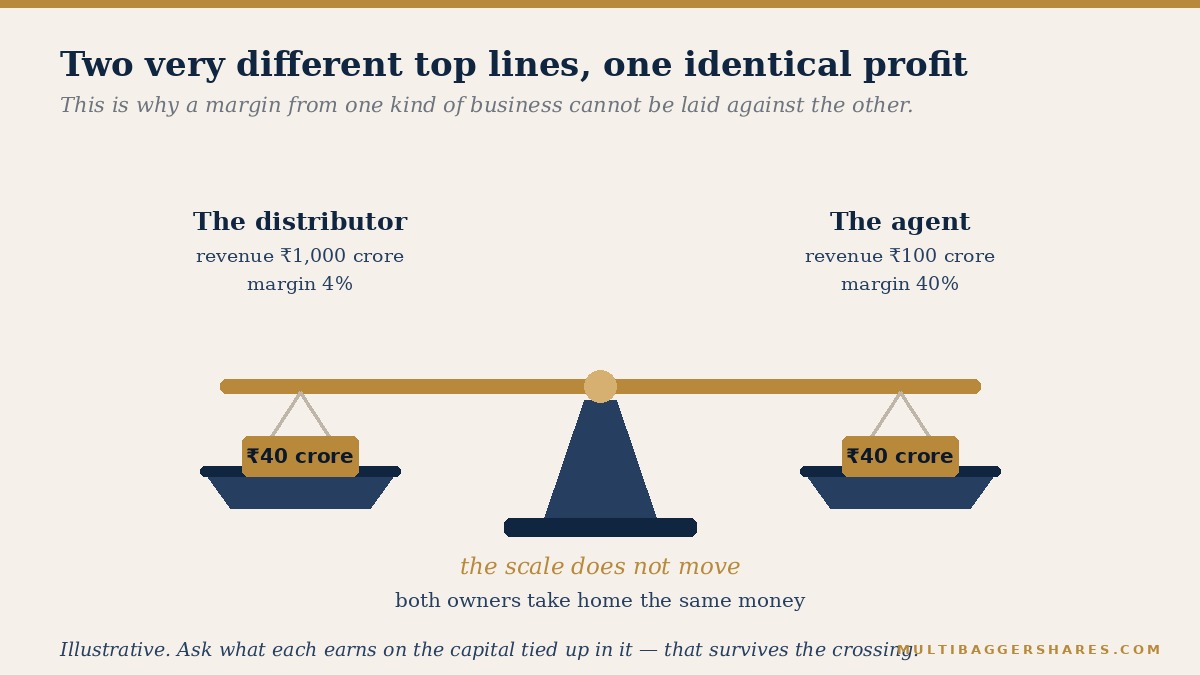
The first is the profit margin. Margin is profit as a percentage of revenue, so if revenue itself means different things in two companies, comparing their margins is meaningless. A distributor keeping four per cent of a thousand crore and an agent keeping forty per cent of a hundred crore both take home forty crore. One looks thin and one looks fat. They are the same size. This is precisely why Warren Buffett, writing to his shareholders as far back as 1979, told them the real test of a management was “a high earnings rate on equity capital employed (without undue leverage, accounting gimmickry, etc.)” rather than the headline figures that are easier to grow. Ask what the business earns on the money tied up in it. That question survives the crossing; margin does not.
The second is growth. A company that reports net will often also publish the gross flow it handles, because the gross flow is impressive. But the share it keeps — sometimes called the take rate — can quietly shrink while that flow grows. Volume up twenty per cent and revenue up two per cent is a real and common pattern, and it tells you the company is losing its grip on the slice, which is the only part that was ever its own.
The third is the year-on-year comparison itself. A company that changes its judgement and starts presenting gross where it used to present net will show a spectacular jump in revenue with no change whatsoever in profit. Nothing improper need have happened — facts change, contracts get rewritten. But you should know that is what you are looking at, and the only place it will be explained is the accounting-policy note.
How you can use this
Five checks, none of which needs a spreadsheet. One: in the annual report, find the note on revenue from contracts with customers and read the significant accounting policies. Companies are required to explain their significant judgements, and the words principal and agent usually appear there in plain sight.
Two: compare the reported revenue against whatever volume number the company chooses to advertise — order value, tickets, tonnes, assets under management. If the company trumpets a number several times larger than its revenue, that number is money passing through, and you have just found the take rate. Track it for a few years.
Three: divide revenue by units. If a company handles a crore of transactions and reports fifty crore of revenue, that is fifty rupees a transaction, which is the shape of a fee, not the shape of a price. The arithmetic tells you the role before the accounting note does.
Four: look at the balance sheet. A genuine principal usually carries inventory and owes its suppliers. An agent’s balance sheet is oddly bare — little stock, mostly cash and receivables. If a company reports enormous revenue with almost no inventory anywhere in its history, ask why.
Five: check whether the presentation changed. A sudden step up in revenue with flat profit, and a fresh paragraph in the policy note, are the same event described twice.
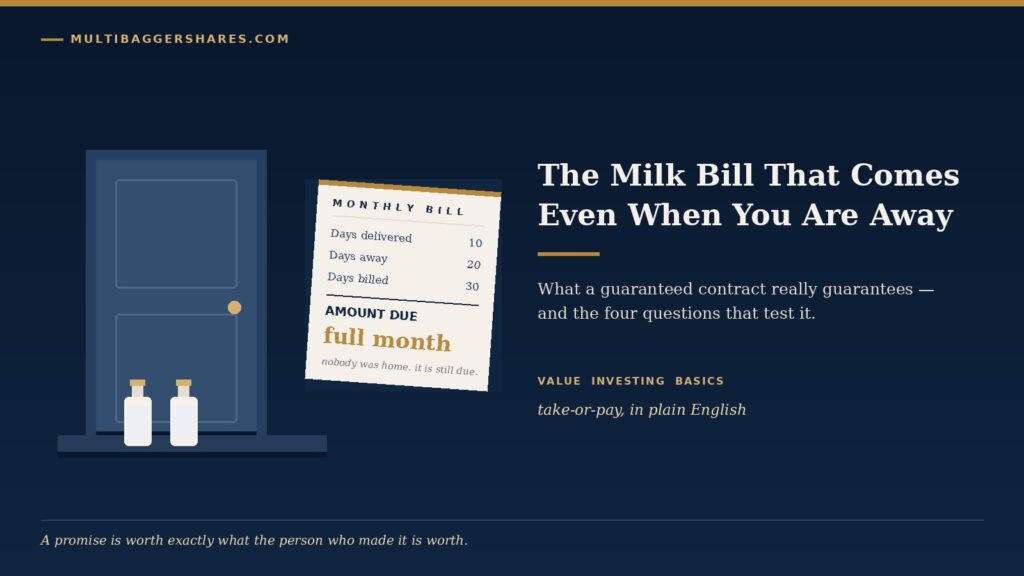
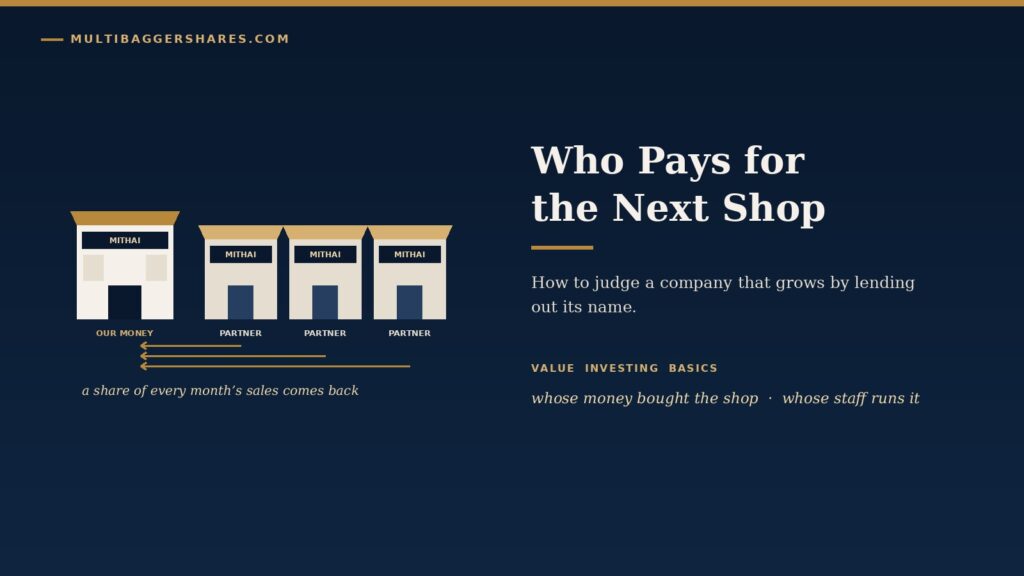
One last separation, because this letter sits close to three others and the differences matter. It is not the question of what a brand pays to sit on a shopkeeper’s shelf, which is about who captures the margin in a chain. It is not the question of who funds the next shop, which is about whether growth is paid for by the company or by its franchisees. And it is not the question of whose name is on the shirt, which is about who does the manufacturing. All three ask who does the work. This one asks a narrower and more basic question: of the money that moved, how much was ever yours?
The arhtiya knows the answer without being taught it. He has two columns in his ledger, and he has never once confused them, because the money in the larger column has to go back to the farmer on Thursday. A company’s accounts keep the same two columns. Most of the time nobody is hiding anything. They are simply waiting for a reader who knows which column to look at.
Key takeaways
- Revenue is not the money that passes through a business. It is the money the business is entitled to keep, and an accounting standard decides which is which.
- A principal controls the goods or services before the customer gets them and reports the full amount. An agent merely arranges, and reports only its fee — even when the whole sum passes through its bank account.
- Three plain tests point the way: who must fix it if it goes wrong, who is stuck with the unsold stock, and who sets the price. Credit risk is deliberately not one of them.
- Never compare profit margins across a principal and an agent. Compare what each earns on the capital employed in it instead.
- When a company advertises a volume figure far larger than its revenue, the ratio between them is the slice it keeps. Watch that slice over several years, not the flow.
— Manish Goel · multibaggershares.com
Disclaimer: This article is published by multibaggershares.com for education and general information only. It is not investment advice, investment research, or a recommendation to buy, sell or hold any security. Any companies named are discussed only as illustrative examples. Markets carry risk; please do your own research or consult a qualified professional before making any investment decision.