The Cart That Must Be Empty by Nightfall: How to Judge a Business Whose Stock Cannot Wait

The Only Chemist Inside the Hospital: How to Judge a Business Protected by a Permission Others Cannot Get
September 23, 2026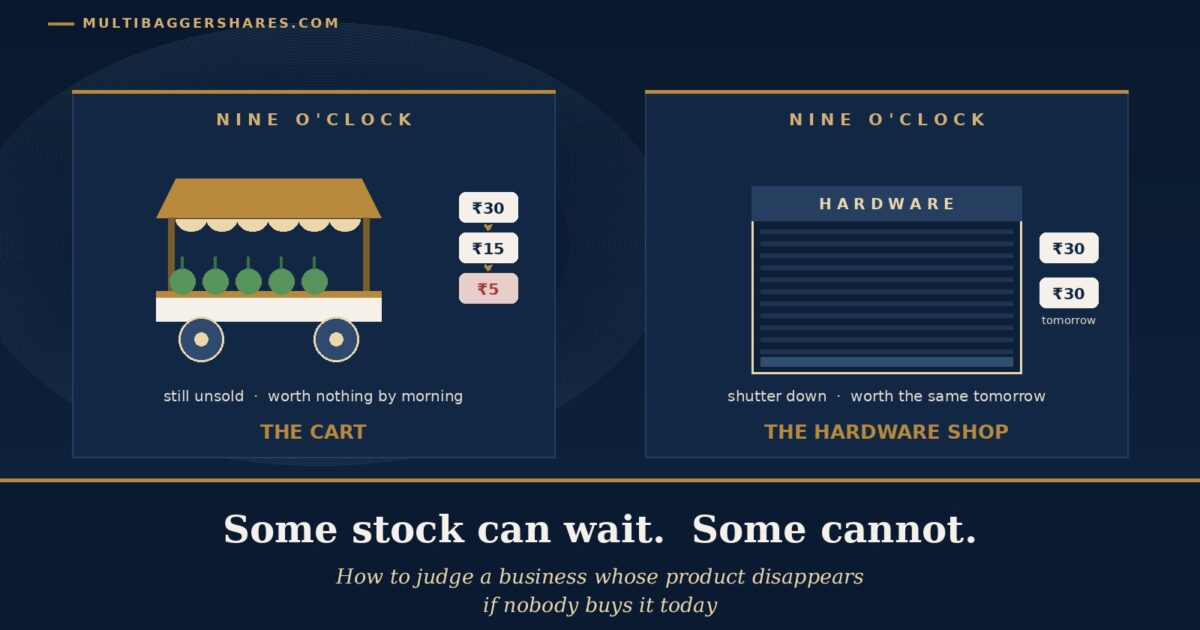
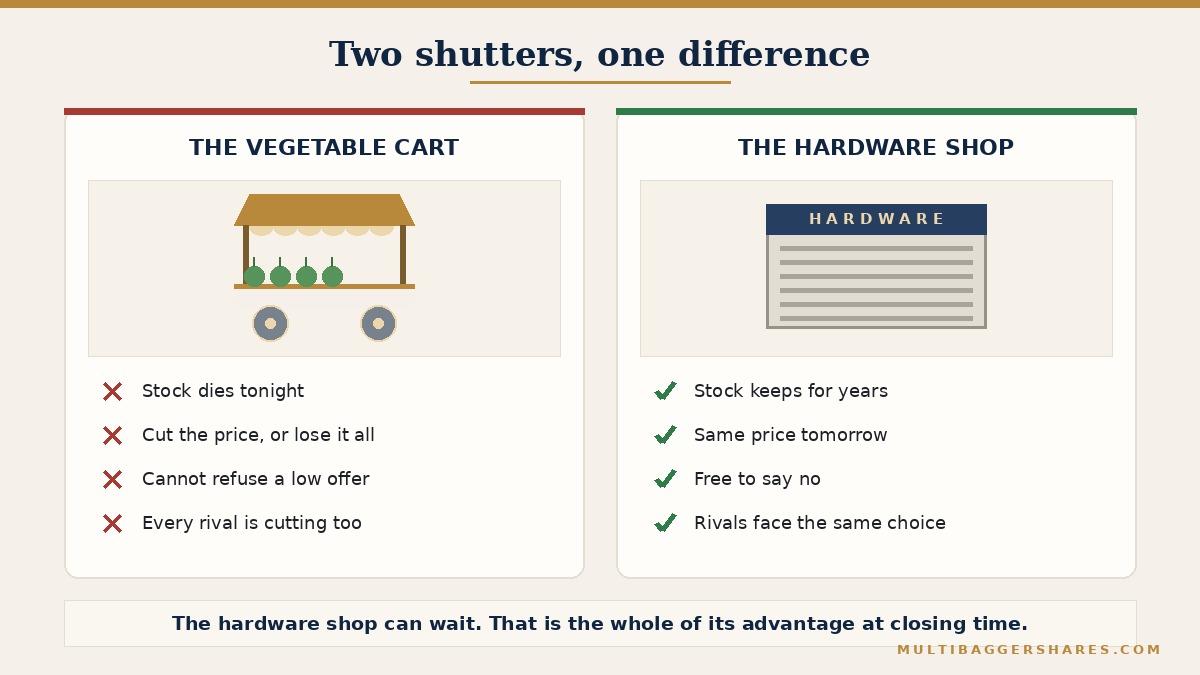
Walk through any vegetable market at seven in the evening, then walk through it again at nine. The same bundle of spinach that cost thirty rupees at seven is offered at fifteen by nine, and if you wait until the seller is folding up his sack, you may be handed the last of it almost for free. Nothing about the spinach has changed in two hours. What has changed is the number of hours left before it becomes rubbish.
Now look at the hardware shop three doors down. At nine o’clock the owner pulls his shutter down with a box of screws still unsold, and loses nothing at all. The screws will be worth the same tomorrow, and the same next month, and very likely the same next year. He has no reason to accept a low offer from a customer at closing time, so he simply does not accept one.
Two shops, same street, same closing hour, completely different businesses. The vegetable seller has a deadline built into his stock. The hardware seller does not. Almost everything that matters about how those two businesses earn their money — how firmly they can price, how they behave in a bad week, how much of their good years they get to keep — follows from that one difference.
Once you learn to look for it, you find that deadline in some very large listed companies, and you find its absence in others. It is one of the quickest ways to understand why two businesses of the same size, in the same country, in the same year, end up with such different-looking profits.
What “perishable” really means here
Perishable (something that spoils or expires, so it cannot be kept and sold later) is a word we normally reserve for food. In business it covers far more than food. The proper test is not whether the thing rots. The test is simply this: if nobody buys it today, can the seller still sell it tomorrow?
An aircraft seat fails that test. The moment the doors close, an empty seat on that flight is gone forever; it cannot be added to tomorrow’s flight. A hotel room fails it too — Tuesday night’s room, unsold, is not available to sell on Wednesday, because Wednesday has its own room to sell. So does a cinema show, a wedding caterer’s Saturday, a consultant’s working day, an unused hour on a factory line, a newspaper printed for this morning, and a unit of electricity generated at two in the afternoon.
That last one is worth pausing on, because India’s power market shows the idea at its purest. Electricity, at the scale a country uses it, cannot be meaningfully stored. It must be consumed at the instant it is produced. This is why the electricity a plant could have generated this afternoon, and did not sell, is not inventory (unsold goods sitting in a warehouse). It is simply gone.
It helps to name two costs at this point. Fixed cost is the money a business must spend whether it sells anything or not — the aircraft lease, the hotel building, the staff salaries, the interest on the loan. Marginal cost is the small extra cost of serving one more customer — the meal and the fuel for one more passenger, the laundry for one more room. In perishable businesses the fixed cost is usually enormous and the marginal cost is usually tiny. Hold on to that pair; it explains everything that follows.
Why this one fact decides so much
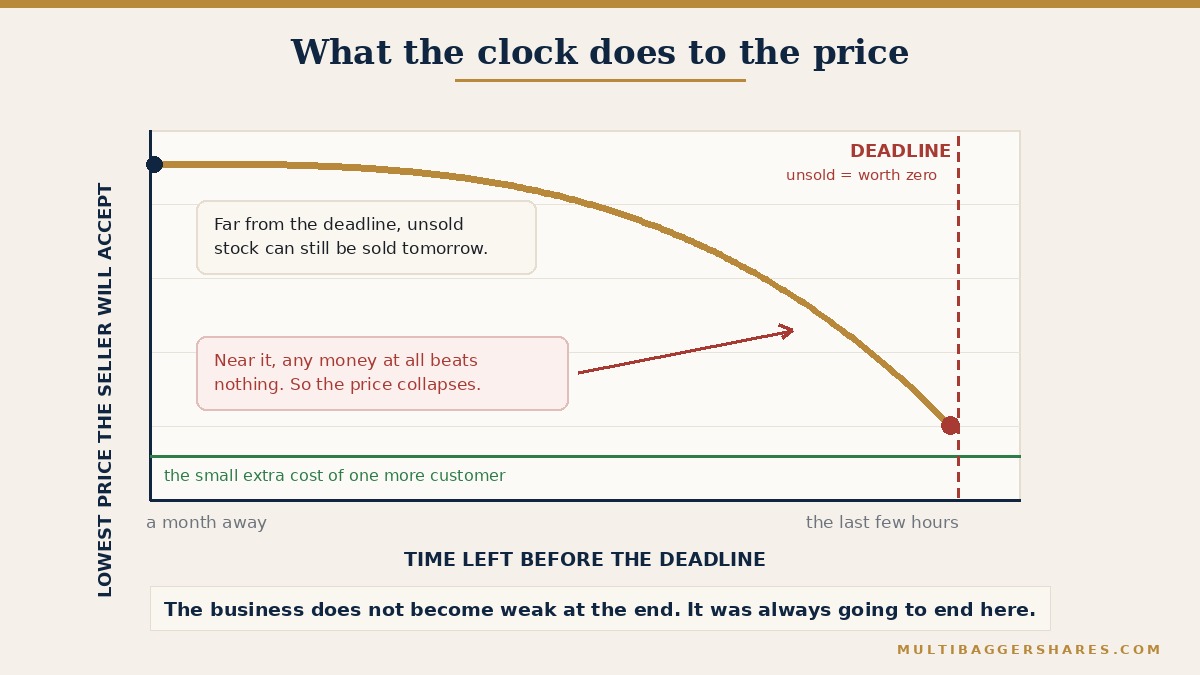
Put yourself behind the counter. The flight leaves in four hours and twenty seats are empty. Each of those seats costs you almost nothing extra to fill. If you can get even two thousand rupees for one, that is two thousand rupees more than you will have if the seat flies empty. So you drop the price. Not because you are a poor businessman, but because the arithmetic in front of you at that moment leaves you no sensible alternative.
Here is the trap. Your competitor across the terminal is doing exactly the same sum, about exactly the same seats, at exactly the same hour. Neither of you can afford to hold your price when the other is cutting, because holding firm does not preserve a sale for tomorrow — it destroys the sale permanently. Perishability takes away the one weapon the hardware shop owner has, which is the ability to shrug and say: fine, I will sell it next week.
So a perishable business tends to spend its life discounting (cutting the asking price to move stock) into its own deadline, and doing it in public, where every rival can see and match. This is why a perishable business with a large fixed cost and no protection is one of the hardest places in the world to earn a steady profit, and it is why the same industries reappear on the list of chronic disappointments decade after decade.
Warren Buffett put it about as bluntly as it can be put. In his 2007 letter to Berkshire Hathaway shareholders, under a heading he gave the word “gruesome,” he wrote: “The worst sort of business is one that grows rapidly, requires significant capital to engender the growth, and then earns little or no money. Think airlines.” He went on to say that a durable competitive advantage had proved elusive in that industry ever since the Wright brothers, and that investors had “poured money into a bottomless pit, attracted by growth when they should have been repelled by it.”
He then did something worth noticing. He named his own mistake. Berkshire bought preferred shares in the American carrier US Air in 1989; as he described it in that same letter, the company went into a tailspin almost immediately and the dividend stopped being paid. Berkshire got out at a gain in 1998 during what he called one of the recurrent but always misguided bursts of optimism for airlines. In the decade after that sale, he noted, the company went bankrupt. Twice.
What the good operators do about it
None of this means a perishable business is doomed, and the way the best ones fight back is itself a quality signal worth learning to spot. The fight has a name: yield management, sometimes called revenue management (selling the same perishable unit at different prices to different customers depending on how early they commit and how much is left).
The classic account is American Airlines in the 1980s. Robert Crandall, who ran the airline, gave the practice its name and built the systems behind it; the airline’s Ultimate Super Saver fares, launched in 1985, were cheap but had to be bought at least thirty days ahead, could not be refunded, and were released only on the seats the airline expected to struggle to fill. Three of its managers later described the whole system in a 1992 paper in the journal Interfaces, and the work was credited with contributing about 1.4 billion dollars of revenue over three years — enough to win the Franz Edelman Award in 1991.
Indians have been living inside a version of this since September 2016, when the Railways introduced flexi-fare on its premium trains. The rule was simple: on the trains covered, the fare rose by ten per cent with every ten per cent of berths sold, up to a ceiling of 1.5 times the base fare in most classes and 1.4 times in third AC. It applied to forty-four Rajdhani, forty-six Shatabdi and fifty-two Duronto trains. First AC and Executive class were left alone.
Look at what that rule actually does. It is the vegetable seller’s problem solved backwards. Instead of starting high and cutting as the deadline nears, the seller starts low and raises the price as the stock runs down — which forces the customers who really must travel to commit early, at a price the seller sets rather than one the clock sets. When you see a perishable business pricing seriously in this way, you are looking at management that understands the thing it owns.
The other defence is to fix the price before the deadline exists at all. A power plant with a long-term supply agreement, a hotel with a block booking, a caterer with the whole wedding season signed in advance — each has converted a perishable unit into a promise made months earlier. For what happens without that protection, consider India’s spot power market: in April 2022 the regulator, the Central Electricity Regulatory Commission, had to instruct the exchanges to accept bids only within a band of zero to twelve rupees a unit, because prices in a market for something that cannot be stored can run to places nobody intended.
Four questions to ask
One. If nobody buys today, can it be sold tomorrow? Ask this of the actual product, not the company. A cement bag keeps for a few months; a hotel night keeps for zero minutes. If the answer is no, you are holding a business that will always be negotiating against its own clock.
Two. How big is the gap between fixed cost and marginal cost? The wider that gap, the more violently the business will discount at the deadline, because the temptation to take any price at all is overwhelming when the extra cost of one more customer is close to nothing. A business with modest fixed costs feels the same deadline far more gently.
Three. How much is spoken for before the deadline arrives? This is the single most useful question of the four. A caterer whose Saturdays are booked eight months ahead, a train whose berths fill at rising fares, a plant selling under a long contract — all of these are perishable businesses that have escaped the worst of perishability. Look for advance bookings, order books, contracted volumes, renewal rates.
Four. Can anybody add more capacity quickly? A deadline is survivable when supply is scarce. A wedding hall in a town with two halls can hold its rate on a wedding date; the same hall in a town with twenty halls cannot. Perishable stock plus easy new supply is the combination that grinds an industry down, and it is exactly the combination Buffett was describing.
When the deadline is not a problem
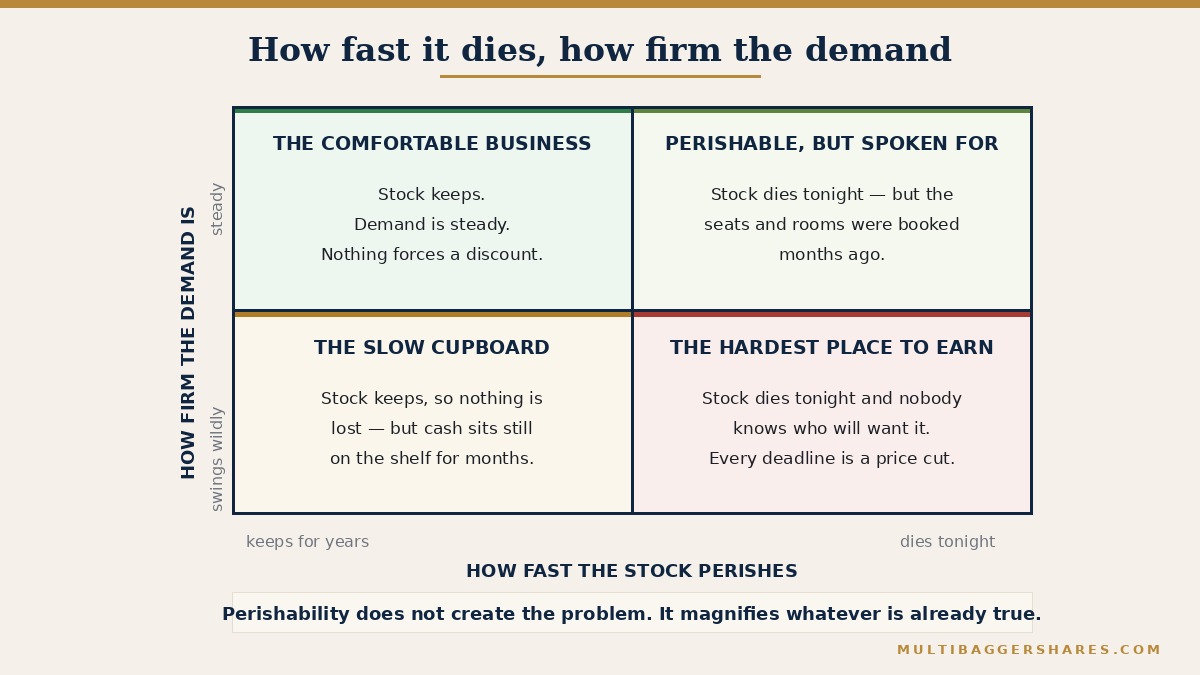
It is worth saying plainly that perishability by itself is not a verdict. Some of the most comfortable businesses in the world sell something that dies at the end of the day and do perfectly well, because one of the other three answers rescues them.
The hospital bed, the school seat, the electricity line into your house — all perishable, all sold against demand that barely moves from week to week, and often with supply that cannot be expanded quickly. India’s hotel industry shows both sides within five years: occupancy fell to somewhere around thirty to forty per cent during 2020–21, when demand vanished, and has since settled in the mid-to-high sixties, on the estimates published by the consultancy HVS Anarock. The rooms were equally perishable in both periods. What changed was whether anyone wanted them.
That is the real lesson. Perishability does not create the problem; it magnifies whatever is already true about demand and supply. Where demand is firm and new supply is hard, the deadline is a detail. Where demand swings and anyone can add capacity, the deadline turns every downturn into a price war and every upturn into a building spree that guarantees the next downturn.
How you can use this
You do not need a spreadsheet for any of this. Read the company’s own description of what it sells, and ask whether that thing survives the night. Then read the annual report looking for the rescue: advance bookings, a contracted order book, long-term agreements, occupancy or utilisation figures that hold up in bad years as well as good ones.
Then look at the pattern of the profits themselves over eight or ten years. A perishable business without protection has a very recognisable shape — two or three wonderful years when demand runs ahead of capacity, followed by several thin or loss-making ones once everybody’s new capacity arrives at once. If you meet that shape, the wonderful years are not the story. The full cycle is.
And be honest about which part of the cycle you are reading it in. It is easy to admire a perishable business in the year everything is full, because in that year it looks like the best business you have ever seen. The vegetable seller also looks like a genius at seven o’clock. The question was always what his cart looks like at nine.
Key takeaways
- Ask one question of the product itself: if nobody buys it today, can it still be sold tomorrow? A seat, a room, a show, an unused factory hour and a unit of electricity all fail that test.
- Perishable stock plus huge fixed costs plus tiny marginal costs is what forces discounting at the deadline — the seller loses the power to simply wait.
- The rescue is demand that is committed in advance: bookings, order books, contracted volumes. Look for it explicitly, and treat it as a quality signal rather than a detail.
- Perishability is survivable when new capacity is hard to add, and punishing when anybody can build more. Judge the two together, never separately.
- Read a perishable business across a full cycle of eight to ten years, not in the year when everything happened to be full.
— Manish Goel · multibaggershares.com
Disclaimer: This article is published by multibaggershares.com for education and general information only. It is not investment advice, investment research, or a recommendation to buy, sell or hold any security. Any companies named are discussed only as illustrative examples. Markets carry risk; please do your own research or consult a qualified professional before making any investment decision.