The Well That Everyone Used, Until Nobody Did: How to Notice a Business Edge That Is Quietly Draining Away

Receivable Days: The Working-Capital Ratio That Reveals Whether Reported Profit Has Actually Turned Into Cash
September 27, 2026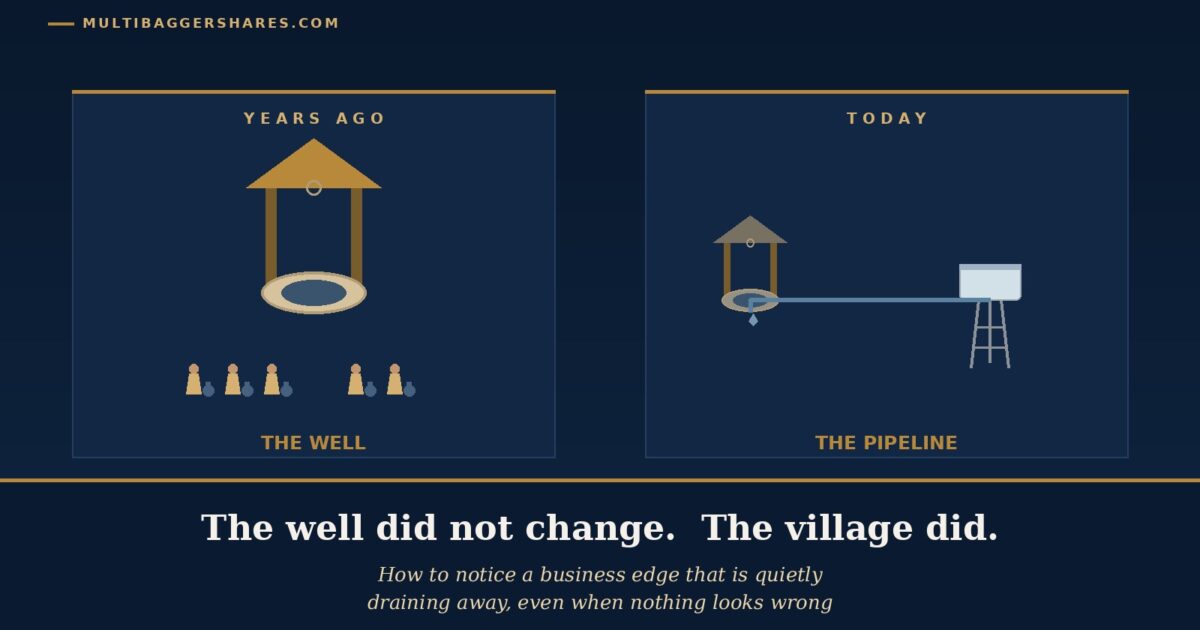
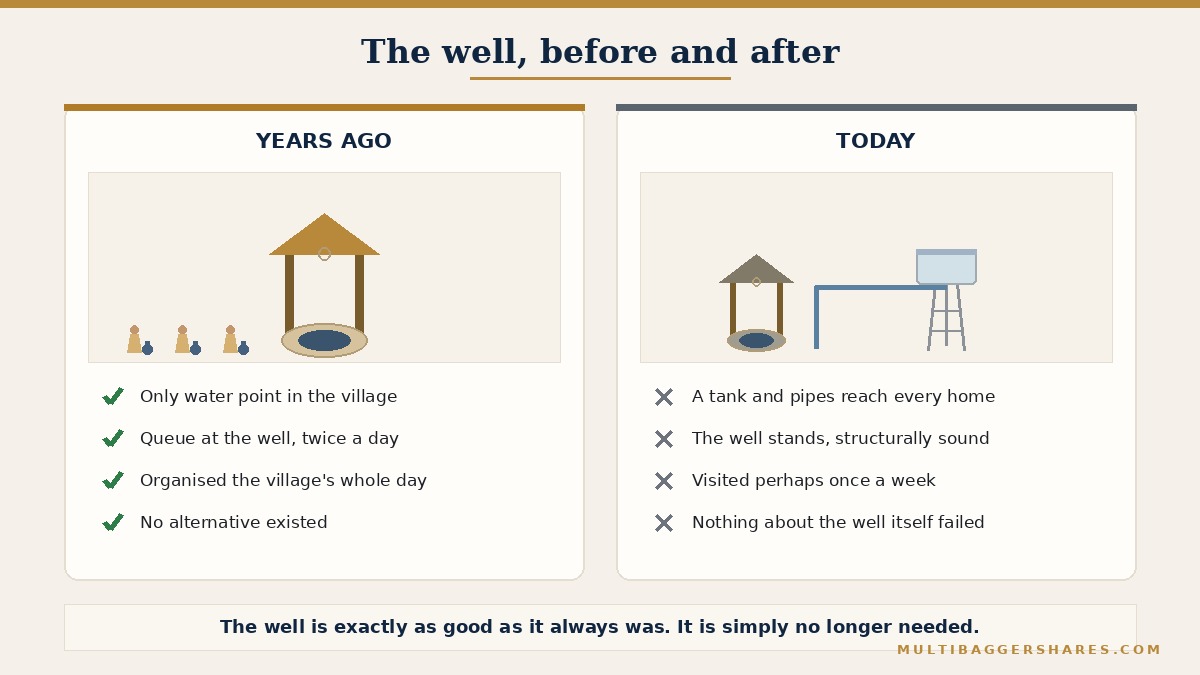
For close to sixty years, a stone well near the centre of a village in central India was the reason the village existed where it did. Every household sent someone to it, usually twice a day, carrying a brass or plastic pot. In the hour before sunset the queue at the well was also the place where news travelled, matches were arranged, and small disputes were settled. The well did not merely supply water. It organised the whole rhythm of the village around itself.
Then, over about four years, an overhead water tank went up on the edge of the village, and a network of pipes was laid to carry that water into individual homes. Nobody voted to retire the well. Nobody even discussed it. Families simply opened a tap in their own courtyard instead of walking to the square, and within a few years the well stood there, structurally exactly as sound as it had always been, visited perhaps once a week by someone whose tap had run dry.
Ask what went wrong with the well and the honest answer is: nothing. Its walls did not crack. Its water did not turn foul. If you had inspected the well itself on the day it fell silent, you would have found it in perfect working order. What changed was not the well. What changed was everything around it — and that is precisely the pattern worth learning to see in a business.
What a moat actually is, and what it is not
A moat (the durable advantage that lets a business keep charging fair prices and earning good returns without being copied away) is usually described as something a company has, like a wall it has built around itself. That description is only half right, and the missing half is the important one. A moat is not a wall the company owns outright. It is a gap between what the company offers and what the rest of the world can currently match. A gap, by definition, is a relationship between two things, and a relationship can close from either side.
This is why a company can do everything correctly — keep its factories running well, keep its accounts honest, keep serving its existing customers politely — and still watch its moat drain away, because the world on the other side of the gap moved rather than the company itself. The well owner did not need to do anything wrong for the well to stop mattering. The village around it simply found a shorter path to the same water.
This single confusion — treating a moat as a fixed possession rather than a moving gap — is probably the most common mistake beginner investors make about business quality. It leads people to check whether a moat exists once, feel satisfied with the answer, and then stop checking. A moat deserves the same kind of yearly attention a farmer gives a well: not because the well is expected to fail, but because the only way to notice it beginning to fail is to keep looking.
Why the draining is usually quiet, not sudden
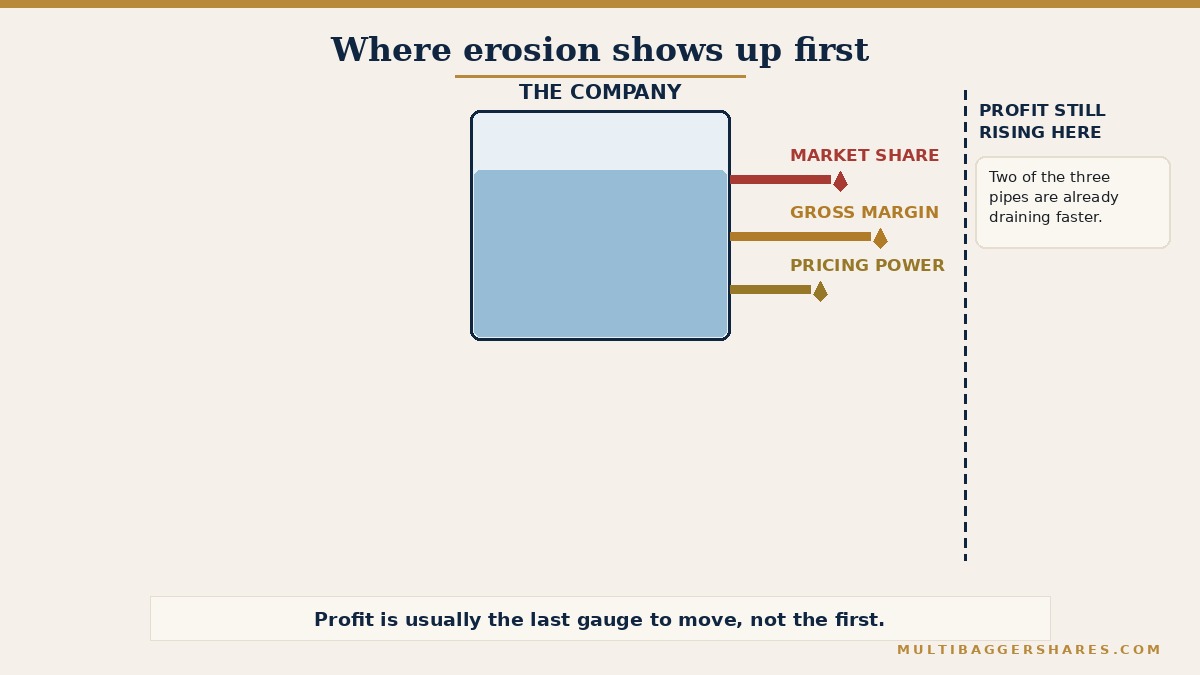
If a moat disappeared all at once, spotting the erosion (the gradual weakening of a business advantage, as opposed to it vanishing overnight) would be easy. It almost never works that way. The three things a moat protects — market share, gross margin (the percentage of sales left after the direct cost of making the product or service, before other expenses), and pricing power (the ability to raise prices without losing customers) — do not drain out at the same speed, and reported profit is usually the very last of the three to show any damage at all.
Market share can slip for several years while a company’s absolute sales still grow, simply because the whole market is growing faster than the company is. Gross margin can compress a percentage point at a time, hidden inside a set of quarterly results that otherwise look perfectly healthy, because the company is quietly discounting to hold on to customers it once did not need to court. Pricing power can vanish well before profit falls, because the company keeps profit steady for a while by cutting costs elsewhere — and cost-cutting is far easier to notice as good management than margin compression is to notice as a warning.
By the time reported profit itself turns down, in other words, the moat has usually already been draining for a while out of view. This is the entire reason erosion is worth learning to watch for specifically, rather than simply waiting to be told about it by the headline profit number. The profit number is a lagging gauge. Market share, margin and pricing power move earlier, and they move in that rough order.
Two examples the whole world watched happen
In 1975, an engineer named Steven Sasson, working inside Eastman Kodak’s research laboratories, built the world’s first working digital camera. It weighed about eight pounds, used a black-and-white sensor with roughly ten thousand pixels, and took twenty-three seconds to record a single image onto a cassette tape. Kodak, at the time, was one of the most dominant and profitable companies on earth, built almost entirely on selling photographic film — a product that a customer bought once, used once, and had to buy again. A camera that needed no film at all was, from the point of view of that business, a direct threat to its own moat, invented inside its own walls.
Kodak did not ignore digital photography. It filed patents on it for years and even licensed some of that technology to others. What it did not do, at the scale or speed the moment required, was rebuild its own business around a product that made its most profitable product unnecessary. Film sales kept the company comfortable for two more decades even as digital cameras, and later camera phones, spread everywhere around it. Kodak filed for Chapter 11 bankruptcy protection on 19 January 2012. At its peak, in the years before its decline, the company had employed well over a hundred thousand people worldwide. None of Kodak’s film factories had gotten worse at making film. The world had simply stopped needing as much of it.
Nokia offers a second version of the same lesson, on a shorter timeline. In 2007, Nokia held roughly forty per cent of the entire global market for mobile phones — a share so large it is difficult for any single company to hold in a large global industry today. Its handsets were considered exceptionally reliable, its distribution reached markets no rival could match, and its brand was, for many buyers around the world, simply the word for a mobile phone. Six years later, on 3 September 2013, Nokia agreed to sell its entire handset business to Microsoft for 7.2 billion dollars, a transaction that also moved thirty-two thousand of Nokia’s ninety thousand employees to their new owner. Nokia’s factories, distribution network and brand recognition had not disappeared in those six years. What had disappeared was the reason a smartphone buyer needed any of those specific advantages, once touchscreen software became the thing customers actually valued.
Both stories share the same shape as the village well. Neither Kodak nor Nokia needed to make a single product worse for their advantage to drain away. The ground shifted underneath a moat that had not moved at all, and by the time the shift showed up in each company’s reported profit, it had already been under way for years.
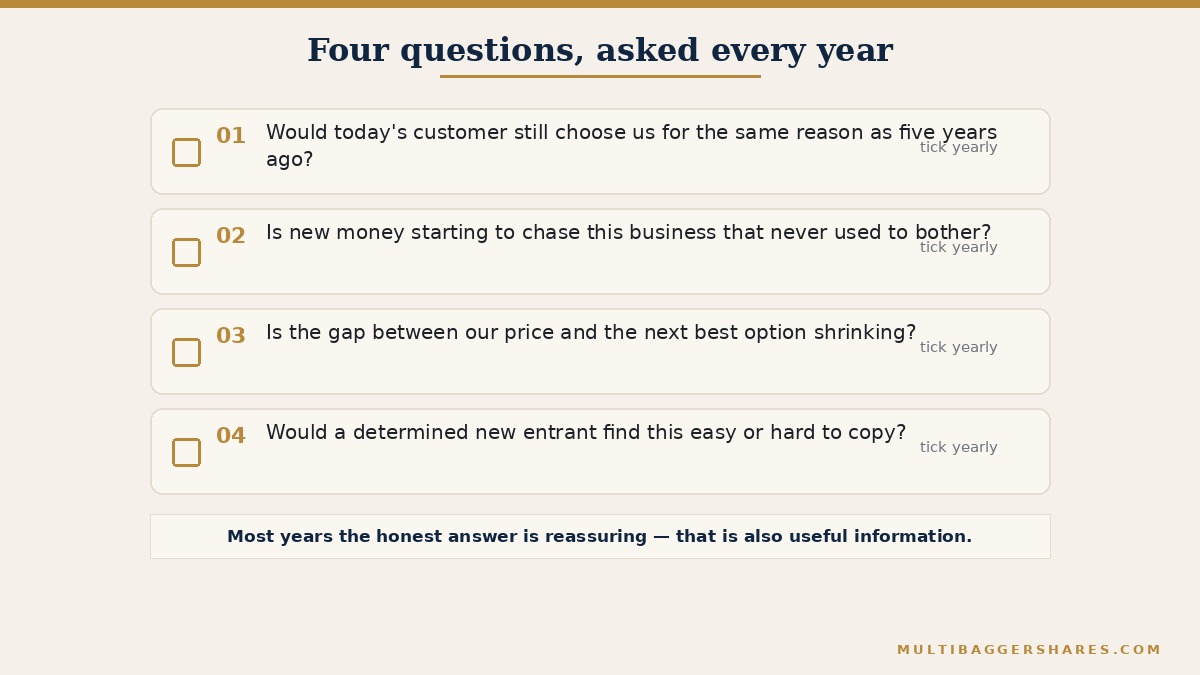
Four questions worth asking every single year
One. Would today’s customer still choose us for the same reason as five years ago? Write down, in one honest sentence, why a customer picks this business over the alternative. Then check that sentence again next year. If the reason has to be rewritten, quietly, to still sound true, that rewriting is the earliest possible warning — long before it reaches a quarterly result.
Two. Is new money starting to chase this business that never used to bother? A moat that genuinely protects high returns is, almost by definition, unattractive to imitate, because imitating it does not pay off. When capital that previously ignored an industry suddenly starts flowing into it — new competitors, new funding rounds, new entrants from adjacent businesses — that is usually a sign the protection has weakened enough to be worth attacking, not a coincidence.
Three. Is the gap between our price and the next best option shrinking? Pricing power does not usually vanish as a single dramatic price cut. It vanishes as a series of small concessions: a discount here, a longer credit period there, a bundled extra thrown in for the same price. None of these show up as headline news. Together, tracked year over year, they are the clearest sign that the customer’s alternative has become good enough to matter.
Four. Would a determined new entrant, starting today with real money, find this business easy or hard to copy? Ask this honestly, not as the business itself would answer it. Kodak’s own engineers could have answered this question about film versus digital in the 1970s; the technology existed inside their own laboratory. The question was never whether copying was possible. It was whether anyone with the incentive to try would eventually turn up — and given enough time, in a competitive economy, someone almost always does.
What this does not mean
None of this is a reason to distrust every business with a strong moat, or to sell out of quality the moment a single competitor appears. Distance moats, brand moats and switching-cost moats, among others, have protected some businesses for decades at a time precisely because the four questions above kept returning reassuring answers year after year. The point of asking them regularly is not to expect erosion. It is to notice it early on the rare occasions when it begins, instead of waiting for the headline profit number to announce it once the draining is already well advanced.
It is also worth being honest about the limits of hindsight here. Kodak and Nokia look, in hindsight, like obvious cases of a company that should have moved faster. At the time, inside each company, the decision to keep investing in the business that was still comfortably profitable looked entirely reasonable, because it was still comfortably profitable. That is exactly why these four questions are worth asking on a fixed yearly schedule rather than only when something already feels wrong. The feeling that something is wrong is, itself, usually a lagging signal.
How you can use this
You do not need access to either company’s internal data to apply this. As an outside investor reading annual reports and quarterly results, watch the same three gauges in the order they tend to move: market share within the specific category the company competes in, not merely total revenue; gross margin trend over five to eight years, not one or two; and any change in the language a company uses about its own pricing, discounting or promotional spending. A business whose gross margin is quietly narrowing while its revenue still grows is very often further along the erosion path than its share price suggests.
Then make the four questions a fixed, annual habit for every business you already own or follow closely, in the same unglamorous way a well would once have been inspected before every summer. Most years, for most well-run businesses, the honest answer to all four questions will be reassuring, and that reassurance is itself useful information, not wasted effort. The habit only pays for itself in the occasional year when an answer quietly changes — and by then, having asked the question every year rather than only once, you will actually notice.
The well in that village is still standing today. It is not broken, and it was never meant as a cautionary tale about neglect or bad workmanship. It is simply the plainest possible illustration of a truth that applies just as well to a hundred-year-old company as it does to a hundred-year-old well: an edge is not something you own forever once you have built it. It is something you keep, for as long as the world around it keeps needing exactly what you offer — and the only way to know whether that is still true is to keep asking.
Key takeaways
- A moat is a gap between a company and the rest of the world, not a fixed wall the company owns — and a gap can close from either side, even if the company itself changes nothing.
- Erosion is usually quiet: market share and gross margin tend to weaken years before reported profit shows any damage, because profit is the slowest of the three gauges to move.
- Kodak invented the digital camera in 1975 and still went bankrupt in 2012; Nokia held roughly 40% global share in 2007 and sold its handset business six years later. Neither company’s factories got worse.
- Ask four questions every year: does the customer still need us for the same reason, is new money entering this business, is our pricing edge shrinking, and would a new entrant find us easy or hard to copy.
- The goal is not suspicion of every quality business — it is a fixed yearly habit, so that the rare year an answer changes gets noticed early rather than after the profit numbers already show it.
— Manish Goel · multibaggershares.com
Manish Goel is a Chartered Accountant and Principal Officer of Multibagger Securities Research & Advisory Pvt. Ltd. (MSRAPL), a SEBI-registered Investment Adviser, Registration No. INA100007736. This content is published by MSRAPL for education only and is not personalized investment advice.
Disclaimer: This article is published by multibaggershares.com for education and general information only. It is not investment advice, investment research, or a recommendation to buy, sell or hold any security. Any companies named are discussed only as illustrative examples. Markets carry risk; please do your own research or consult a qualified professional before making any investment decision. |