The Copy Test: Could a Rich Rival With Unlimited Money Copy This Business?

The Tiffin Lady’s Arithmetic: What It Costs a Business to Win a Customer, and What That Customer Is Worth Over the Years
October 2, 2026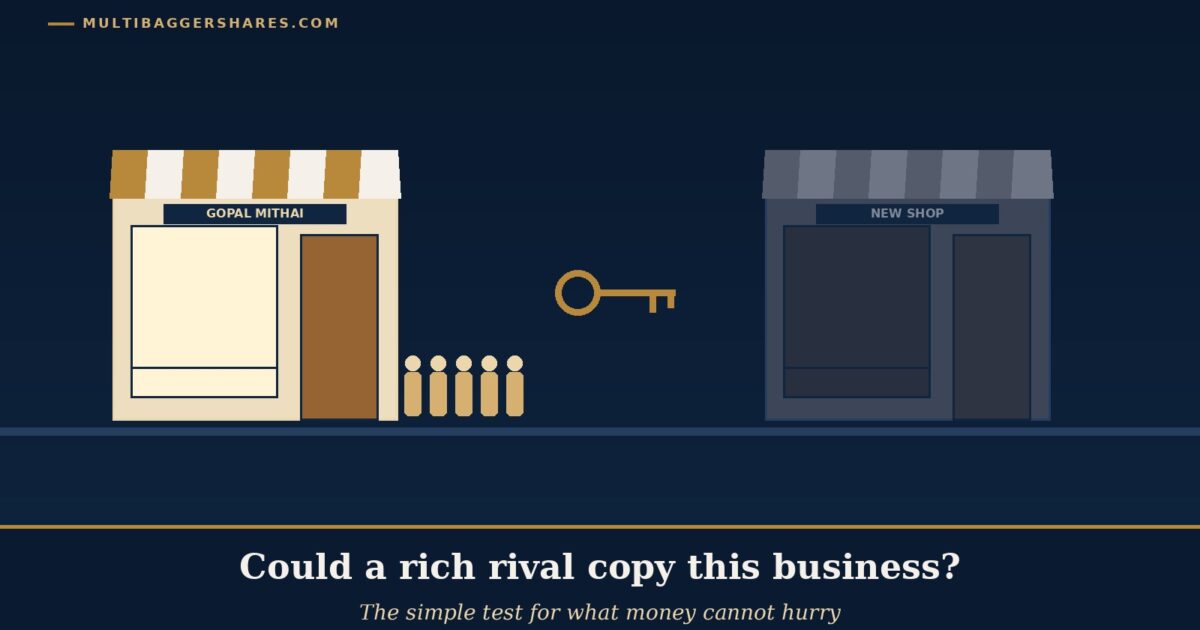
Picture a small sweet shop in the old lane of a town. Call it Gopal Mithai. It has stood on the same corner since 1962. The paint is a little faded. The glass counter has one crack that nobody has fixed in twenty years. But on the evening before Diwali, the queue outside runs all the way to the chemist.
Now imagine a rich businessman who watches that queue and thinks, I can do this better. He rents the shop opposite. He spends twenty lakh rupees on marble, bright lights and a glass display. He hires a skilled cook away from a famous kitchen and copies every sweet on Gopal’s menu. He prices them ten percent lower. For the first month he gives a free box of barfi to anyone who walks in.
Six months later, the new shop is handsome and half empty. The old shop, with its cracked glass, still has its queue on festival evenings. The businessman copied the shop, the sweets, the cook and the price. Everything that money could purchase, he purchased. And yet the one thing that filled the old shop was never for sale.
Today’s letter is about that gap. It gives you one simple question to ask about any business, large or small. I call it the copy test.
What it really means
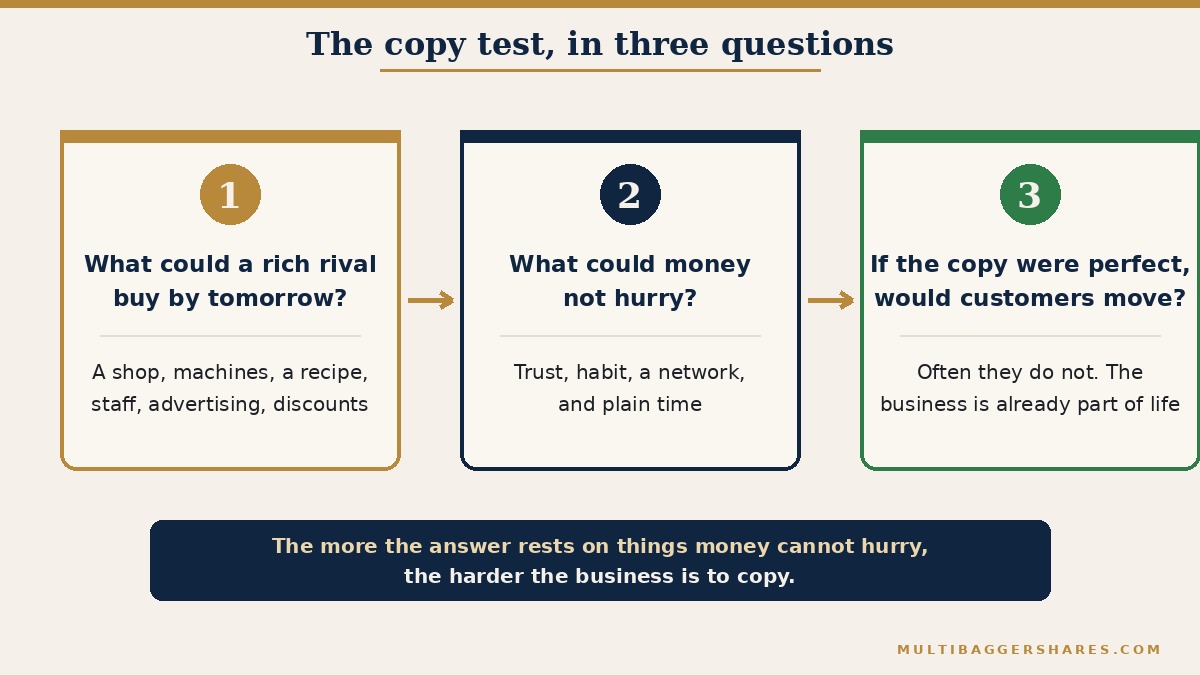
Here is the test in one sentence. Imagine a rival with unlimited money, good people and a free hand. Could they copy this business tomorrow? And if they did, would the customers leave?
Investors have a name for what protects a business from copying. It is called a moat (a lasting advantage that keeps rivals out, the way a water-filled ditch kept armies away from a castle). The copy test is a plain way of checking whether a moat is real. It asks you to look past the numbers and imagine the attack.
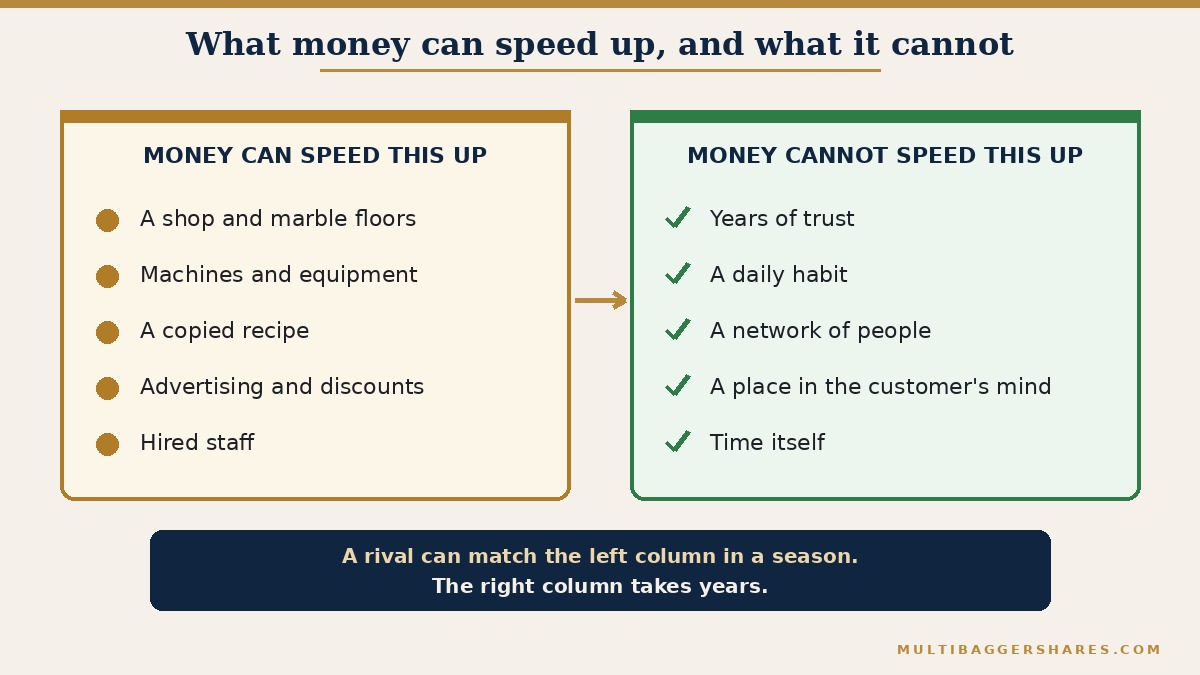
The test has three steps. The first step is to list what the rival could purchase straight away. A shop, machines, a recipe, advertising, hired staff, even discounts. Money moves quickly through all of these, so none of them protects anything for long.
The second step is to ask what money could not hurry. The things on this list are usually trust (the feeling customers have that this business will not let them down), habit (doing something without thinking, like asking for the same brand each time), a network (many people connected to one another, so that each new person makes the whole thing more useful), and plain time. You cannot hurry forty years. You cannot hurry a farmer’s faith that he will be paid on the first of every month.
The third step is the hardest and the most useful. Suppose the copy were perfect. Would customers actually move? Many a perfect copy has failed here, because people do not choose a business by comparing it with a checklist. They choose it because it is already part of their life.
Why it works
To see why this test is better than it first sounds, look at what it replaces. When most people try to judge a business, they look at what it earns today. But earnings today tell you what has happened. They say very little about whether it can keep happening once a hungry rival arrives.
A profit margin (the share of every rupee of sales that the business keeps as profit) that looks healthy is also a signal that attracts competitors. If the profits are high and the business is easy to copy, competitors will come, and their arrival will push the profit back down. If the profits are high and the business is hard to copy, they stay. The copy test helps you tell these two situations apart.
Think of two street stalls. The first sells pani puri (hollow crisp shells filled with spiced water). A newcomer can start the same stall in a week. The cost is a cart, a few vessels and a supplier of shells. There is nothing here that money cannot purchase by Friday. Even if the stall is very popular today, that popularity is built on a recipe anyone can learn.
The second is Gopal Mithai. Its recipes could be copied too. But what it really owns is forty years of mothers telling daughters where to order sweets for a wedding. That is trust, and it was built one box at a time. A rival can spend a crore and still not own a single such memory.
There is a second reason the test works. It forces you to stay honest about luck. A business may be doing well because of a strong run in its industry, a favourable season or a single large customer. None of those would survive a determined copy. The test asks what would be left once the good weather passed.
There is a third reason, and it is about the rival’s arithmetic. A rich newcomer does not have unlimited patience, even if he has unlimited money. Every month that the new shop stays half empty, its rent, its staff and its electricity bill still arrive. A business that is hard to copy forces the rival to lose money for years before the first rupee of profit. Most rivals give up long before that day comes. This is why the strongest businesses rarely need to fight. The attacker runs out of appetite first.
A real example or two
Warren Buffett, the American investor, once put the test in a very vivid way. As widely quoted, he said: “If you gave me $100 billion and said, take away the soft-drink leadership of Coca-Cola in the world, I’d give it back to you and say it can’t be done.” Notice what he was not saying. He was not saying that the drink is impossible to make. A hundred other companies can make a cola. He was saying that the thing which matters is not the drink. It is the place the drink holds in billions of daily habits.
The company itself learned this in 1985, in the hardest possible way. On 23 April 1985, Coca-Cola replaced its original formula with a new, sweeter one, which became known as New Coke. The company had good reason. In blind taste tests (where people sip unmarked cups so they cannot be swayed by the label), many people said they preferred the new taste.
The public reaction was fierce. According to the history of the episode, the company received about 8,000 phone calls a day and about 40,000 letters of complaint. Customers were not complaining about flavour. They were complaining that something that belonged to them had been taken. On 11 July 1985, just 79 days after the launch, the original returned under the name Coca-Cola Classic, and it soon regained its place as the leading cola.
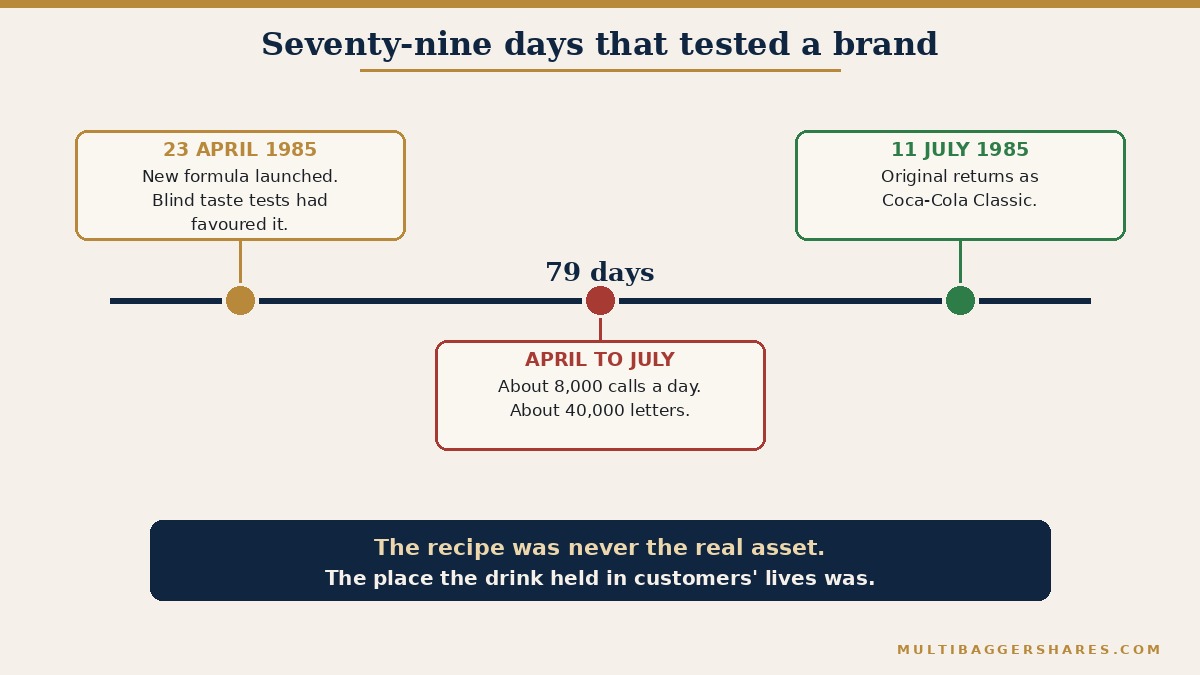
Read that story as a copy test run in reverse. The owner of the brand could not make people drop the old taste, even with a better result in the taste test. If the owner could not move customers, think how difficult it would be for a stranger with a bigger cheque.
Now an Indian example, which is even more striking because there was almost no money in it. In the 1940s, the farmers of Kaira district in Gujarat sold their milk through traders. One company, Polson, held an effective monopoly (the only buyer in the market) on the milk going to Mumbai. The farmers had little choice and little say in the price. So, guided by Sardar Vallabhbhai Patel, they formed their own cooperative (a business owned and run by the very people who supply it). It was registered on 14 December 1946 as the Kaira District Co-operative Milk Producers’ Union, under the leadership of Tribhuvandas Patel, and joined in 1949 by the dairy engineer Verghese Kurien. It adopted the brand name Amul in 1955.
Today that cooperative network reaches about 3.6 million milk producers. Run the copy test on it. A rival can rent a factory, hire a dairy engineer and spend heavily on advertising. What the rival cannot purchase is the millions of small farmers, each delivering a litre or two every morning to a village collection point, each trusting that payment will come. That network took decades of patient work, one village at a time. It cannot be hurried by a larger budget.
I name these two organisations only as stories from business history, because they show the test so clearly. They are not a signal about any share, and nothing here says what any share is worth.
How you can use it
You do not need a computer for the copy test. You need a quiet half hour and a notebook. Here is how an ordinary investor can use it on any business they are curious about.
Start by writing down, in one line, what the business actually sells and to whom. Then write the attack. If I had twenty crore rupees and three years, what exactly would I do to take its customers? Be concrete. Which shops would I open? Which people would I hire? What would I price at?
Next, cross out everything on your list that money can finish within a year. What is left is the real protection. If your list is now empty, the business is, in plain words, easy to copy. That does not make it a bad business. A good pani puri stall can feed a family for life. But it means the business must keep running faster than its rivals, and its profits will always attract company.
If something is left, give it a name. Is it trust? A habit? A network? A licence that takes years to obtain? A customer who would face a real hassle in switching? Naming it matters, because a named advantage can be watched. You can ask each year whether it is getting stronger or weaker.
Finally, look for evidence that the advantage is real, and not just a story the business tells about itself. In the annual report, check whether customers come back year after year, whether the business has held its profit margin through rough patches, and whether rivals have already tried and failed. A business that has survived serious attacks has already passed part of the test in real life. Another useful clue is the company’s own spending. A business with a real advantage does not need to keep paying heavily to hold its customers.
Be careful with four things that look like protection but usually are not. The first is size alone. A big business is not hard to copy simply because it is big; a bigger rival can match it. The second is a hot product. A product that everybody wants this year can be matched by next year. The third is a famous founder or a brilliant manager. Talent is valuable, but people leave, retire and get poached. The fourth is a technology lead. A lead of two years is a head start, not a wall. In each case, ask the same question: could a rich rival close this gap within a few years? If the answer is yes, it is a lead, not a moat.
One caution. The test is about understanding quality, not about guessing a price. It says nothing about the market price of any share, and it is not meant to. Its job is smaller and more durable: to teach you to recognise the kind of business that is hard to take apart.
Return, for a moment, to the lane with the two sweet shops. The businessman with the marble floor was not foolish. He simply looked at what he could see, the counter, the sweets and the price, and assumed that was the whole business. The real business was invisible. It lived in the memory of ten thousand families. Learning to look for what is invisible, and what cannot be purchased in a hurry, is one of the most useful habits an investor can build.
Key takeaways
- The copy test asks one question: if a rich rival tried to copy this business tomorrow, what could their money not purchase?
- Shops, machines, recipes, advertising and discounts can all be bought quickly, so they protect very little on their own.
- Trust, habit, a network and time are the things money cannot hurry, and they are where a lasting advantage usually lives.
- Ask a third question too: even if the copy were perfect, would customers actually move?
- Name the advantage you find, and check each year in the annual report whether it is getting stronger or weaker.
— Manish Goel · multibaggershares.com
Manish Goel is a Chartered Accountant and Principal Officer of Multibagger Securities Research & Advisory Pvt. Ltd. (MSRAPL), a SEBI-registered Investment Adviser, Registration No. INA100007736. This content is published by MSRAPL for education only and is not personalized investment advice.
Disclaimer: This article is published by multibaggershares.com for education and general information only. It is not investment advice, investment research, or a recommendation to buy, sell or hold any security. Any companies named are discussed only as illustrative examples. Markets carry risk; please do your own research or consult a qualified professional before making any investment decision. |