Fix the Roof While the Sun Shines: What a Business Does With Its Best-Ever Year

Who Is Standing at the Counter? How to Judge the Quality of the People a Business Sells To
October 5, 2026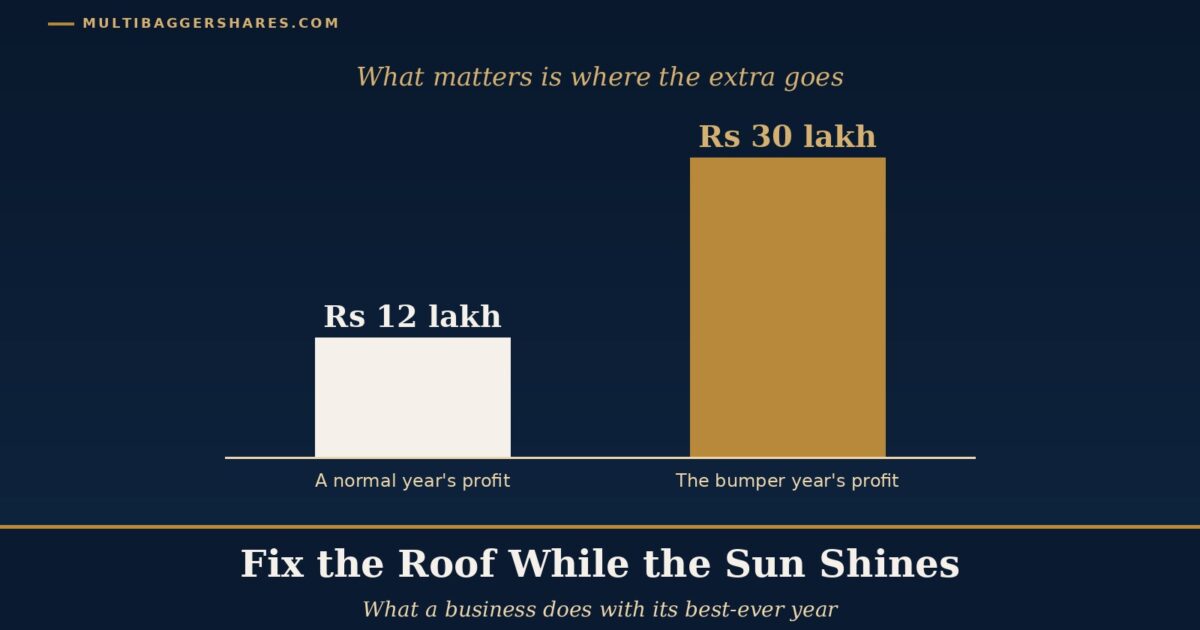
Meena and Rajan run two sweet shops in the same town. Every year, in a normal year, each earns a profit of about Rs 12 lakh (one lakh is one hundred thousand rupees). Then comes a Diwali like no other. The weather is perfect, the town is full of visitors, and orders pour in. Each of them earns Rs 30 lakh in profit that year. That is Rs 18 lakh more than usual.
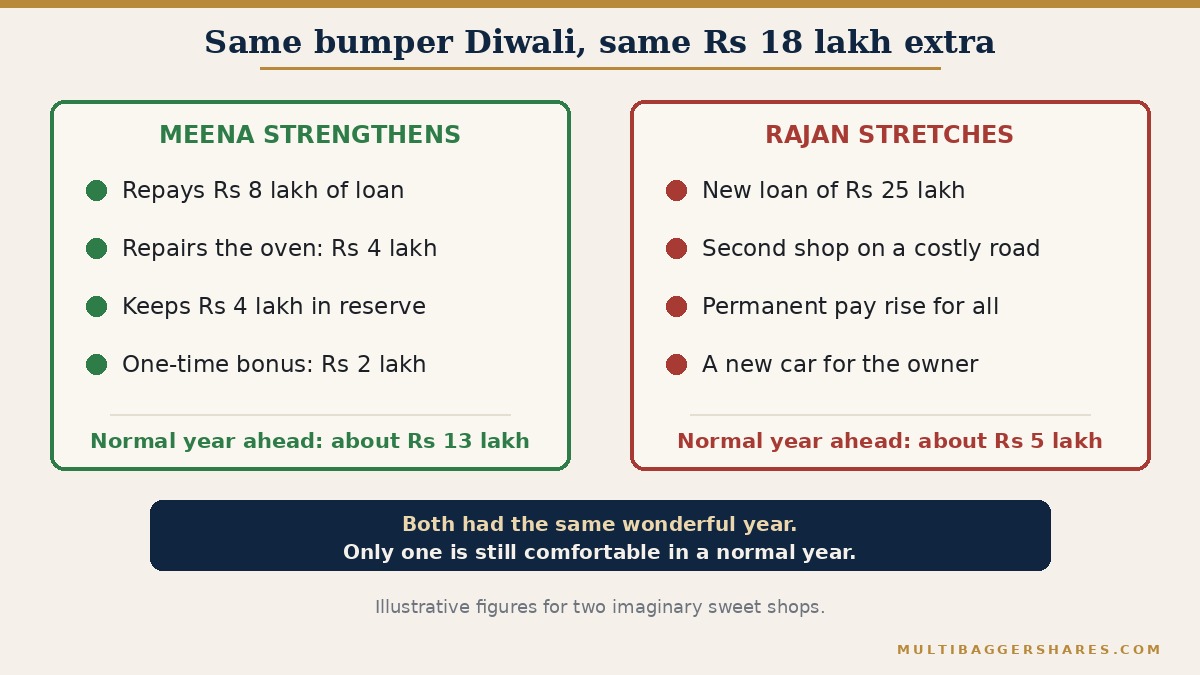
Now watch what each of them does with the extra Rs 18 lakh. Meena repays Rs 8 lakh of a bank loan (a loan is borrowed money that carries interest, like rent paid on money). She spends Rs 4 lakh on repairing the old oven that has been giving trouble for years. She keeps Rs 4 lakh aside as a reserve. And she gives her staff a one-time bonus of Rs 2 lakh with a warm thank-you.
Rajan feels like a king. He takes a fresh loan of Rs 25 lakh and opens a second shop on the busiest road in town. He raises every salary by a tenth, for good, so that nobody leaves. He also buys himself a new car, because he has earned it.
Next year, the town returns to normal. Profit before any new costs is back to Rs 12 lakh. Meena has no interest to pay on the loan she cleared, so she earns about Rs 13 lakh. Rajan has Rs 3 lakh of yearly interest, Rs 2 lakh of extra salaries, and a new shop that is still losing about Rs 2 lakh. His profit is only about Rs 5 lakh. Both had the same wonderful year. Only one of them is still comfortable.
This is today’s lesson. A good year is not the real test of a business. What the owners do with a good year is.
What it really means
Almost every business has years that are better than usual. A good monsoon lifts a seed company. A cold winter lifts a sweater maker. A boom in the building trade lifts a cement or steel producer. These businesses are called cyclical (their fortunes rise and fall in waves, like the tide). In such years, profits can double without the business becoming any better at what it does.
So the first thing to understand is the difference between a bumper year and a normal year. Think of a farmer who has a bumper harvest. The grain in the store is real, and the farmer is richer today. But the next monsoon may be poor. A wise farmer does not plan the next ten years as if every harvest will be a bumper one.
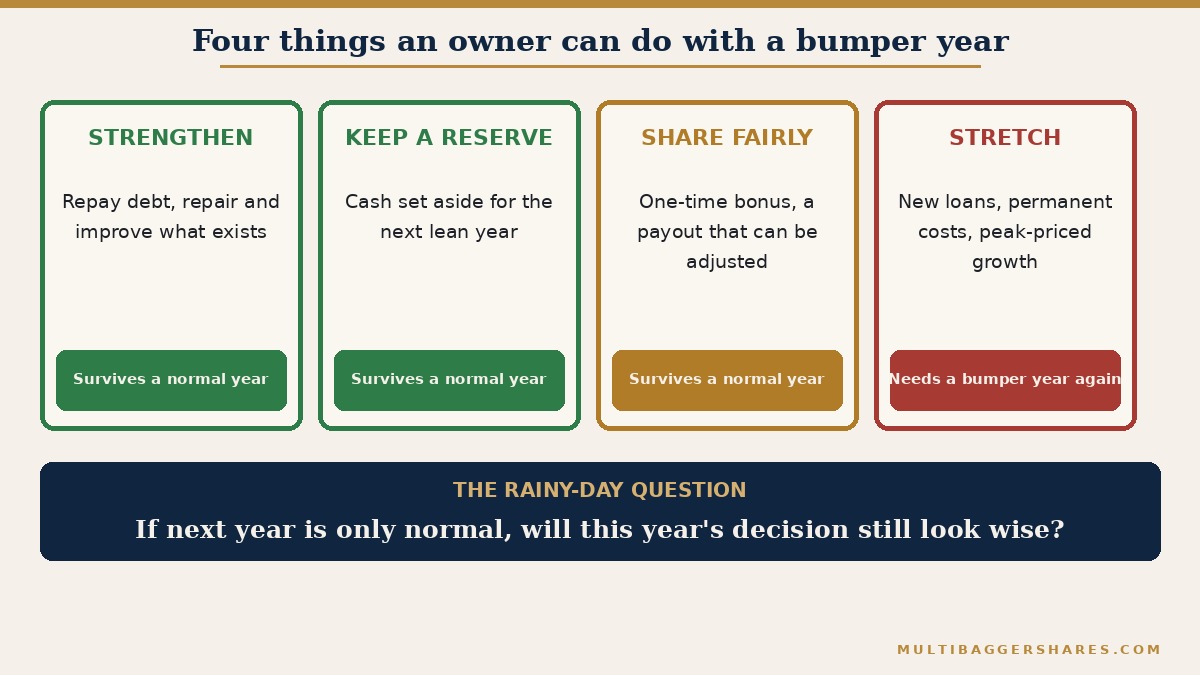
The second thing to understand is that extra money has to go somewhere. An owner has only a few choices. The money can be used to strengthen the business, for example by repaying debt (money borrowed) or by repairing and improving what is already there. It can be kept aside as a reserve. It can be shared with staff or owners in a way that can be adjusted next year. Or it can be stretched, meaning it is used to take on bigger costs that will stay long after the good year is gone.
The investor’s job is not to guess which year will be good. Nobody can do that reliably. The job is to look back at the last good year and see which of those four choices the owners made. It is a little like asking how a person behaves when they win a small lottery. Their answer tells you more about their character than a hundred speeches.
There is an old line from John F. Kennedy that fits perfectly. In his State of the Union address on 11 January 1962, he said: “The time to repair the roof is when the sun is shining.” Nobody repairs a roof happily in the rain, and in the rain the leak is already inside the house. Good owners do their repairs while the weather is kind.
Why it works
The reason is simple arithmetic, and it comes from a quiet difference between two kinds of spending. A one-time cost is paid once and is over. A permanent cost, such as interest on a new loan or a salary rise, comes back every single year. Accountants call costs that do not shrink when sales shrink fixed costs (costs that arrive whether the shop is busy or empty).
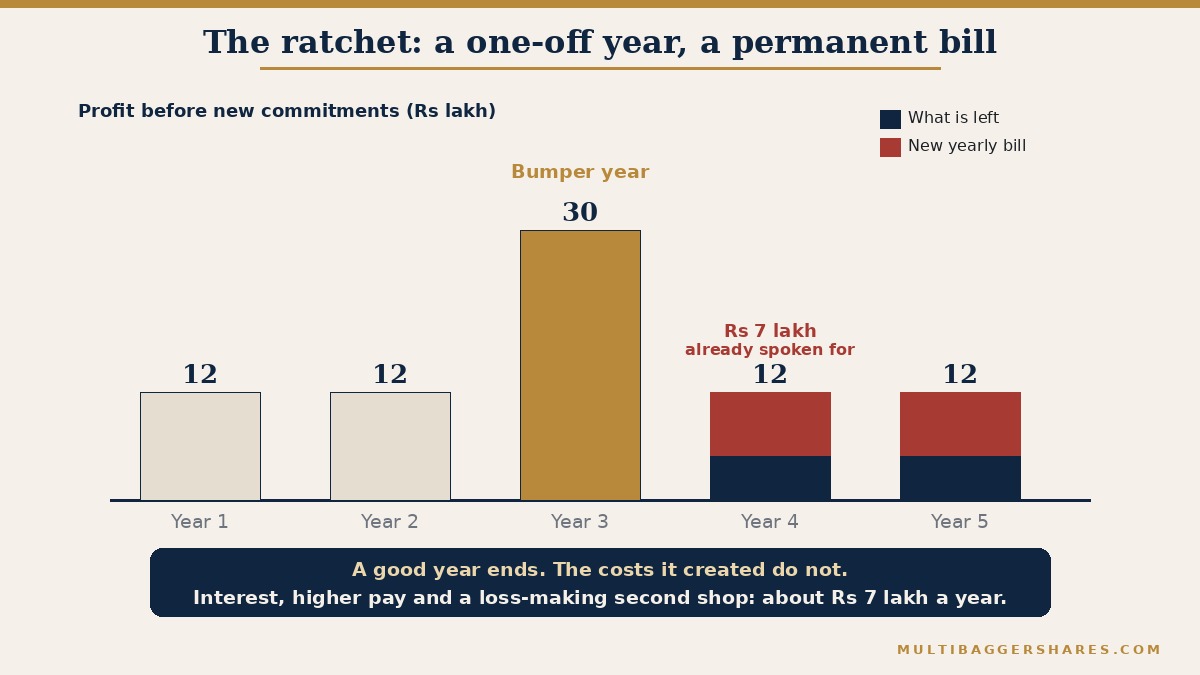
Think of it like a ratchet, the kind of tool that turns easily one way and does not turn back. A good year makes it easy to add costs. A normal year makes it very hard to take them away. Once you have given everyone a pay rise, nobody will cheerfully accept a pay cut when the sun goes in. Once you have borrowed money, the bank wants its interest on the due date, and it does not care whether Diwali was kind.
That is why a stretched business is fragile. In Rajan’s case, one bumper year created seven lakh rupees of yearly commitments (interest, salaries and the losses of the new shop). He now needs a bumper year again just to feel comfortable. A business that needs luck to stay healthy is not a strong business. It is a lucky one, for now.
Strengthening works the opposite way. Every rupee of debt repaid in a good year is a rupee of interest that never has to be paid again. Every repair done now is a breakdown that does not happen during the busy season later. The strengthening is also permanent, but this time it works in the owner’s favour. Think of it as planting a tree during a good year, so the shade is there every summer afterwards.
There is also a human reason. Easy money makes people feel clever. Prices seem low compared with their plans, rivals seem weak, and every idea looks sensible. Owners who stay calm in such a year, and treat part of the profit as a gift of the weather rather than a reward for their own genius, tend to make better choices over decades.
None of this means an owner should never spend in a good year. A good year can be the right time to invest in something that will truly pay for itself. The point is the way it is done. Investment that is paid for with the business’s own spare money, and that would still make sense even in a normal year, is healthy. Investment that is paid for with new borrowing and that makes sense only if the boom continues is not.
A real example or two
Let us look at one Indian company in two different years. Tata Steel is one of India’s best-known steel makers. We name it here only to tell its history. This is a lesson, not a view on the share.
In January 2007, steel was in a strong period. Tata Steel announced that it had agreed to buy Corus, a large Anglo-Dutch steel maker, after a bidding contest with a Brazilian steel company. During that contest its offer rose from 455 pence per share in October 2006 to 608 pence per share. The company said the purchase would be funded by a combination of extra credit facilities and a cash contribution from the company. This was a bold, long-term strategic decision with many moving parts, made in a good time for the industry, and it was paid for partly with borrowed money. The world economy then went through a sharp downturn from 2008, and steel went through a hard stretch.
Now look at a different good year. In its financial year 2021-22, Tata Steel reported its highest ever consolidated EBITDA (earnings before interest, tax and certain other charges, a rough measure of what the business earns from its operations) of Rs 63,830 crore, against Rs 30,892 crore a year before. In its own results release, the company said that it made net repayments of Rs 15,232 crore during the year, and that its net debt had come down to Rs 51,049 crore by March 2022. In a bumper year, a good part of the extra money went to reduce borrowing.
We are not saying that either decision was right or wrong. The first was a strategic bet and the second was a balance-sheet clean-up, and a single company can reasonably do both at different times. What the two stories show is how an investor can look at a company’s history. In a very good year, ask: where did the extra money go? To lower debt, or to bigger and heavier commitments?
Here is the same idea from a village. In the story of Joseph in the Bible, a ruler is warned of seven years of plenty followed by seven years of famine. He stores grain during the plentiful years, so that the kingdom can eat during the lean years. Indian farmers have always done the same with their grain stores (kothis) after a good monsoon. These are old stories, but they say what a modern annual report says in numbers: store in the good years, so that the bad years are survivable.
How you can use it
You do not need special software for this. You need an annual report, a few years of numbers, and four plain questions. Think of them as questions you would ask before lending a friend money for his shop.
Question one: in the company’s best-ever year, did borrowing go down or up? Place the debt figure for the year before the good year next to the debt figure at the end of it. A company that was truly strengthened by a good year will usually show lower debt, or at least not much more.
Question two: did permanent costs jump in step with the good year? Look at employee costs, interest costs and rent over five years. If they leapt up in the good year and stayed up, the owner has created a ratchet. Some increases are fair and necessary, such as paying people well. The worry is a jump that is far bigger than the long-run growth of the business.
Question three: was the spending on new capacity or acquisitions made at the very top of the good cycle, and with borrowed money? Capacity built at the peak is ready just when demand has gone back to normal. Look at how much of the new spending was funded from the company’s own cash flow (the cash that comes in from the operations of the business), and how much from new loans.
Question four: how do the owners talk about the good year? Read the chairperson’s letter and the management discussion. Honest owners say plainly that the year was unusually good, give the reasons, and say what they expect from a normal year. Be careful with phrases such as “the new normal” that explain away every windfall as a permanent change.
It also helps to see the owners’ own pay and perks. In a bumper year, did the pay and perks of the promoters and top managers (the people who own and run the company) rise far faster than the profits of the ordinary shareholders? This is a small clue, but it speaks of how the owners think about the people who share the risk with them.
Notice what these questions leave out. They do not ask whether a share is cheap or costly today. They only ask about the quality of the owners’ choices when life was easy. A business whose owners behave like Meena will go on strengthening itself, year after year, and compounding (earning returns on past returns, like interest on interest) works best on strong foundations.
Next time you read about a company with a record year, do not stop at the headline number. Ask the rainy-day question: if next year goes back to normal, will the decisions made in this year still look wise? If yes, the sun was used well. If no, the roof was left leaking.
Key takeaways
- A bumper year is a gift of the cycle, not proof that the business has permanently become better.
- What owners do with extra money in a good year shows their character more than any speech: strengthen, save, share fairly, or stretch.
- Permanent costs added in a good year (new loans, pay rises, new capacity) work like a ratchet and come back every year.
- Check the last record year: did debt fall, did fixed costs jump, and was new spending paid from cash or from borrowing?
- Ask the rainy-day question: if next year is only normal, will this year’s decisions still look wise?
— Manish Goel · multibaggershares.com
Manish Goel is a Chartered Accountant and Principal Officer of Multibagger Securities Research & Advisory Pvt. Ltd. (MSRAPL), a SEBI-registered Investment Adviser, Registration No. INA100007736. This content is published by MSRAPL for education only and is not personalized investment advice.
Disclaimer: This article is published by multibaggershares.com for education and general information only. It is not investment advice, investment research, or a recommendation to buy, sell or hold any security. Any companies named are discussed only as illustrative examples. Markets carry risk; please do your own research or consult a qualified professional before making any investment decision. |