The Slowest Step in the Kitchen: Why a Business Can Only Move as Fast as Its Bottleneck

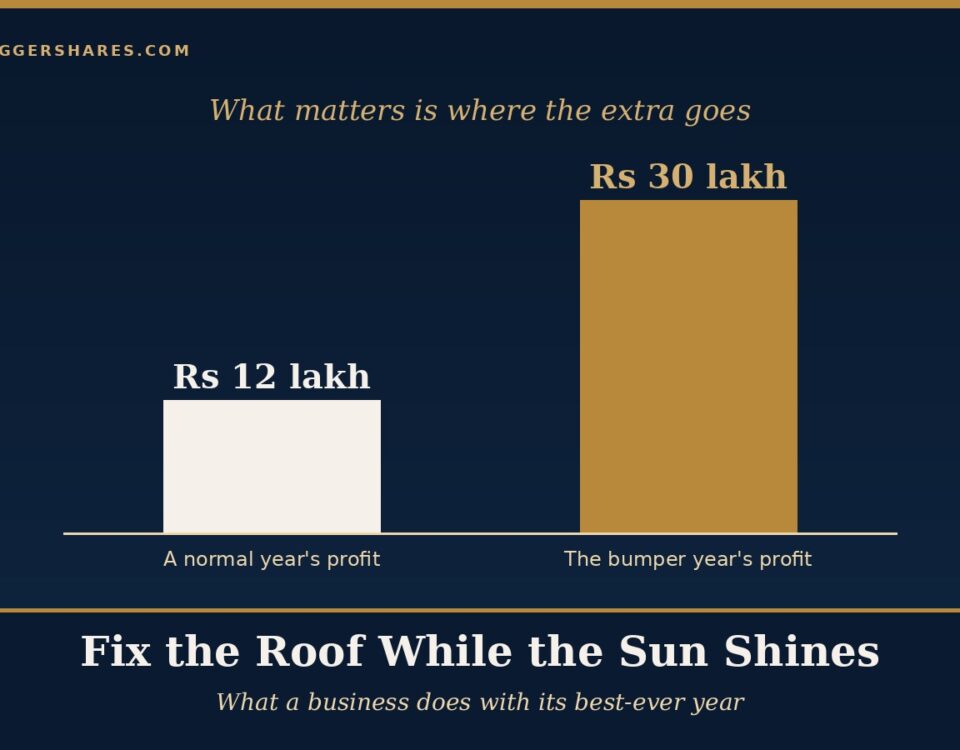
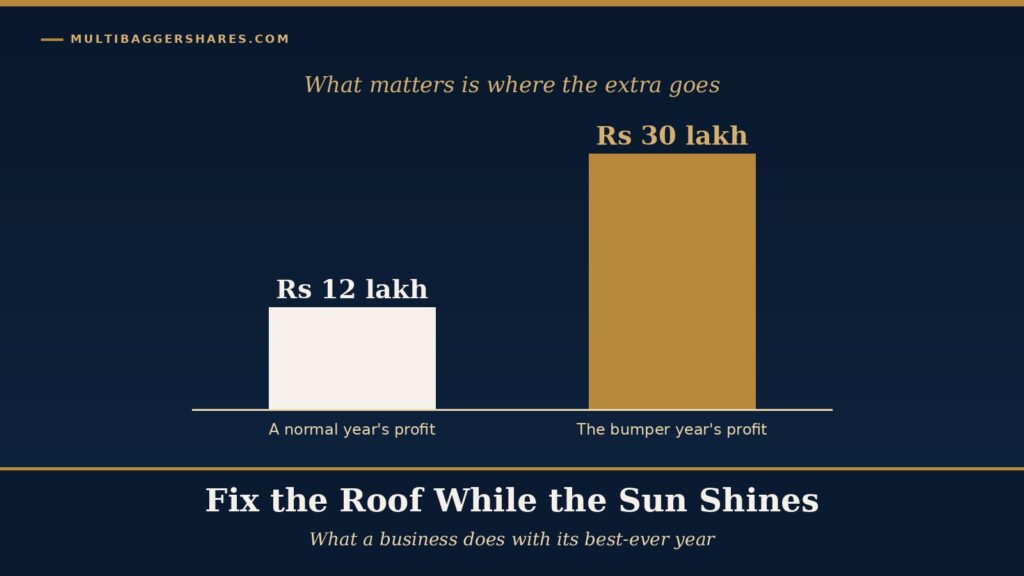
Fix the Roof While the Sun Shines: What a Business Does With Its Best-Ever Year
October 6, 2026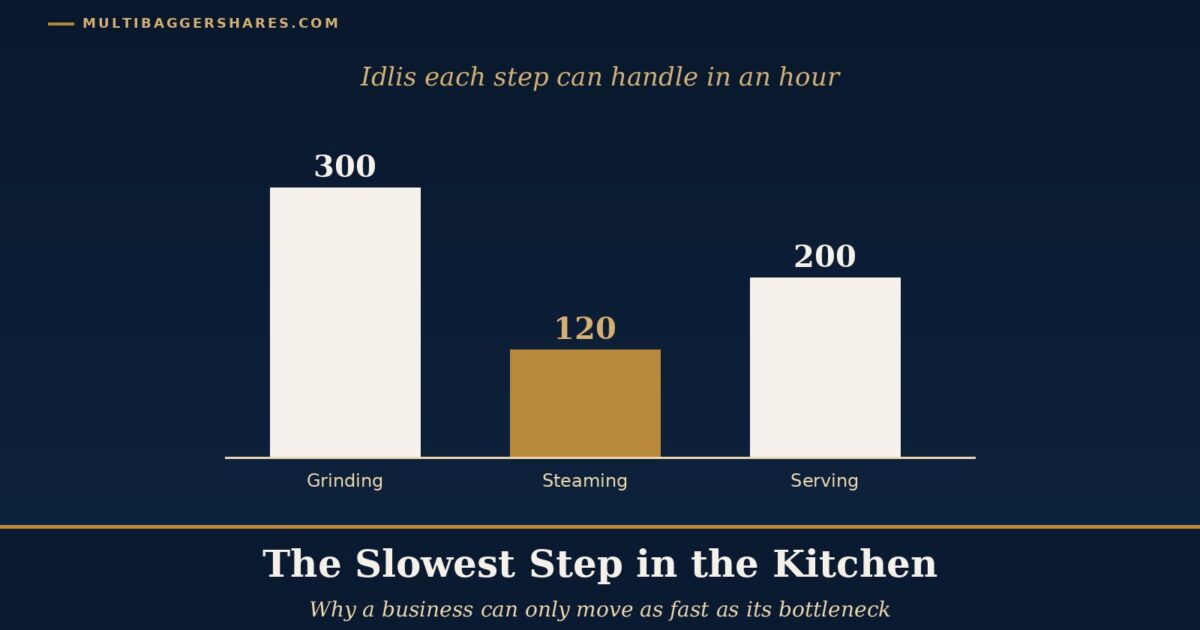
Ravi runs an idli stall near a bus stand. Every morning from seven to ten, a line of hungry customers waits at his counter. He is tired of watching people leave because the wait is too long. So he decides to spend some money to sell more.
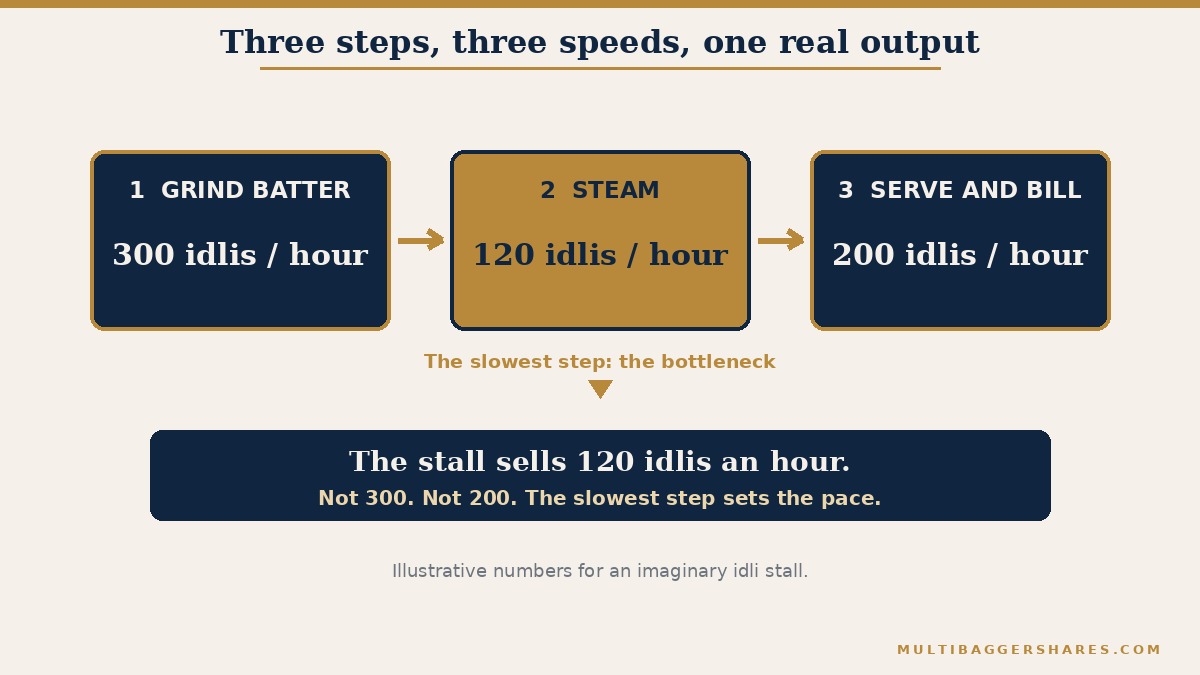
Let us look at how his stall works. An idli (a soft steamed rice cake) goes through three steps. First, batter is ground. Second, the idlis are steamed. Third, they are served and the bill is taken. Each step has its own speed. His grinder can prepare enough batter for 300 idlis in an hour. His steamer can cook only 120 idlis in an hour. And the counter, where he and his helper serve and bill, can handle 200 an hour.
In the morning rush, about 250 customers an hour want idlis. Each idli earns Ravi a profit of about Rs 4 after paying for rice, lentils and gas. These are imaginary numbers, chosen to keep the arithmetic easy.
Now, how many idlis does Ravi actually sell in an hour? Not 300, and not 200. He sells 120. Whatever the grinder can do, and whatever the counter can do, the steamer lets out only 120 idlis an hour. The slowest step decides the speed of the whole kitchen. That step has a name: the bottleneck (the narrow neck of a bottle, which decides how fast the water can pour out, however wide the bottle is below it).
What it really means
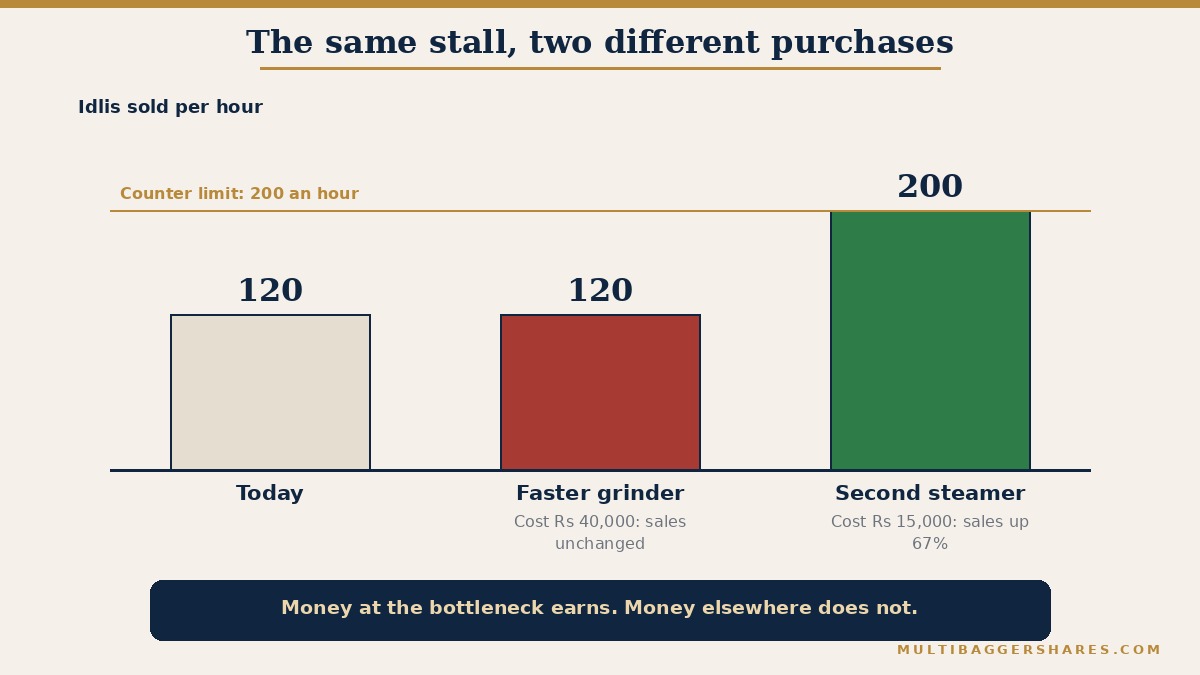
Ravi has two ideas for spending his savings. The first is to buy a faster grinder for Rs 40,000, which would raise batter from 300 to 450 idlis an hour. The second is to buy a second steamer for Rs 15,000, which would double his steaming from 120 to 240 an hour.
The faster grinder looks impressive and costs far more. It also changes nothing. The steamer still lets out 120 idlis an hour. The extra batter just sits in a bucket. Ravi has spent Rs 40,000 and his profit has not moved by one rupee.
The second steamer is different. Steaming now handles 240 an hour, but the counter can serve only 200, so the stall now sells 200 idlis an hour, up from 120. That is 80 more idlis every hour, and at Rs 4 each, Rs 320 more profit every hour. Over a three-hour rush, it is Rs 960 a day. The Rs 15,000 steamer pays for itself in about sixteen days.
The same business, the same savings, and two very different results. The only difference is where the money was spent. Money spent on the bottleneck earns at full speed. Money spent anywhere else earns nothing at all.
Notice something else. After the second steamer, Ravi’s bottleneck moves. It is now the counter, at 200 an hour. The bottleneck never disappears. It only travels from one step to the next, like a traffic jam that moves down the road when you clear one junction. The wise owner keeps asking the same question: what is the slowest step now?
This is worth saying twice, because it goes against our instinct. We tend to admire a business that looks busy: machines humming, workers rushing, trucks coming and going. But busy is not the same as productive. A kitchen where every step is working flat out, except that the slowest step is jammed, is a kitchen that is wasting effort. What matters is not how busy the business looks. What matters is how much good work comes out of the narrowest point.
Where this idea comes from
This way of thinking was made famous by an Israeli physicist and business teacher, Eliyahu Goldratt. In 1984 he published a novel called The Goal (written with Jeff Cox). The hero, Alex Rogo, is the manager of a factory that is late with its orders and losing money. Everything in the factory looks busy. Yet the orders do not go out on time.
The most loved scene in the book does not happen in the factory at all. Alex takes a troop of boy scouts on a hike. He notices that the line of boys keeps stretching out, with the fast walkers far ahead and the slow ones far behind, and the troop has to keep stopping to wait. The slowest boy, called Herbie, sets the real pace of the whole group, because the troop can only reach camp together.
Alex tries putting the fastest boys at the front. That makes things worse, because the line stretches even more. Then he puts Herbie at the front, so that everyone else must walk at Herbie’s pace. The troop stays together, and it reaches camp much sooner and in good spirits. Alex then sees that his factory is just like the hike. A few slow points hold the entire factory back, while the rest of the plant is busy making piles of half-finished goods that nobody can use.
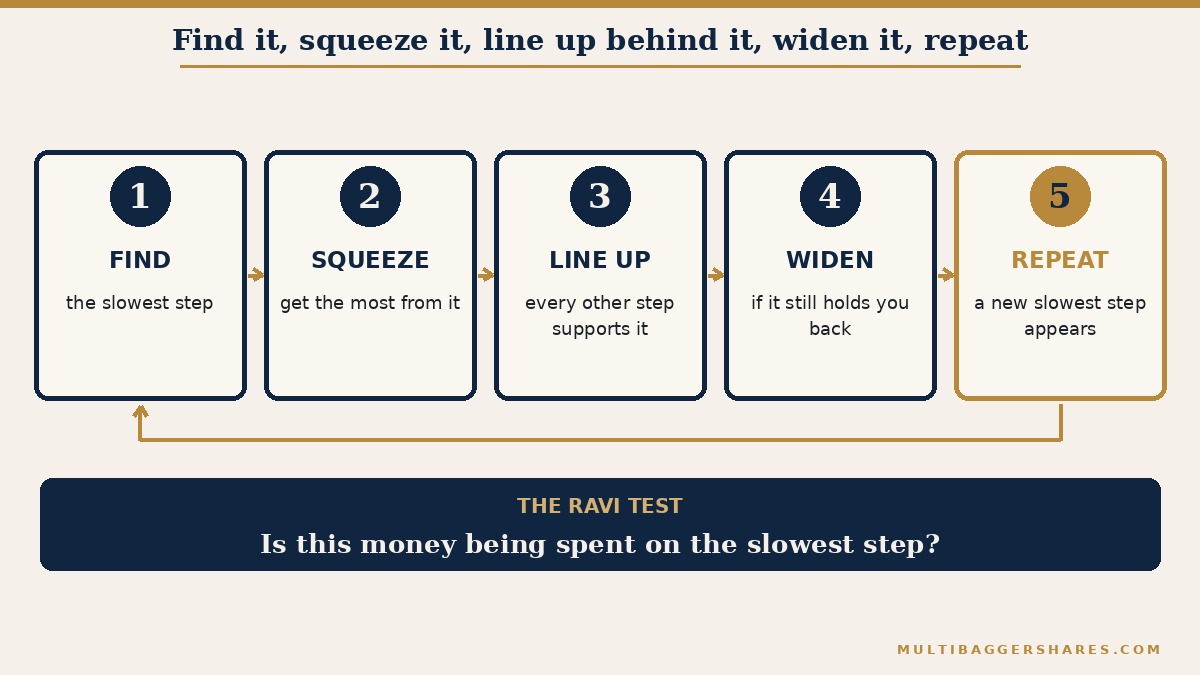
Goldratt called his approach the theory of constraints (a constraint is simply whatever limits the system). Its core is five plain steps. Find the slowest step. Get the most you can out of it. Make every other step support it instead of racing ahead. Widen it, if it still holds you back. And then repeat, because a new slowest step will appear. A line often quoted from Goldratt says it neatly: “An hour lost at a bottleneck is an hour lost for the entire system.”
Why it works
The idea works because of one simple rule of arithmetic. In any chain of steps, the output of the chain is the output of its slowest step. Nothing more. You can make the other steps ten times faster, and the answer stays the same.
Think of a highway with six lanes that narrows to a single lane at a toll plaza. Cars race along the six lanes and then pile up at the plaza. Making the highway wider before the plaza will not get a single extra car through the toll gate. Only widening the gate does. Everyone who has sat in such a jam understands this at once, yet many owners forget it when they spend their own money.
There is a second lesson, and it is a surprising one. Steps that are not the bottleneck should not be pushed to run flat out. If Ravi’s grinder worked at full speed all morning, it would only produce a mountain of batter that goes sour by noon. An idle grinder is not a waste. A grinder that makes too much batter is. Work should be released at the speed that the slowest step can take it.
You can see this in many places. A queue of unfinished work piling up in front of one machine is a signal. So is a department that is always working late while everyone else seems relaxed. These are the places where the bottleneck is hiding.
The third reason is about money. When the bottleneck is cheap to widen, a business can grow its sales a lot while spending very little. Ravi’s Rs 15,000 produced Rs 960 of extra profit every day. A business that keeps finding such small, cheap bottlenecks earns a high return on the money it invests (return on capital means how many rupees of profit each rupee put into the business earns each year). That is exactly the kind of business long-term investors like to own.
The opposite also happens. Imagine an owner who does not know where his bottleneck is. He spends Rs 40,000 on a faster grinder, then more on a grand new counter, and the sales hardly move. His profits stay flat while the money in the business grows. Year after year, the return on every rupee invested falls. Nothing is wrong with his products. Something is wrong with where he looks.
A real example or two
The scout hike is our first real example, even though it comes from a book. Goldratt’s The Goal has been read by a great many managers, and it is still widely read. Its lesson is simple enough for a child to follow: the group moves at the pace of its slowest member.
Here is a second example, closer to home. Think of any busy railway station where one ticket window is open and four are shut. The platforms are ready, the trains are on time and the staff are present. But the passengers move only as fast as that one window. A new escalator for the station will not shorten the line. Opening one more window will. A sensible manager watches the queue at the window, not the shine on the platform.
Indian industry has its own word for it. Companies in cement, steel, chemicals and paper often tell their shareholders about debottlenecking (a plant-floor word for widening the narrowest part of a factory, so that output rises without building a whole new plant). A company that raises its output noticeably by fixing a narrow section, for a small fraction of what a new plant costs, has used Ravi’s second steamer. We are describing the idea, not any company. Whenever you meet the word in an annual report, you now know what to ask.
A restaurant kitchen shows the same thing on a busy night. A restaurant can have ten waiters and a beautiful dining hall, but if the one tandoor (a clay oven) can bake only forty rotis in an hour, then that is all the restaurant can serve in an hour. Hiring five more waiters will not help. A second tandoor will. The owner who understands this spends on the oven. The owner who does not spends on new curtains.
How you can use it
You do not have to visit a factory to use this idea. A few plain questions, asked while reading an annual report or an investor presentation, will take you a long way.
Question one: where does the work wait? Look at the balance sheet for inventory (goods held in stock). If a company’s pile of semi-finished goods keeps growing faster than its sales, work may be piling up before a slow step. Read the notes and management discussion for any mention of a particular machine, department, or permit that is holding things back.
Question two: when the company announces a big expansion, which step is it widening? A company that says it will add capacity should be able to tell you whether the new capacity is at the narrowest step or somewhere else. If management speaks only about size, such as bigger and more, be careful. If it speaks about the specific step it is fixing, that is a good sign that the owners understand their own kitchen.
Question three: how much does it cost to widen the bottleneck, compared with what it earns? A small spend that adds a good amount of sales is a mark of a quality business. A huge spend that adds little, or one that has to be repeated again and again, is the opposite. Compare the money put into new plant over several years with the growth in sales and profit that followed.
Question four: can a rival simply buy its way past this bottleneck? If Ravi’s slowest step is a steamer, any rival can buy one in an afternoon. But some bottlenecks cannot be bought. A hospital may be limited by a handful of trusted senior doctors. A craft business may be limited by the few artisans who can do the work well. A shop may be limited by one location that nobody else can get. When a business owns the slow step, and rivals cannot simply spend money to widen theirs, its profits are better protected.
Notice what these questions do not ask. They do not ask whether a share is cheap or costly. They only ask whether the owners know their own business well enough to spend money where it counts. A business run by such owners tends to compound (earn returns on past returns, like interest on interest) quietly for a long time.
Next time you read of a company that is spending heavily to grow, do the Ravi test. Ask: what is the slowest step in this business, and is this money being spent on it? If the answer is yes, the owners are buying a steamer. If the answer is no, they may be buying a faster grinder.
Key takeaways
- Every business is a chain of steps, and its real output is the output of its slowest step, the bottleneck.
- Money spent on the bottleneck earns at full speed. Money spent on any other step earns almost nothing.
- Once one bottleneck is widened, the next slowest step becomes the new bottleneck, so the question never ends.
- A cheap bottleneck to widen means cheap growth and high returns on capital. A bottleneck rivals cannot buy protects profits.
- When a company announces expansion, ask which step it is widening, and whether that step is the slowest one.
— Manish Goel · multibaggershares.com
Manish Goel is a Chartered Accountant and Principal Officer of Multibagger Securities Research & Advisory Pvt. Ltd. (MSRAPL), a SEBI-registered Investment Adviser, Registration No. INA100007736. This content is published by MSRAPL for education only and is not personalized investment advice.
Disclaimer: This article is published by multibaggershares.com for education and general information only. It is not investment advice, investment research, or a recommendation to buy, sell or hold any security. Any companies named are discussed only as illustrative examples. Markets carry risk; please do your own research or consult a qualified professional before making any investment decision. |