The Dog That Did Not Bark: What a Company Leaves Out Can Tell You as Much as What It Says

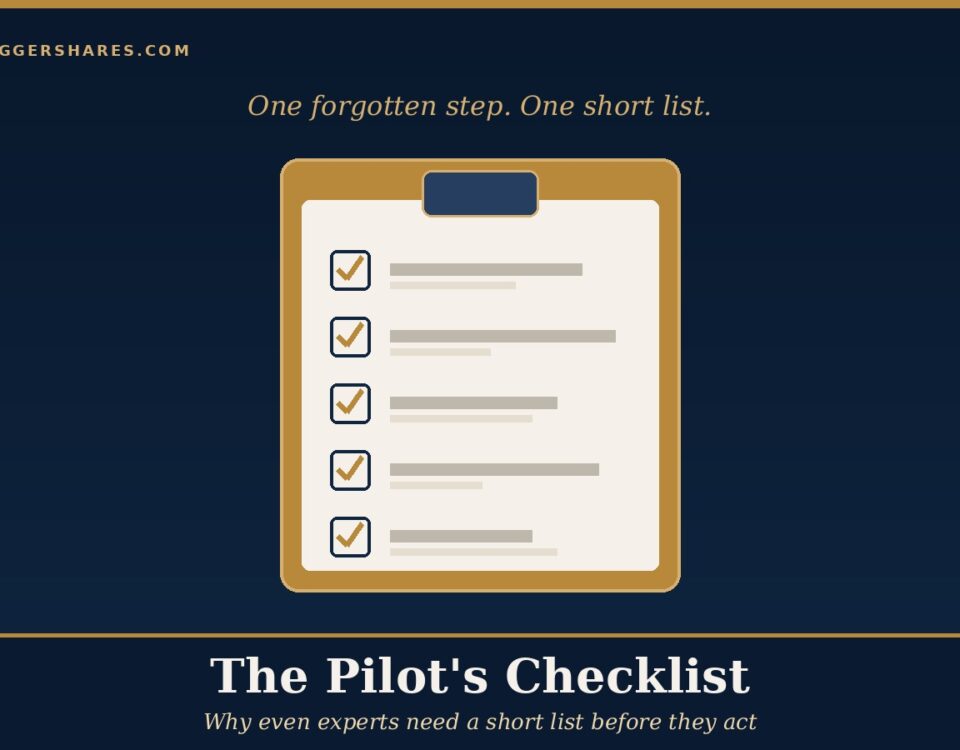
The Pilot’s Checklist: Why Even Experts Need a Short List Before They Act
October 14, 2026
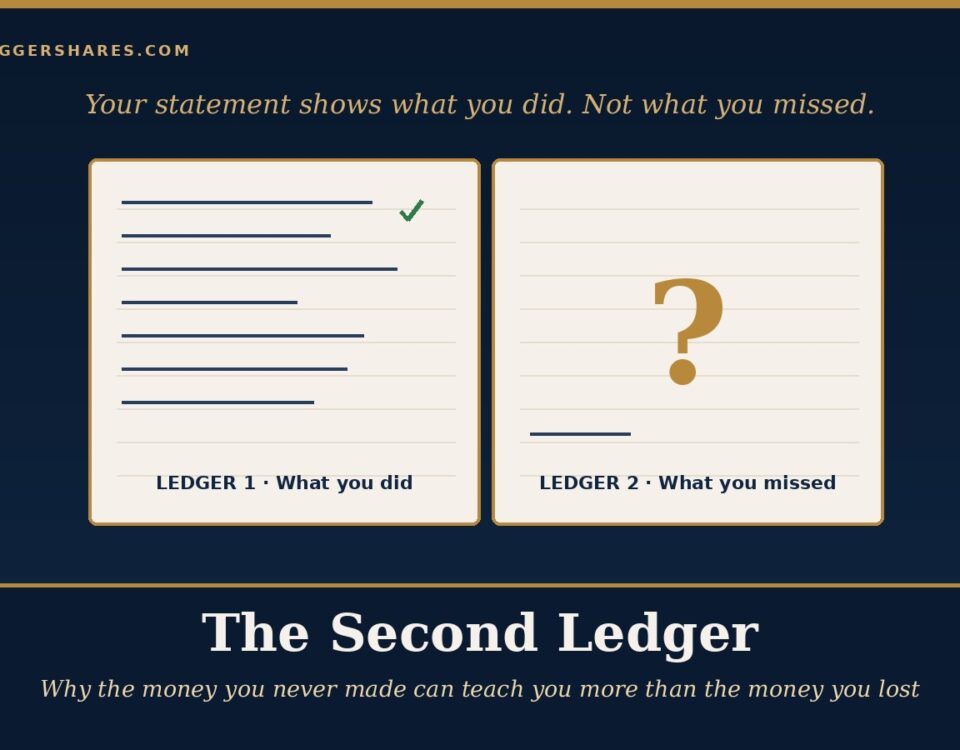
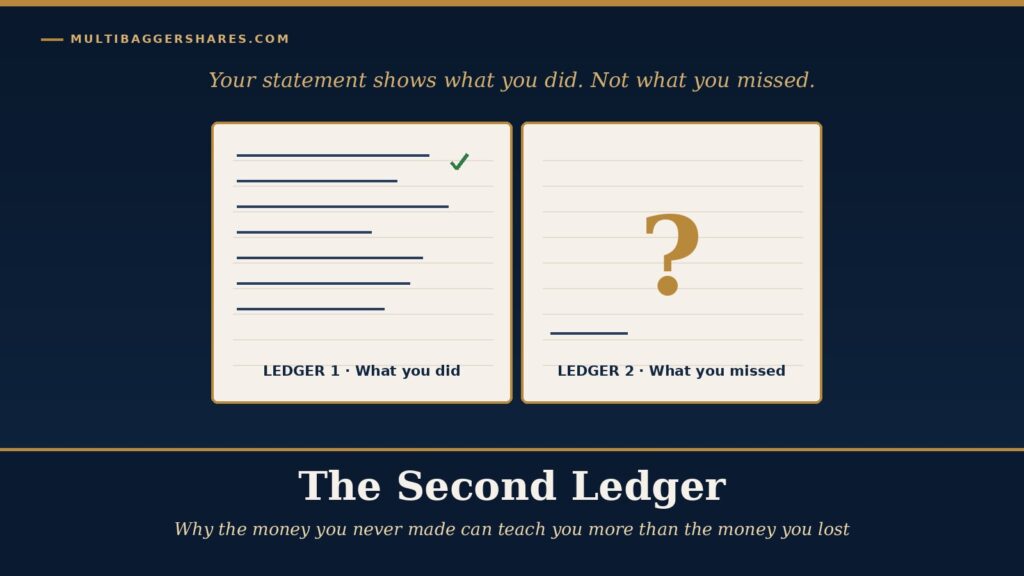
The Second Ledger: Why the Money You Never Made Can Teach You More Than the Money You Lost
October 16, 2026
In a quiet English stable yard, one night in a story written long ago, a famous racehorse called Silver Blaze vanished. His trainer was found dead on the moor nearby. The stable boy on guard had been drugged. A bookmaker, who had been seen near the stables that evening, was arrested for the crime. The police were sure they had their man. Then the great detective Sherlock Holmes arrived and asked the local inspector a strange question.
“Is there any other point to which you would wish to draw my attention?” asked Inspector Gregory. “To the curious incident of the dog in the night-time,” said Holmes. “The dog did nothing in the night-time,” said the puzzled inspector. “That was the curious incident,” replied Holmes. A watchdog was kept in that stable yard. If a stranger had walked in at midnight, it would have barked loudly. It stayed silent. So the visitor was someone the dog knew well, and that one missing sound pointed straight to the answer.
The story, “Silver Blaze”, by Arthur Conan Doyle, first appeared in The Strand Magazine in December 1892. More than a hundred and thirty years later, the idea inside it is still one of the most useful habits an investor can learn. Everyone studies what is on the page. Very few ask what ought to be on the page and is not.
What it really means
Most of the time we look for clues that are present. We read the numbers a company shows us, listen to what the chairman says, and notice what is loud and bright. But a company’s story is edited by people. Someone decides what goes into the annual report, what the chairman talks about, and what the manager says on the phone call with investors. That means the things left out were also chosen, even if only by habit.
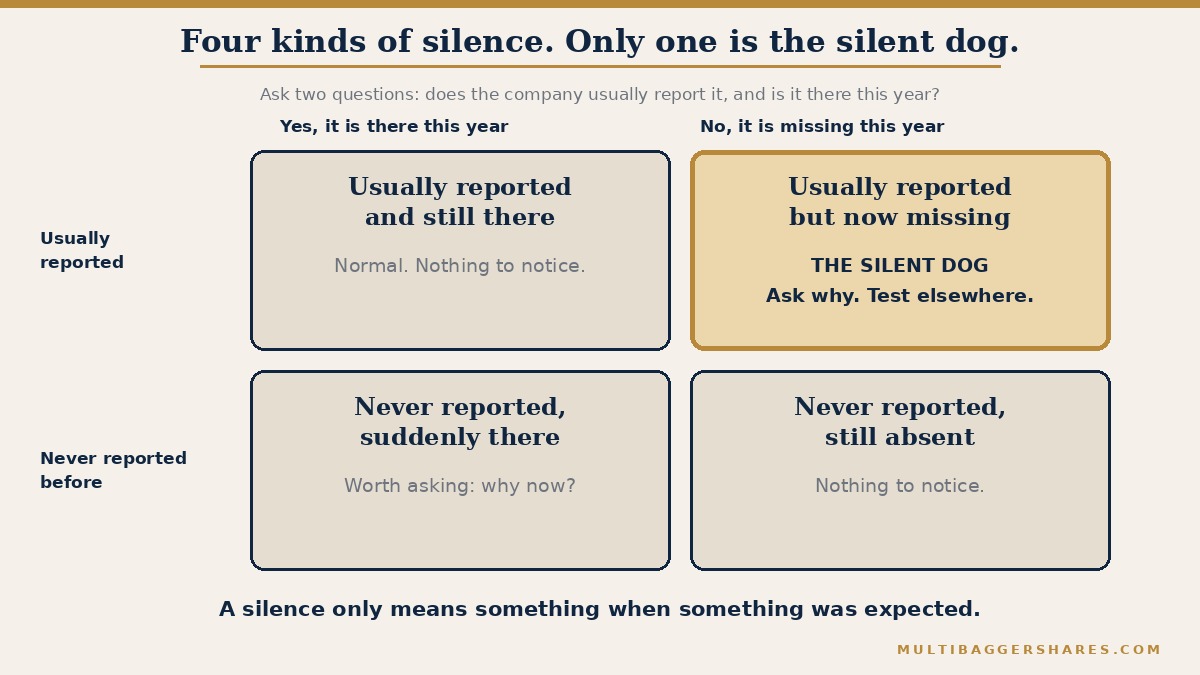
A missing clue is only a clue when something was expected. The dog was only meaningful because a watchdog normally barks at strangers. If the stable had no dog, its silence would tell Holmes nothing. So reading silence needs two things. First, a normal pattern (what the company usually says). Second, a gap in that pattern (something it usually says is not there).
Think of a mother at home on a busy afternoon. Her children are always noisy. One day the house goes quiet. She does not wait for a scream. She walks to the kitchen at once, because she knows that silence from noisy children means something is happening. She has no proof of anything yet. She only has a question, and she goes to look. That is exactly the habit we are describing.
Sanjay Bakshi, a well-known Indian value investor and a professor who teaches behavioural finance (the study of how emotions shape money decisions), described this kind of alertness in a 2015 interview. He spoke of the prepared mind, one that notices an oddity and asks why, and he linked it to Holmes and the dog that did not bark. The point is not to be suspicious of everything. It is to be curious about the things that do not fit.
Why it works
The first reason is that the loud parts of a report are the best-prepared parts. Companies work hard on how they present good news. Glossy photographs, charts that point upward and cheerful words are all carefully made. The quiet parts get less polish. Often the story a company does not tell is easier to find than the story it tells well.
The second reason is that good news travels loudly. When a business has a wonderful year, its managers usually shout about it. They name the number, put it in the headline and repeat it on the call. So when a number that would normally be a boast goes unmentioned, it is fair to wonder whether it is not so good this time. The silence itself is a small piece of information.
The third reason is that people find it hard to notice what is not there. A strange sentence stands out. A missing sentence does not. This is why the habit has to be learned and practised. The mind gives its attention to what it can see and glides over what it cannot. A detective, a doctor or an investor who trains to look for the gap sees something that others walk past every day.
An everyday picture may help. Suppose the kirana shopkeeper near your home always tells you when a fresh batch of your favourite biscuits arrives. He says it with pride, every single time. One month he stops mentioning the biscuits at all, and talks only about the new soap on the shelf. You would not conclude that something terrible had happened. You would, however, ask him, and his answer might teach you something about his supplier, his stock or his prices. Noticing the missing sentence is the first step to a better conversation.
The fourth reason is that a gap turns a vague worry into a clear question. Instead of feeling that something seems wrong, you can say, the company used to report this number and now it does not, why? A clear question can be tested. A vague worry can only keep you awake.
One honest warning belongs here. A silence is not a verdict. Holmes did not simply accuse someone because the dog was quiet. He used the silence to ask a better question, and then he went and checked. Many gaps have harmless explanations. A company may stop reporting a number because it truly no longer matters to the business. A chairman may skip a topic because there is nothing new to say. The skill is to treat a gap as a reason to look closely, never as proof.
A real example or two
Our first example comes from a very well-known company, and we use it only to show the habit, not to judge anything. In April 2024, the video-streaming company Netflix told its investors that from the first quarter of 2025 it would stop reporting its quarterly membership numbers. It said memberships were just one part of its growth and that it preferred to be judged on revenue, profit margin, free cash flow (the cash left over after running the business and paying for equipment) and the time people spend watching, all of which it would keep reporting.
That is a clear, stated reason, and a reader may well accept it. But look at the habit it teaches. A number that had been given every three months was going to disappear. A careful reader would notice the change, write it down, and look closely at what replaced it. Whether the change was wise is for each reader to decide. We draw no conclusion about the company. The lesson is only that a number going missing is a moment to pay attention, especially when nobody has told you why.
Our second example is imaginary, and it shows the habit at work. Picture a made-up company called Kamal Foods Limited. For five years in a row, its chairman’s letter has included a short line about cash from operations (the money that actually comes in from running the business, as opposed to profit on paper). Each year the line said something like, we again turned most of our profit into cash. Then the sixth letter arrives. It talks happily about record sales, a new advertisement and a beloved brand. The cash line is gone.
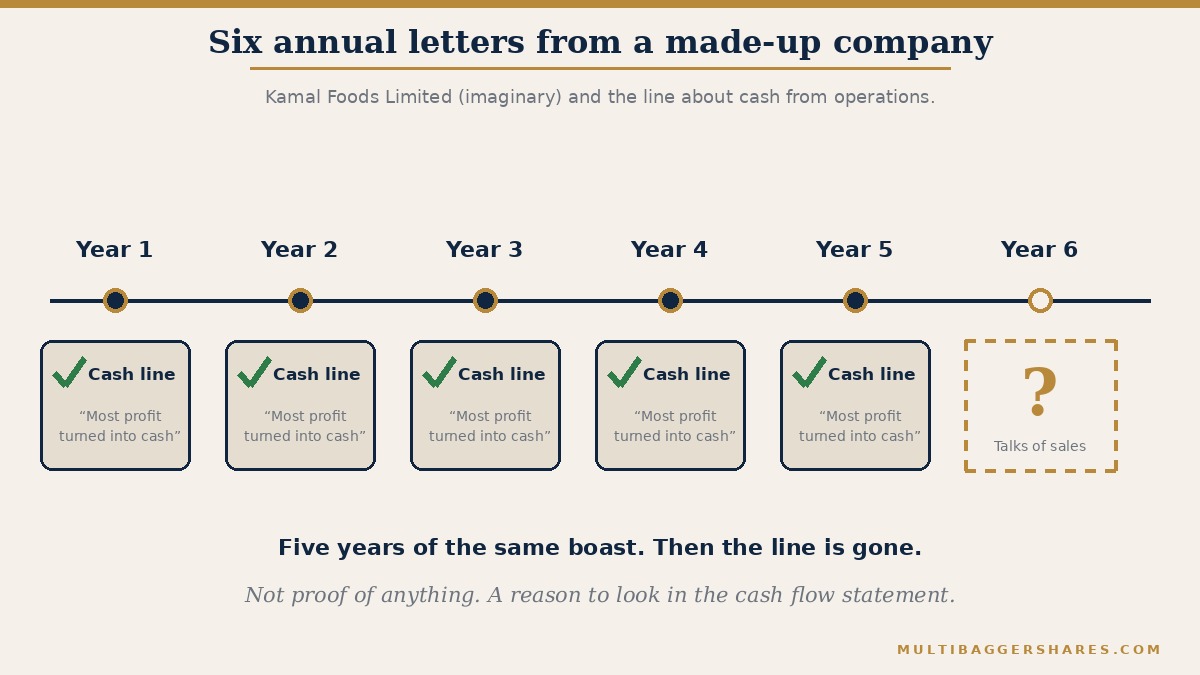
An investor named Meena reads the sixth letter beside the fifth. She notices the missing line and does not panic. She writes down two harmless reasons: perhaps the company changed the style of its letter, or perhaps the new chairman prefers shorter notes. She also writes one worrying reason: perhaps profit is no longer turning into cash. Then she tests the worrying reason somewhere else, in the cash flow statement (the page that shows the money in and out). She finds that profit rose from 10 crore rupees to 12 crore, while cash from operations fell from 9 crore to 3 crore, and that the money owed to the company by its customers had grown from 20 crore to 35 crore. All these numbers are made up to show the idea.
The silent line led Meena to a real question, and the real question led her to a real finding. The customers were paying more slowly, and some of the reported profit was sitting in other people’s pockets. She did not need to predict anything. She noticed a gap, asked why, and went to look. We make no suggestion about what she should do next. The point is that she found out something important because she listened to what was not said.
How you can use it
You can train this habit with a few simple steps. Start with a baseline, which means a normal pattern to compare against. Keep last year’s annual report open beside this year’s. Read the two side by side and look not only at what changed, but at what vanished. Here are five quiet places worth listening to.
First, a number that used to be reported and no longer is, or one that is now defined a little differently. Second, good news that should have been shouted but is not, such as cash flow in a year of rising profits. Third, a risk that other companies in the same line of business always mention and this one never does. Fourth, a familiar name, perhaps a manager, a customer or an important product, that quietly leaves the page. Fifth, a question put to the management on a call that gets answered with a story about something else.
It also helps to listen to the way a management speaks about its own record. A team that is comfortable with its business will often explain a bad quarter in plain words and say what it plans to do about it. A team that is not comfortable may talk for ten minutes about the future and say nothing about the past. The weight of the words spent on the pleasant topics, compared with the awkward ones, is itself a clue. Make a habit of asking, what was the one thing I expected to hear today, and did I hear it?
When you spot a gap, do not rush to a conclusion. Write it down in one line. Then list at least two harmless reasons and one worrying reason, exactly as Meena did. Listing a harmless reason first keeps you fair. Listing a worrying reason keeps you alert.
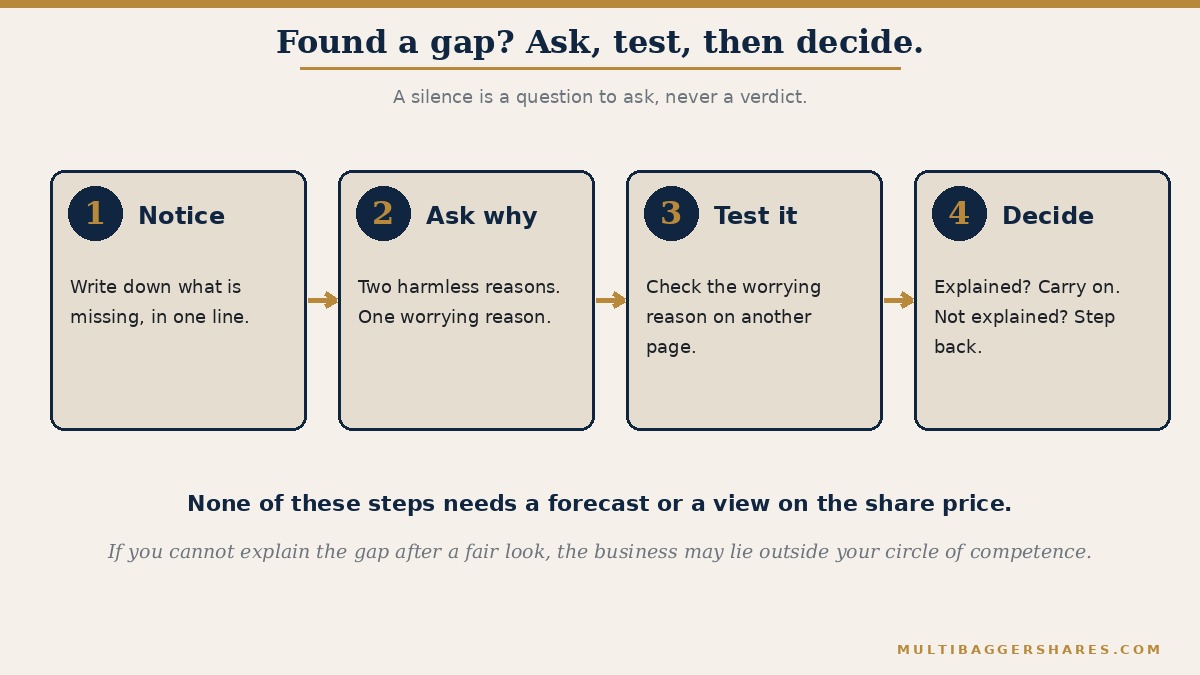
Next, test the worrying reason in a different part of the report. If a profit line has gone quiet, go to the cash flow statement. If a customer name has vanished, look in the notes to the accounts for a change in who the big buyers are. A clue from one page should be checked against another page. Think of it as asking a second witness.
Finally, decide honestly. If you can explain the gap with a sensible, harmless reason, carry on. If you cannot explain it after a fair look, treat that as a sign to step back. A business you cannot understand is a good reason to leave it alone. Not understanding is not a failure. It simply tells you that this one lies outside your circle of competence (the zone of things you truly understand), and there are many other businesses to study.
Notice that none of these steps needs a prediction about the future, and none of them needs a view on the share price. The method is entirely about the quality of the information you are being given. A business that is open about the dull parts as well as the bright parts is a pleasure to study. A business whose reports keep losing pieces is asking you to guess, and guessing is not a method.
One last thought. The habit also works on ourselves. When we feel excited about an idea, what have we left out of our own story? Which question have we quietly avoided asking? Holmes never took the first neat answer. He kept looking for the thing that was missing, and he often found it in the quietest corner of the room.
This article is for education only. It does not tell you what to do with any particular investment.
Key takeaways
- A missing clue only counts when something was expected, so first learn the normal pattern.
- Good news is usually shouted, so a boast that goes unmentioned is worth a closer look.
- A silence is a reason to ask a question, never proof of a problem.
- Write down the gap, list two harmless reasons and one worrying one, then test it in another part of the report.
- If you cannot explain a gap after a fair look, step back and move on.
— Manish Goel · multibaggershares.com
Manish Goel is a Chartered Accountant and Principal Officer of Multibagger Securities Research & Advisory Pvt. Ltd. (MSRAPL), a SEBI-registered Investment Adviser, Registration No. INA100007736. This content is published by MSRAPL for education only and is not personalized investment advice.
Disclaimer: This article is published by multibaggershares.com for education and general information only. It is not investment advice, investment research, or a recommendation to buy, sell or hold any security. Any companies named are discussed only as illustrative examples. Markets carry risk; please do your own research or consult a qualified professional before making any investment decision. |