The Red Queen’s Race: Why Some Businesses Must Keep Running Just to Stay Where They Are

The Second Ledger: Why the Money You Never Made Can Teach You More Than the Money You Lost
October 16, 2026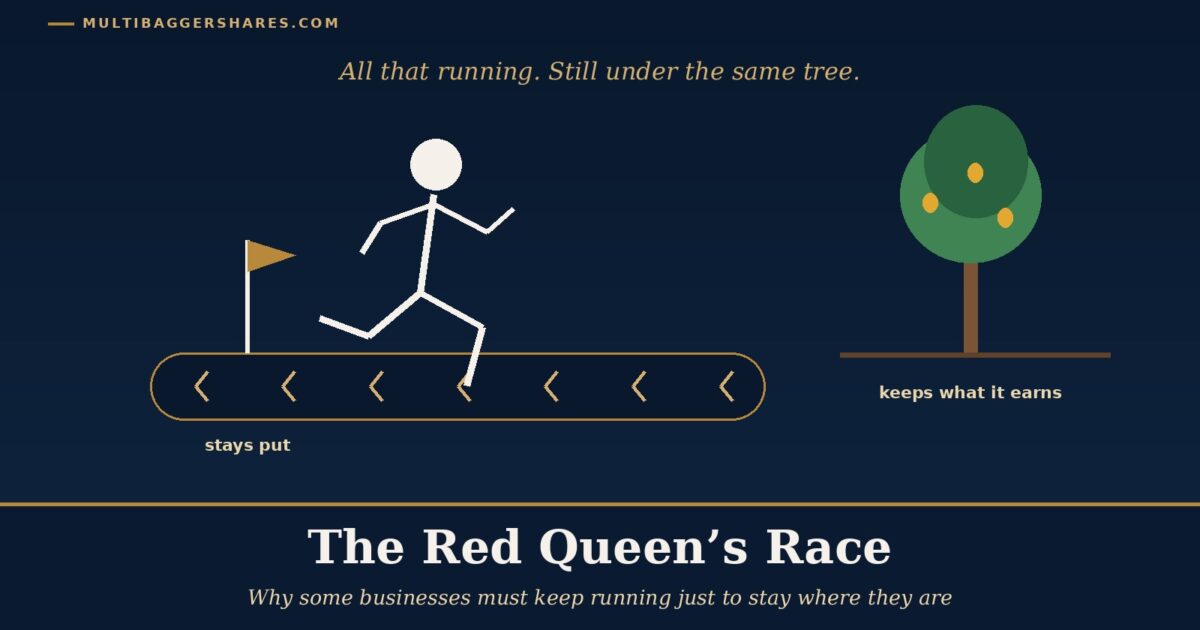
In 1871, the English author Lewis Carroll published a book called Through the Looking-Glass, the sequel to Alice in Wonderland. In one scene, a young girl named Alice is dragged along by the Red Queen. They run and run, faster than Alice has ever run in her life. Then they stop, and Alice looks around in surprise. They are standing under the very same tree where they began.
Alice says that in her country, you would generally get somewhere else if you ran very fast for a long time. The Queen is not impressed. She explains that here it takes all the running you can do, just to keep in the same place. If you want to get somewhere else, she says, you must run at least twice as fast as that.
Some businesses live in exactly this world. Every year, the owner spends a large sum of money. New machines are bought. The shop is refitted. Discounts are given. Fresh models are stocked. The owner works hard, the staff works hard, and the business looks busy and alive. Yet at the end of the year, it is standing under the same tree. This lesson is about how to tell a business that runs on the spot from one that runs and actually gets somewhere.
What it really means
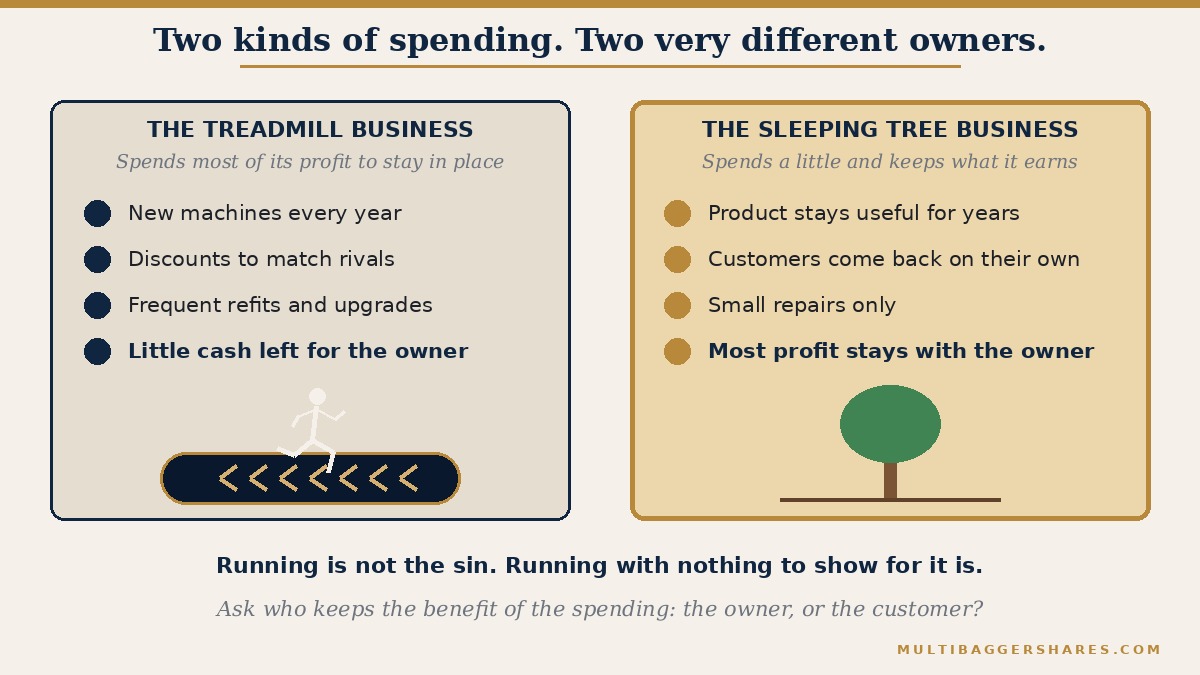
Let us start with a simple idea. A business spends money for two very different reasons. The first reason is to stay where it is. A flour mill replaces a worn-out grinding stone. A mobile phone shop stocks the latest models because last year’s models no longer sell. A restaurant repaints its walls so that customers do not walk away. Call this must-spend money, because the business would slowly shrink if it stopped.
The second reason is to move forward. The mill opens a second branch. The restaurant starts a home delivery service in a new city. Call this growth money. It is a choice, and the owner can say yes or no. Must-spend money is not a choice at all.
A Red Queen business is one in which the must-spend money is very large compared with what the business earns. Most of the profit is eaten up by the cost of standing still. The owner can see the profit in the books, but the cash that can actually be taken out is thin. Think of a bucket with a hole in it. You can pour water in all day, and the bucket will look full for a while, but you cannot drink much from it.
The idea has a long history outside business as well. In 1973, a biologist named Leigh Van Valen noticed that animals and the creatures that hunt them or compete with them are locked in a never-ending race. The rabbit becomes faster, so the fox must become faster too. Neither is ahead at the end. He named it the Red Queen hypothesis (the idea that living things must keep changing just to survive against rivals who are also changing). Businesses in crowded, fast-changing fields behave the same way.
One more thing must be said clearly, so that we do not learn the wrong lesson. Running is not a sin. A business that spends heavily and wins is a wonderful thing. The question is never, does this company spend a lot? The question is, who gets the benefit of the spending, the owners or the customers? In a Red Queen business, the benefit of the running is passed on to customers in the form of lower prices and better products, and the owners are left with very little.
Why it works
The first reason is that rivals can copy. Suppose one tailor in a lane buys an embroidery machine that makes designs in half the time. For a few months he enjoys an edge. Then the second tailor buys the same machine, and the third. Now every shop can finish orders in half the time, and customers expect it. Prices come down. Everyone has spent money, and nobody is better off except the customer.
Warren Buffett, the American investor who runs Berkshire Hathaway, described this beautifully in his 1985 letter to shareholders. He compared it to people watching a parade. One person stands on tiptoe and sees a little better. Then the person behind him does the same, and so on down the line. In the end everybody is standing on tiptoe, nobody sees better than before, and everyone is tired. Each decision looked sensible on its own. Taken together, the decisions cancelled each other out.
The second reason is that some things go out of date quickly. A packet of salt is the same today as it was ten years ago. A mobile phone, a fashion trend or a piece of software is not. When what you sell loses its value within months, you must keep replacing it, and the replacing never ends. We can call this the shelf life of a product (how long it stays useful and wanted). A short shelf life means a long, heavy treadmill.
The third reason is that customers may not be loyal. If a shopper will walk across the road for a discount of ten rupees, then you must keep buying his attention again and again, with advertisements, offers and festival sales. Each purchase of attention is spent and gone. It does not build anything that stays. A business whose customers return on their own, without being paid to do so, does not have to run at all.
The fourth reason is a quiet one. Profit in the accounts and cash in the owner’s hand are two different things. A Red Queen business can show a rising profit year after year, while its bank balance barely moves, because the cash goes straight back into machines and stock. An investor who looks only at the profit line may think the business is racing ahead. An investor who looks at what is left over sees it standing under the same tree.
A real example or two
Our first example is a true one, and it is from the investor’s own backyard. When Buffett’s investment partnership took control of Berkshire Hathaway in the mid-1960s, Berkshire was a textile maker in New England (it turned raw cotton and other materials into cloth). For about twenty years he tried to make it work. Again and again, the managers came to him with a proposal to buy new, better machinery. Each proposal, as he wrote later, looked like an immediate winner.
And each one was sensible. The new machines really would cut costs. But competitors were buying the same machines for the same reasons. After each round of spending, the players all had more money tied up in the game, and the returns stayed poor. In July 1985, Buffett decided to close the textile operation. In his words, the choice was miserable. A huge investment would have kept the business alive, but only with terrible returns on ever larger amounts of money.
The most useful line in that letter is about people, not machines. He wrote that a good record, measured by economic returns, depends far more on what business boat you get into than on how well you row. The managers at the mill were not lazy. They rowed hard. The boat was simply a leaky one, and rowing harder could not fix a leak. That is the Red Queen business in one sentence.
Our second example is made up, so that we can look at the numbers calmly. Imagine two shops in the same lane of a town. The first is Mobile Zone, which sells phones. The second is Atta Chakki, a small flour mill. Both earn a profit of 10 lakh rupees a year before the must-spend money is counted. On paper, they look like twins.
Now look at what each one must pay just to stay in business. Mobile Zone must stock the new models every few months, refit its shop to look fresh, and match the prices of the shop across the road. All of that takes 8 lakh rupees a year. Atta Chakki needs only 1 lakh rupees, for repairs and a new grinding stone now and then, because people will want flour in ten years just as they do today. After the must-spend money, Mobile Zone has 2 lakh rupees left for its owner. Atta Chakki has 9 lakh.
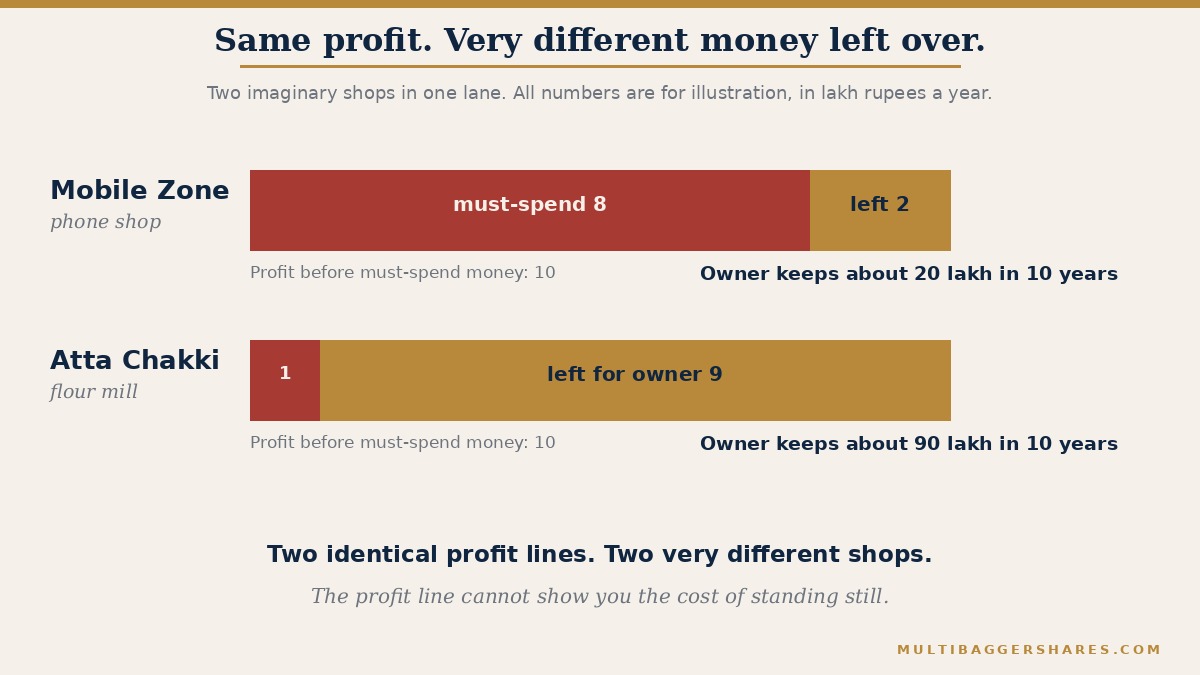
Over ten years, if nothing else changes, the owner of Mobile Zone takes home about 20 lakh rupees, and the owner of Atta Chakki takes home about 90 lakh. The two profit figures were identical. The two shops were not. The first owner ran very hard and ended up under the same tree. The second owner hardly ran at all and kept almost everything. All of these numbers are made up, and they are meant only to show how the leftover money can differ.
Please note what this example does not say. It does not say that phone shops are bad or that flour mills are wonderful. A phone shop with a loyal crowd, low rent and a clever way of buying stock might do very well. It says only that two businesses with the same profit can leave very different amounts of cash for their owners, and that the profit line alone will never show you the difference.
How you can use it
You do not need any special software. You only need four simple questions, and the habit of asking them whenever you study a business. We can give each question a name so that it is easy to remember.
The first is the stop test. Imagine that the owner stopped spending on machines, refits and upgrades for two full years. What would happen to sales? If the business would carry on almost as before, as a flour mill would, then the spending is mostly growth money. If sales would fall quickly, then most of the spending is must-spend money, and the business is running to stay in place.
The second is the parade test. When one rival invests in something new, must all the others follow? If the answer is yes, and if the benefit usually ends up with the customer as a lower price, you are looking at a parade. Everyone is standing on tiptoe. Look for businesses where one player’s spending builds something that rivals cannot simply copy next month, such as a trusted name or a strong network of customers.
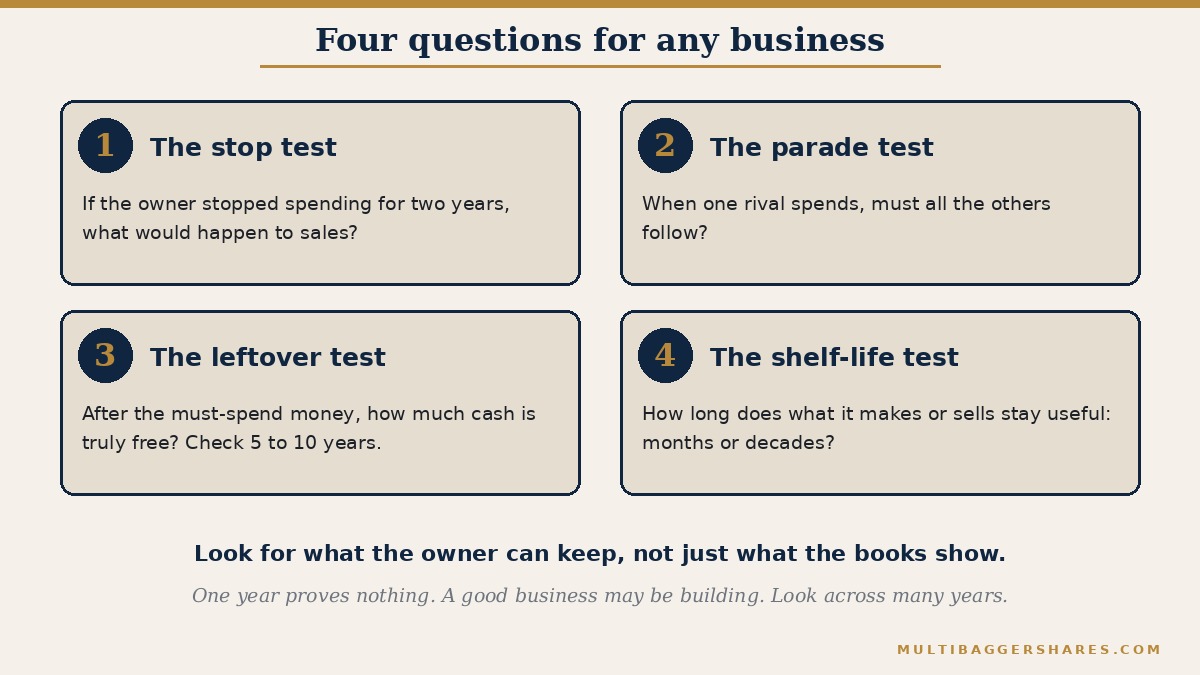
The third is the leftover test, and it is the most useful of the four. Open the company’s annual report and find the cash flow statement (the part that shows the real cash coming in and going out). Look at the cash earned from running the business, and subtract the money spent on machines, buildings and equipment. What remains is the cash that is truly free. Do this for five or ten years, not one. Buffett taught the same idea in his 1986 letter, when he asked investors to count the spending needed to maintain a business’s position as a real cost of owning it.
The fourth is the shelf-life test. How long does what the business makes or sells stay useful? Salt, flour, soap and cement have a long shelf life. Fashion, phones and software have a short one. A short shelf life is not a reason to run away. It is only a warning that the business may need to be a very good runner, and you must check that it is.
A few cautions will keep you fair. A single year proves nothing, because a good business may be building a new plant, and the spending will look heavy for a while. Look at many years and ask whether the spending is to stay or to advance. Also ask what the business earns on the money it spends. If every rupee put in earns a good return year after year, the running is paying for itself. The trouble is running that earns little.
Finally, remember that this is a way of seeing quality, and not a way of deciding what a share should cost. It will not tell you whether any particular company is a good or bad purchase. It will teach you to look past a rising profit line and ask the more important question: how much of this can the owner actually keep?
This article is for education only. It does not tell you what to do with any particular investment.
Key takeaways
- Businesses spend for two reasons: must-spend money to stay in place, and growth money to move forward.
- A Red Queen business spends most of its profit on standing still, so the profit in the books is far larger than the cash the owner can keep.
- Warren Buffett’s parade picture explains why: when every rival spends, nobody gets ahead and the customer collects the benefit.
- Use four questions: the stop test, the parade test, the leftover test and the shelf-life test.
- Look over five to ten years at the cash left after maintaining the business, because running is only worth it when the owner keeps something.
— Manish Goel · multibaggershares.com
Manish Goel is a Chartered Accountant and Principal Officer of Multibagger Securities Research & Advisory Pvt. Ltd. (MSRAPL), a SEBI-registered Investment Adviser, Registration No. INA100007736. This content is published by MSRAPL for education only and is not personalized investment advice.
Disclaimer: This article is published by multibaggershares.com for education and general information only. It is not investment advice, investment research, or a recommendation to buy, sell or hold any security. Any companies named are discussed only as illustrative examples. Markets carry risk; please do your own research or consult a qualified professional before making any investment decision. |