The Shop in Someone Else’s Mall: How to Judge a Business That Depends on One Platform

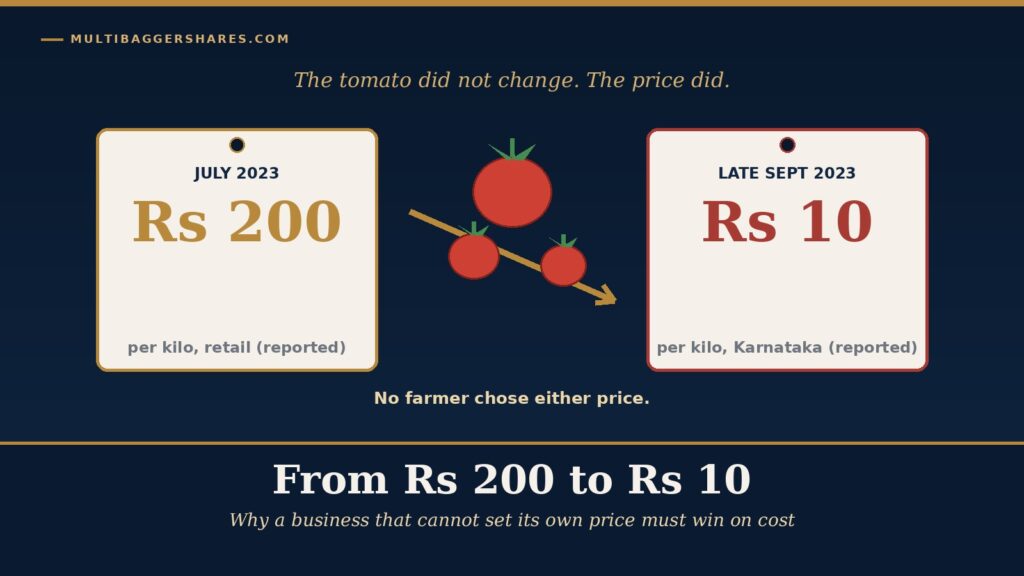
From Rs 200 to Rs 10: Why a Business That Cannot Set Its Own Price Must Win on Cost
October 22, 2026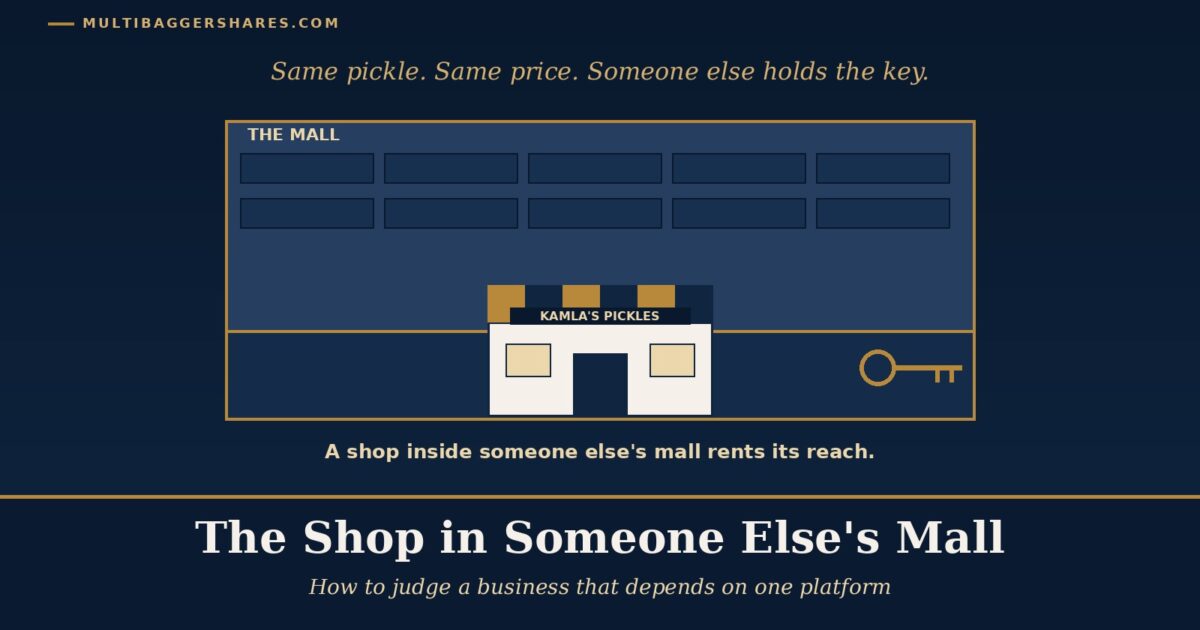
Imagine a woman called Kamla who makes mango pickle in her kitchen in Pune. Everything in this story is made up to teach an idea. For years she sold her jars to neighbours and to two small shops nearby. Her business was small but steady. Then a big shopping app (a phone app and website where thousands of sellers list their goods and millions of buyers come to shop) invited her to list her pickle. Within a month, her sales doubled. Within a year, they had tripled. Kamla hired two helpers and bought a bigger stove.
Nothing about the pickle changed in those years. The recipe was the same. The jar was the same. What changed was something she hardly noticed at first. Almost every customer now came through the app’s door, and not through hers. Today’s lesson is about that door. Who holds it, who can change the lock, and what happens to a business when the answer is not “me”.
What it really means
Investors call the app in this story a platform (a place that brings sellers and buyers together, such as a shopping app, a search engine, a phone’s app store, or a big shopping mall). A platform can be very useful. It brings crowds that a small seller could never gather alone. But a platform is also a gatekeeper (someone who stands between you and your customers and decides who gets through the gate, and on what terms). When most of a business’s customers arrive through one gatekeeper, we say the business depends on that platform.
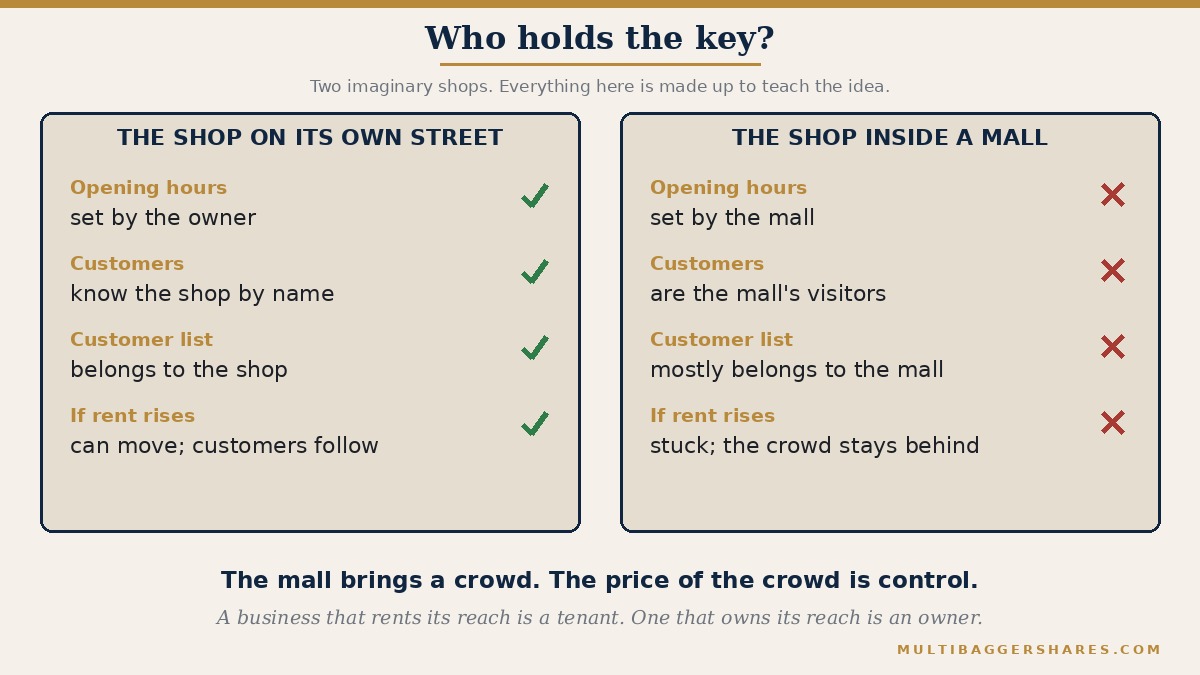
Think about two shops. The first stands on its own street. The owner decides when to open and when to close. She decides what to stock and what to charge. Her regular customers know her name, and she knows theirs. If her landlord raises the rent too high, she can move down the road, and many of her customers will follow her, because they know where she went. The second shop sits inside a large mall. The mall brings a crowd, which is a real gift. But the mall decides the opening hours, the position of the shop, and what may be displayed. The shop pays rent, and often a share of its sales as well. And the people who walk in are the mall’s visitors. The mall knows who they are. The shop mostly does not.
That is the whole idea in one picture. The mall-shop is not doing anything wrong. It has chosen to rent its reach (its ability to put its goods in front of buyers) from someone else. The price of that choice is control. A business that rents its reach is a tenant. A business that owns its reach is an owner. And tenants, however well they run their shops, are always one decision away from a different life.
Why it works
There are three things worth understanding about a business that depends on a platform.
The first is that the platform usually owns the customer relationship (the direct link between a business and the people who buy from it, such as their phone number, their email, or simply their habit of walking in). When Kamla sold to neighbours, she knew who bought a jar and could call them when a new batch was ready. When the app sells the jar, the app knows the buyer. If Kamla ever wants to leave, she leaves behind the crowd she thought was hers. Many of those people never knew her name. They knew the app.
The second is that the rules can change, and the tenant does not get a vote. A platform can raise its fee. It can decide that sellers who pay for advertising will be shown first. It can change how search results are ordered. It can even start selling its own pickle next to hers. None of this needs her permission. And because most of her customers arrive through that one door, she has very little power to say no. Bargaining power (your ability to get a better deal because you could walk away from a bad one) belongs to whichever side has somewhere else to go.
The third is the slow squeeze, and it is easiest to see with numbers. Let us make some up for Kamla. In Year 1, for every Rs 100 of pickle she sells on the app, Rs 50 goes on the cost of making it, Rs 15 goes to the app as a fee, and Rs 5 goes on advertising inside the app to be seen. That leaves Rs 30 as profit. She is delighted. Four years later, her sales are even higher and the price of the jar has not changed. But the app has raised its fee to Rs 25. Sellers who do not advertise have sunk to the bottom of the list, so she now spends Rs 15 on advertising to stay visible. The cost of making the pickle is still Rs 50. What is left for her? Just Rs 10.
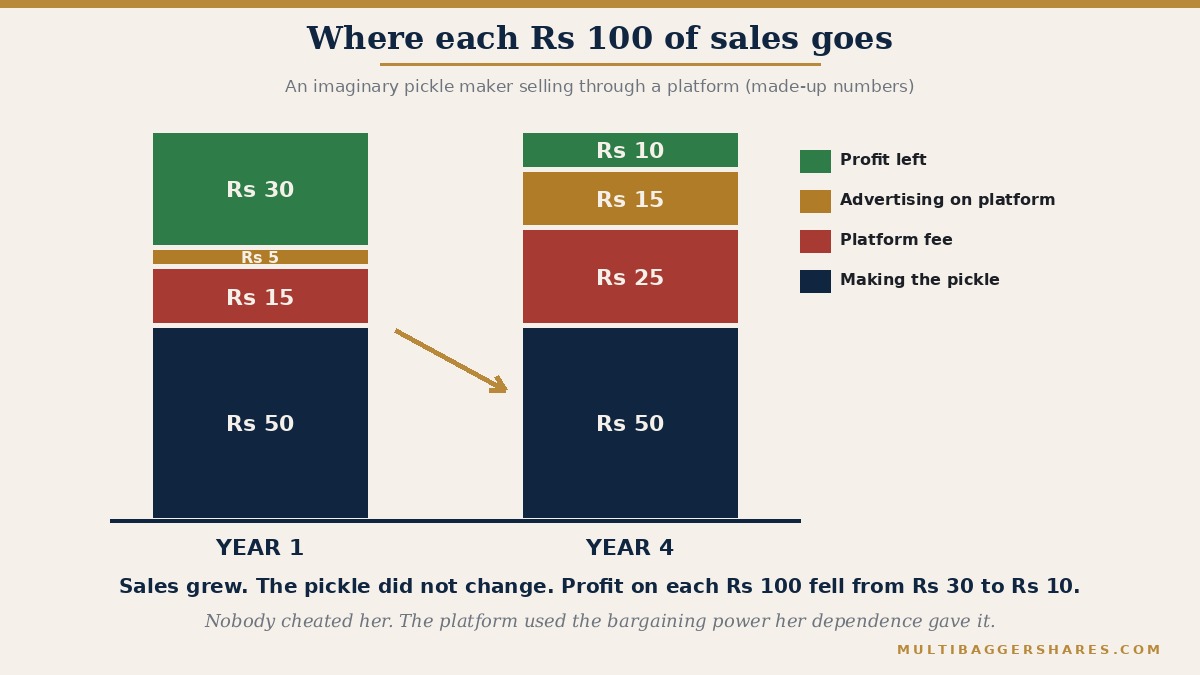
Look at what the picture shows. Her sales have grown. Her pickle has not changed. Her work has not changed. Yet her profit on each Rs 100 has fallen from Rs 30 to Rs 10, which is a drop of two thirds. Nobody cheated her. The platform simply used the bargaining power that her dependence gave it. This is why investors look not only at whether a business is growing, but at who is collecting the growth.
Here is a useful way to remember it. A business that depends on one platform may look very strong in the good years, because the platform is sending it customers. The weakness shows up only when the platform changes its mind. By then, the business has built its team, its stock and its costs around a flow of customers that someone else controls.
A real example or two
Our first example comes from the early days of social-media games, and it is told here only as history. In 2011, a company called Zynga prepared to offer its shares to the public. When a company does this, it must publish a prospectus (a long document that describes the business and lists its main risks, so that buyers know what they are getting into). Zynga’s prospectus was very plain about its position. It said that the company generated “substantially all of our revenue and players through the Facebook platform.” One of the risk headings read: “If we are unable to maintain a good relationship with Facebook, our business will suffer.” The document also said that Facebook passed on 70% of the face value of the credits that players bought, which means Facebook kept the other 30%. Zynga was telling readers, in its own words, that its door belonged to someone else, and that the landlord took a share of every sale.
Our second example is a more recent one, and it shows that even very large businesses can rent part of their reach. In April 2021, Apple released an update to its iPhone software, called iOS 14.5, that included a feature named App Tracking Transparency. After the update, apps had to ask iPhone users for permission before tracking them across other apps and websites. On 2 February 2022, Meta’s chief financial officer, Dave Wehner, told investors on a call about the company’s results that the change would cost Meta about $10 billion in revenue in 2022. In his words, it was “on the order of $10 billion, so it’s a pretty significant headwind for our business.” He described this as an estimate. Meta is itself a huge platform for advertisers. Yet part of its business reached its customers through the phone’s operating system (the basic software that runs a phone), and the company that controlled that software changed a rule.
Read these two stories side by side. In both, a business was doing well, and then someone else’s decision about a door changed the picture. Neither company is being praised or criticised here, and nothing in this article says anything about the value of their shares. They are told only because they show, in the plain words of the people involved, what it means to rent your reach.
Now picture the opposite. Think of an old sweet shop in a small town whose customers have bought from it for forty years. They know the name above the door. If the shop moved to the next street, they would walk there. Such a shop may sell fewer sweets than the mall-shop, but nobody can switch it off. That is the kind of strength this lesson is asking you to notice.
How you can use it
You do not need special data to apply this idea. You need patience, an annual report (the yearly document in which a company describes its business and its numbers), and a few plain questions. Try these five on any business you study.
Question one: through whose door do most customers arrive? Look in the annual report for the section that describes how the company sells. Does it sell directly, through its own shops or website, or mostly through one app, one search engine, one big retailer or one marketplace? Companies are often asked to describe their main risks. Read that part slowly, and look for words such as “we depend on” or “we rely on”.
Question two: how large is that one door? If a single platform brings 10% of the sales, it is a useful channel. If it brings 70% or 90%, it is closer to a landlord. There is no magic number. The point is that the bigger the share, the less the business can afford to say no.
Question three: who sets the rules, and can they change them without asking? Is there a written contract for a few years, or can the platform change its terms at any time? And does the platform also sell its own products that compete with yours? A gatekeeper that is also a rival has a reason to change the rules in its own favour.
Question four: does the business know its own customers? Can it contact them directly, through its own phone numbers, its own emails or its own loyal habits? Or do they belong to the platform? A business that owns the relationship has somewhere to go if the door closes.
Question five: what is the business’s plan B? Look at how it has behaved over many years. Has the share of sales from the one platform been shrinking as the company builds its own reach? Or has the dependence deepened each year? A company that keeps working to build its own door, even when the platform is generous, is showing foresight. It is like Kamla putting a card with her phone number in every jar.
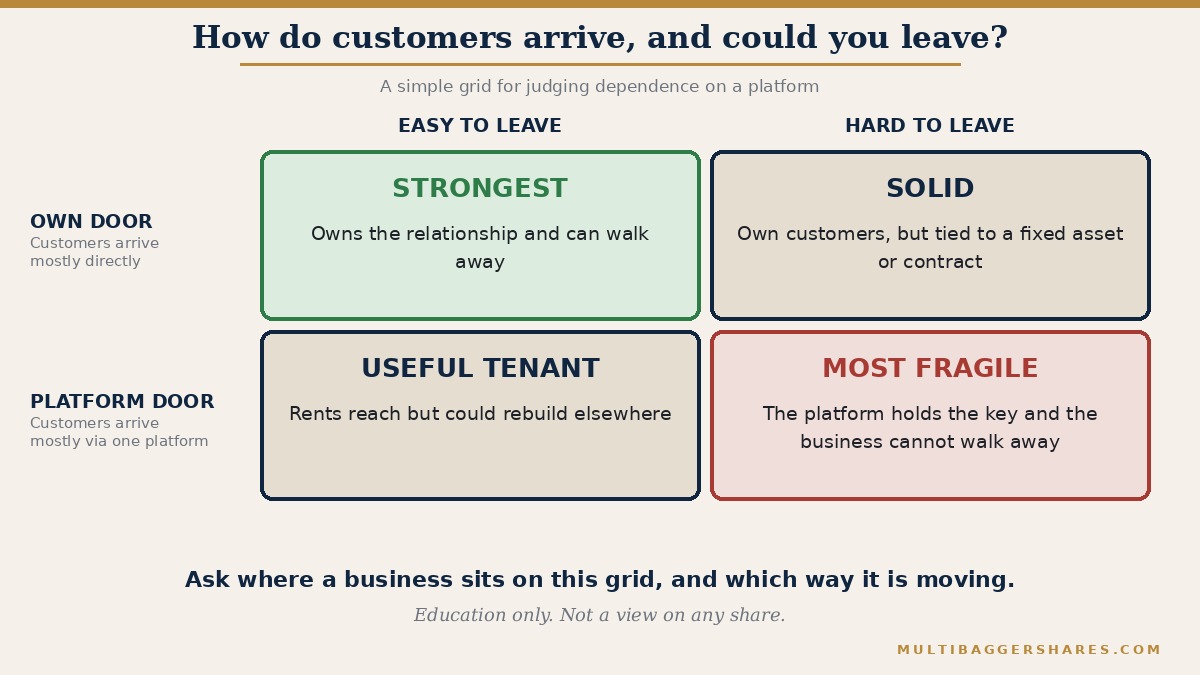
A few cautions will keep you balanced. First, depending on a platform is not a sin. For a young business, a platform can be the only way to be seen at all. The question is whether the business uses the platform to build something of its own, or becomes more and more tied to it. Second, the opposite mistake is also possible. A business with no platform risk can still be a poor business for many other reasons, so this one question is never enough by itself. Third, look at the trend. The risk is not only how dependent a business is today, but whether the dependence is getting deeper or lighter.
There is something calming in this lesson for ordinary investors as well. It reminds us that a business’s strength is not only what it sells, but who controls the path between the seller and the buyer. A good pickle is a fine thing. A good pickle with its own loyal customers is much better, because nobody can take those customers away with a change of rules.
Come back one last time to Kamla. After the Year 4 squeeze, she did something wise. She put a card in every jar with her number and a small offer for people who called her directly. Slowly, more orders came through her own door. It was a small door, but it was hers. The lesson is not that platforms are bad. The lesson is to notice who holds the key, and to prefer businesses that hold their own.
This article is for education only. It does not tell you what to do with any particular investment.
Key takeaways
- A platform is a gatekeeper that brings customers to a business; a business that gets most of its customers from one platform depends on it and is not fully in charge of its own future.
- The platform usually owns the customer relationship, can change fees and rules without asking, and may even become a rival, so the tenant’s bargaining power is weak.
- Growth through a platform can hide a slow squeeze: in the made-up example, sales rose while profit on each Rs 100 fell from Rs 30 to Rs 10.
- Zynga’s 2011 prospectus and Meta’s 2022 comment on Apple’s iPhone rule change are told only as history, to show what renting your reach can mean.
- Ask five questions: through whose door do customers arrive, how large is that door, who can change the rules, does the business know its own customers, and what is its plan B.
— Manish Goel · multibaggershares.com
Manish Goel is a Chartered Accountant and Principal Officer of Multibagger Securities Research & Advisory Pvt. Ltd. (MSRAPL), a SEBI-registered Investment Adviser, Registration No. INA100007736. This content is published by MSRAPL for education only and is not personalized investment advice.
Disclaimer: This article is published by multibaggershares.com for education and general information only. It is not investment advice, investment research, or a recommendation to buy, sell or hold any security. Any companies named are discussed only as illustrative examples. Markets carry risk; please do your own research or consult a qualified professional before making any investment decision. |