The One-Man Shop: Why a Business That Cannot Run Without One Person Is Fragile

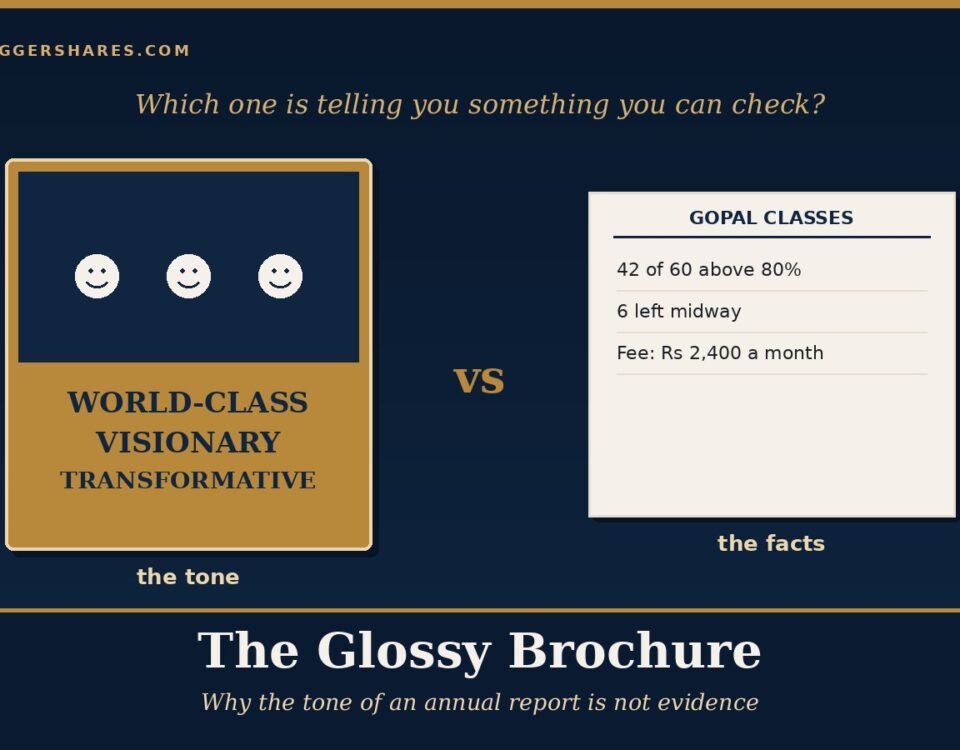
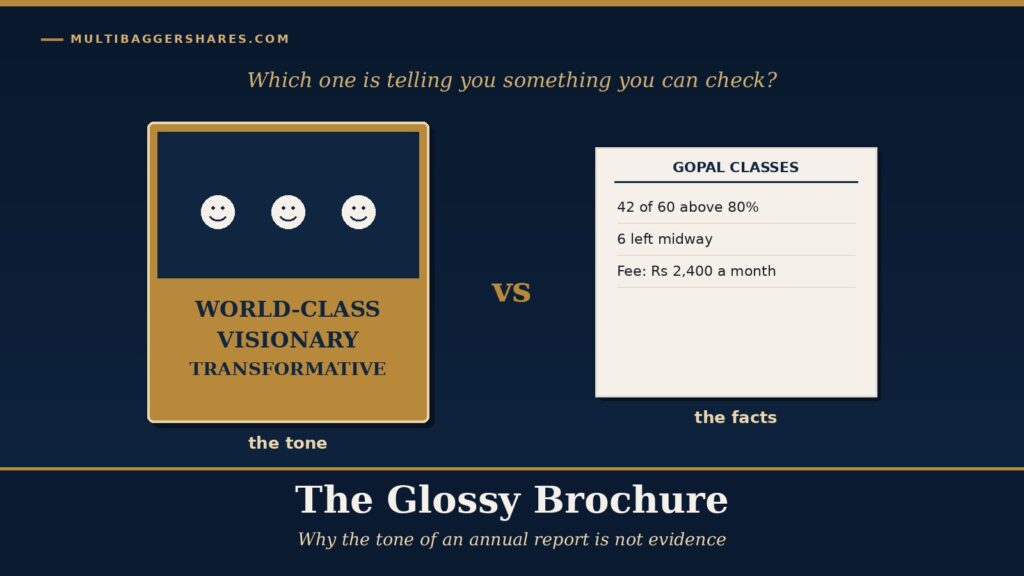
The Glossy Brochure: Why the Tone of a Company’s Annual Report Is Not Evidence
October 20, 2026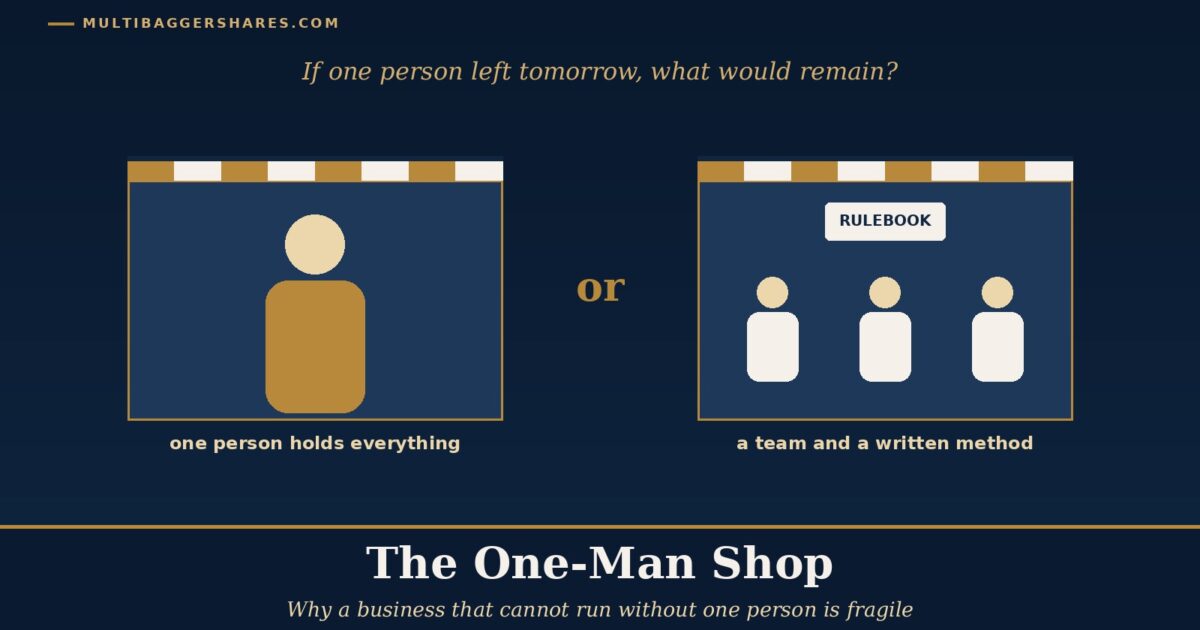
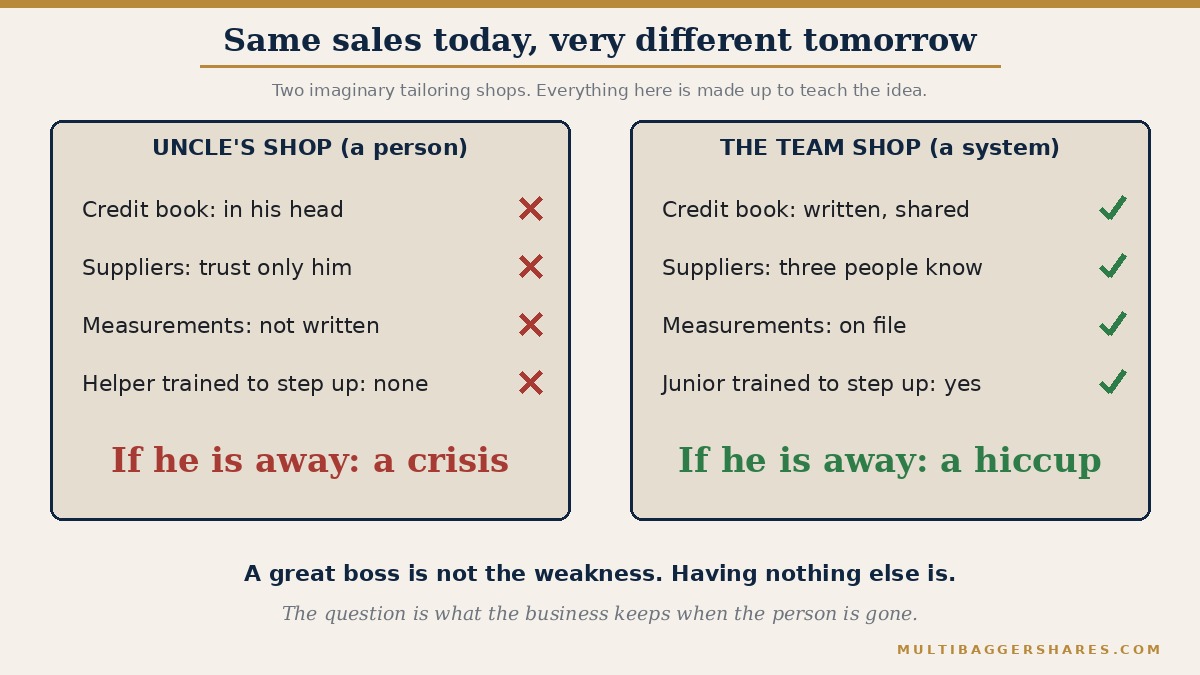
Every neighbourhood has a shop like this one. Let us call him Uncle. He has run the same small tailoring shop for thirty years. He cuts every piece of cloth himself. He remembers the measurements of every customer, and he knows which of them pays late. The cloth suppliers will give credit to nobody but him. The shop is busy, the shirts are lovely, and people say it is the best tailor in the area.
Now suppose Uncle falls ill for three months. What happens to the shop? His helpers can sew, but they do not know the measurements. They do not know which supplier to call or which customer to chase. Orders slow down, some customers drift away, and a few never return. The shop was making good profits on Tuesday. It was not really a business on Tuesday. It was Uncle, with a shop built around him.
This is today’s lesson. When we study a business to see whether it is of good quality, we usually ask about its products, its debt and its profits. A quieter question sits underneath all of them: does this business depend on one particular person? And if that person left tomorrow, what would remain?
What it really means
Investors have a name for this. They call it key-person risk (the danger that a business suffers badly if one specific person leaves, falls ill or simply loses interest). Some call it key-man risk, which means the same thing. A business with high key-person risk is like a table standing on a single leg. It may stand perfectly well for years. But everything depends on that one leg.
It is important to be fair here. Having a great leader is not a weakness. Every business needs able people, and many of the best companies in the world were shaped by one strong founder. The weakness is not the presence of a great person. The weakness is the absence of anything else. A business can have a brilliant boss and still be well built, if the boss has trained others, written down how things are done and left behind habits that continue without him.
Think of two kitchens. In the first, there is a famous cook who never writes down a recipe. He adds a pinch of this and a handful of that, and only his hands know the taste. In the second kitchen, the recipes are written, the cooks are trained, and the head cook is a good teacher. Both kitchens may serve a wonderful meal tonight. Only one of them will still serve it after the famous cook retires.
Why it works
The first reason this matters is that a business is meant to last for many years, but a person is not. A company that earns money for thirty years will almost certainly outlive the career of any single leader. So the real question for a long-term owner is not “is the boss good today?” It is “will the business still be good when the boss is gone?” The first question is about the present. The second is about the whole journey.
The second reason is that the loss of a key person does not arrive politely. People retire, fall ill, get tempted by other work, or quarrel with their partners. Sometimes the departure is planned and gentle. Sometimes it is sudden. If a business has only one person who holds its knowledge, contacts and decisions, then a sudden exit can leave it with no one who even knows what questions to ask.
The third reason is that dependence on one person quietly lowers the quality of the business even while the person is present. When everything flows through one pair of hands, decisions queue up at that person’s desk. Juniors learn to wait instead of to think. The best younger people, seeing that the top job will never be open to them, often leave. A business that does not grow its own future leaders is slowly using up its stock of talent.
The fourth reason is trust. Customers, suppliers and lenders sometimes deal with a business only because they trust the person at the top. This trust is real, and it is valuable. But it belongs to the person, and not to the business. When the person goes, the trust may go along with him. Compare this with a brand people trust (a name that customers rely on regardless of who is running the company), which stays when the people change.
There is one more thing worth noticing. A business that works well without its founder is not just safer. It is also usually higher in quality, because it has solved a hard problem that most small businesses never solve. It has taken the cleverness out of one head and put it into a method that others can follow.
A real example or two
Let us look at two stories from the past. They are told only as history, to teach an idea, and not as a view on any company today.
The first is from India. J. R. D. Tata led the Tata group for more than fifty years, from 1938 until 1991, when Ratan Tata took over as chairman. A leadership that long can easily become a one-person show. Yet the group carried on as one of India’s largest business houses after the change, and it is widely associated with customs of trusteeship and careful governance (rules and habits about how a company is directed and watched over) that belonged to the whole group and not to one chairman. The point is not that the group never faced difficulties. The point is that it had something besides one person to hold on to.
The second story is from the United States, and it is a story of a very public handover. Warren Buffett has run Berkshire Hathaway, a large American holding company (a company that mainly owns shares in other businesses), for decades. For years, people asked the obvious question: what happens when he steps back? The company did not leave the answer to chance. In January 2018, it named Greg Abel and Ajit Jain as vice chairmen, which was widely read as a sign that the next leaders were being prepared. In 2021, Buffett said that Abel would be his successor. On 5 May 2025, the board voted that Abel would become chief executive, and he took the role on 1 January 2026, with Buffett staying on as chairman.
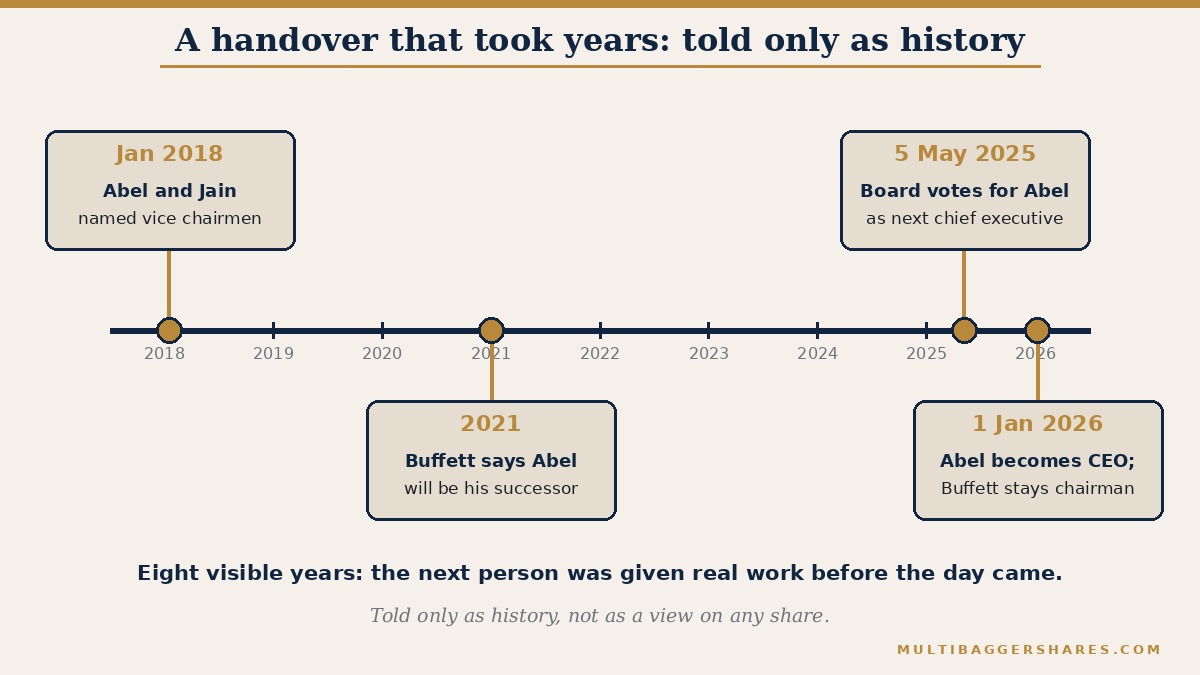
Look at the shape of this story. The handover was not a surprise announced in a hurry. It was a slow walk, visible over eight years, with the next person given real work and real responsibility long before the day came. This is what a well-prepared succession looks like. Whether one thinks well or badly of any company is a separate matter, and not today’s subject. The lesson is about the method: a handover that is rehearsed is a handover that is far less likely to hurt.
The investor Peter Lynch gave a famous piece of advice that fits this lesson. As quoted in USA Today in March 1989, he said: “Go for a business that any idiot can run – because sooner or later any idiot probably is going to be running it.” It sounds like a joke, but it carries a serious idea. Lynch did not mean that talent is unimportant. He meant that a really sturdy business does not need a genius at the controls every single day. Warren Buffett has voiced a similar thought, in a 2008 news report, when he spoke of a business doing so well that an idiot could run it, because sooner or later one will.
Notice what this says about quality. The best businesses are often the ones that are a little dull to run. Their results come from a good product, a loyal set of customers and a sound method, and not from the daily heroics of one person. A business that needs heroes every week is telling you something about its design.
How you can use it
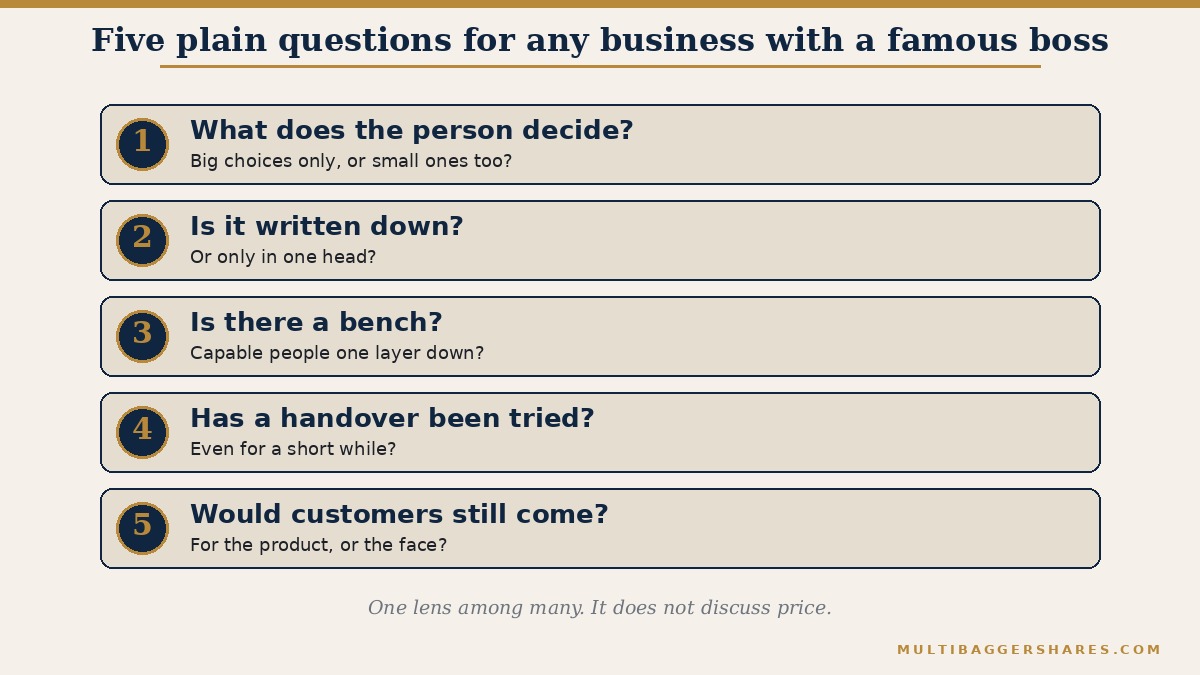
You do not need inside information to look for key-person risk. Most of the clues are in plain sight, in annual reports, interviews and news. Here are five simple questions. Write them in your notebook and try them on any business you study.
Question one: what does this person actually decide? Some leaders make the big choices, such as where to spend money and which markets to enter, but leave daily work to others. Others personally approve small things as well. The more a single person touches, the more the business leans on him.
Question two: is the knowledge written down, or is it only in one head? Look for signs of systems and routines, such as trained managers, clear processes and several people who know the key customers and suppliers. Be careful when every interview and every news story describes one person as the answer to every question.
Question three: is there a bench underneath? In cricket, a team with only one great batsman is in trouble the day he is injured. Look for a visible second layer of capable people, who have been in the company for a long time and have been given real responsibility.
Question four: has a handover ever been tried, even for a short while? Companies sometimes let a younger leader run things for a few months, or hand over one division, before the full change. A business that has practised handing over is like a family that has practised a fire drill. When the real day comes, the steps are already known.
Question five: would customers still come if the person left? Ask yourself why people buy. Do they buy because of the product, the brand or the price? Or do they buy because of one individual’s name and face? If it is the individual, then the customers belong to that person, not to the business.
A few cautions will keep you balanced. First, a strong founder is not a red flag by itself. Many excellent businesses have one, and they are often the reason the business started. What you are looking for is whether the strength has been passed on. Second, a succession plan on paper is not the same as a tested one. Look for evidence that the next people have actually done important work. Third, no business is completely free of this risk, and no one can predict who will leave and when. The aim is not to find a business with zero risk. The aim is to tell a fragile arrangement from a sturdy one.
It also helps to remember that this is only one lens. A business can pass all five questions and still be a poor one for other reasons, such as heavy debt or weak cash flow. And a business that fails some of them may still be sound in many ways. Key-person risk is one piece of the quality puzzle. It sits beside the other habits you have been learning: looking at returns on capital, debt, cash flow and honest management.
One more practical habit: read how a company talks about its people in its own reports. Does it describe a team, with names and roles, and a clear explanation of who is responsible for what? Or does the whole report revolve around a single name? Over a few years, you will begin to notice the difference between companies that speak in the plural and companies that speak in the singular.
Come back to Uncle’s tailoring shop one last time. Imagine that, years ago, Uncle had written down every customer’s measurements, trained two helpers to cut, and introduced his suppliers to a second person. His illness would have been an inconvenience, and not a crisis. He would not have been less important. He would simply have built something that did not break when he stepped away. That, in the end, is the sign of a business that is made to last.
This article is for education only. It does not tell you what to do with any particular investment.
Key takeaways
- Key-person risk is the danger that a business suffers badly if one specific person leaves, falls ill or loses interest.
- A great leader is not the weakness; the weakness is having nothing else, such as written methods, a trained bench and trust that belongs to the business.
- A well-prepared handover is slow and visible, as in the years-long, openly announced succession at Berkshire Hathaway from 2018 to 2026.
- Peter Lynch’s 1989 line sums it up: go for a business that any idiot can run, because sooner or later one will.
- Ask five plain questions: what does the person decide, is knowledge written down, is there a bench, has a handover been tried, and would customers stay.
— Manish Goel · multibaggershares.com
Manish Goel is a Chartered Accountant and Principal Officer of Multibagger Securities Research & Advisory Pvt. Ltd. (MSRAPL), a SEBI-registered Investment Adviser, Registration No. INA100007736. This content is published by MSRAPL for education only and is not personalized investment advice.
Disclaimer: This article is published by multibaggershares.com for education and general information only. It is not investment advice, investment research, or a recommendation to buy, sell or hold any security. Any companies named are discussed only as illustrative examples. Markets carry risk; please do your own research or consult a qualified professional before making any investment decision. |