The Fertile Field: Why the Stage of a Business’s Life Matters as Much as How Good It Looks Today

The Rabbit’s Advantage: Why Being Small Can Help an Investor, and Where the Help Ends
November 6, 2026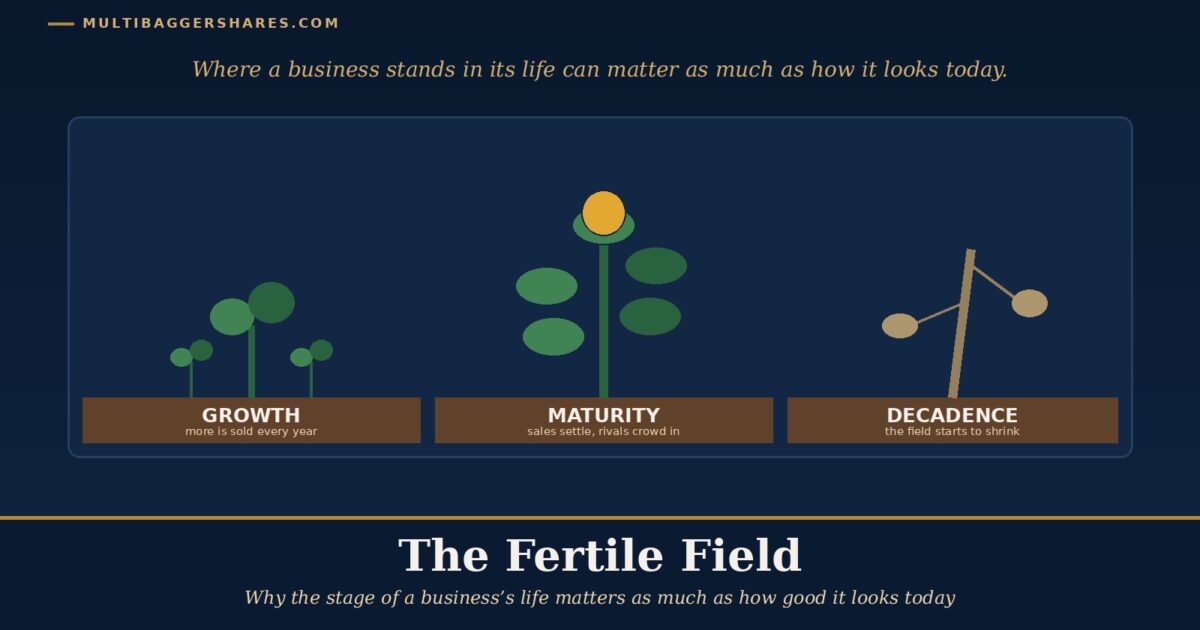
Imagine a new housing colony being built at the edge of a town. In the first year, 200 families move in. A man called Raju opens the first tea and snacks shop on the corner. Nobody has to tell him how to do business. Every month there are more families, more footsteps, and more cups sold. Raju is not a genius. He is simply standing in a place where the crowd is growing.
Now fast-forward some years. All the plots are full and the colony has 800 families. It stops growing. Two more tea shops open nearby, and then three more. Raju is the same man, with the same tea and the same smile. But he now shares the same 800 families with five other shops. Later still, younger families move to shinier colonies further out, and the old one slowly empties. Raju works just as hard as before, yet each year is harder than the last.
Look closely at the story. Raju did not become a worse shopkeeper. The place where he stood changed its stage of life. This lesson is about that idea. How good a business looks today is only part of the picture. The stage of life of the field it works in matters just as much. It is a lesson about spotting quality, and it has nothing to do with the price of any share.
What it really means
The idea comes from an American investor named Thomas Rowe Price Jr. He was born in 1898, founded his own firm in Baltimore in 1937, and is often called the father of growth investing (the style of owning businesses whose profits keep rising for many years). He died in 1983. His firm still carries his name.
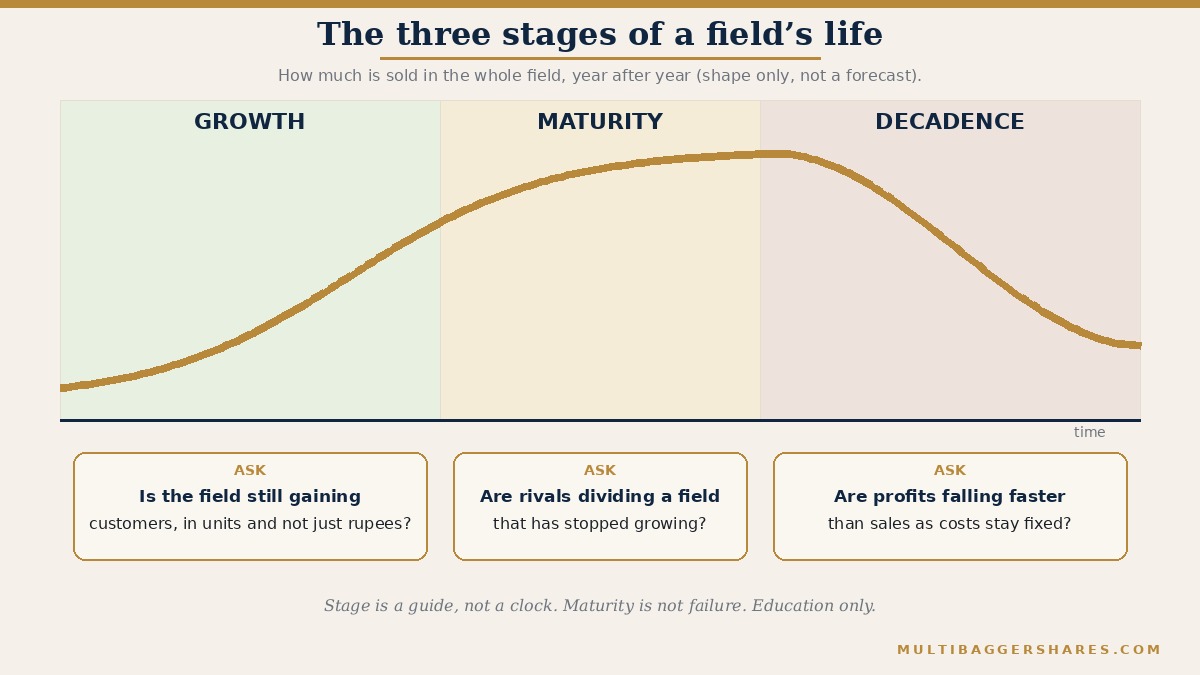
Price noticed that industries (whole groups of businesses doing similar work, such as tea shops, banks or phone companies) seem to pass through three phases, much like a person does. As later writers summarise his view, the phases are growth, maturity and decadence. In growth, the field is young and more is sold every year. In maturity, sales settle and the field stops getting bigger. In decadence, the field starts to shrink, usually because something newer does the same job better.
He believed the best place for a patient investor to look was a “fertile field”, meaning an industry still early in its growth. In such a field, the tide itself lifts the boats. An ordinary business can do well because customers keep arriving. He also held that the time to be careful comes before decline begins, because once the decline is obvious, the best part of the story is over.
Notice what Price did not say. He did not say that growth alone makes a business good. In a 1939 series of articles he described growth stocks (shares of companies whose profits keep reaching new highs over the years) and listed several qualities he wanted to see. He looked for capable management, steady work on new products, strong finances to survive bad years, and a reasonable return on invested capital (the profit a business earns on the money put into it). He reportedly used 8% or more as a rough floor. He also said that no single formula can find such businesses.
Why it works
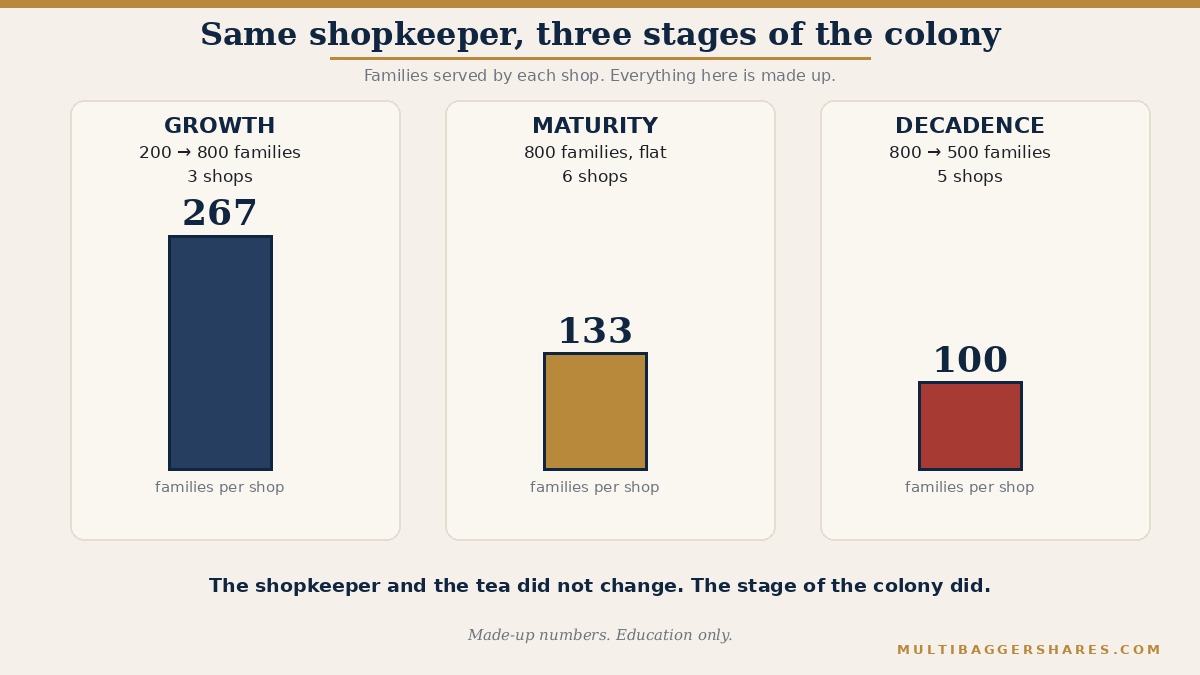
Let us go back to the colony and put some made-up numbers on it. Everything here is invented to keep the sums clean. In the growth stage, the colony fills from 200 to 800 families over three years, and the shops grow from two to three. That is about 267 families for each shop at the end. A shop that opens in that stage is carried by the crowd.
Then maturity arrives. The families stay at 800. But the numbers have changed in a quiet way. Because the field looked so promising, other people noticed it. Three more shops open, making six. The same 800 families are now shared among six, so each shop serves about 133. The field did not shrink. Rivals simply divided it. This is the part many people miss. A field that is no longer growing is not a field with no problems. It is a field where one shop can only gain by taking customers from another.
Decadence follows. Younger families move to newer colonies. The colony falls from 800 to 500 families. One shop closes, so five remain, and each serves about 100. Look at how it went: about 267 families a shop, then 133, then 100. The business, the owner and the tea stayed the same. The stage changed everything.
There is a second reason the late stage is so tough, and Price pointed to it. A business has some costs that do not shrink when sales shrink. Raju must pay his shop rent and his helper’s salary whether he serves a hundred customers or eighty. Say his sales are Rs 1,000 a day, his rent and salary together are Rs 400, and the tea, milk and sugar cost Rs 400. His profit is Rs 200. Now sales fall by a fifth to Rs 800. The tea, milk and sugar fall with them to Rs 320, but the Rs 400 of rent and salary stays. His profit is now Rs 80. Sales fell by 20%, and profit fell by 60%.
Price described this as an industry declining “on leverage” (the same idea as a heavy load on a small lever: a small push in sales moves profits a lot more). He pointed to railways as one example. You do not need to master the arithmetic. Just keep this in mind: in a shrinking field, profits can fall much faster than sales, and the people who read only the sales numbers are surprised.
Now see why the early stage is so kind in comparison. In growth, a business can make mistakes and still look fine, because new customers keep covering the cost of those mistakes. A late-stage business has no such cushion. Every error shows up straight away in the numbers. That is one reason the same management can look brilliant in one decade and ordinary in the next without having changed at all.
A real example or two
India has recent examples at both ends of the life of a field. First, the young end. UPI, India’s system for moving money between bank accounts on a phone, handled about 92 crore transactions in the financial year 2017-18. A written reply in the Lok Sabha, as reported by Business Standard in August 2025, put the figure at 18,587 crore in 2024-25. That is a jump of roughly two hundred times in seven years. This is what a field in its growth stage looks like. More is used each year, and many businesses around it find new customers without having to fight for each one.
Be careful with what that does and does not tell you. A fast-growing field attracts many businesses, and plenty of them fail anyway. A fertile field gives a good business a better chance. It does not give every business a good result. Growth in the field is a helpful starting point for an investor, not a guarantee for any company.
Now the old end. The telegram service in India began with the first message in 1850. At its peak in 1985, according to reports, about 60 million telegrams a year were sent and received through some 45,000 offices. Then came phones, and later text messages and smartphones. By 2013, only around 5,000 telegrams a day were being sent, from about 75 offices, with just under a thousand workers. BSNL, the state-run telephone company, said it was losing more than 23 million US dollars a year on the service. It sent its last telegram on 14 July 2013 and closed the service the next day.

Look at what the telegram story shows. No management could have saved the telegram once a cheaper, faster way arrived. The people who ran it were not careless. The field itself was fading. That is the heart of Price’s lesson. A skilful owner in a fading field is rowing against the current. A good owner in a fertile field has the current helping.
Price was also humble about his own method. He is reported to have expected that only about one in four of the shares he chose would turn out to be true long-term growth stocks, and he accepted being wrong most of the time. He once wrote an article titled “Change: The Investor’s Only Certainty.” The point of the title is that no field stays young for ever, so an investor must keep asking where it stands.
How you can use it
The first use is to ask a plain question about any business you study: what stage is its field in? Do not ask only whether the business grew last year. Ask whether the field is still gaining customers or only dividing them. A helpful habit is to look at the number of units sold, not only the rupees earned. Rupees can rise because prices went up while fewer people actually buy. Price himself looked at unit sales and profits together to find growing industries.
The second use is to check the quality of the growth. Growth that needs more and more money to produce the same profit is weaker than growth that pays for itself. So ask whether the return on the money put into the business is holding up as the business grows. If it keeps falling, the field may be getting crowded.
The third use is to watch for the early signs of the late stage. Reporters who have summarised Price’s work list a few warning signs. One is a falling return on invested money. Another is the difficulty of telling an ordinary slow patch from a real end of growth. A third is that a field’s ups and downs may stop following the wider economy. You do not need a formula. You need the habit of asking, once a year, “Is this field still young?”
The fourth use is to remember that maturity is not failure. Many settled businesses earn steady profits for years and pay regular dividends (a share of profit paid out to owners). A mature field simply asks for a different expectation. You should not expect fast growth from it, and you should look closely at who is quietly winning the shared customers.
It also helps to be fair to the other side. A stage is a guide, not a clock. Some businesses reinvent themselves and move into a new field before the old one fades, which is why Price put such weight on the quality of management. Some fields stay mature for a very long time. And it can be hard to tell a growth slowdown from a bad year. Because of this, stage-spotting is a way of asking better questions. It is not a way of predicting the future.
So the next time a business looks wonderful today, pause and ask Raju’s question. Is this a young colony or an old one? A good shopkeeper helps wherever he stands. But where he stands decides how much of his work will be rewarded.
Key takeaways
- Every field of business tends to pass through three stages: growth, maturity and decadence, as T. Rowe Price put it. The same business can look very different at each stage.
- In a young, growing field, even an average business can do well because new customers keep arriving. In a mature field, a business gains mainly by taking customers from rivals.
- In a shrinking field, profit can fall much faster than sales because some costs stay fixed. In the made-up example, a 20% fall in sales cut profit by 60%.
- Ask whether the field is still gaining customers, whether units sold are rising and not just rupees, and whether the return on invested money is holding up.
- Stages are a guide, not a clock. Growth in a field does not guarantee any single business a good result, and maturity is not failure. Use the idea to ask better questions.
— Manish Goel · multibaggershares.com
Manish Goel is a Chartered Accountant and Principal Officer of Multibagger Securities Research & Advisory Pvt. Ltd. (MSRAPL), a SEBI-registered Investment Adviser, Registration No. INA100007736. This content is published by MSRAPL for education only and is not personalized investment advice.
Disclaimer: This article is published by multibaggershares.com for education and general information only. It is not investment advice, investment research, or a recommendation to buy, sell or hold any security. Any companies named are discussed only as illustrative examples. Markets carry risk; please do your own research or consult a qualified professional before making any investment decision. |