The Fence With an End Date: Why a Patent Protects a Business Only Until the Day It Runs Out

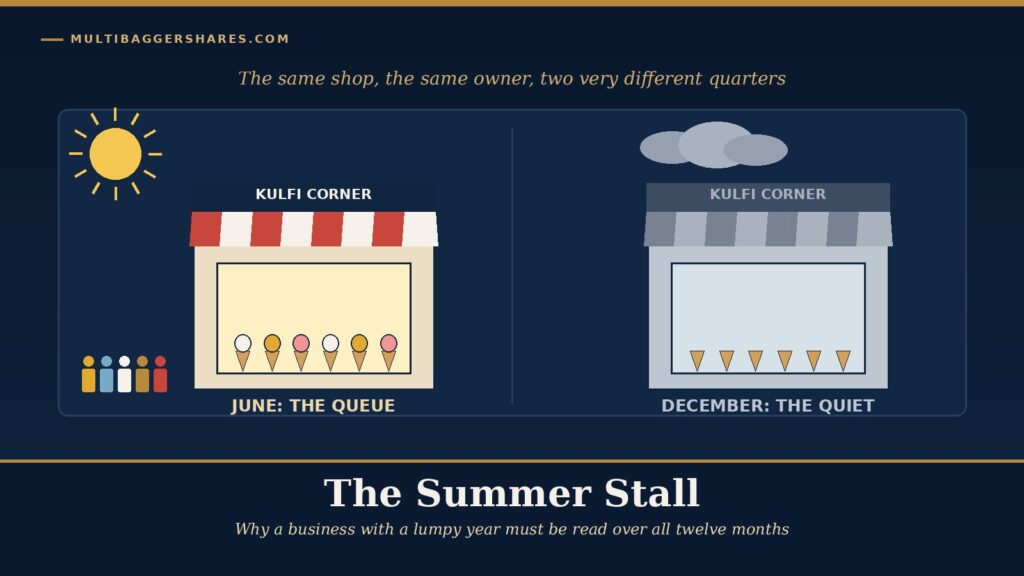
The Summer Stall: Why a Business With a Lumpy Year Must Be Read Over All Twelve Months
November 10, 2026
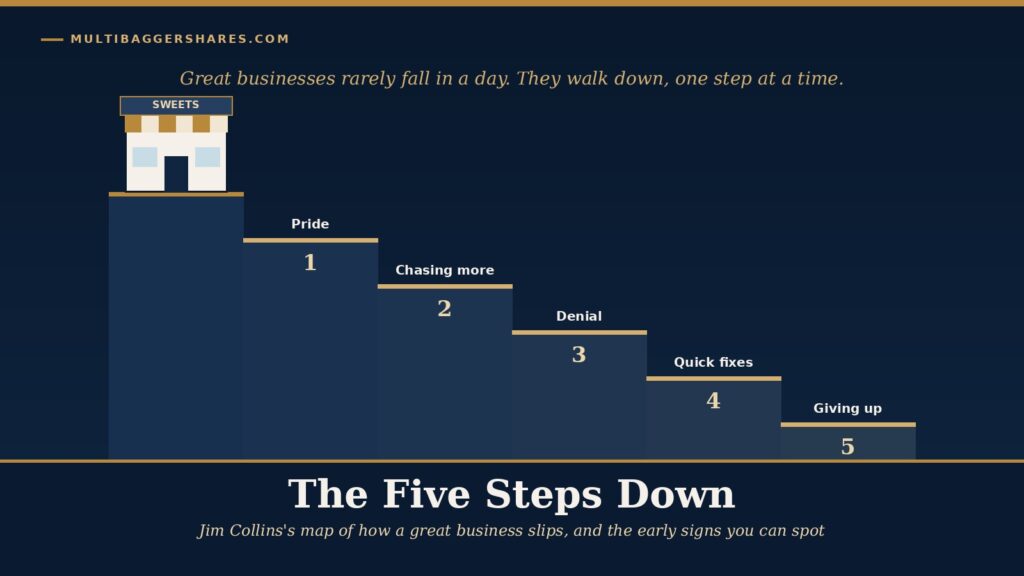
The Five Steps Down: Jim Collins’s Map of How a Great Business Slips, and the Early Signs You Can Spot
November 12, 2026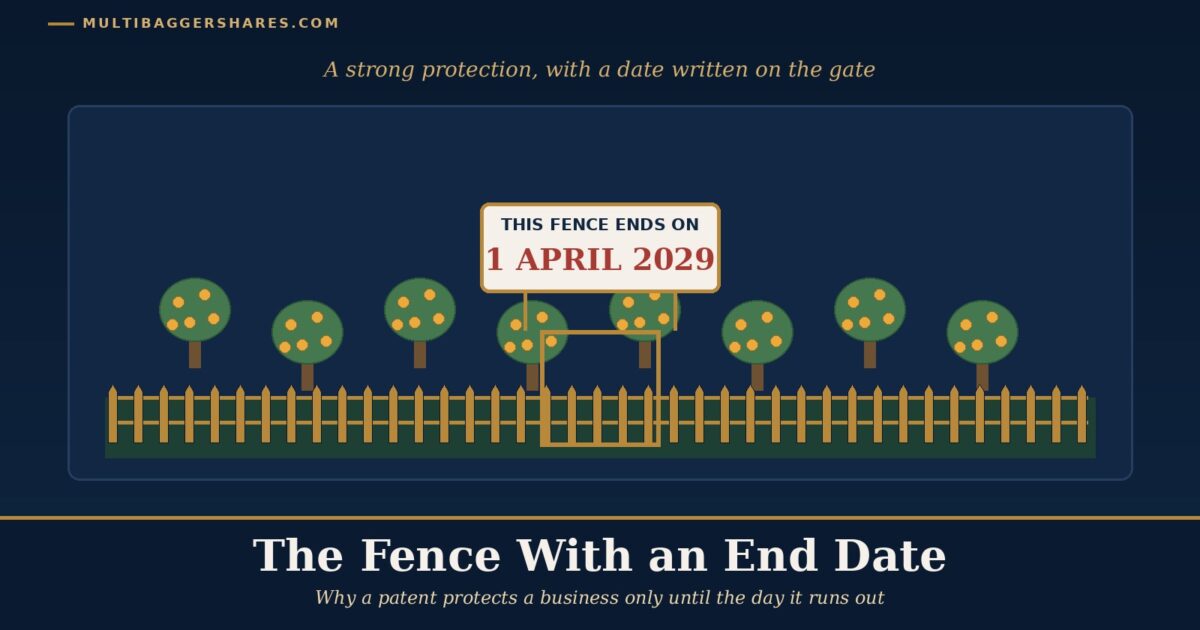
Imagine a mango orchard at the edge of a village. The owner has put a strong fence around it. Nobody else may pick its fruit, so he sells every mango at his own price. Now imagine one more detail. On the gate hangs a small signboard, put there by the village council, which says: “This fence will be taken down on 1 April 2029.” After that date, anyone may walk in.
Would you judge that orchard only by this year’s harvest? Of course not. You would look at the harvest, and then you would look hard at the date on the gate. You would ask how many more seasons are left, and what the owner plans to do when the fence is gone.
Some real businesses live inside exactly this kind of orchard. The fence is called a patent. This lesson is about how a patent works, why it is such a strong protection while it lasts, and why the most useful number in such a business can be a date rather than a rupee figure.
What it really means
A patent is a right given by the government to the person or company that invents something new and useful. For a fixed number of years, nobody else may make, use or sell that invention without permission. In plain words, it is a legal fence around an idea.
In India, Section 53 of the Patents Act, 1970 sets the term of a patent at twenty years from the date the application is filed. Most large countries follow the same twenty-year rule. Once the term ends, or once the owner stops paying the yearly renewal fee, the protection is gone, and anyone may copy the invention.
Notice that the clock starts on the day of filing, not on the day of the first sale. This matters a great deal. A company usually files early, to stop others from filing first. Then it may spend years testing, improving and seeking approval before it sells a single unit. A new medicine is the clearest case, because it must pass long trials before a regulator (the government body that allows a medicine to be sold) lets it reach patients. By the time sales begin, a large part of the twenty years may already be used up.
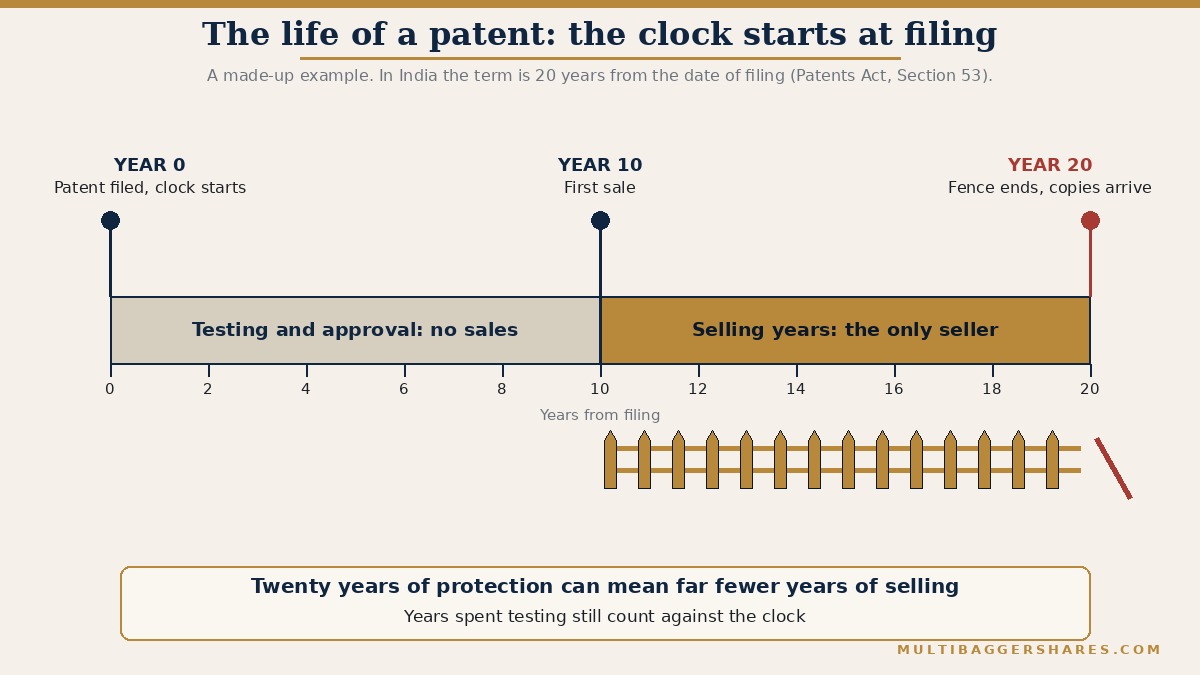
So a patent is like a shop lease at a railway station that runs for twenty years from the day you sign it, even though building the shop takes you ten. You get the only shop on the platform, but only for the years that remain.
There is a fair deal hidden inside every patent. To get the fence, the inventor must publish how the invention works, in enough detail that a skilled person could make it. Society gets the knowledge now and the right to copy it later. The inventor gets a period of protection as a reward for the effort and risk. When the period ends, the deal is complete, and the idea belongs to everyone.
Why it works, and why it ends
While the fence stands, a patent can make a business look wonderful. There are no copies, so there is little pressure on price. The company can charge well above its cost. Margins (the share of each sale left as profit) can be very high. Return on capital (how much profit the business earns on the money invested in it) can be excellent. All the usual signs of a strong business may be there.
But this strength has a different shape from most strengths we study. A trusted brand, a habit, a wide distribution network or a low-cost factory can last for decades if they are looked after. Nobody has written an end date on them. A patent is different. Its end date is written into law, and everyone, including every rival, knows it.
And rivals plan for that day. Copy-makers prepare years in advance, so that their version is ready the moment the fence comes down. In medicines these copies are called generics (medicines with the same active ingredient as the original, sold after the patent ends, usually at a much lower price). India knows this world well. A large part of our pharmaceutical industry grew by making good, low-cost generic medicines for patients at home and abroad.
So when the date arrives, the change is rarely slow. Several sellers arrive at once. The price falls. Buyers, and the doctors, pharmacies and insurers who pay for them, move to the cheaper copies. Profits that took years to build can shrink within months.
There is an everyday Indian picture for this too. Think of a family that owns a flat and rents it to a bank branch on a nine-year lease at a very high rent. While the lease runs, the income is steady and generous. But the family would be unwise to plan its whole life around that rent as if it would last for ever. When the lease ends, the bank may leave, and the next tenant may pay far less. A patent is a lease of that kind, and the end date is printed on the agreement for everyone to read.
A made-up example: Asha Medicines
Let us put numbers on it. Imagine a company called Asha Medicines. Everything about it is made up, to keep the sums clean. Asha earns a profit of Rs 100 crore a year. Rs 70 crore of that comes from one patented medicine. The other Rs 30 crore comes from about forty ordinary products that anyone could make.
Here is the patented medicine in detail. Asha sells 10 lakh packs a year at Rs 1,000 a pack. That is Rs 100 crore of sales. Each pack costs Rs 300 to make and sell, so the cost is Rs 30 crore and the profit is Rs 70 crore. A business earning 70 paise of profit on every rupee of sales looks like a dream.
Now the fence comes down. Copies arrive, and the price drops. Suppose Asha can now get only Rs 400 a pack, and loses half its buyers to cheaper copies, so it sells 5 lakh packs. Sales become Rs 20 crore. Cost is still Rs 300 a pack, or Rs 15 crore. Profit from the medicine falls from Rs 70 crore to Rs 5 crore.
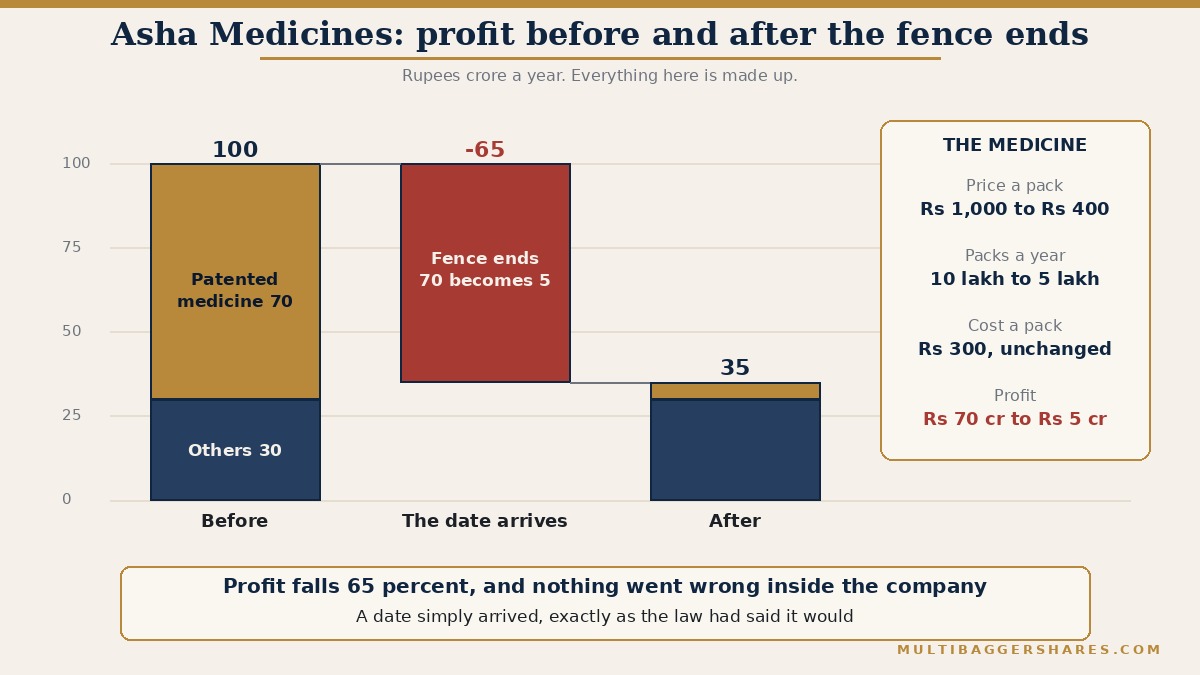
Add the ordinary products back, and Asha’s total profit falls from Rs 100 crore to Rs 35 crore. That is a fall of 65 percent, and nothing went wrong inside the company. The factory ran as well as before. The staff worked as hard as before. A date simply arrived, exactly as the law had said it would.
Now picture a second made-up company, Bharat Cures. It also earns Rs 100 crore a year, but from many medicines, and no single product brings in more than Rs 10 crore. When its biggest patent ends, it loses less than a tenth of its profit. Both companies looked equally profitable last year. They are not equally safe, because one carries most of its eggs behind a single fence with a known end date.
This is also why a beginner should be careful with averages. If you add up Asha’s last five years and divide by five, you will get a lovely number, because all five years were spent behind the fence. That average says nothing about the years after the date. With a patent business, the past is not a fair guide to the future, because the one thing that made the past so good is the one thing that is about to change.
Two real examples
History gives us clear cases. We use them only as stories about how fences work. Nothing here is a view on any share.
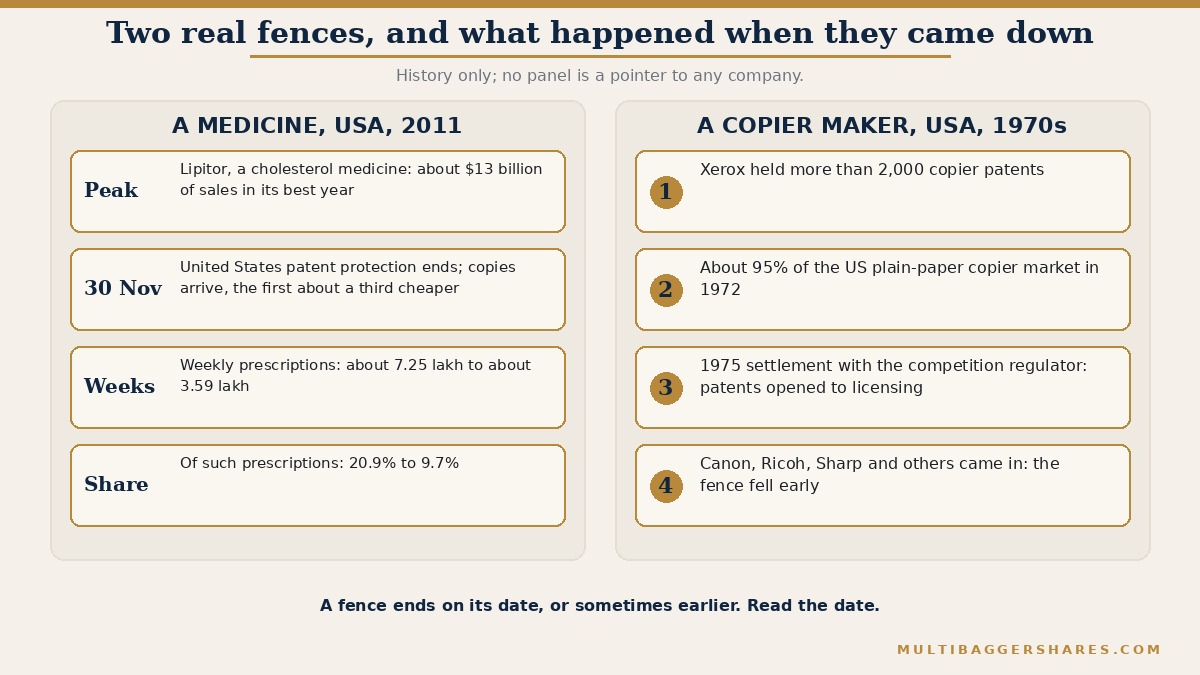
The first is Lipitor, a cholesterol medicine sold by Pfizer. At its peak it earned about 13 billion dollars of sales in a single year, which made it one of the best-selling medicines ever. Its United States patent protection ended on 30 November 2011. Copies arrived at once, the first ones about a third cheaper. A news report from December 2011 counted the change. In the week ended 11 November, about 7.25 lakh Lipitor prescriptions were filled. In the seven days ended 9 December, the figure was about 3.59 lakh. Its share of prescriptions for medicines of that kind fell from 20.9 percent to 9.7 percent, within weeks.
The second shows that a fence can also come down early. In the early 1970s Xerox held more than 2,000 patents on its copying machines and had about 95 percent of the American market for plain-paper copiers. In 1975 it settled a case with the Federal Trade Commission, the American competition regulator, and agreed to license its copier patents to other companies. Japanese makers such as Canon, Ricoh and Sharp went on to build strong copier businesses of their own. The fence had come down before its date.
India has its own famous lesson on fences that are never built at all. On 1 April 2013, the Supreme Court of India upheld the refusal of a patent for Glivec, a cancer medicine made by Novartis, under Section 3(d) of the Patents Act, a rule that stops many small changes to known medicines from getting fresh patents. The wider point for a beginner is simple. A patent is decided by law and courts, so a business that depends on one depends partly on decisions outside its own walls.
Warren Buffett once put the whole idea in one line. Writing in Fortune magazine in November 1999, he said the key to investing is “determining the competitive advantage of any given company and, above all, the durability of that advantage.” A patent answers the first half of that sentence very well. It answers the second half with a date.
How you can use it
First, ask what share of the profit sits behind a fence. If a business earns most of its money from one or two protected products, treat those products as the heart of the story. A company’s annual report and its presentations often name its key products. Read them with this one question in mind.
Second, find the date. When does each important protection end? Companies that depend on patents often discuss this openly, because careful readers ask about it. If you cannot find the date, or the company seems unwilling to talk about it, treat that silence itself as information.
Third, ask what is ready to replace the fence. A careful owner of an orchard plants new trees long before the old fence comes down. In a business, this means new products, already tested and nearly ready, that can carry the profit forward. A business with one great product and nothing behind it is living on a countdown.
Fourth, ask what will last after the fence is gone. Some strengths outlive a patent: a name that doctors and patients trust, a wide network of sellers, a factory that makes things more cheaply and more reliably than others. In the Asha example, the company kept half its buyers even after the copies arrived. That half was paying for trust, not for the fence.
Fifth, judge the business on the years after the date as well as the years before it. Last year’s profit tells you how good the fence was. It does not tell you how good the business will be without it. A beginner who keeps both pictures in mind, the orchard with the fence and the orchard without it, will read such a company far more fairly than one who looks only at this year’s harvest.
One word of balance. A patent is not a bad thing. Many fine businesses were built on patents, and many keep inventing new ones, so that as one fence comes down another goes up. The point of this lesson is only that a patent is a strength with a printed end date, and a careful reader always looks for the date.
Key takeaways
- A patent is a legal fence around an invention; in India its term is twenty years from the date of filing.
- The clock starts at filing, so the years of actual selling behind the fence can be far fewer than twenty.
- When the fence comes down, copies arrive together and prices and profits can fall within weeks, as Lipitor showed in 2011.
- Ask how much profit sits behind the fence, when it ends, what is ready to replace it, and what will last without it.
- This is a way of reading businesses fairly. It is not a judgement on any company or share.
— Manish Goel · multibaggershares.com
Manish Goel is a Chartered Accountant and Principal Officer of Multibagger Securities Research & Advisory Pvt. Ltd. (MSRAPL), a SEBI-registered Investment Adviser, Registration No. INA100007736. This content is published by MSRAPL for education only and is not personalized investment advice.
Disclaimer: This article is published by multibaggershares.com for education and general information only. It is not investment advice, investment research, or a recommendation to buy, sell or hold any security. Any companies named are discussed only as illustrative examples. Markets carry risk; please do your own research or consult a qualified professional before making any investment decision. |