The Five Steps Down: Jim Collins’s Map of How a Great Business Slips, and the Early Signs You Can Spot

The Fence With an End Date: Why a Patent Protects a Business Only Until the Day It Runs Out
November 11, 2026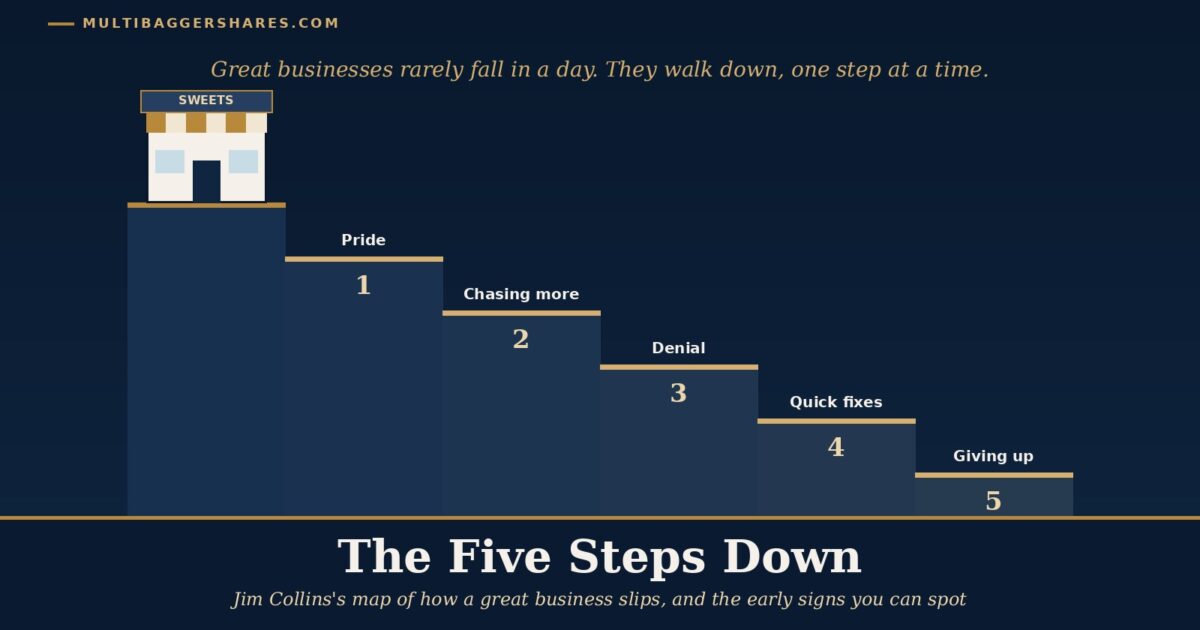
For thirty years, Sharma Sweets had the longest queue in town. Every Diwali the line stretched past the bus stand. The old owner tasted every batch of kaju katli himself before it went on the tray. If the sugar syrup was even slightly wrong, the whole batch was given away to the workers and made again.
Then the old man retired, and his son took over. Ten years later the shop was gone. There was no fire, no flood and no single terrible day. The decline happened one small step at a time, and for most of those years the cash box still looked full.
This lesson is about that staircase. A business writer named Jim Collins studied how famous companies fall, and he found that they usually walk down the same five steps. If you own shares in good businesses for many years, as patient investors do, knowing these steps helps you notice trouble early, while it is still small. It is a way to watch the health of a business, and it has nothing to do with guessing share prices.
What it really means
Jim Collins is an American writer who spent decades studying why some companies become great. His best-known book, Good to Great, came out in 2001. Some of the companies he praised in it later stumbled badly. So he turned the question around and asked how great companies fall. The answer became a book called How the Mighty Fall, published in 2009.
His main finding is simple. Decline is usually self-inflicted (caused by the company’s own choices, not by bad luck from outside). It also tends to follow a pattern, which Collins describes as five stages. Here they are in plain words.
Step one is hubris born of success. Hubris means too much pride, the kind that makes you careless. The people in charge start to feel that success is theirs by right. They forget the hard work and the luck that brought it. Collins lists discounting the role of luck as one of the signs.
Step two is the undisciplined pursuit of more. Proud of past success, the company chases more of everything: more shops, more products, more size. Discipline (doing only what you do best, and doing it well) gets weaker. Collins borrows an idea from David Packard, a co-founder of Hewlett-Packard: no company can keep growing faster than its ability to find enough of the right people to run that growth.
Step three is denial of risk and peril. Bad news starts to arrive, but the leaders explain it away. Collins describes a habit of amplifying the positive and discounting the negative (talking up the good numbers and talking down the bad ones). Setbacks are blamed on the weather, the economy or competitors, never on the company itself.
Step four is grasping for salvation. By now the trouble is visible to everyone. Instead of quietly going back to basics, the company looks for a silver bullet (one dramatic fix that will solve everything at once). Collins names the usual ones: a charismatic new leader, a bold but untested strategy, a game-changing acquisition.
Step five is capitulation to irrelevance or death. Capitulation means giving up. The business is sold, shrinks into something nobody notices, or closes.
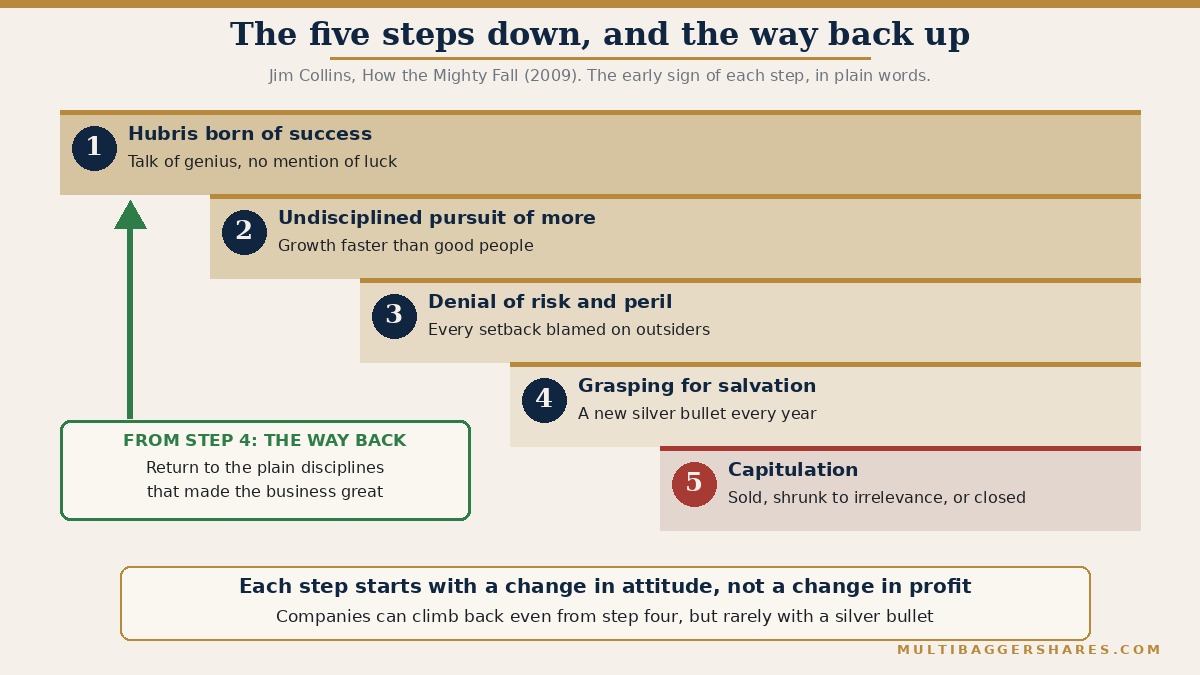
There is hopeful news inside this map too. Collins found that companies can stop the slide and climb back, even from step four. He points to businesses such as IBM and Disney that fell into deep trouble and recovered. The way back was rarely a silver bullet. It was a return to the plain disciplines that had made them strong in the first place.
Notice something about all five steps. None of them begins with a falling share price or a bad year of profits. Each one begins with a change in attitude inside the company: pride, impatience, denial, panic. The numbers follow later, sometimes much later.
Why it works: sick inside, strong outside
Why should an investor care about a map of decline? Because of one sentence Collins wrote, which every long-term owner should remember: institutions can be sick on the inside and yet still look strong on the outside.
Think of a person who stops exercising, eats badly and sleeps too little. For a year or two, nothing shows. The weighing scale looks the same and the face looks the same. The illness builds quietly, and the fever comes last. A business works the same way. Profit is the weighing scale. It is the last thing to change, not the first.
Go back to Sharma Sweets. When the son stopped tasting every batch, sales did not fall that year. Loyal customers kept coming out of habit. When he opened twelve branches in two years, total sales actually jumped, because there were more counters selling. When complaints about stale sweets rose, the branches that were still good hid the ones that were bad. On paper, the business looked bigger and better than ever.
By the seventh year, the profits finally fell, and everyone could see the trouble. Then came step four. The son hired a famous chef from Mumbai at a huge salary, put up hoardings across town, and bought a rival bakery with borrowed money. Each move made news for a few weeks. None of them fixed the stale sweets. By the tenth year he sold the family name to a large packaged-food company, and the original shop on the bus-stand road closed. That was step five.
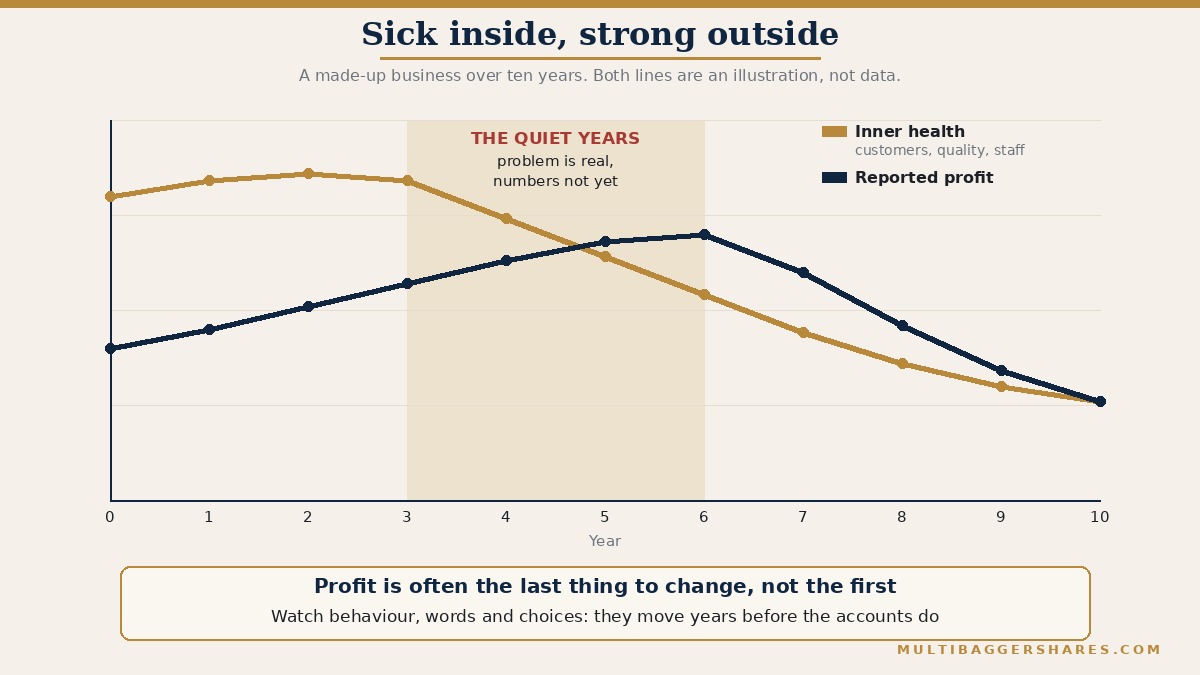
This gap between inside and outside is what makes the five steps useful. If you wait for profits to fall before you look closely, you are reading step four or step five. The first three steps show up much earlier, in behaviour, in words and in choices. Anyone can notice them, with no special data at all.
This is different from a business whose edge is worn away by outsiders, like a village well that loses its customers once a water pipeline arrives. Collins’s staircase is about decline that starts from inside, from the choices of the people running the business. That is exactly why an owner who watches behaviour, and not only results, can often see it coming.
It is a bit like a kirana shop owner judging a new supplier. He does not wait for the bill to go wrong. He watches small things. Does the delivery boy come on time? Are the packets sealed properly? Does the supplier admit a mistake or argue about it? Small habits tell you about the big result long before it arrives.
A real example or two
Circuit City was an American electronics chain. It began in 1949 as a small storefront in Richmond, Virginia. By 2000 it employed more than 60,000 people across 616 locations. Collins himself had featured it in Good to Great as a company that had made the leap to greatness. These facts come from a 2013 history published by the Federal Reserve Bank of Richmond.
Then the steps began. In 2003, the company let go of about 3,900 of its highest-paid salespeople, the experienced staff who were paid partly by commission (a share of each sale) and who knew the products best. In 2007 it let go of about 3,400 more. Between 2003 and 2007 it also spent almost one billion dollars buying back its own shares, at an average price of about twenty dollars. By the end of 2007 the share price was about four dollars, and that cash was no longer there for a rainy day.
The rainy day came. On 10 November 2008, Circuit City filed for bankruptcy protection with 567 stores and about 34,000 employees. No buyer was found, and the last store closed on 8 March 2009. Sixty years of history ended in about four months.
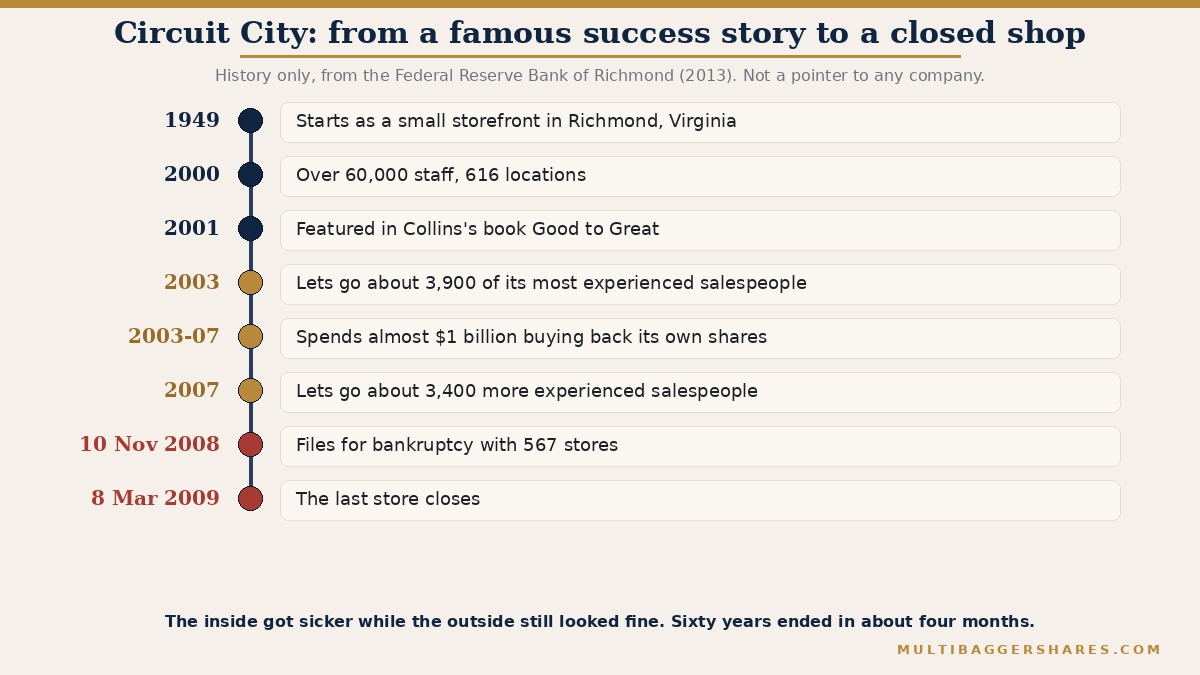
Look at the pattern. Cutting the experienced salespeople saved money, and in the short run the numbers looked tidier. But those people were a big part of why customers chose the shop over a rival. That is the inside getting sicker while the outside still looked fine.
Rubbermaid, the American maker of plastic household goods, shows the same staircase from another angle. In early 1994 Fortune magazine named it America’s most admired company. It was launching new products at a rate of roughly one a day. Within about a year, according to published company histories, its profits had their first decline in fifteen years. Large shop chains gave more shelf space to cheaper rivals, and the company went through costly restructuring (a big reorganisation with closures and job cuts). In October 1998, Newell agreed to buy Rubbermaid for about 5.8 billion dollars. A business admired by everyone at the start of 1994 had been sold within five years.
None of this is a comment on any share today. These are old stories, told only because they show the steps clearly.
How you can use it
You do not need to become a detective. Once a year, when a business you own publishes its annual report, sit down with a cup of tea and ask five simple questions, one for each step.
First, does the management still talk about customers and products, or mostly about how brilliant it has been? A letter to shareholders full of praise for the company’s own genius, with no mention of luck or of mistakes, is a small warning light for step one.
Second, is the company growing faster than it can find and train good people? Watch for sudden jumps into many new products, new cities or new businesses at once, especially ones far from what it knows. Watch also for growth paid for with borrowed money. That is step two.
Third, when something goes wrong, who gets the blame? A company that blames the monsoon one year, the government the next and competitors the year after, and never itself, may be in step three. Notice, too, if a number the company used to report proudly quietly disappears from the report.
Fourth, is there a new grand plan every year? A new chief executive every two years, a big surprise acquisition, a fresh slogan promising a transformation. One change is normal. A string of silver bullets is step four.
Fifth, if you can, visit the shop, use the product, or talk to people who do. Collins’s message is that the inside changes first. Customers and staff often see it years before the accounts do.
A simple notebook makes this much easier. Each year, write one line against each of the five questions. After three or four years, read your own notes from top to bottom. A slow change that your memory would smooth over becomes plain to see when the answers sit together on one page.
Two cautions keep this tool honest. Every business has a bad quarter now and then, and one stumble is not a staircase. Look for a pattern across several years, not a single event. And the steps are a reason to look more closely, not a signal to act in a hurry. Sometimes, as IBM and Disney showed, a company notices its own slide and climbs back by returning to its basics.
The old owner of Sharma Sweets never read Jim Collins. But tasting every batch was his own small discipline against step one. The best businesses keep habits like that long after they become famous. As an owner, your quiet job is to check, once a year, that the tasting has not stopped.
Key takeaways
- Jim Collins found that great companies usually decline in five steps: hubris, the undisciplined pursuit of more, denial of risk, grasping for salvation, and capitulation.
- A business can be sick on the inside while it still looks strong on the outside, so profit is often the last thing to change.
- The early steps show up in words, behaviour and choices, such as no mention of luck, growth faster than good people can be found, and blaming outside forces.
- Once a year, ask one question for each step, and look for a pattern over several years rather than one bad quarter.
- This is a way to watch the health of a business. It is education only, not a judgement on any company or share.
— Manish Goel · multibaggershares.com
Manish Goel is a Chartered Accountant and Principal Officer of Multibagger Securities Research & Advisory Pvt. Ltd. (MSRAPL), a SEBI-registered Investment Adviser, Registration No. INA100007736. This content is published by MSRAPL for education only and is not personalized investment advice.
Disclaimer: This article is published by multibaggershares.com for education and general information only. It is not investment advice, investment research, or a recommendation to buy, sell or hold any security. Any companies named are discussed only as illustrative examples. Markets carry risk; please do your own research or consult a qualified professional before making any investment decision. |